

(Lav Diaz, together with filmmakers Sheron Dayoc, Kevin Zarate Alambra and film critic Tito Valiente, will give a four-day workshop, June 4 to June 7, 2026, in Sampaloc, Quezon, titled Regional Filmmaking Workshop, Where Stories Begin: Rooted in Place. Follow Sine Sampaloc Film Festival socials for details)
“BY all means move at a glacial pace, you know how that thrills me.” Miranda Priestly (Meryl Streep) said this now-iconic line in 2006’s The Devil Wears Prada to one of her assistants, Andrea Sachs (Anne Hathaway), who couldn’t catch up.
Streep was in character, of course, but 10 years later, she’d be introduced to the work of a Filipino filmmaker who is regarded one of the masters of slow cinema—long meditative scenes with actors moving at, yes, a glacial pace—and she’d be thankful for the experience.
From an article in an online fashion and lifestyle magazine that we chanced upon, we were reminded of how Miranda Priestly gave her stamp of approval to Filipino auteur Lav Diaz. Well, not in the realm of fashion, but in Diaz’s work as filmmaker in 2016’s Hele Sa Hiwagang Hapis (Lullabye To A Sorrowful Mystery).
The eight-hour film combines myth, literature and Philippine history as it creatively melds the characters from Jose Rizal’s Noli Me Tangere and El Filibusterismo in the story of Gregoria “Oryang” de Jesus’ search for her husband, Andres Bonifacio, who was hacked to death on Mt. Nagpatong in Maragondon, Cavite by Filipino soldiers carrying out a written order signed by Emilio Aguinaldo.
It had John Lloyd Cruz, Piolo Pascual, and Ely Buendia in the cast, making Hele the only film where three icons of cinema and music appeared together.

John Lloyd Cruz and Lav Diaz with Meryl Streep and Clive Owen during the 2016 Berlinale awarding ceremony (Photo from Susan Africa FB page)
Streep, who reprised her role in The Devil Wears Prada 2, served as head of jury at the 2016 Berlin International Film Festival. Hele was awarded the Alfred Bauer Prize or the Silver Bear Award, the second highest prize in one of the most prestigious film festivals in the world.
In a sit-down interview with Boy Abunda in a talk show for ABS-CBN, Diaz recounted the encounter with Streep. Diaz said he and Streep had a long talk.
We quote: “She was telling me when she saw Hele she felt very sad because she thought of the old days of making cinema. They had patience, time. Now, everyone’s rushing to finish their tasks. She was very, very nostalgic and sad and she loved Hele. She said she would watch it again in the US.”
Praising Hele and Diaz, Streep was also quoted as saying, “This film, this guy, he rearranged the molecular system in my brain.”
Streep was referring to the zen-like euphoria after experiencing Diaz’s black and white aesthetics, his use of one camera focused on a scene that makes viewers notice and feel the details, the absence of soundtrack and use of natural sound, and his insights on the frailties of humanity.
RELATED STORY: ‘I’m making films until I die’: The day I shot Lav Diaz
Ten years after Hele, the 67-year-old Diaz is still creating works that continue to make an impact on world cinema and changing a few lives in the process.
In our earlier story about Diaz, who, in our personal cinematic universe, is the greatest living Filipino filmmaker, we mentioned how his being a resident of hilly Sampaloc town in Quezon province led to the start of a local film festival in mid-December last year.
Diaz’s being a resident of hilly Sampaloc town in Quezon province led to the start of a local film festival in mid-December last year
RELATED STORY: Lav Diaz: ‘We brought Gael Garcia Bernal to Manila, and he likes pansit’
The successful festival created interest among filmmakers and tourists. Award-winning director JL Burgos has just finished shooting countryside scenes in Sampaloc for his new film, Ganggang, one of the 10 finalists in the Cinemalaya Independent Film Festival scheduled in August this year. And there are more young filmmakers who have sent word that they wanted to shoot in the green little town near the foot of the mystic Mount Banahaw.
It’s easy to assume Diaz is someone easily recognized in the town by local folk called Sampalukins, but surprisingly, like in Metro Manila, with exceptions of people in the film industry and cinephiles, Diaz is one in the crowd.
Sometimes, it could get bad. Hazel Orencio, one of Diaz’s longtime collaborators and assistants, told this writer not so long ago how the long-haired, reed-thin filmmaker, who prefers wearing black shirts and jeans, was once stopped by a security guard in a mall. The guard asked for Diaz’s ID because, apparently, there was robbery in a jewelry store a day before, and Diaz must have been mistaken for a hold-upper, a snatcher, or something.
Interestingly Diaz remains unrecognized in the town where he lives and where he shot scenes for three of his recent films, Magellan, Ang Kawalan ng Kawalan, Phantosmia.
Then again, could it be an unwritten rule among Sampalukins to protect the privacy that Diaz and the Sine Olivia team seek?
“Maganda ring di tayo kilala, ‘tol, para ‘di makalkal ang mga nakaraang kaso natin gaya nang pag-ani ng kaymito ng kapitbahay, pananakit ng patong dumaan, at pagtawid sa ilog na burlesk. Minsan, napagkamalan akong si John Lennon, sa may palengke, buti na lang nasabi ko, ako po si Roxlee (It’s also good that we’re not known, so our past isn’t dredged up—like when we picked the neighbor’s caimito, or harmed a passing duck, or crossed the river in the nude. One time I was mistaken for John Lennon, in the market. Good thing I said I was Roxlee),” Diaz told TheDiarist.ph in an email message.
Besides being known as director and actor in the independent film community and an occasional musician, Roxlee is a well-known cartoonist-painter, who with brother Mon Lee, created the satirical komiks strip Cesar Asar. Before the brothers decided to retire Cesar Asar, it ran for more than four decades, starting in Jingle Magazine and continued in Manila Bulletin.
Diaz, Roxlee, and fellow filmmaker Khavn dela Cruz are members of the Pinoy avant-pop, punk jazz boy band called The Brockas.
And there’s the case of Gael Garcia Bernal and a group of Portuguese, Mexican, and Spanish actors who lived for two months in Sampaloc in the summer of 2024 to shoot scenes in Magellan.
In 2024, we asked some kind-hearted Sampalukins around the town market if they remember seeing a group of bearded Spaniards roaming the town, often reportedly seen eating pancit.
The same answers came from the waitresses and owners of nearby carinderias. No “Spaniards” sightings.
However, an old jeepney driver plying the Sampaloc to Lucban route told us he often saw a long-haired, white-bearded, thin guy wearing a black bucket hat in the wet market. “I think I know who you are referring to. I often see him walking here, buying stuff in the palengke. He looks like a musician,” he said.
I asked him, “Does he look like John Lennon?”
“Someone from the ’70s, yes, like John Lennon, an old John Lennon if he were still alive,” the driver said in Filipino.

The author with Ronnie Lazaro in last year’s Sine Sampaloc Film Festival (Photo by Totel V. de Jesus)
“But here, most Sampalukins aren’t obsessed with celebrities, with artistas. We’re not showbiz fans at all. Well, am speaking for myself and some people I know. If Sampalukins see them for the first time, we’re happy, probably a few selfies but after a while, we treat them as normal people, as normal tourists, as visitors, so they get the privacy they need. That’s why actors like Janine (Gutierrez) or the old man from Batang Quiapo (Ronnie Lazaro), they feel comfortable walking around,” he said.
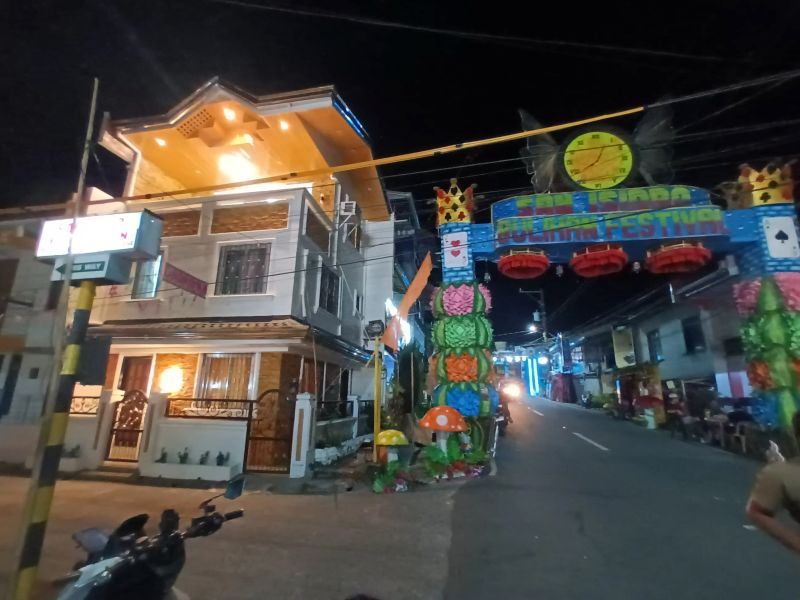
This three-story building is one of the transient houses in the town where Ronnie Lazaro, Bart Guingona, and Nanding Josef resided while filming. Beside it is Charlotte’s liquor store and mini-grocery. (Photo by Totel V. de Jesus)
Lazaro and Bart Guingona, we learned, have a favorite drinking place after a day’s work with Diaz’s film. Lazaro calls it Charlotte’s. It may sound like some fancy bar with live blues or jazz band or with some exotic performers, but it’s actually the one and only liquor store mini-grocery along the town’s main street, Quezon Avenue.
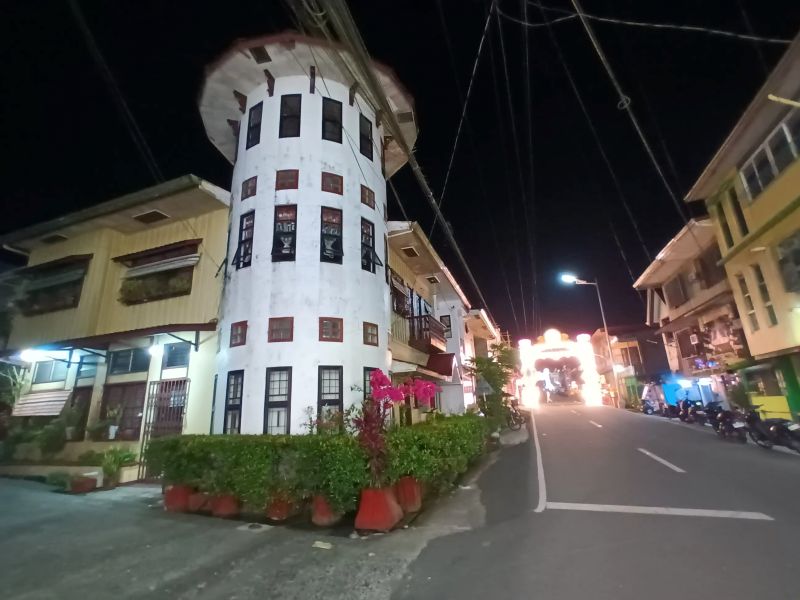
Perfect night for strolling on Quezon Avenue in Sampaloc, Quezon, where one can see pre-WWII houses (Photo by Totel V. de Jesus)
This writer talked to the night shift store overseer named Len, and she pointed to us a table with monobloc chairs in front the store. “Si Sir Ronnie, dyan siya umiinom halos gabi-gabi kasama ibang aktor. Minsan nga habang nagkukwento, natumba pa yung kasama nyang artista rin… Nakalimutan ko name pero lumalabas din sya sa TV (That’s where Sir Ronnie would drink every night, with some actor. One time at the height of storytelling the actor fell from his chair).”
“Sobrang intense po kasi nyang magkwento, parang umaarte, may pakumpas-kumpas pa ng kamay (He was intense telling the story, gestures and all),” she said.
Diaz confirmed it was Bart Guingona, one of the greatest living multi-platform actors we admire. We could imagine Lazaro helping Guingona get up, asking his fellow inebriated friend if he was alright.
I actually imagined a two-hander play with the working title, Charlotte’s, and Lazaro and Guingona playing themselves. I told Len I would like to suggest to the store owner, expectedly named Charlotte, to put a marker somewhere with the words: “Sa pwestong ito nag-iinuman sina Ronnie Lazaro at Bart Guingona, ating bigyan ng nararapat na pagkilala at respeto.”
‘Sa pwestong ito nag-iinuman sina Ronnie Lazaro at Bart Guingona, ating bigyan ng nararapat na pagkilala at respeto’
In my messenger conversation with Guingona in 2023, I told him he could be the only multi-platform actor who holds the record of having the highest number of films with Diaz.
“Yes, I think so. I started with Hesus Rebolusyonaryo, then nine or 10 after that. It’s mutual love. I mean Lav,” he said, with laugh emojis.
Hesus Rebolusyonaryo was the fourth and last film that Diaz did for Regal Films before he turned his back for good in doing mainstream films. Since my online chat with Guingona was three years ago and he has acted in three or four more films that Diaz has directed in the past couple of years, it could be more than a dozen now.
Lazaro, as of last count, has at least seven films with Diaz. As of this writing, Guingona and Lazaro are part of Diaz’s ongoing shoot for his latest opus whose title and plot can’t be revealed yet.

Sampalukin children and their dog enjoy the cool waters in Maapon River in Sitio Kakati, Brgy. Apasan, Sampaloc (Photo by Totel V. de Jesus)

Sampalukin farmer gives his horse a much-needed bath in Maapon River amid sweltering summer heat. (Photo by Totel V. de Jesus)
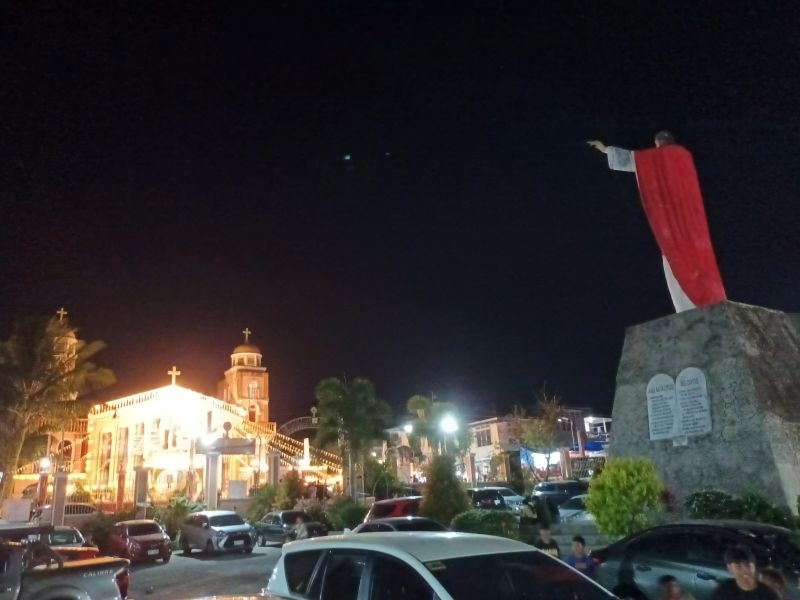
The patio in front of San Vicente Ferrer Parish Church has a larger-than-life sculpture of the Risen Christ. It also serves as parking lot. (Photo by Totel V. de Jesus)
In the last two weeks of April, Diaz was supposed to go to Melbourne for the talkbacks and meet-and-greet in a festival where Magellan and his other films will be screened for eight months.
The Australian Centre for the Moving Image (ACMI), a national museum in Melbourne that aims to promote visual culture across television, film, and digital media, is hosting Focus on Lav Diaz, a retrospective of his 15 films. ACMI scheduled fortnightly screenings every Saturday from last January to April. Last May 9, A Lullaby to the Sorrowful Mystery (Hele sa Hiwagang Hapis) was shown, followed by the John Lloyd Cruz–Charo Santos film The Woman Who Left (Ang Babaeng Humayo) on May 23.
Still to be shown are Panahon ng Halimaw (Season of the Devil) on June 6 and Ang Hupa (The Halt) on June 20. Both films were made during the Duterte administration. They tackle extra-judicial killings, misogyny, the reign of terror, systemic corruption, and the like. On July 4, there’s Lahi, Hayop (Genus, Pan), followed by History of Ha (The History of Ha) on July 18.
In August there’s the Papauran saga, otherwise known as the final two films where the now-reclusive John Lloyd Cruz appeared: When The Waves Are Gone on Aug. 1 and, skipping a few Saturdays, Essential Truths of the Lake on Aug. 29.
Reece Goodwin, ACMI senior programmer for film and screen industry, described Diaz’s work as “transcendental films.” In his note for ACMI, he wrote: “When we consider commercial cinema, the films that come to mind are bright, fast-paced, dialogue-heavy, and often run for a neat 90 minutes to maintain a steady flow of foot traffic through the candy bar. The antithesis of this, in every regard, is Lav Diaz.”
He described the Filipino auteur as “one of cinema’s true punks” and “a contemporary master whose unique brand of slow cinema is postcolonial and intensely political. Its long form and slow pace give it an intrinsic anti-commercialism.
“He has made some of the world’s longest films, and while they might be impractical to screen at your closest multiplex, they take pride of place here at ACMI.”
Goodwin added, “Diaz’s films ask a lot from audiences—they demand time, planning, and patience—but the rewards are rich. Discarding the three-act structure and storytelling conventions of any kind, his films don’t allow audiences to anticipate. Instead, we’re profoundly anchored to the present, watching sequences unfold gradually, casting meditative spells as they go.”
‘Diaz’s films ask a lot from audiences—they demand time, planning, and patience—but the rewards are rich’
The scheduled talk with Diaz in the last week of April was cancelled, citing unavoidable circumstances. However, Diaz told TheDiarist.ph, “Ang daming gawain dito. Nakakapagod na ang bumiyahe. Ang filmmaker sa akin, dapat gumawa lang ng pelikula at tula at awit, at iba na sana ang pumunta sa mga festivals katulad ng actors at producers at crew.”
Diaz’s followers and loyal fans, if there are few in Quezon, would be delighted to know there’s a possibility Magellan will be shown in the next Sine Sampaloc Film Festival. Last year, the inaugural festival was held mid-December, where the showing of Phantosmia was the highlight of the event.
Town mayor Nikko Devanadera told us that the festival will be adjusted four months earlier, to take place in September instead of end of the year. “We feel we need to highlight the festival on its own and not compete with the pre-Christmas festivities,” he said.
Diaz was down with a bad flu for a few days, but he reassured us he would finish his new film. “The shoot is about to be finished the first week of May. If not for my flu, I would have wrapped up shooting much earlier.”
While finishing Magellan, in the cold winter in Portugal and Seville, he contracted tuberculosis. He was already vomiting blood as he tried to finish post-production. He took a rest for six straight months in Sampaloc before going back to work.
Magellan would, indeed, require him to circumnavigate the globe, based on an agreement with producers, to attend talkbacks and premieres in festivals. The Australia trip would have been the latest.
In the meantime, Diaz enjoys being unrecognizable in a town where there’s no pollution and traffic hell, where “above him there’s only sky, living life in peace.”
Diaz told me in our epic long interview last December his seven-year research about Magellan led him to the conclusion the Lapu-Lapu is a myth created by Raja Humabon. But that would be for another story.
READ MORE:


