
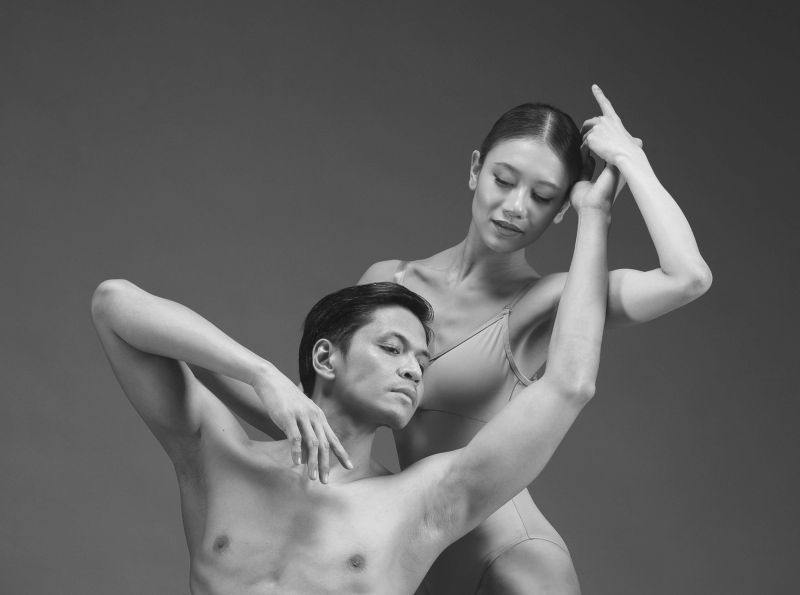
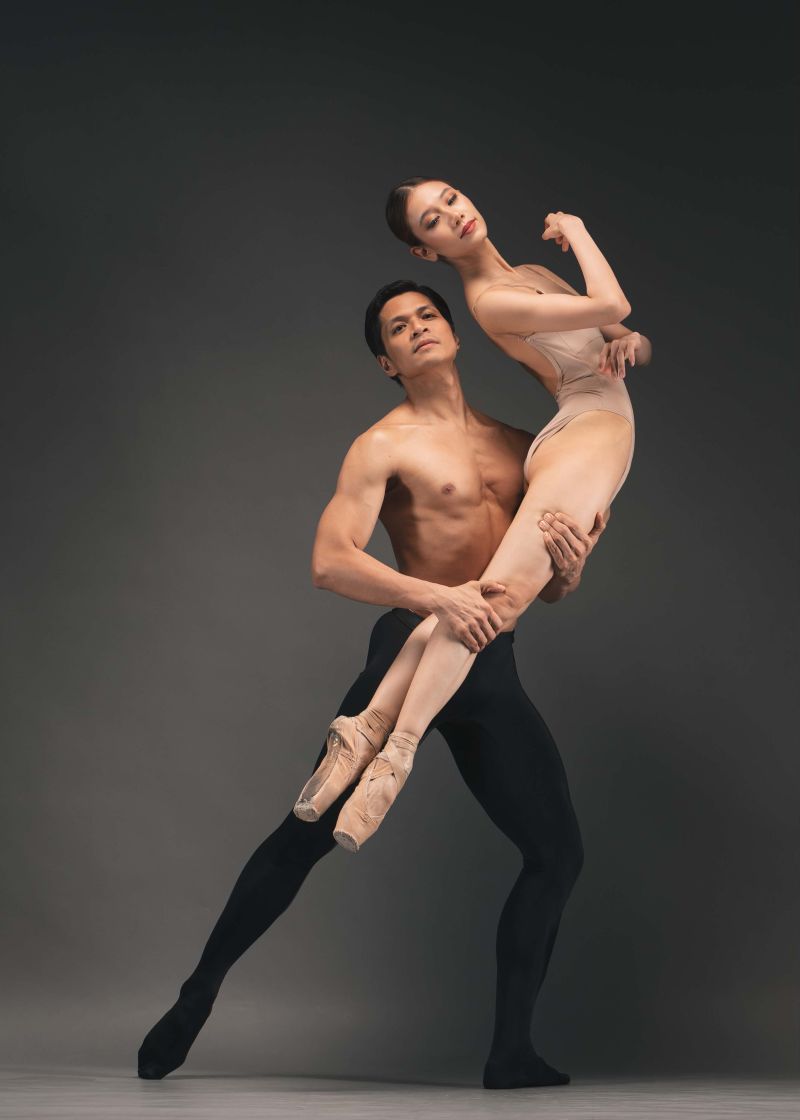
Abigail Oliveiro and Mark Sumaylo, onstage and offstage couple, will lead as Paquita and Lucien.
‘Paquita’ goes onstage at Aliw Theater in Pasay City on June 19 at 8 pm, followed by 5 pm shows on June 20 and 21.
Ballet Manila will stage a world premiere of Paquita, largely choreographed by artistic director/CEO Lisa Macuja-Elizalde. She retains only two of the ballet’s celebrated pieces set by French choreographer Marius Petipa. The classic story is about a gypsy who learns she is of noble birth, foils a villain’s plot, and finds love with the French officer Lucien. It features the glittering Paquita Pas de Trois in Act I and the Grand Pas de Deux in the finale. Both are recast as technically demanding showcases for ensemble and soloists. Company stalwarts Abigail Oliveiro and Mark Sumaylo, onstage and offstage couple, will lead as Paquita and Lucien.
Elizalde said the company’s longtime pair bring a rare intimacy to the leads. She created the roles of Alfredo and Violetta in her La Traviata for Oliveiro and Sumaylo, among the most heartfelt potrayals. Elizalde recalled that Oliveiro was given solos and principal parts early, in part because she was taller than most of her peers. Sumaylo, though not given to flashy technical displays, is prized for his magnetic stage presence and seamless partnering.
A Singaporean raised in Australia, Abigail Oliveiro possesses the refined, porcelain beauty often associated with classical Chinese paintings. Her features, delicate yet striking, belie the determination that would eventually carry her across oceans in pursuit of a ballet career.
The Oliveiro surname traces its roots to Portuguese ancestors who settled in Singapore generations ago. When Abigail was 11, her father relocated the family to Melbourne, believing Australia would offer a more balanced upbringing than Singapore’s highly competitive academic environment. There, she enrolled in a local ballet school and continued her dance training.
Her parents, however, insisted that education come first. Oliveiro completed the Victorian Certificate of Education, Australia’s equivalent of senior high school, before enrolling at university. She studied pharmacy for a year until a realization came: Unlike many professions, ballet comes with an expiration date. Oliveiro understood that if she wanted to pursue her dream, she had to act while time was on her side. She left university and returned to full-time ballet training.
Her parents supported the decision, but under one condition. She would have to finance her own training and international auditions. If she failed to secure a professional contract, she promised she would return to her studies.
“They instilled in me that if I wanted something, I had to fight for it,” she recalled. “I worked, earned money, and saved so I could attend auditions around the world.”
Several companies in Europe and the United States offered contracts, but the opportunities proved financially impractical because of the high cost of living. Her final attempt was the Asian Grand Prix in Hong Kong in 2013 at the age of 21. If nothing came of it, she planned to return to college.
The competition nearly ended in disaster. While performing the Esmeralda variation, Oliveiro miscalculated her traveling steps and found herself dancing into the wings, leaving the stage empty for several seconds. She quickly recovered and finished the performance.
Among those watching was the late Osias Barroso, then Ballet Manila’s associate artistic director. Seeing her potential, he encouraged her to contact Ballet Manila’s artistic director Lisa Macuja-Elizalde. Oliveiro sent an email. Just hours later, shortly before boarding her flight back to Melbourne, she received a reply.
Within three weeks, she had moved to the Philippines, a country she knew little about. Yet after seeing Ballet Manila’s strength and artistry at the competition, she felt confident she was heading to the right place.
She spent her first year living in a dormitory with two other foreign dancers before eventually moving to a condominium near the company’s studios.
The move to Ballet Manila required another adjustment. Oliveiro had trained in a different system and now had to master the Vaganova method, the influential Russian ballet training system renowned for producing dancers with exceptional technique, strength, and artistic expression.
The move to Ballet Manila required another adjustment. Oliveiro had trained in a different system and now had to master the Vaganova method
“Adjusting was crazy,” she said. “I remember seeing the women’s legs up by their ears.”
What surprised her even more was the men. “I was nowhere near the boys,” she said. “It made me nervous. I wanted to understand. Why do we do this? Why do we do things a certain way?”
Barroso became an important mentor during the transition. He gave her books on the Vaganova syllabus and sent her videos to study whenever she was preparing a role. Oliveiro also immersed herself in archival footage from the Mariinsky Ballet, carefully observing the style and technical details that define the Russian tradition.
Her progress was swift. In 2014, barely a year after arriving in the Philippines, she made her debut as Odette/Odile in Swan Lake, partnered by Alfren Salgado.
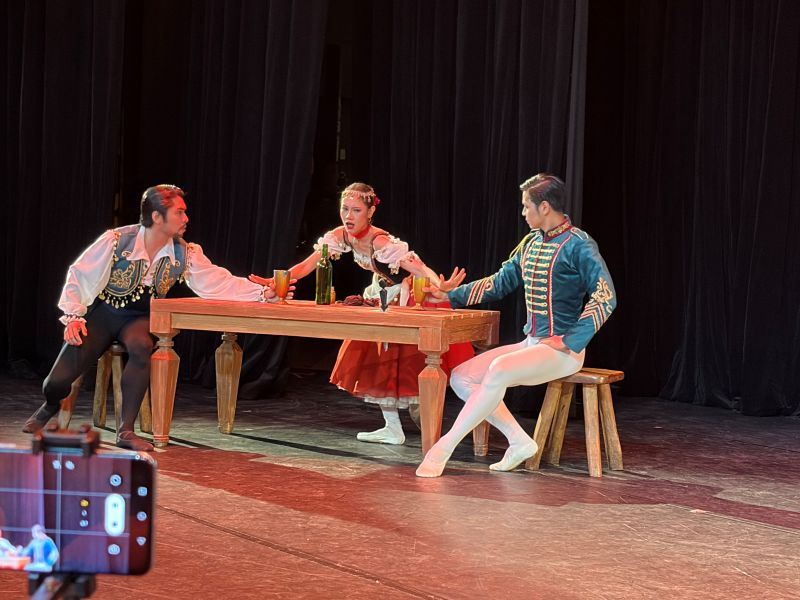
Paquita (Oliveiro) foils the plot of villain Iñigo (Romeo Peralta) to poison Lucien (Sumaylo).
The previous year, she had appeared in Le Corsaire, which required another skill she had never formally learned: the art of pas de deux. She underwent an intensive crash course in partnering techniques while preparing for the ballet.
It was during Le Corsaire that she first got to know Mark Sumaylo. The rest of the company already knew the choreography, while Oliveiro, still new to BM, she was struggling to catch up. She kept a video file of the ballet on her phone and studied it whenever she could.
Sumaylo found an excuse to borrow her phone so he could review the choreography. Looking back, she suspected it was also a way to start a conversation. At the time, however, she barely remembered what he looked like.
As they were paired together more frequently, a relationship gradually developed.
Today, their partnership extends both onstage and off. Oliveiro describes Sumaylo as a dependable partner whose support is so secure that she rarely thinks about it while dancing.
“You know it’s good partnering when you don’t feel it,” she said. “He’s not gripping. I’m just putty.”
The two dancers regularly exchange ideas about character development and dramatic interpretation. Both are deeply invested in their work and share a similar approach to rehearsals. “We’re always striving for clarity and nuance,” she said.
They are comfortable experimenting, even when early rehearsals feel awkward or unfinished. Trusting the process, they refine details until the partnership appears effortless.
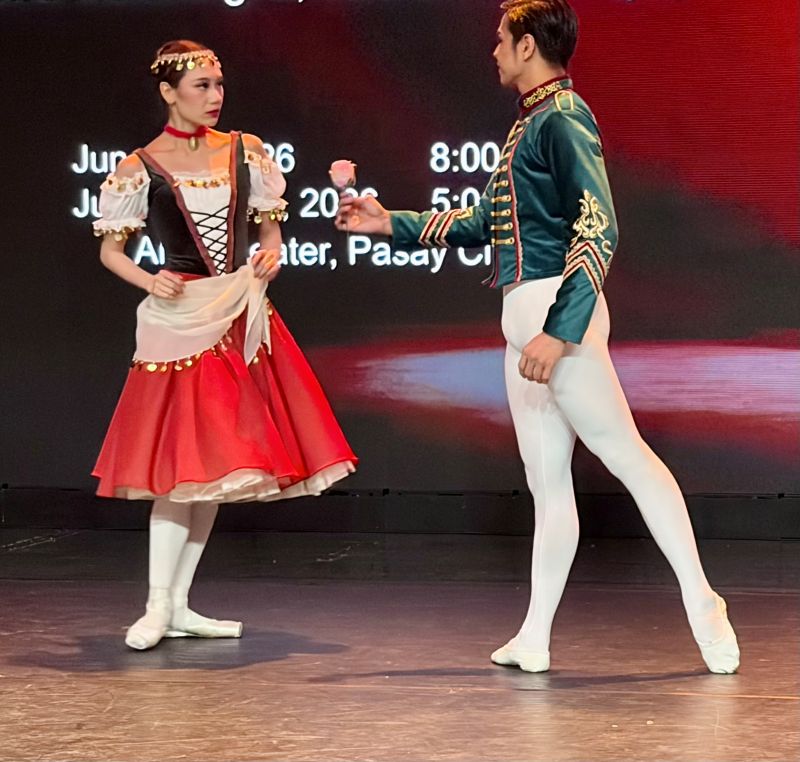
Abigail Oliveiro and Mark Sumaylo
Away from the studio, Oliveiro often turns to books as another way of studying character. While recreational reading is less common in a culture increasingly shaped by digital entertainment and social media, she remains an avid reader.
“I love reading, because whatever you get from the words, you create in your mind,” she said. “I imagine what the words mean.” The habit informs her approach to performance. Just as readers visualize characters differently, she believes dancers should bring their own imagination to a role.
On her interpretation of Paquita, Oliveiro sees her as a resilient and independent young woman shaped by survival.
“Paquita is free-spirited,” she said. “Unlike her, I would probably back off from certain things. I’m quite reserved.” But when she dons the white tutu in the finale, Oliveiro believes the transition to aristocrat feels right.
The role also allowed her to explore a different side of herself. She is more often cast as flirtatious, dramatic, or emotionally intense characters. Paquita’s playful nature presented a welcome departure.
With Sumaylo by her side, she approaches performances with complete confidence.
“Half the time I close my eyes and dance with him,” she said. “I enjoy it very much.”
Mark Sumaylo had already settled into the role of Iñigo, the villain in Paquita, when an unexpected challenge arose. Joshua Enciso, who was cast as the ballet’s romantic lead Lucien, suffered an injury. With only three weeks before opening night, Sumaylo was asked to step into the role and learn both the choreography and the character.
For a senior dancer, the challenge could have been intimidating. Ballet Manila’s younger danseurs often possess the explosive jumps, multiple pirouettes, and athleticism associated with dancers at the height of their physical powers. Sumaylo, however, sees them not as competition but as inspiration.
“I always appreciate their talents and skills,” he said. “I ask them what it feels like to do multiple turns or jump high.”
Rather than comparing himself to younger colleagues, he remains curious and eager to learn from them.
Rather than comparing himself to younger colleagues, Sumaylo remains curious and eager to learn from them
That mindset has shaped a career marked by persistence and reinvention.
Sumaylo grew up in Cagayan de Oro City, where he first encountered dance through school folk dance programs. His introduction to ballet came through a VHS tape featuring Spanish ballet superstar Ángel Corella. Fascinated by what he saw, he began training at a local ballet school.
In 2008, he entered the regional National Music Competitions for Young Artists (NAMCYA). It was a bold move for a young dancer from Mindanao with limited exposure to the country’s ballet circles. During the finals in Cagayan de Oro, he met Osias Barroso for the first time.
Sumaylo did not place among the winners. Yet during a master class, Barroso noticed something others had overlooked. Convinced of the young dancer’s potential, he spoke with the judges and secured Sumaylo a wildcard performance opportunity.
The experience was daunting at the NAMCYA finals in Manila. He found himself competing alongside dancers who would later become some of Philippine ballet’s most recognizable names, including Jared Tan, Jose Salgado, and Alfren Salgado.
Barroso subsequently offered him a scholarship to Ballet Manila. Sumaylo declined. His family needed financial support, and pursuing ballet full time seemed like a luxury he could not afford. After studying at Liceo de Cagayan University, he moved to Singapore in search of work. For two months, he took on odd jobs while applying for dance-related positions.
An opportunity soon arrived. He received a scholarship offer from the Nanyang Academy of Fine Arts and also applied to Universal Studios Singapore for a role that required singing and dancing. Yet the pull of ballet remained strong.
In 2013, at age 25, he returned to Ballet Manila through a summer workshop, hoping to regain his conditioning and re-enter the profession.
Unlike many male dancers, Sumaylo had never received formal partnering training. In Cagayan de Oro, students learned largely by observing videos and teaching themselves. Still, his natural strength proved an advantage. He could execute demanding overhead lifts that required the strength of a weightlifter performing a heavy shoulder press.
Combined with his stage presence and striking looks, those physical gifts helped earn him the lead role of Conrad in Le Corsaire.
His romance with Oliveiro developed more gradually.
One day, a fellow dancer showed him a photograph of Oliveiro and her best friend, whom they had met at the Asian Grand Prix. He barely paid attention. When Oliveiro eventually arrived at the studio, she appeared in the standard dancer uniform of practice clothes and tightly secured hair.
“I wasn’t attracted to her at first,” he admitted. That changed at a party, where he saw her dressed up away from the studio for the first time. The relationship deepened over the years, and the couple married in 2022.
Their artistic partnership, however, took work. In the beginning, differences in opinion occasionally led to friction, especially during long rehearsals when both were exhausted. Over time, they learned how to communicate more effectively. Today, they move together like two musicians performing from the same score, anticipating each other’s timing, rhythm, and intent.
“In terms of energy, we’re on the same channel,” Sumaylo said in Filipino. “We have the same goal. I ask her what she needs, and she asks me the same thing.”
Years of dancing together have created a shared rhythm and understanding that extends beyond technique.
“It has become enjoyable when we dance together,” he said.
Onstage, the connection becomes almost complete.
“When we’re dancing, the world disappears,” Sumaylo said. “It’s just the two of us.”
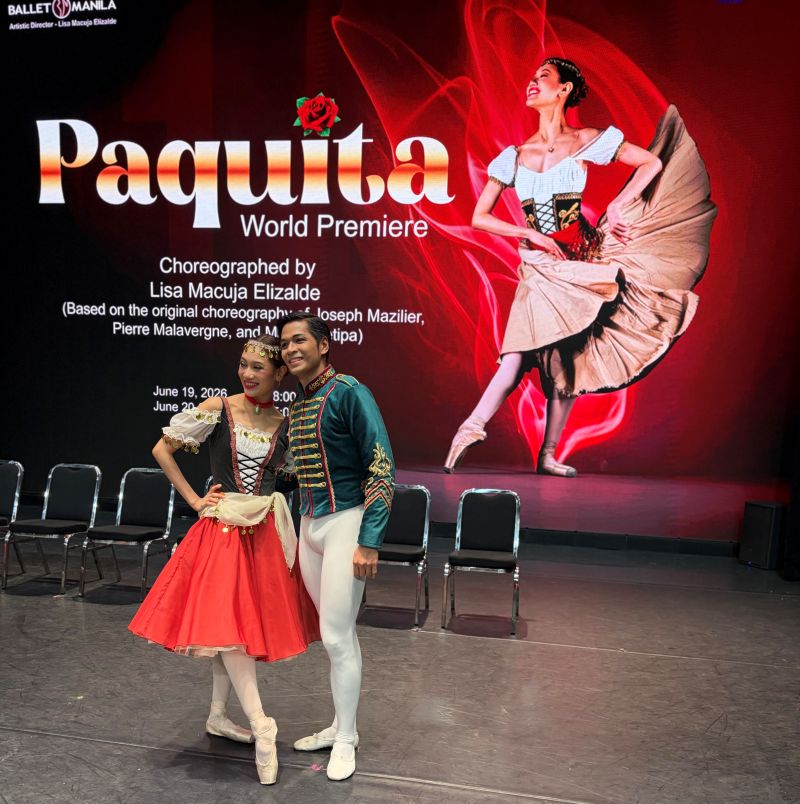
Abigail Oliveiro and Mark Sumaylo in front of Oliveiro’s image at the presscon
‘Paquita’ goes onstage at Aliw Theater in Pasay City on June 19 at 8 pm, followed by 5 pm shows on June 20 and 21. For tickets, visit Ballet Manila’s website www.balletmanila.com.ph or Ticketworld page www.ticketworld.com.ph).


