
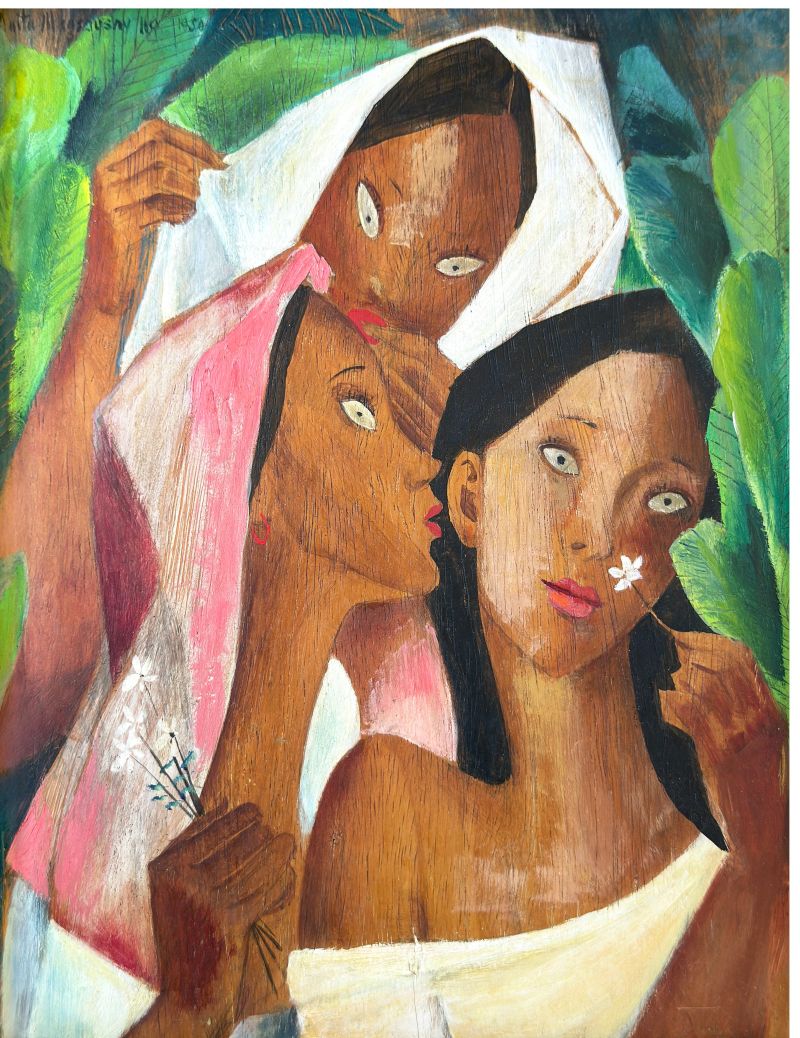
‘Five Senses,’ Anita Magsaysay-Ho (1914–2012), signed and dated 1950 (upper left), oil on wood, 13″ x 10″ (33 cm x 25 cm)
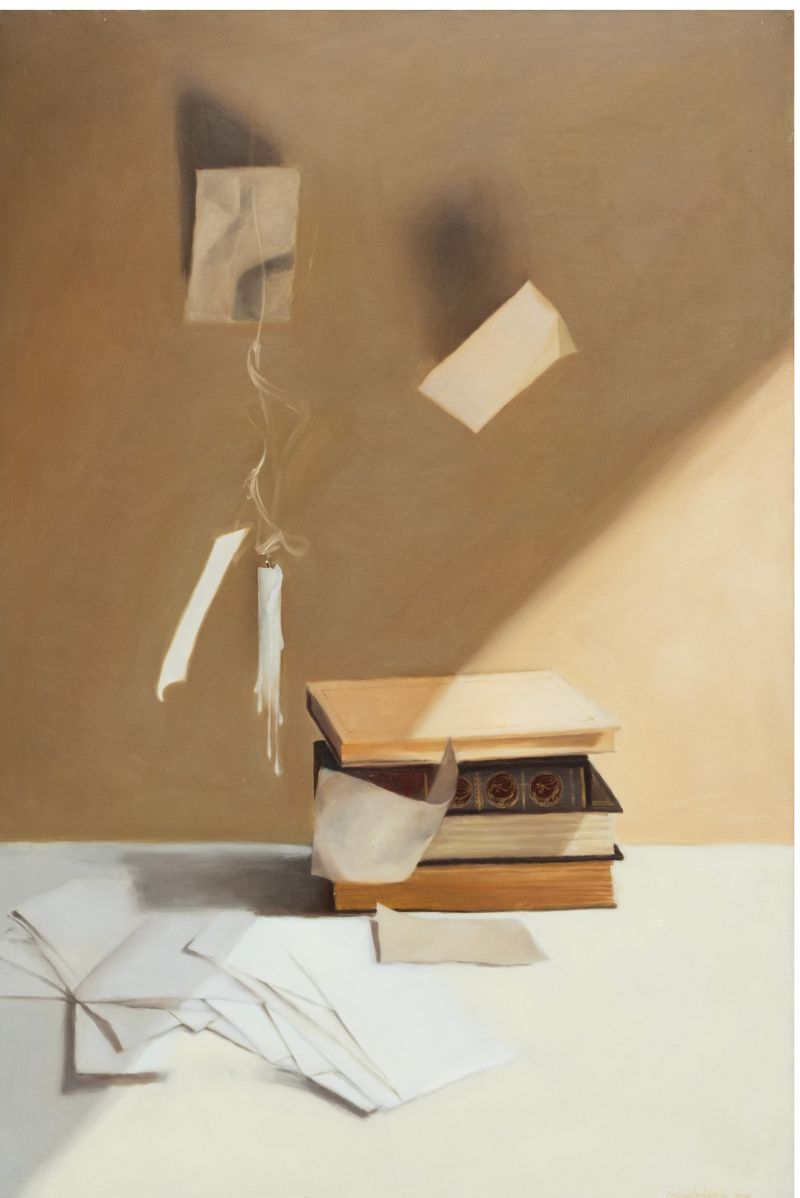
‘One Decision Away 4,’ Chelsea Theodossis (b. 1991), signed and dated 2019 (lower right), oil on canvas, 36″ x 24″ (91 cm x 61 cm
León Gallery made exceptional sales and created two world records in The Spectacular Mid-Year Auction held on 13 June 2026.
Topping this record-breaking Independence Day sale was Anita Magsaysay-Ho’s first award-winning piece in a major painting competition. Opening with a bid of PhP 16 million, Five Senses went for P52,870,400 (inclusive of buyer’s premium).
Resurfacing after over seven decades since its last display in 1950, Five Senses was Magsaysay-Ho’s entry in the Manila Grand Opera House Art Exhibition, which won silver, distinguishing her as a foremost Filipina painter of all things Filipino and folk.
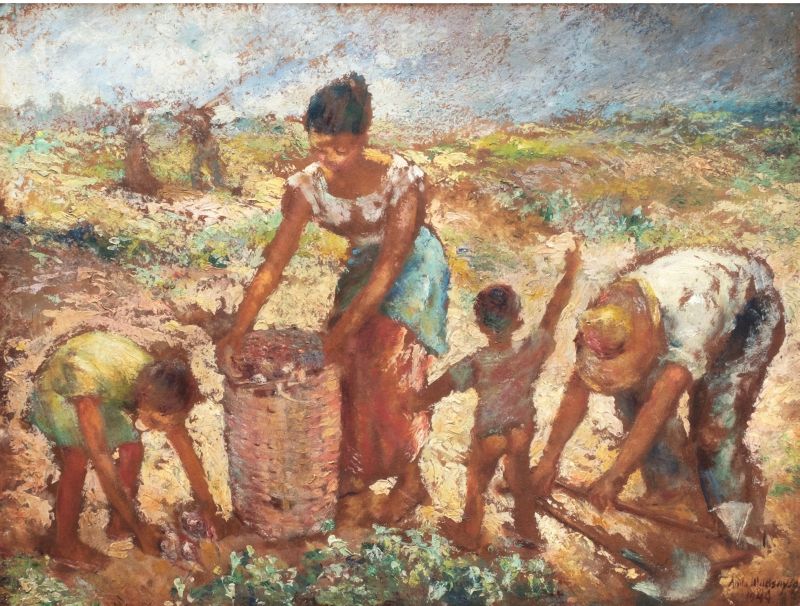
‘In the Farm / Digging Camotes / Family,’ Anita Magsaysay-Ho (1914–2012), signed and dated 1944 (lower right), oil on board, 18″ x 24″ (46 cm x 61 cm, formerly from the Benguet Corporation collection
Another Magsaysay-Ho masterpiece fetched an astonishing price. Sold for P28,838,400, her Digging Camotes/In the Farm captures the artist’s memories of Montalban, where her family took refuge during the war. It ranked among the major highlights of the artist’s landmark solo debut at the United States Information Library in early 1946.
Such a rousing success was this debut that painter Galo Ocampo christened Anita “an exceptionally gifted artist who will go on hurdling the obstacles that stand in the way.”
Jaime Ponce de Leon, director of León Gallery, noted the continued dominance of Anita Magsaysay-Ho in recent auctions. “There is a strong appreciation for the works of Anita,” he said. Her constant record-breaking sales speak for themselves.
The impressive collection of Fernando Amorsolo sold in this sale boasts illustrious provenance, and continues to emphasize the artist’s lasting influence in Philippine art.
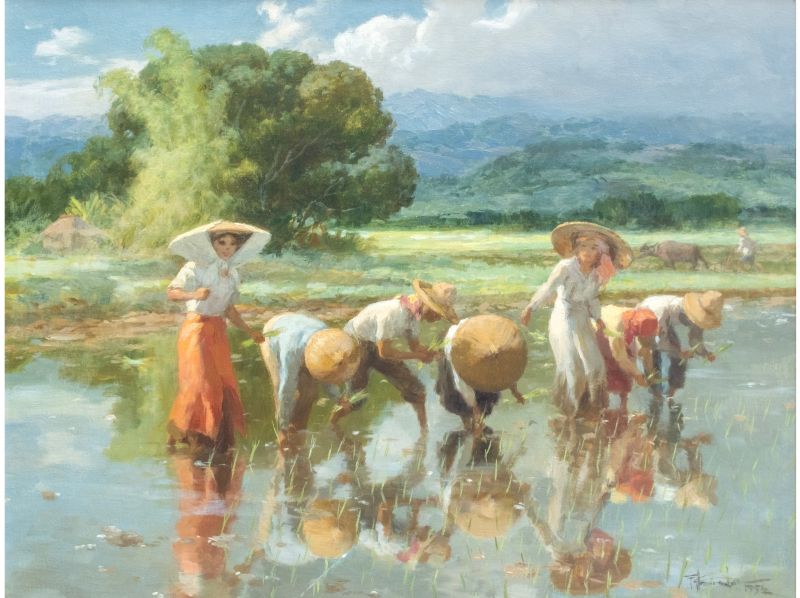
‘Planting Rice,’ Fernando Amorsolo (1892–1972), signed and dated 1954 (lower right), oil on canvas, 20″ x 26″ (51 cm x 66 cm), from the Hon. George A. Malcolm collection
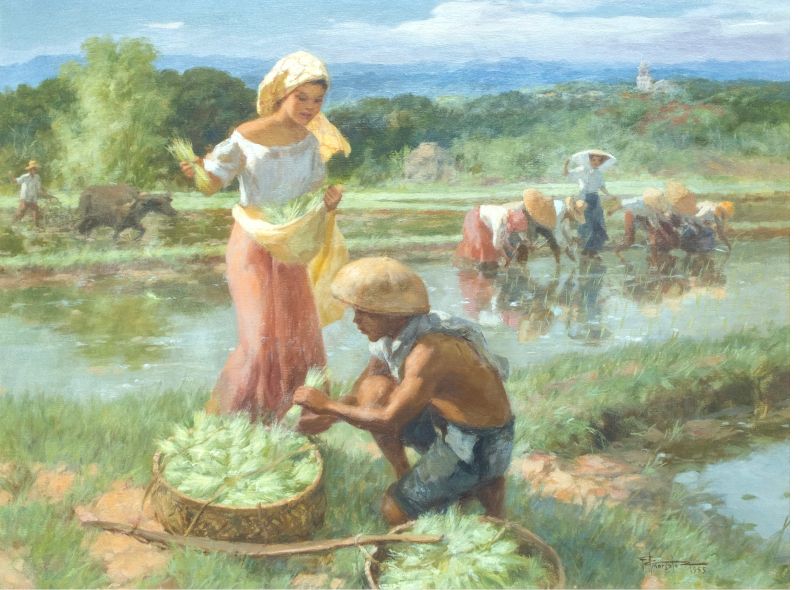
‘Planting Rice,’ Fernando Amorsolo (1892–1972), signed and dated 1955 (lower right), oil on canvas, 24″ x 32″ (61 cm x 81 cm), from the Hon. George A. Malcolm collection
Two Planting Rice pieces, both from the collection of the 17th Associate Justice of the Supreme Court of the Philippines, the Hon. George Arthur Malcolm, fetched P10,814,400 and P10,213,600, respectively.
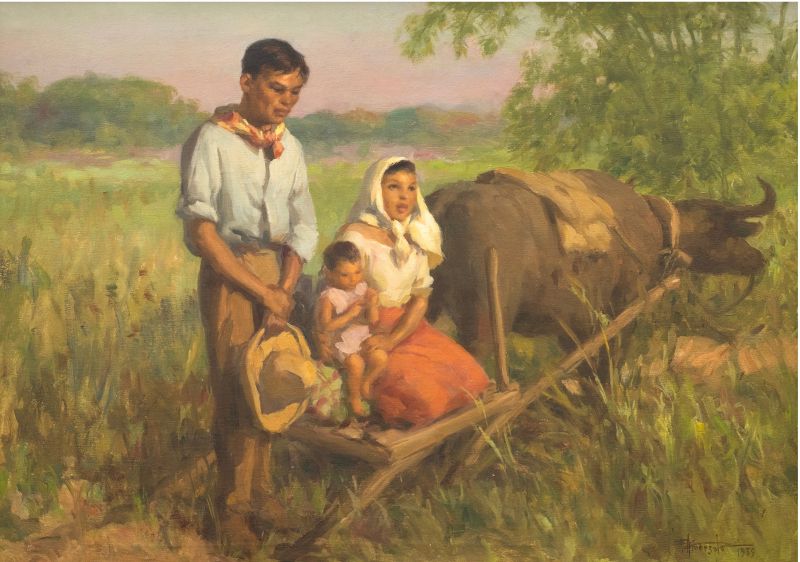
‘Angelus,’ Fernando Amorsolo (1892–1972), signed and dated 1959 (lower right), oil on canvas, 24″ x 34″ (61 cm x 86 cm), from the Ossorio family collection
The Ossorio family’s Angelus, one of the only two known Amorsolo paintings depicting the oracion, went for P13,217,600.
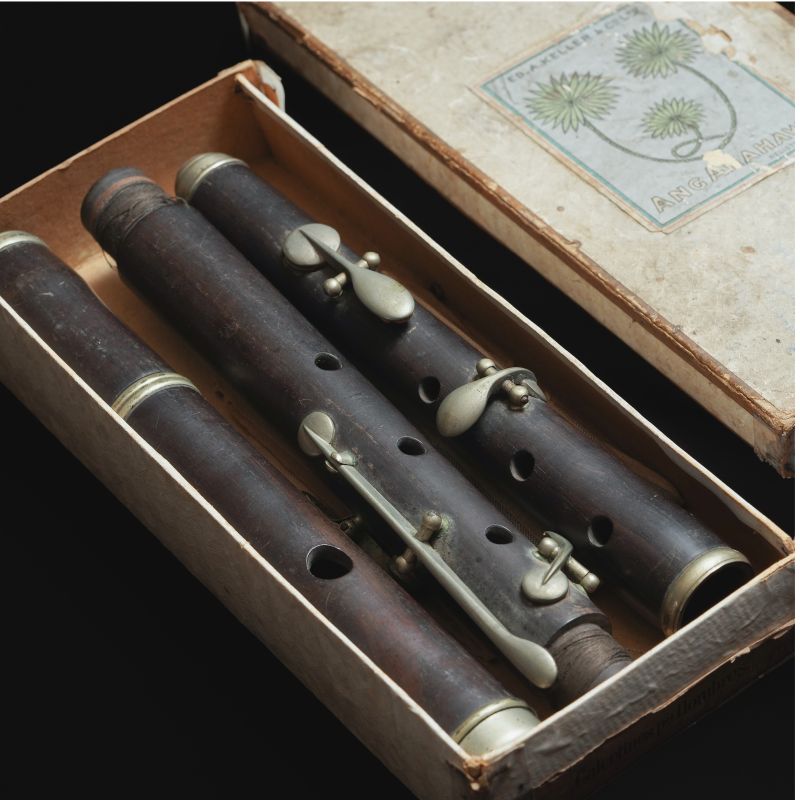
‘Nach Meyer,’ in the style of Heinrich Friedrich Meyer (1814–1897), the José Rizal Flute, ca. 1880s, rosewood with nickel bands and keys, composed of three parts (a head joint, body, and foot joint and encased in a cardboard box, with labels from the Ed. A. Keller & Company and
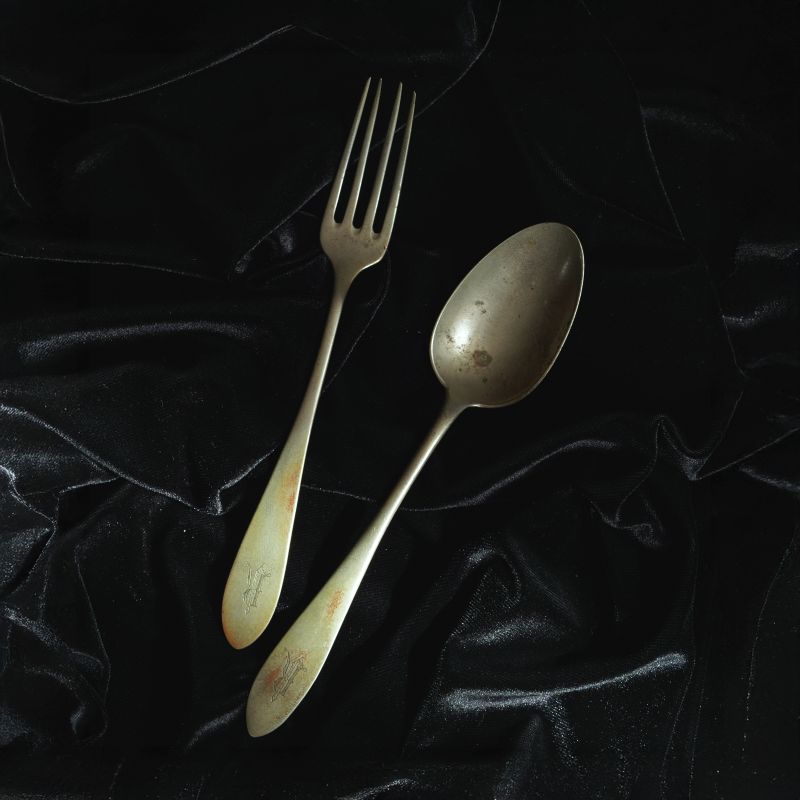
José Rizal’s personal flatware consisting of dinner fork and spoon, engraved with ‘J.R.’ for José Rizal, F.M. & Cie. Pacfong (Hallmark), spoon; F.K. Superior (Hallmark), fork, German silver (a nickel alloy), c. 1880s, property of the Dr. Leoncio Lopez-Rizal family
The historical lots drew impressive bids. Two of Jose Rizal’s ephemera won the hearts of collectors and enthusiasts. More than a musical instrument, Rizal’s Nach Meyer flute is a testament to the ilustrado’s passion for music, even as his friends attested that the hero was not a natural musician. Undeterred, Rizal persevered, not only learning how to play the flute but also taking up piano, voice, and composition. This piece sold for P3,124,160.
Rizal’s dinner set, consisting of a spoon and fork engraved with the hero’s initials, fetched P2,162,880.
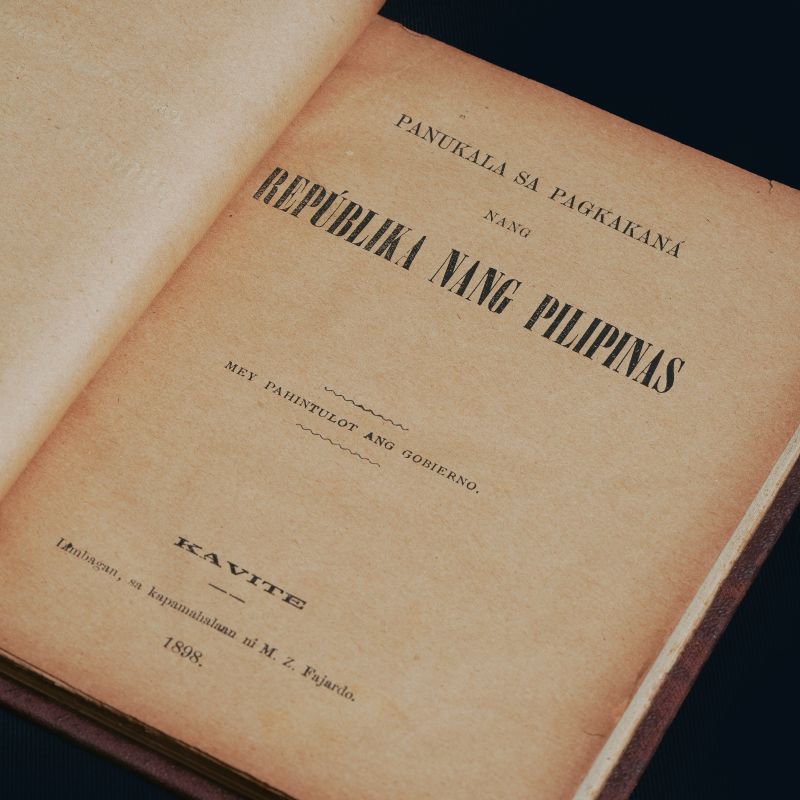
‘Panukala sa Pagkakana ng Republika Nang Pilipinas (1898)’ (Proposal for the Creation of the Philippine Republic), includes Mabini’s ‘True Decalogue,’ printed at the Limbagan M.Z. Fajardo on 6 July 1898 with orders by Aguinaldo that the pamphlet be sold for one peseta each, 65 pages, 7” x 5 1/4” (18 cm x 13 cm), from the Richard and Sandra Lopez collection
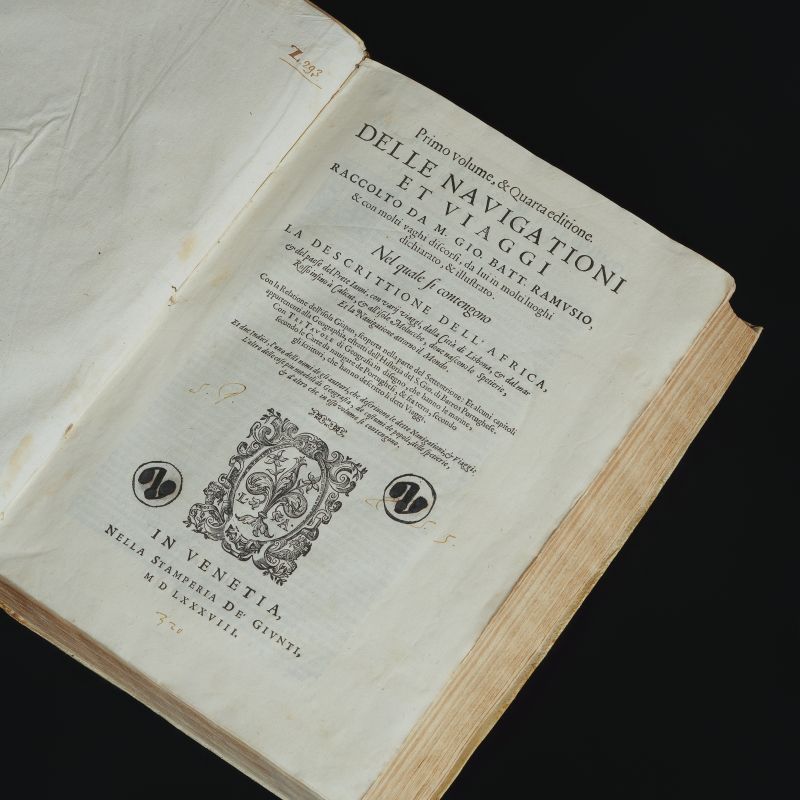
‘Delle navigationi et viaggi’ (On navigations and travels), three volumes, Giovanni Bautista Ramusio (1485–1557). Including Giacomo Gastaldi’s famous Terza Tavola map of the Philippines, in a rare woodblock edition. Volume I: Landmark 4th edition, containing Antonio Pigafetta’s account of Magellan’s voyage, Venice: Stamperia de Giunti, 1588; Volume II: 3rd edition, Venice: I Giunti, 1583; and Volume III: 2nd edition, Venice: Stamperia de Giunti, 1565. From the collection of Sir Thomas Phillips
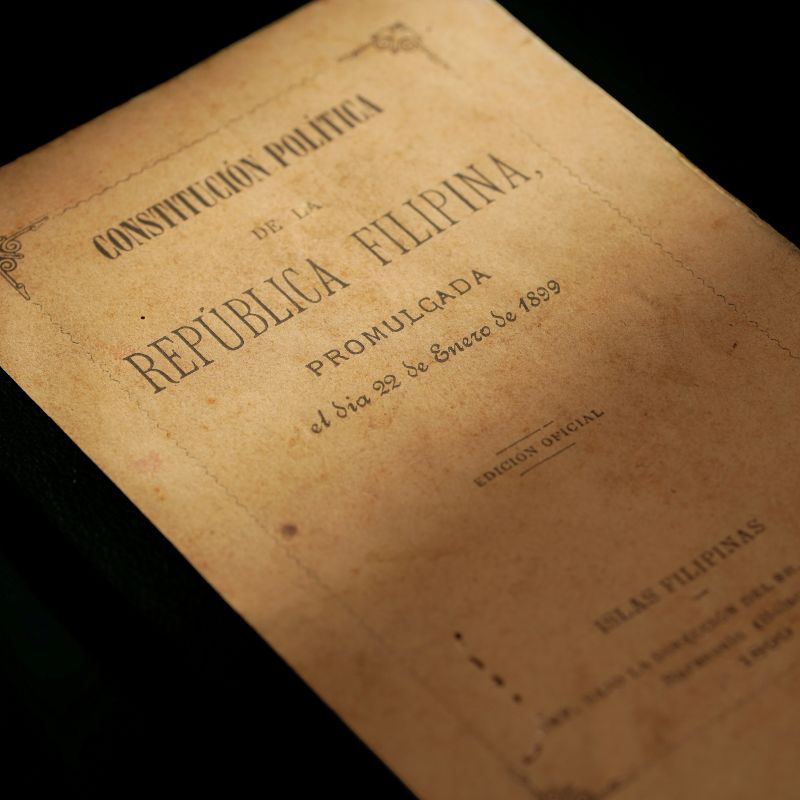
‘Constitucion Politica de la Republica Filipina Promulgada el dia 22 de Enero de 1899, Edicion Oficial,’ printed by Z. Fajardo, Barasoain (Bulacan), 1899), 48 pages, 5 3/4” x 4” (15 cm x 10 cm), from the Richard and Sandra Lopez collection
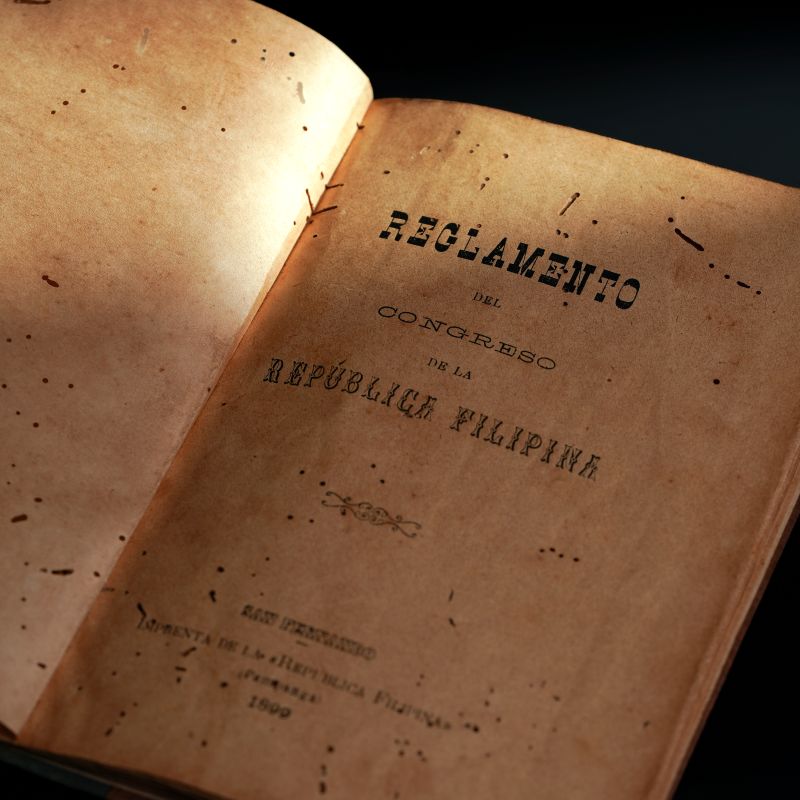
‘Reglamento del Congreso de la Republica Filipina’ (Rules of the Congress of the Philippine Republic), printed at the Imprenta de la Republica Filipina, San Fernando Pampanga, 1899, 37 pages, 7 1/4” x 5” (18 cm x 13 cm), from the Richard and Sandra Lopez collection
Several historical documents stood out. Relics of the Malolos Congress were welcomed warmly—an official edition of the Malolos Constitution sold for P2,403,200, while a copy of Apolinario Mabini’s draft for the Constitution sold for P781,040.
A monumental battle for a copy of Reglamento del Congreso de la Republica Filipina (Rules of the Congress and the Philippine Republic) happened at this sale. Fetching P720,960, the book found its way into the hands of Sen. Juan Miguel Zubiri, a direct descendant of the co-author of Reglamento and a Malolos Congress member, Pablo Ocampo.
In a historic twist, he immediately donated it to the National Library, which had launched an appeal to have its own copy of this significant work.
“It’s important for people to know that as far back as 1899, we had rules—and knew the importance of having them,” Zubiri said in a post-auction interview. He symbolically turned the copy over to Jeremy Barns, director-general of the National Museum of the Philippines, with Ponce de Leon in attendance.
The three-volume set of Giovanni Bautista Ramusio’s Delle navigationi et viaggi, which includes the historically significant “Birth Certificate of the Philippines,” the Ramusio-Gastaldi map, secured an astonishing P2,643,520.
A symbol of 19th-century Filipino opulence, the exceedingly rare pineapple-shaped “palitera” sold for a whopping P3,608,800.
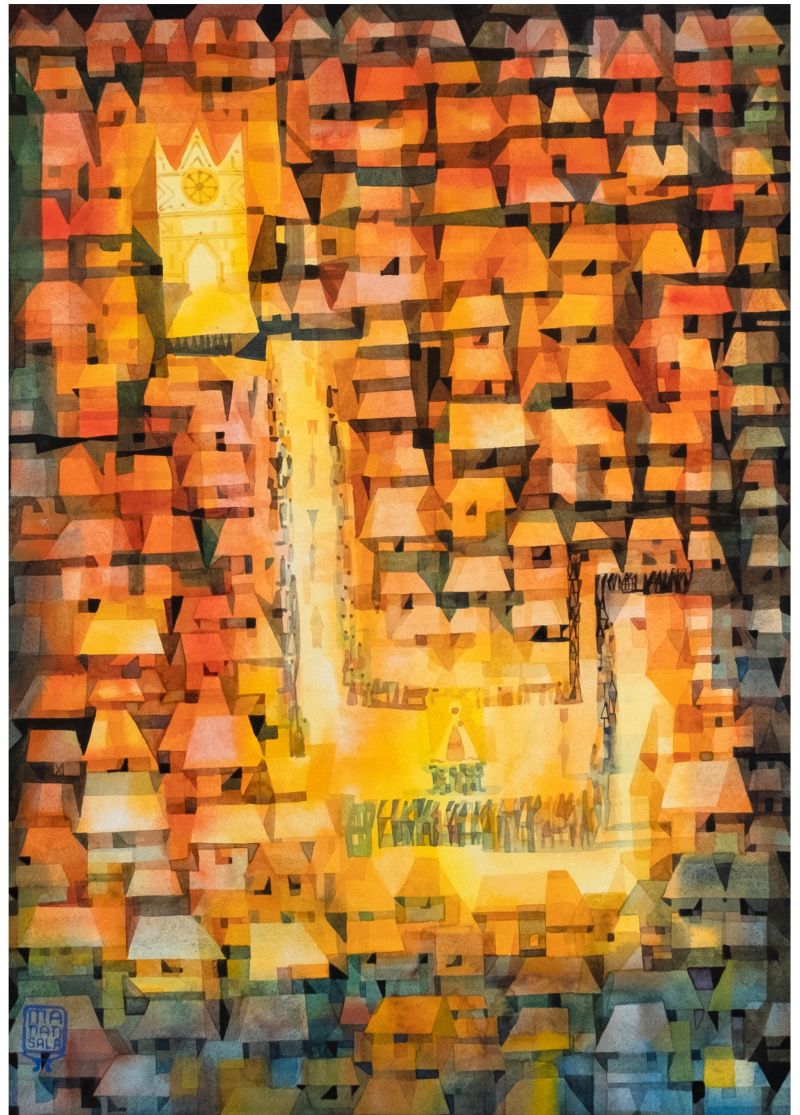
‘Procession (Nuestra Señora del Carmen de San Sebastian),’ Vicente Manansala (1910–1981), signed (lower left), ca.1952, watercolor on paper, 21 1/4″ x 15″ (54 cm x 38 cm)
The modernists continued to dominate. Vicente Manansala’s Procession, the artist’s watercolor rendition of the Fiesta Tradicional of the Nuestra Señora del Carmen de San Sebastian, opened with a P300,000 starting bid and quickly rose to its winning price of P2,403,200.
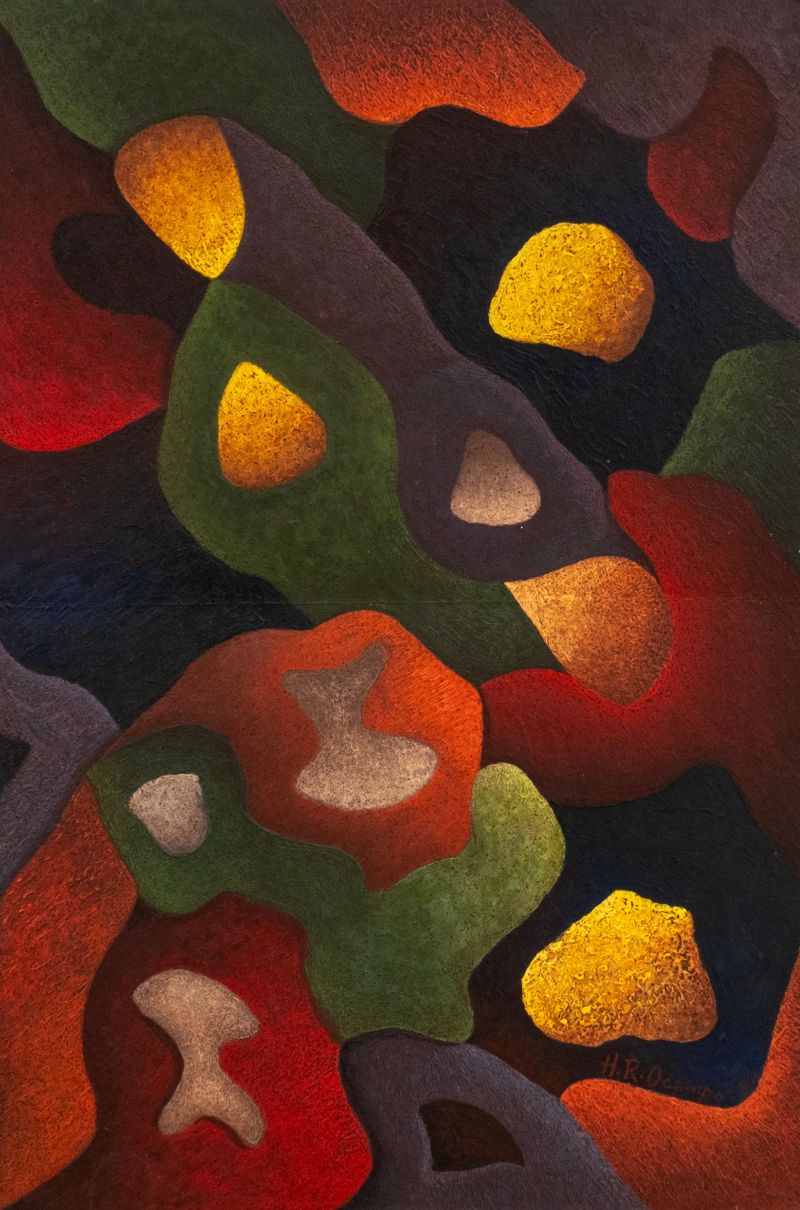
‘Color Study,’ Hernando R. Ocampo (1911–1978), signed and dated 1952 (lower right), oil on cardboard, 17 1/2″ x 12″ (44 cm x 30 cm)
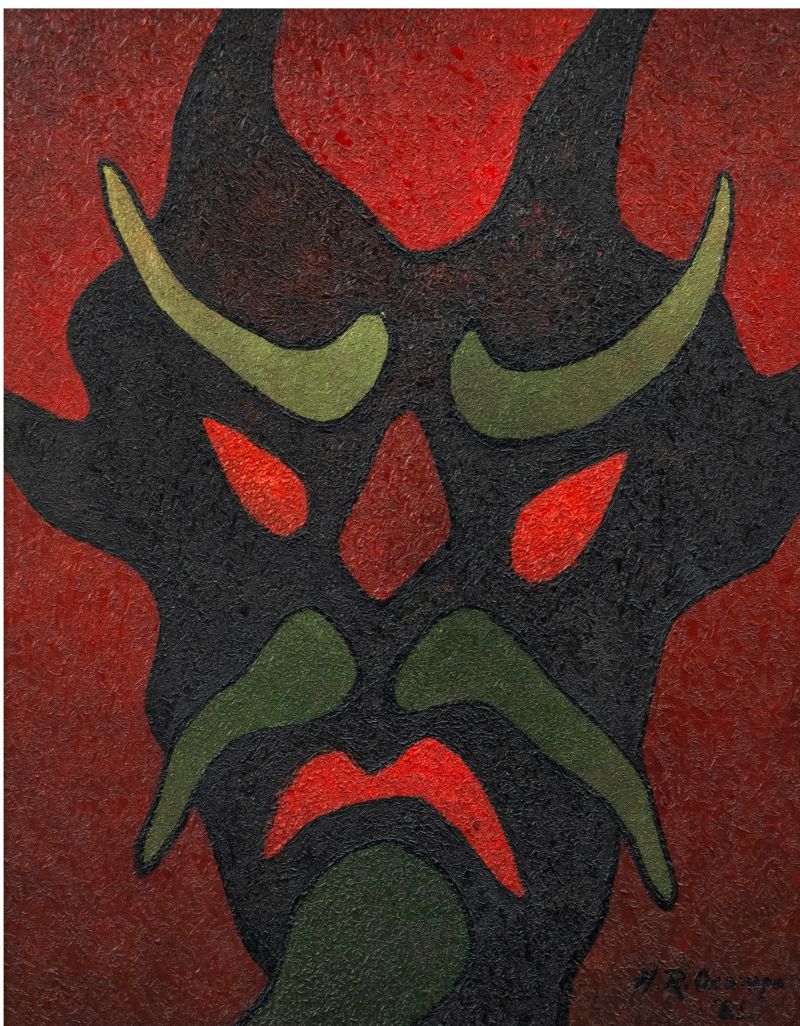
‘Mask’ (Possibly ‘The Clown/ Mask for a Lady’), Hernando R. Ocampo (1911–1978), signed and dated 1961 (lower right), oil on canvas, 28″ x 22″ (71 cm x 56 cm)
Two of Hernando R. Ocampo’s works stood out. His Color Study and Mask fetched P2,042,720 and P7,209,600, respectively.
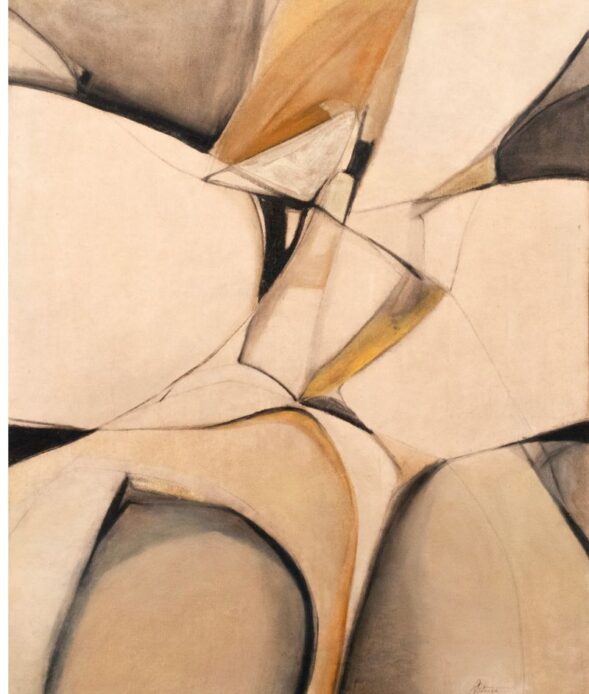
Two Filipina artists secured world records during this sale. One of the Philippines’ first Filipina abstractionists, Rosario Bitanga, posted a record-breaking sale of P781,040, a testament to the artist’s lasting influence.
Chelsea Theodossis’s One Decision Away 4 set her record at P2,883,840 in her debut auction at León Gallery. This groundbreaking sale, according to Ponce de Leon, is the start of a shift for a generation of artists. “Contemporary works have democratized and found their value in the Philippine art market,” he said.
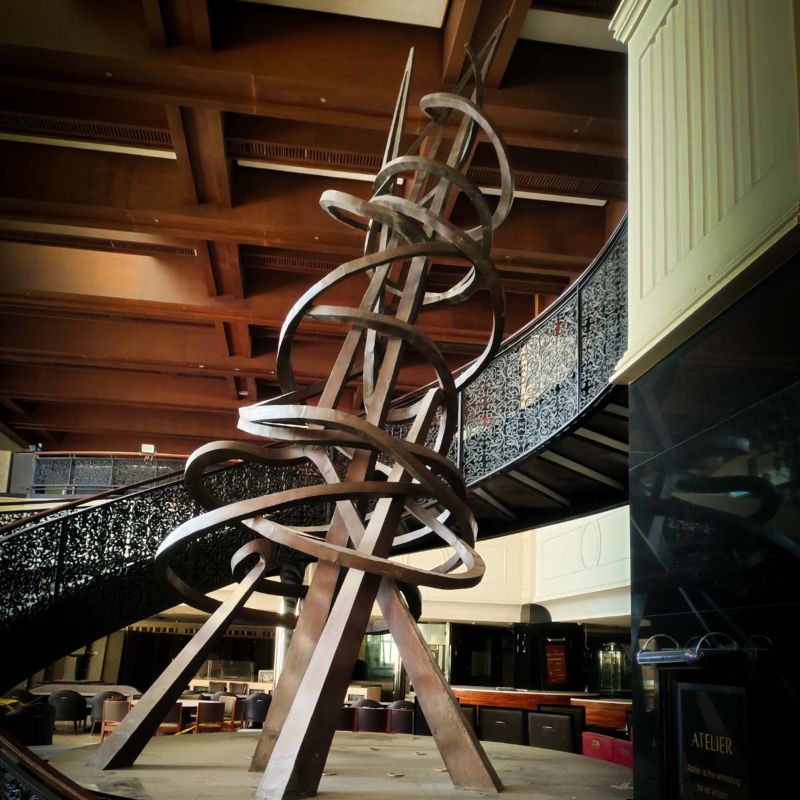
‘Rhythmic Movements,’ Eduardo Castrillo (1942–2016), brass, property of Philippine Plaza Holdings Inc.
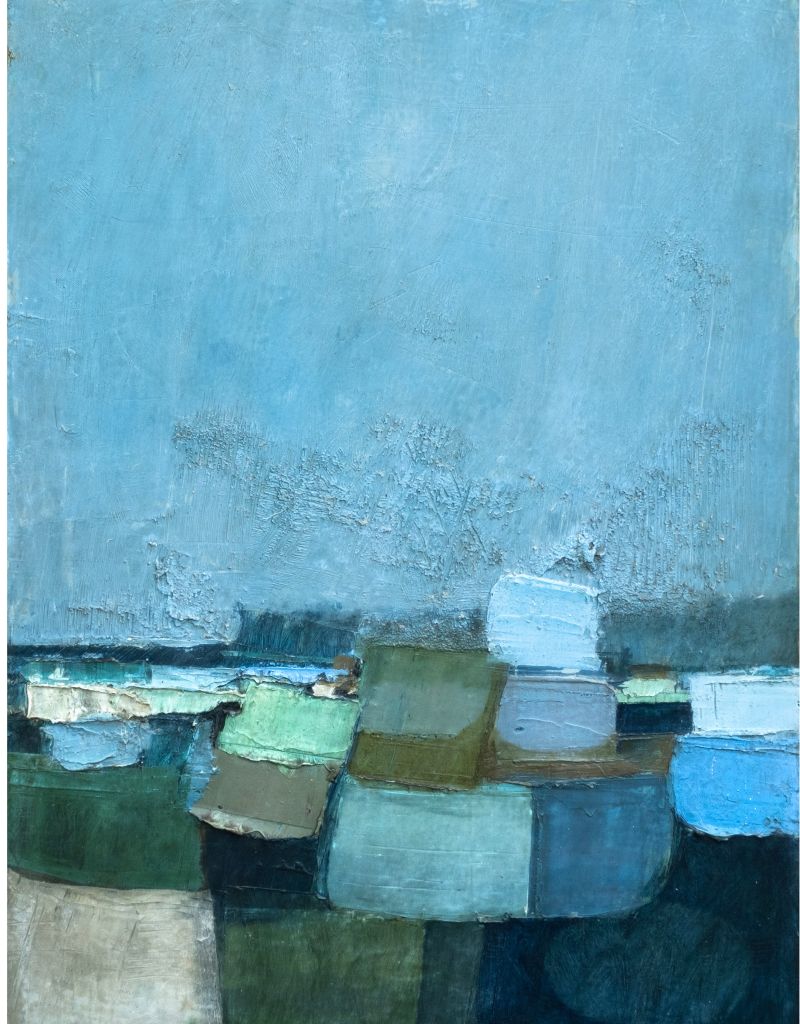
‘Nilad,’ José Joya (1931–1995), signed, titled and dated ‘May 17, 1970’ (verso), oil on wood, 32″ x 24″ (81 cm x 61 cm)
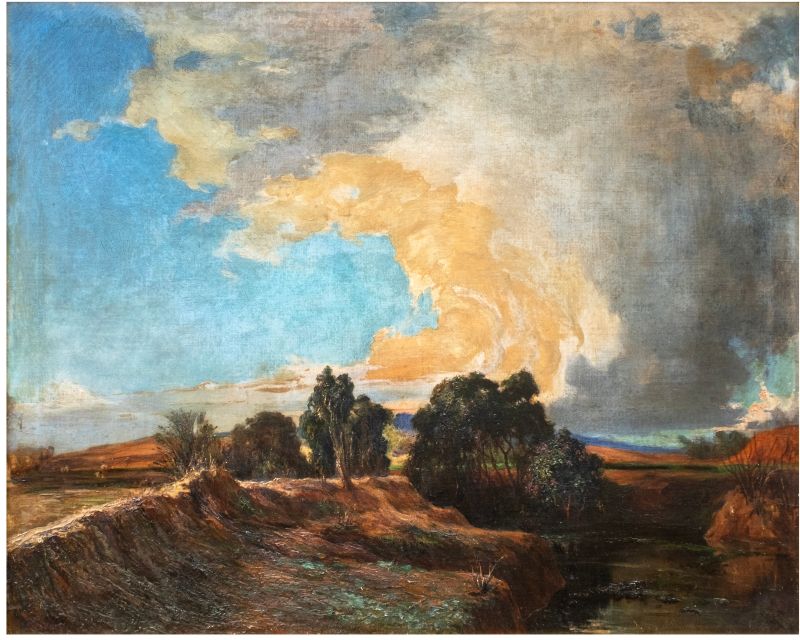
‘Country Landscape (Riverside View of Santa Ana, Manila),’ Fabian dela Rosa (1869–1937), signed (lower left), ca.1930, oil on canvas, 31″ x 39″ (79 cm x 99 cm)
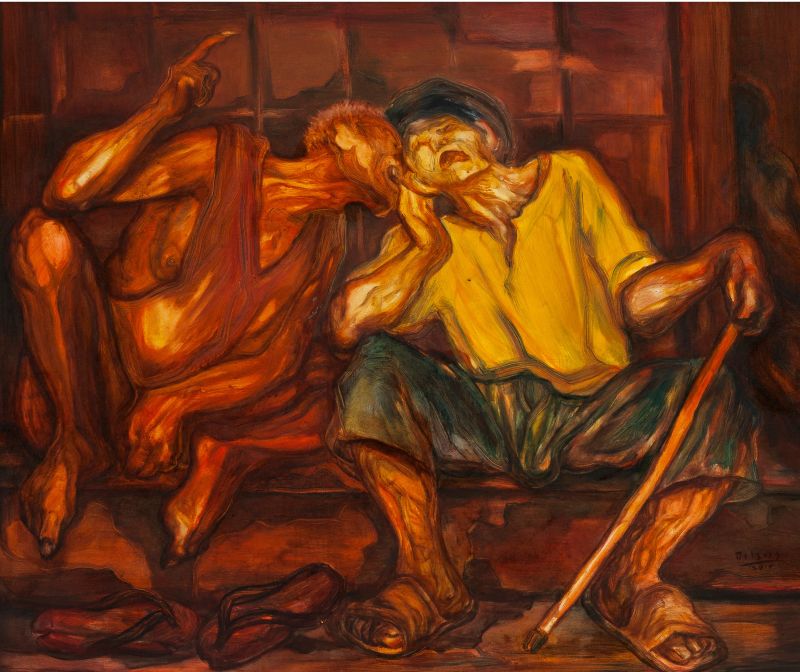
‘Ano Kamo? (Pakil Series),’ Danilo Dalena (b. 1942), signed and dated 2010 (lower right), oil on canvas, 40″ x 48″ (102 cm x 122 cm), from the artist’s collection
Other outstanding auction results include Eduardo Castrillo’s 22-foot Rhythmic Movement, once the centerpiece of Sofitel Philippine Plaza’s (formerly Philippine Plaza) flagship restaurant, Spiral (P9,012,000); José Joya’s depiction of Manila’s lush origins in Nilad, showing the mangrove plant from which the city got its name (P7,810,400); the pre-war civic power couple Arsenio and Agapita Tenmatay’s Fabian dela Rosa Country Landscape (P4,325,760); and Danilo Dalena’s humorous depiction of the country’s national pastime of gossiping, Ano Kamo? (P7,810,400).
Historical provenance, great beauty, and outstanding artistry combined made auction history.


