
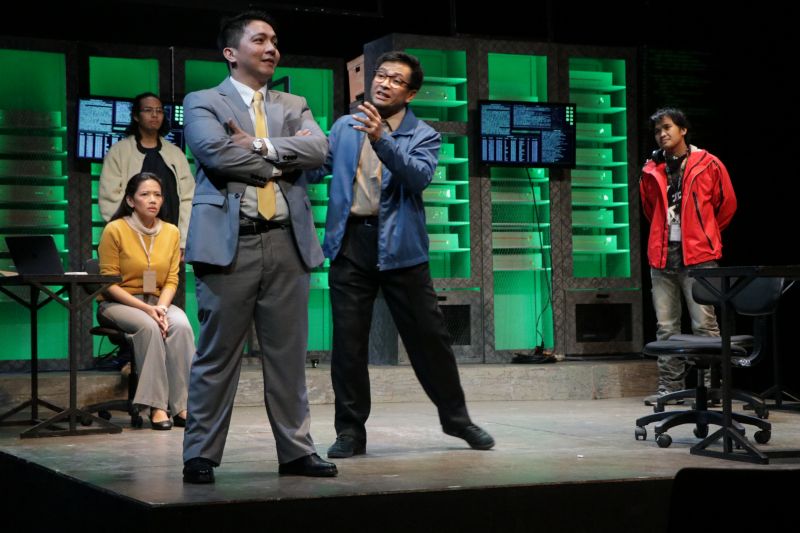
Gio Gahol and Noel Rayos lead the cast in Anthony Kim Vergara’s ‘Password 123, Pilipinas 321.’ (Photo by Kiko Cabuena)
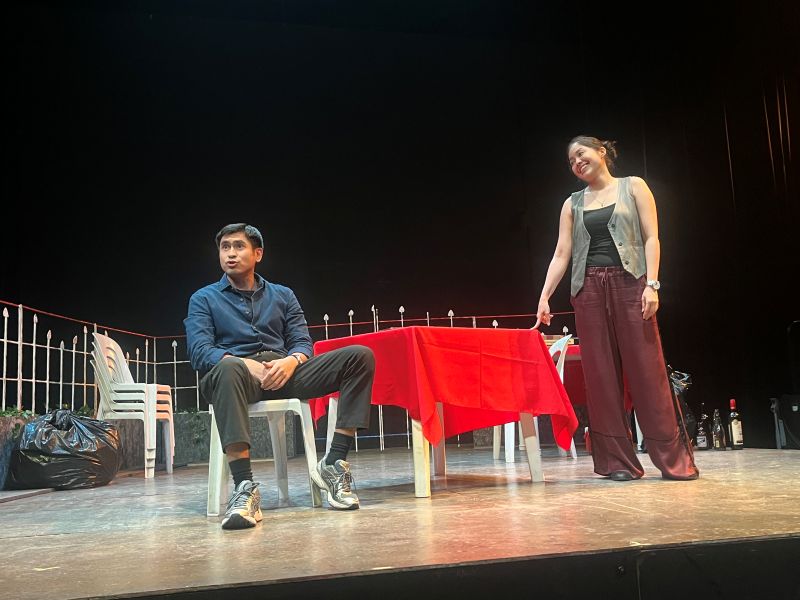
CJ Navato and Justine Peña in ‘Human Rights Story of the Year’ (Photo by Totel de Jesus)
There’s a certain high when a play is about to start, the a few-minutes lulle when you steal a glimpse at your fellow audience, overhear conversations, witness the photo-finish arrival of people finding their seats, while the final pre-show chime of Prelude Etnika by National Artist for Music Lucrecia Kasilag is played.
We’re at the 21st edition of the annual Virgin Labfest, the annual festival of untried, untested and unstaged one-act plays at the Cultural Center of the Philippines (CCP) Black Box Theater, the 300-seat Tanghalang Ignacio Gimenez (TIG).
Unlike in previous years when the festival ran for only three weeks, this VLF is running four weeks, June 3 to June 28, with 18 new one-act plays and three revisited. There are 18 because it’s also the first time VLF co-founder Rodolfo “Rody” Vera and his team of readers and decision makers decided to have six plays for staged readings, unlike in the previous plays when they could accommodate only two or three plays at the most.
“We trimmed our selections from the 282 submitted new plays,” Vera told The Diarist.ph in Messenger.
We caught the chosen 12 new plays spread out in Sets A, B, C, and D during the first week run, (June 3-6_. They were grouped according to themes or common narratives.
We go to the theater to experience catharsis, more than entertainment and some good laughs we share with the rest of the audience who pay P1,000 to P1,200 per ticket, and endure traffic and the start of the rainy season to go to Pasay City.
Now, VLF goes full throttle with plays with daring narratives and surprisingly off-the-cuff, no-holds-barred, braver punch lines from actors and even from the audience themselves.
“Ang platong ito ay para sa mga corrupt na pulitiko, corrupt na contractors ng gobyerno, corrupt na sistema ng flood control scandal. Tacsyapoooo! (This plate is for corrupt politicians, corrupt government officials, systemic corruption in the flood control scandal!)”
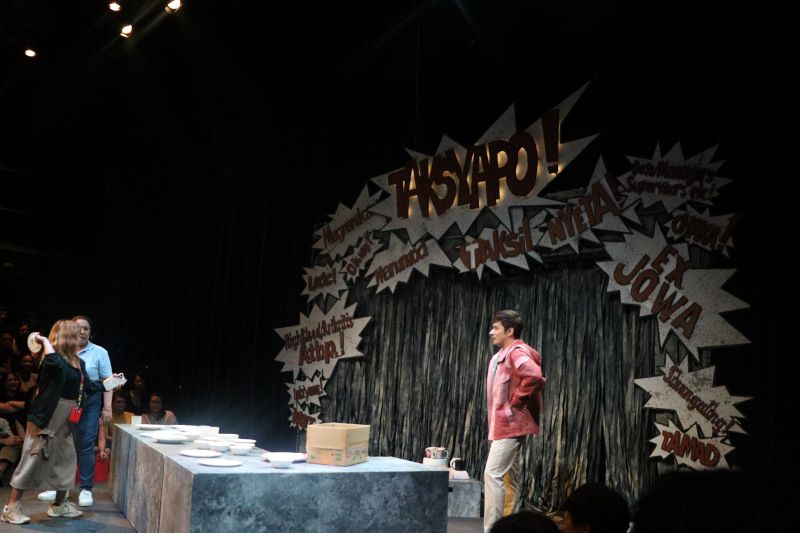
Go, gurl! An audience member is called to the stage to throw a plate in ‘Taksyapo.’ (Photo by Orly Daquipil)
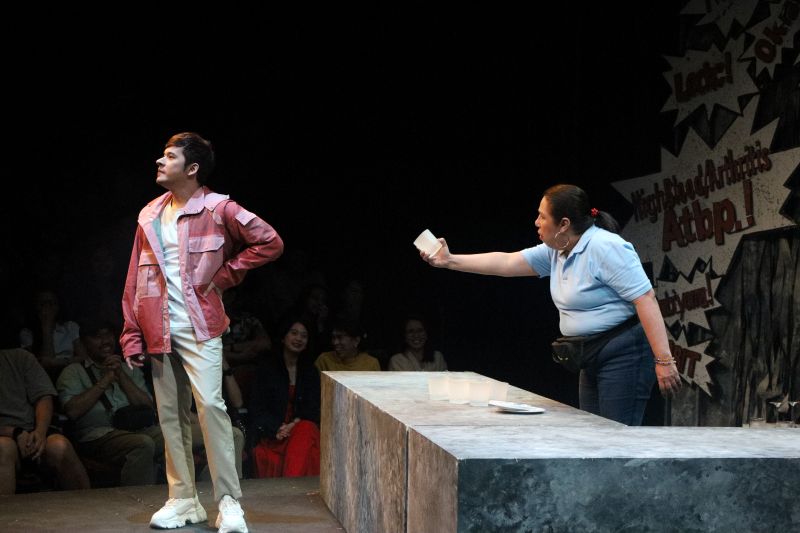
Those are lines delivered with much aplomb by TV-film actor Christian Bables, now doing a cross-over to theater, before he throws a plate at a concrete wall. He plays JM, a gay character dealing with a broken heart in the two-hander comedy Taksyapo, written by popular comedian-actor John “Sweet” Lapus and directed by former VLF festival director and now De La Salle-College of Saint Benilde professor Tuxqs Rutaquio.
Taksyapo, sometimes spelled tacsiapo, is Kapampangan term for disgust and frustration, though a bit tamer than cursing someone dead. In English, the closer Google term is “damn it.”
However, in a Facebook post, historian Ambeth Ocampo, who hails from Pampanga, said that “tacsyapo” is Kapampangan for “bwiset!” “I used to hear ‘taksyapo’ around adults during childhood summers in San Fernando, where I learned other bad words my mother didn’t allow in our Manila home. I was to learn later ‘tacsyapo’ was a very rude reference to an old woman’s genitalia.”
VLF goes full throttle with plays with daring narratives and surprisingly off-the-cuff, no-holds-barred, braver punch lines from actors and, on some occasions, the audience themselves
The setting of Taksyapo is patterned after a real restaurant in Gerona, Tarlac, named Isdaan, where the famous attraction is the “Taksyapo Wall.” It is where guests are encouraged to throw plates, drinking glasses, cups, mugs, saucers at a concrete wall to vent anger, frustrations, regrets, and other negativities that need physical release. In some extreme cases, TV sets are offered, with a baseball bat to aid the guest if the wall isn’t able to break the home appliance. Of course, there’s a fee for every item thrown against the wall.
In Lapus story, JM is the lone “plate-thrower” at the Taksyapo Wall, encouraged by a female attendant named Maya, played by a TV and film actress who likes to be called by her screen name, Mosang (real name: Maria Alilia Bagio).
Taksyapo is a riot of a comedy. When I saw it on the first week (June 3 to June 7), the theater was jampacked, a sold-out show, we were told.
Coincidentally, the first week was when the moro-moro in the Senate took place, so the lucky audience had the best release of negativity inside the theater.
Bables and Mosang were a perfect match. We were in stitches every minute. The blunt honesty, witty dialogues, and unexpected punchlines are all perfect therapy for everyone’s mental health as we try to shut down our social media feeds to take a break from what was happening in the GSIS Complex building, just a few hundred meters away from the CCP Black Box theater.
Rutaquio’s direction has always been topnotch, as shown by the chemistry of Bables, a virgin theater actor nonetheless, and not-so-theater virgin Mosang. There’s audience participation that makes spontaneity a vital element of the play.
On the day I watched, two audience members were called onstage to throw plates. They were asked to say over the mic who their rage-filled plates were directed at. A bespectacled young lady said something about her problem with her boss.
But what made the audience almost stand up and applaud was when one guy said, without hesitation, “Ang platong ito ay para kay Alan Peter Cayetano! Taksiapoooo!” It was near-pandemonium, as the audience laughed and applauded in agreement for about a minute or two.
In the media conference before the VLF opening, Lapus said it was his way of coping with a broken heart after his boyfriend left him for another gay guy, who is “super rich but ugly.” In short, Lapus is JM.
It took some time for Lapus to get his play into VLF’s magic 12. It wasn’t his first time to join the annual festival as a playwright. In 2018, he said his initial entry, Bagyolanda, also directed by Rutaquio, was chosen for the Staged Reading set.
He pointed out, in good humor, that at the time, when he watched those 12 plays that made it to Sets A, B, C and D, he asked himself why a few made it to full production when they were, as he implied, badly written.
“Since Bagyolanda was for Staged Reading lang, nagtataka ako. Pinanood ko lahat ng plays. May dalawa o tatlo na…tumalo sa play ko? Huh, pumasok yan, yung sa kin, hindi? Pasensya na, Writers’ Bloc. Nagmumura ako, ‘p—ina-naman’. Sandali nga, may kanya-kanyang taste ba talaga? (I watched all the plays. I was surprised why two or three were chosen. I asked myself, how did these plays make it to full production? I was cursing while watching them. Wait a minute, why oh? Sorry to The Writers’ Bloc. We really have diverse tastes),” he said.
He could have a point. In my 21 years of watching and chronicling the VLF, some plays looked intriguingly good on paper, the synopsis, but the actual execution on stage sometimes fell short.
The way Lapus expressed his frustration made media people and vloggers as well as his fellow playwrights, actors, and the CCP people laugh
Sometimes I don’t even agree with the choices of the judges, who remain nameless, of those that made it the Revisited Set. Then again, as Lapus said, we have diverse choices.
The Writers’ Bloc, co-founded by Rody Vera, is the group of veteran and aspiring playwrights that started the VLF in 2005 with the CCP and its resident theater company, Tanghalang Pilipino (TP). Though various sponsors and organizations helped finance the festival in succeeding years, the triumvirate—CCP, TP, Writers’ Bloc—remained constants in making the annual VLF a success. This year, Arete, the art hub of Ateneo de Manila University, is one of the Good Samaritans for VLF.
Going back to Lapus, he said it was worse for him in 2019 when his new play didn’t even make it to Staged Reading.
“Sumali uli ako ng 2019, hindi pa rin pumasok. Nanood na naman ako. Same questions. (Internal monologue) ‘Pumasok ‘yang mga yan?’ So, pause muna and after a few years, sumali uli ako at eto na yun. (I joined again in 2019, same case. I watched all the plays and wondered why some made it to the top 12 and mine didn’t. I stopped submitting for a few years. But now, finally I made it).
“Noong 2018, laplapan lang, ito na, devirginized na ako. Parang Miss Universe lang, dati semi-finalist, ngayon pasok na ako sa finals (At the time, it was just like making out, now I’m fully devirginized. Or like in the Miss Universe pageant, semi-finalist but now, I made it to the finals).”
Dingdong Novenario, who has been a regularly featured playwright in VLF, submitted, and his play titled Manang made it to this year’s Staged Reading, Set 2. In jest, he said he supported Lapus’ sentiment. Incidentally, since he joined the festival more than a decade ago, Novenario has had eight plays staged in the regular VLF sets, some of them even part of the Revisited Sets.
“Kayo ba, nakailang plays na kayo sa VLF? Dalawa? Tatlo? Ako, walo na, plus itong Staged Reading. Staged Reading lang pala kami pero manonood pa rin ako ng mga plays sa Sets A to D…na may hawak na kutsilyo sa likod nyo (How many plays have you had staged in VLF? Two? Three? I’ve had eight, plus this Staged Reading, but I’ll still watch Sets A to D…with a knife for your back),” he said, again drawing laughter.
Marco Viaña, VLF’s co-festival director, in response to Lapus’ and Novenario’s playing down those that made it to the Staged Reading, the stripped-down reading performance, pointed out that after the pandemic, VLF had its script development sessions for three months. Each entry now undergoes intensive workshops before it lands on the chosen director’s lap. Also in good humor, he said, “Huwag nyo pong nila-lang ang (Don’t belittle the) Staged Reading. And let me remind everyone that those entries who made it to Staged Readings could submit them again the following year for a possible full production as part of Sets A to D.”
True enough, the plays that were staged since live shows opened at CCP in 2022 and the following years were more refined, and some critics described them among the best in the history of the VLF.
Lapus is, indeed, very proud of his baby, Taksyapo.
“Ako hindi natakot, ang tapang ng script ko. Bago ko ipasa sa VLF, nag name drop ako sa text mismo ng isang taong tumarantado sa akin. Pinangalanan ko doon sa script ko para sa lahat ng manood sa VLF 21, malaman kung sino itong tinarantado ako. Pero bumalik ako sa Taksyapo Wall sa Tarlac,” he said.
People at the CCP Black Box Theater gave Lapus some resounding applause, but he had a follow up: “Pero may sumpa pa rin sa kanya (there’s still a curse on him), of course.” Viaña then suggested to Lapus to just invite his ex-boyfriend and the new lover to watch VLF and see their reactions. Lapus agreed.
Vera, co-founder of The Writers’ Bloc and VLF, with his team of VLF “dictators,” er, rather, decision-makers, scheduled Set D, with Lapus’ material as highlight, being the final play, to close VLF21 on the night of June 28, Sunday, when they will announce the three plays that will make it to the Revisited Set in VLF22 next year.
Taksyapo is the third play in Set D: Pusong Mamon, grouped with Jerom Canlas’ Footprint and Gerald Manuel’s Buhaghag.
SET D’s common theme is how we take care of our mental health. With creative restraint under the direction of Miko Angeles, Footprint tackles how family members cope with the unexpected loss of a loved one. It’s something very personal for Canlas, whose younger brother, promising actor JM Canlas, passed away at age 17 in August 2023.
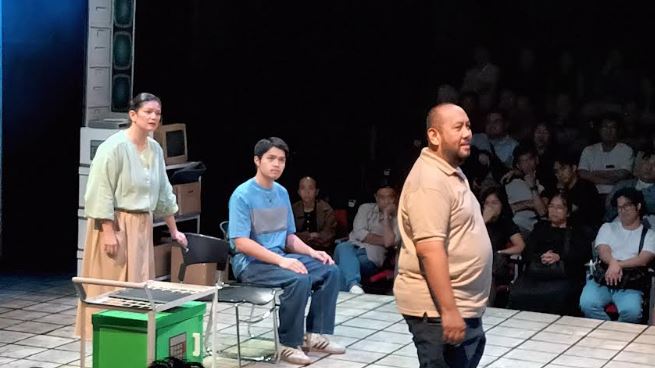
Meryll Soriano, playwright-actor Jerom Canlas, and Jojo Cayabyab in ‘Footprint’ (Photo by Totel de Jesus)
Canlas’ brother Elijah, another much-talented multi-platform actor, is a member of the cast, and it’s a highly emotional, cathartic experience for them and the audience.
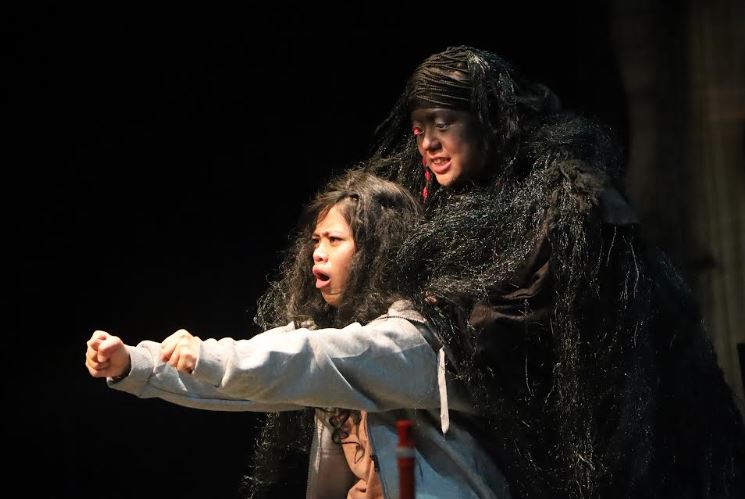
Adrienne Vergara as Lala and Krystle Valentino as Phoebe in ‘Buhaghag,’ a play about depression and anxiety (Photo by Orly Daquipil)
Gerald Manuel’s Buhaghag is about being rendered paralyzed by depression and anxiety. Director Tess Jamias uses what looks like a shrub of black vines, a hairpiece that keeps the main character from doing what she needs to do, or function like a normal human being. We are reminded of Japanese horror movies where the ghosts are pale, long-haired creatures riding on the protagonist’s back.
With her signature highly energetic, standout performance that VLF regulars have grown accustomed to, the very efficient and spontaneous Adrienne Vergara almost steals the show as the massive, messy two-legged heap of black hair tormenting the main character, the nearly catatonic Phoebe, played by Krystle Valentino.
Set C: Balat Kalabaw (Carabao Skinned) has Dustin Celestino’s Elehiya, regarded by earlier reviews as the most heart-wrenching play this year.
It has real-life father-and-son filmmaker Carlitos and theater-film-television actor Rafa Siguion-Reyna in the cast, playing the same roles.
‘Elehiya’ has real-life father-and-son filmmaker Carlitos and theater-film-television actor Rafa Siguion-Reyna in the cast, playing the same roles
What gets us overthinking the play days after watching it is theater actor Yan Yuzon’s portrayal of Lalaki, the narrator. We knew him as the former lead guitarist of Ely Buendia’s post-Eraserheads rock bands Mongols and Pupil. It was our first time to see Yuzon act on stage, though we’re aware he’s been part of several plays staged in Ateneo. As he makes his VLF debut, he delivers the final monologue that never fails to get most of the audience members, both male and female, tearing up even after the show.
With direction by Ron Capinding, the play is simply described in the synopsis as a series of monologues about father-and-son relationships. But it’s more than that, as it tackles toxic masculinity in Filipino middle-class households. It shows how Filipino men try to cope in a society that discourages them from opening up about their feelings.
But on hindsight, Celestino’s play reminds us that we are still imprisoned in the age-old belief that men should stay as the stoic rulers at home, and sons are forever soldiers learning how to wield their swords and throw their spears. And that is the tragedy that still exists in some Filipino families.
On a bigger scale, Celestino reminds us of the lost opportunities between fathers and sons to become the best of friends. That no one is above the other, just two pals navigating and enjoying life.
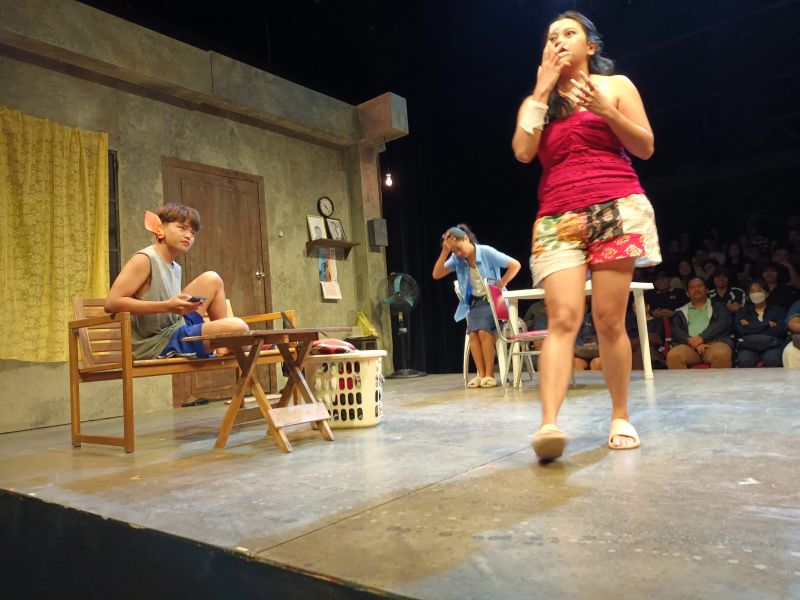
‘Seeing pigs’: Jam Binay, Sean Innocencio, and Jorrybell in ‘Betamax’ (Photo by Totel de Jesus)
Betamax is the second play in Set C, written by Faith Ferrer Lacanlale, directed by Sheenly Gener. It tackles male chauvinism, the belief that most men behave like pigs, with apologies to pigs. Throwing away symbolism, in a literal sense, characters turn into pigs in this satirical play that has the finest performances of up-and-coming actors Jam Binay, Jorrybell, and Sean Innocencio.
And the final play in this set is She’s Electric, which, to this writer, has the bravest, most direct-to-the point punchline ever uttered so far in the festival.
“Android sya, hindi sya DDS (She’s an android, not a DDS!)” says Joshua Cabiladas’ character, a playboy named Robert, describing his new girlfriend, Rose. He is defending her to his best friends played by Aldo Vencilao, Ybes Bagadiong, and Yesh Burce.
Robert is someone who has given up on finding the right human partner. Without giving much of a spoiler, the “android sya, hindi sya DDS” line was a last-minute inclusion in She’s Electric, by virgin playwright Ron Evangelista, directed by filmmaker JP Habac, who is also a VLF first-timer. Habac is the “salarin.”
Habac, at the lobby after She’s Electric, told us he thought of inserting that line about three days before opening week. The cast agreed, since it fits the narrative.
Like in Taksyapo’s dialogues that have direct references to current issues, this one sentence from She’s Electric comes like an underwater missile that takes the enemies—rather, the clueless audience—by surprise.
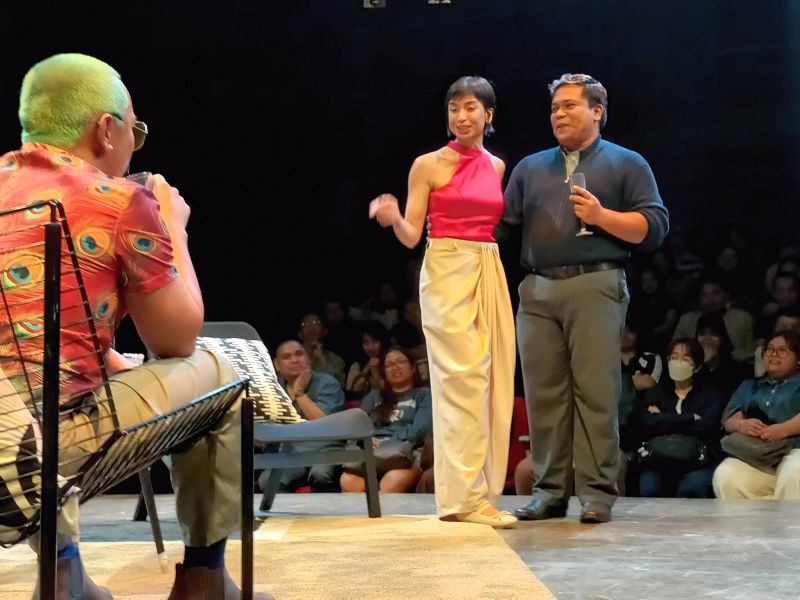
Glaiza de Castro is at home in theater, with Joshua Cabiladas and (back to the camera) Aldo Vencilao. (Photo by Totel de Jesus)
She’s Electric is the debut play of popular television and movie actress Glaiza de Castro, who has proven she can handle theater with the same versatility and credibility. She nailed the role of a beautiful robot that men, like the macho characters in Celestino’s universe, want to be with.
De Castro told us in an earlier interview she easily felt at ease because of her co-actors, Bagadiong and Vencilao, batchmates at TP Actor’s Company. They are among the best in displaying comic chops and time-tested spontaneity on stage.
People, especially the masa, always see her in tear-jerker soaps and playing fairies in fantaseryes, but this time, she fulfilled her dream of acting for the stage. And she gave justice to Rose as if the role was written for her.
De Castro is not new to the CCP community of actors and performers. In 2018, she played the titular role in Kip Oebanda’s biographical story, Liway, for the Cinemalaya Independent Film Festival, for which she won a Balanghai Trophy for Best Actress.
The character Kumander Liway is patterned after Oebanda’s mother, Cecilia Flores-Oebanda, a student activist turned revolutionary rebel who was pregnant when she was caught and imprisoned in a military camp during martial law. She gave birth in prison and lived inside the camp with her son until the tail-end of the first Marcos administration. The story is a recollection of the filmmaker’s childhood spent in the said camp.
During the Cinemalaya awarding ceremony, we remember De Castro’s performance when she sang two original songs by Asin, Himig ng Pag-ibig and Pagbabalik. It was melancholic and hypnotic, a haunting and beautiful performance, directed by CCP artistic director Dennis Marasigan. That kind of live musical performance never leaves us, and seeing her again, this time, as actor for the live stage, confirms our belief that she could be the next big thing in Philippine theater, if she chooses to be.
Set A: Tengang Kawali has a powerhouse selection of political plays that exposes sensitive issues that affect our lives.
Password123, Pilipinas321 by playwright Anthony Kim Vergara, under the direction of Norbs Portales, tackles one of the most controversial issues during the 2022 national elections.
Vergara, a cybersecurity expert by day and a semi-veteran playwright in VLF on weekends, explores how a group of hackers is able to mine personal information from a government agency to be used, as the play implies, in the 2028 polls. Vergara’s play is not to be missed, for this could be its only run.
Vergara, a cybersecurity expert by day and a semi-veteran playwright in VLF on weekends, explores how a group of hackers is able to mine personal information
At the TIG lobby during intermission, we bumped into Vergara and told him that his play reminded us of the now-silent TNTrio group and allegations of rigged presidential elections.
Set A also has Human Rights Story of the Year by Elijah Felice Rosales, a business reporter for The Philippine Star. He has been a regular VLF audience since college at nearby De La Salle University, and he felt it was time he wrote his own play.
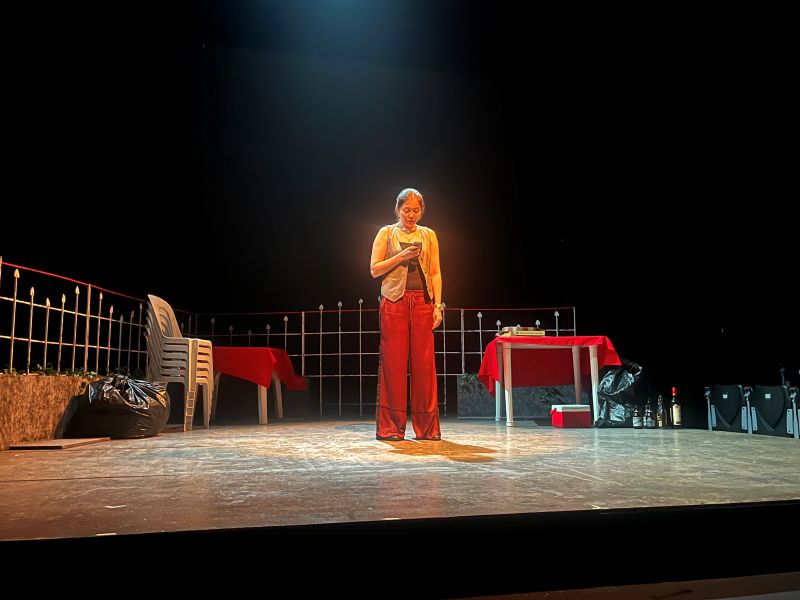
Justine Peña as Ish, an award-winning journalist in ‘Human Rights Story of the Year.’ (Photo by Bianca de Jesus)
His story is about an investigative reporter named Ish, played by the underappreciated and versatile musical theater actress Justine Peña. Ish is on her way to New York to receive an award for a human rights story many believed she wrote on her own. The award includes a one-year fellowship in a prestigious news organization also based in New York. During Ish’s despedida, her former reporter buddy, Doy, played by CJ Navato, shows up to celebrate. But after having too much to drink, Doy reminds her of journalism ethics and, well, honesty in the profession.
It is revealed Doy helped her conceptualize the award-winning story and even accompanied her in interviewing sources. But Doy now works as public relations and crisis communications officer for a government agency—in short, someone “na nilamon ng sistema” for a bigger paycheck.
Rosales’ story somehow exposes media corruption and how even the “respectable” members of the Fourth Estate could also be the jaded ones hiding behind bylines and teleprompters. The play tells us there’s no black and white in the media industry, and the Fourth Estate might as well be known as a subdivision in Parañaque City than the perceived torchbearers of truth and justice who bravely hold the line.
Human Rights Story of the Year is directed by Shakespearean director and Quintosian actor Nelsito Gomez, who also directs the ongoing Man of La Mancha at Repertory Theater in Eastwood City on the other side of Metro Manila.
There’s a connection there somewhere because nowadays, if you’re an honest, truth-seeking, fearless journalist, you’re like the idealistic, chivalrous Don Quixote, who, in the age of untruth and fakes and massive trolling, is fighting the unbeatable foe.
RELATED STORY:
Man of La Mancha: Nelsito Gomez assembles one of most intelligent cast performances of 2026
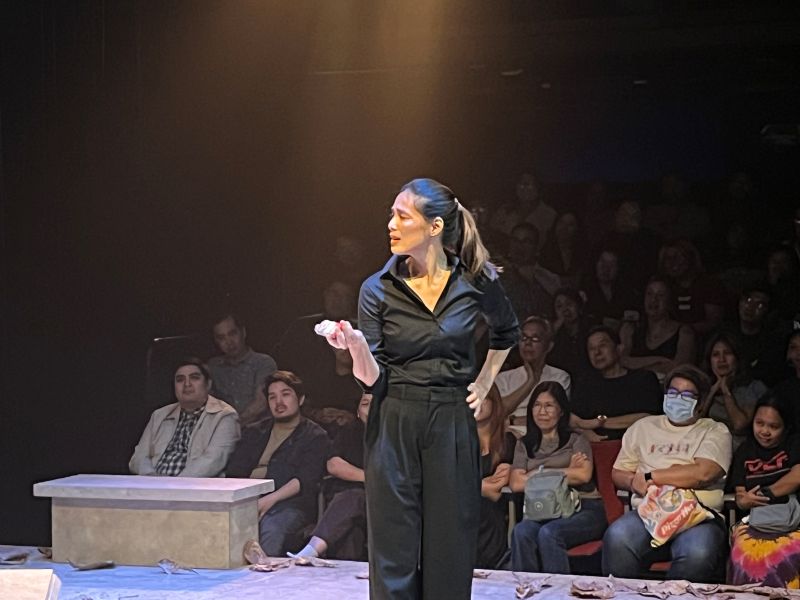
Angel Aquino as Jacinta, a former nun and former lover to Jackie Lou Blanco’s titular character ‘Lualhati’ (Photo by Bianca de Jesus)
There are more noteworthy performances, like Angel Aquino and Jackie Lou Blanco in Gab Marcial’s Lualhati, directed by Mara Paulina Marasigan in Set B: Kapit Tuko.
Blanco plays the titular role, Lualhati, a nun visited by Jacinta, played by Aquino, a former nun who was her former lover. They try to confront their past with the hope to heal and free themselves from the pain.
For me, what made this play a standout and a must-watch is Aquino and Blanco’s magnificent acting on the live stage that reminds me of the classic scenes by Nora Aunor and Vilma Santos in Ishmael Bernal’s 1978 iconic masterpiece, Ikaw Ay Akin.
We’ll leave it to Vincen Gregory Yu to discuss the other plays in this year’s VLF. Just see for yourself why this year’s VLF has Hubo’t Hubad as its chosen theme.


