
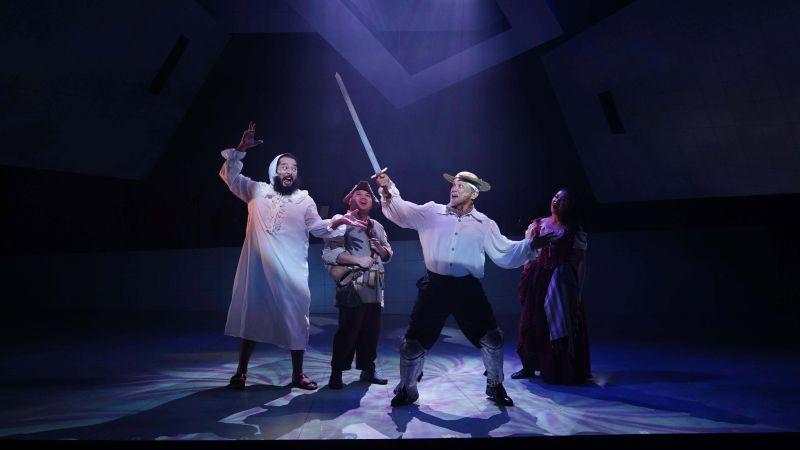
Repertory Philippines’ ‘Man of La Mancha’ runs at Rep Eastwood Theater, Eastwood, Quezon City.
If theater is the art of looking at ourselves, then I must say I felt pretty seen by Steven Hotchkiss in Repertory Philippines’s (Rep) revival of Man of La Mancha.
In the 1965 Broadway musical freely adapted from the Spanish national epic Don Quixote, Hotchkiss plays the priest known only as Padre. But his most revealing work happens much earlier in the show, long before he even dons his brown frock.
The musical is a play within a play, told from the perspective of an incarcerated Miguel de Cervantes, author of Don Quixote. In their holding cell, Cervantes and his manservant are subjected to a mock trial by their fellow prisoners, who demand that the two surrender the trunk of possessions they’ve brought with them unless the former is found not guilty of being “an idealist, a bad poet, and an honest man,” as one prisoner phrased the make-believe charges.
At Cervantes’ suggestion, the mock trial that unfolds becomes a (not-so-faithful) dramatization of the Cervantes epic itself, with the author taking on the role of the aging protagonist Alonso Quijano, who reinvents himself as the titular knight and sets off on a fool’s adventure with his loyal squire Sancho Panza (the manservant now playing his counterpart from the novel).
In the Broadway musical’s original script, the fictionalized Cervantes’ incarceration occurs against the backdrop of the Spanish Inquisition in the late 16th century. But Rep’s currently running version, directed and conceptualized by Nelsito Gomez, transposes this “real world” into our present, with Cervantes and his fellow prisoners in modern dress, and corralled “inside” the stage by a massive chain-link fence that dominates the opening scenery.
Echoes of Donald Trump’s ICE and Israel’s torture camps, with their attendant air of pervasive intolerance and disregard for basic humanity, are unmistakable—a dramaturgical choice reinforced by the fact that almost none of Cervantes’ fellow prisoners are simultaneously male, straight, and White.
When Cervantes springs the idea of mounting his defense in the form of a play, Hotchkiss’ prisoner is evidently one of those less inclined to participate—not so much hesitant as wholly uninterested. Even when the theatrical proceedings have started, with Cervantes/Quijano and Sancho putting on a literal show for the holding cell like a traveling double act, Hotchkiss keeps mostly to himself—eyeing the shenanigans from a careful, judgmental distance—the expression on his face a perfect mix of “What are these fools up to now?” and “I can’t wait to see how this tomfoolery turns out.” And really, who can blame him?
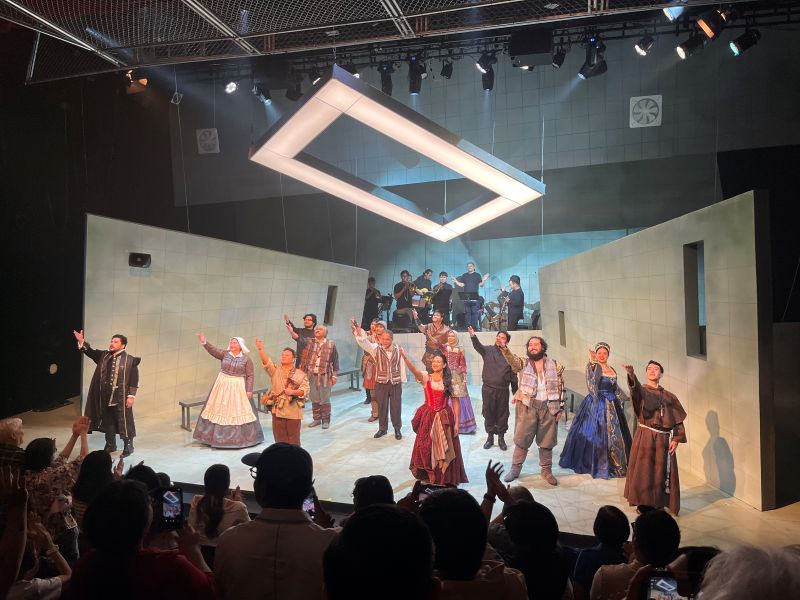
The cast and orchestra of ‘Man of La Mancha’ (Photo by Vincen Gregory Yu)
The original message of La Mancha about the power of the creative mind in challenging fascism and authoritarianism—and consequently, its depiction of the harassment and persecution that writers and other artists have long suffered at the hands of those who wish to silence them—comes through quite clearly enough.
But the musical also delivers all of this in a manner most worthy of a million eye rolls. The idea serving as the musical’s dramatic impetus is, for lack of a better word, silly. So silly, in fact, that I feel like only the most earnest, sheltered writer could have dreamed it up. No wonder Hotchkiss’ spectator is so over it before the whole thing has even begun. And, well, you and me both, brother.
Why on earth are we having this pretend play in a fascist holding cell? That’s the obstacle of an idea one must overcome to even appreciate this musical—and the production itself.
The imposition for make-believe comes across as a very liberal, near-fantastical notion of what social justice looks like, as if whipped up by the kind of privileged White people who fancy themselves “on the right side of history” and “on the left side of the political spectrum,” but can’t be bothered to join an actual protest on the streets. Meanwhile, artists like newly minted Tony winner Ali Louis Bourzgui, who used his acceptance speech during the June 7 awards ceremonies to call out the billionaires, Zionists, and colonizers on a global platform—at great risk to his career, no doubt—are actually being silenced.
I’d like to think Hotchkiss’ character’s disenchanted state of mind extends toward the musical’s idealistic (because detached) and romantic (because possibly delusional) bent. Not for nothing did this musical give us The Impossible Dream, one of those Broadway anthems that even the least theatrically inclined is bound to recognize, though probably not for its stage origins. That strange smell in the theater is La Mancha itself, as if it has just been yanked out of your grandparents’ closet, where it has no doubt been gathering dust and mold.
Credit where credit is due, then: To the best of his ability, Gomez has tried to make La Mancha not just worth our while, but also worth listening to (which is a feat, given that it doesn’t exactly have the most memorable score in the Broadway canon). At various points in the show, I was honestly just so bored and out of it—unable to take seriously what I was watching—but at other points, I also found myself moved to tears.
Gomez has assembled a cast that features some of the most thrilling—and most intelligent—musical theater performances of the year thus far. The musical direction by Farley Asuncion, who commands a live band onstage, is one of the crispest I’ve heard in a while, managing to evoke so much through the sparest music (and, dare I say it, coming the closest among all the artistic elements to capturing the romanticism of the material without crossing over to histrionic territory).
And, despite its fundamental imperfections, the set by Julio Garcia does a lot of the heavy lifting in pushing the production’s metaphors, as the stage’s three walls slowly levitate (and distractingly wobble while afloat) to reveal the play within the play. (To this end, I have to point out that D Cortezano’s lighting here is one of his less impressive works; when I saw the show, the lights rather felt all over the place and out of sorts with the rest of the production’s vibe.)
It all comes together and becomes quite a moving experience whenever it stops insisting on its artifice
Whether intentional or not with regards to the direction, Gomez’s La Mancha all comes together and becomes quite a moving experience whenever it stops insisting on its artifice. Especially toward the end, when it just keeps things real and sincere, shedding off the masquerade it’s been feeding the audience for the last hour and a half, this production is able to arrive at a genuinely touching place.
It pleads its case for love, acceptance, and simple human goodness with such conviction that one is swept up entirely in its arguments. And its best performers become exemplars of timeless authenticity, no longer hazy figures roaming this forcibly sketched landscape, but flesh-and-blood creatures who could very well have come from one of the seats in the house.
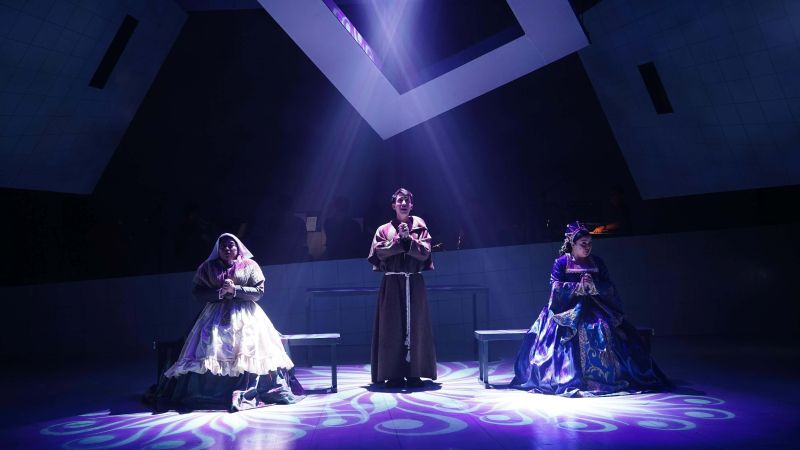
From left, Sarah Facuri, Steven Hotchkiss and Mikkie Bradshaw-Volante in ‘Man of La Mancha’ (Photo by Krizhal Daryl Ordas)
In fact, we already get a glimpse of that authenticity early in the show, during one of the production’s high points, in which Hotchkiss, Mikkie Bradshaw-Volante, and Sarah Facuri sing as the priest, Quijano’s niece, and Quijano’s housekeeper, respectively. As Sancho Panza, Marvin Ong is able to make the squire’s loyalty to his master believable—sometimes pityingly so, like a brainless, sentient thing programmed to be loyal and nothing else. And though I found her performance rather thin and wobbly at the start, Katrine Sunga (as Quijano’s romantic interest Aldonza/Dulcinea) is nevertheless able to conjure an emotional whirlwind in the latter half of the musical, turning the climactic scene into an undeniable tearjerker.
The beating heart and stabilizing spirit of this production, though, is Nonie Buencamino as Quijano/Quixote. That may seem self-evident, but there’s bewitching method to the actor’s madness: Buencamino is the farthest thing from a romantic, chivalrous, classical leading man—so convincing as a crazy, reclusive artist who’s found himself in the enemy’s crosshairs, and now left without a choice but to indulge the fascists for his own survival.
To pull this off, Buencamino becomes both star and character actor—a balancing act he achieves with what appears to be the least effort. And it’s through this balancing act that Buencamino injects his very conspicuous humanity into a production otherwise animated by sometimes clashing narrative impulses. Through him, this production achieves its fullest potential: a show rid of its rose-tinted glasses, stripped of its lofty fantasies, and finally, firmly planted in a reality it has no choice but to grapple with.
Thanks to Buencamino, this La Mancha somehow inches closer and closer toward realizing its elusive, hackneyed impossible dreams.


