
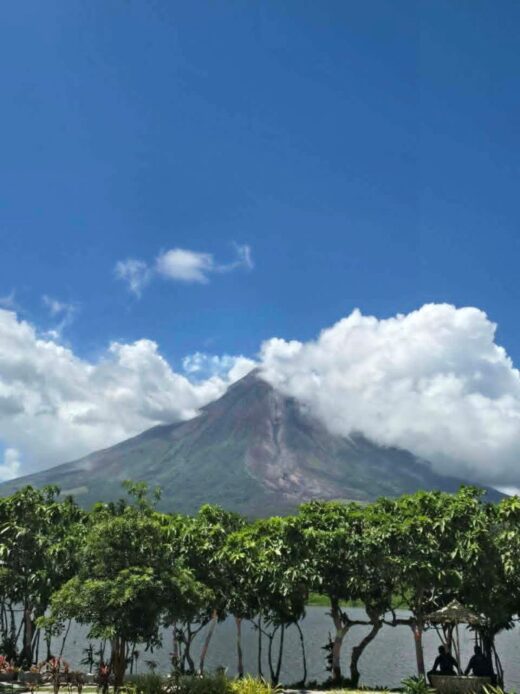
Despite the rumblings of two volcanos—Mayon in Albay and Bulusan in Sorsogon—we finally decided to go to Bicol, specifically Sorsogon, where my parents are from. I was skeptical. Mayon had been acting up since January, and there could be a major eruption.
But Jim, my youngest son, was quite enthusiastic. The last time he went to our ancestral house in Juban was 40 years ago. He wanted to bring his two boys, Leon, 14 and Hugo, 12, to see where Lola O (that’s me) went on vacation as a little girl. But the best thing on the agenda, was to see the gentle giant whale sharks in Donsol. Henry, my youngest grandson, 9, was excited, both at the prospect of being with his cousins and swimming with the butanding.
Jim planned the four-day weekend in May for a party of 11 and booked the flights and hotels as early as March. My second son Gabby and son-in-law Rob stayed behind at home.
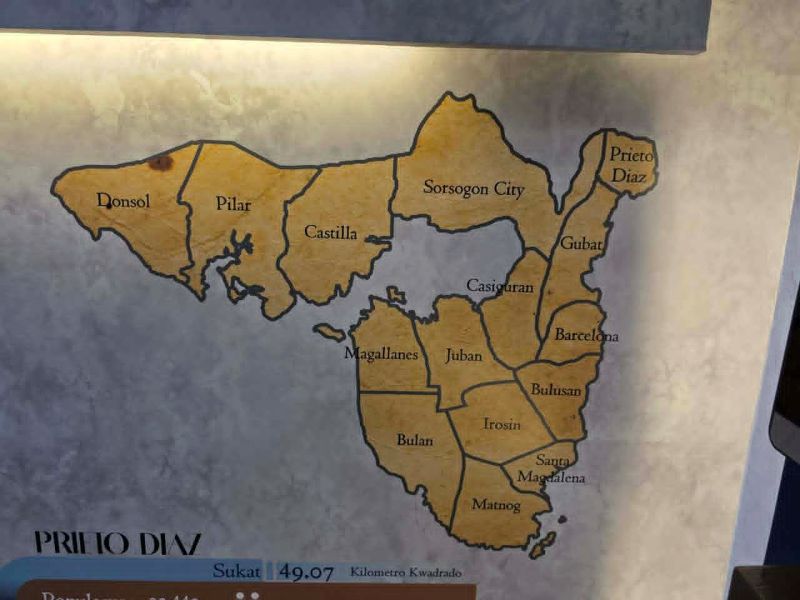
Map of Sorsogon
We landed in Albay on May 8, Friday. I was looking forward to seeing majestic Mayon, but it was a no-show. We were quite disappointed, as I was telling my apos (grandchildren) that you know you’re in Albay because you can’t miss the volcano. Anywhere you look, it would be “in your face.”
We had two vans. One had all our luggage, which my daughter-in-law Edhel named the “quiet” van, while the other, where all the kids were, was the “noisy” van. Of course I opted to be in the noisy van to be with the apos.
Jim even arranged for a tour guide. I was able to point out the school of my mother, St. Agnes Academy. The guide took us to Daraga Church, where a wedding was taking place, and the Cagsawa ruins.
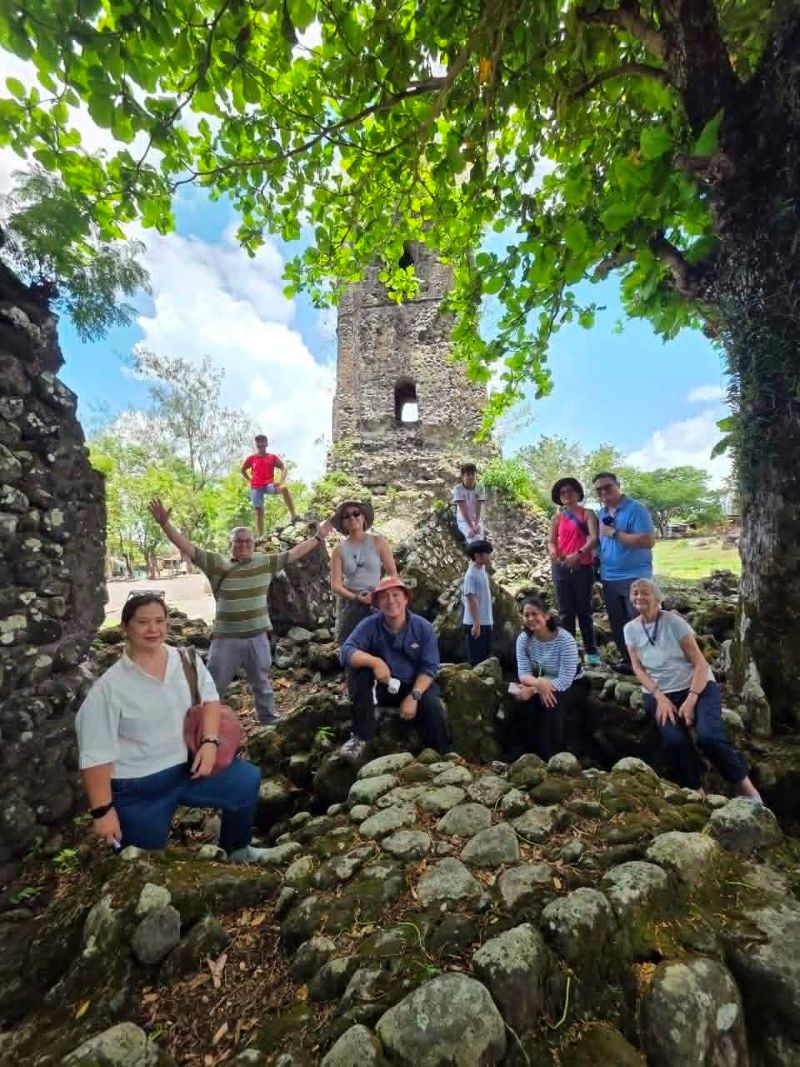
The author’s family in the Cagsawa ruins
The Cagsawa ruins are what’s left of the bell tower. The guide said the church itself was not buried, but destroyed. The government has plans to rebuild it. A whole tourist complex has sprouted there with handicrafts and Bicolano pasalubong like pili nut delicacies, and sili (red chili pepper) ice cream! We had fun tasting sili ice cream with four levels of spiciness in different flavors. My favorite is mango ice cream at only P50 per cup.
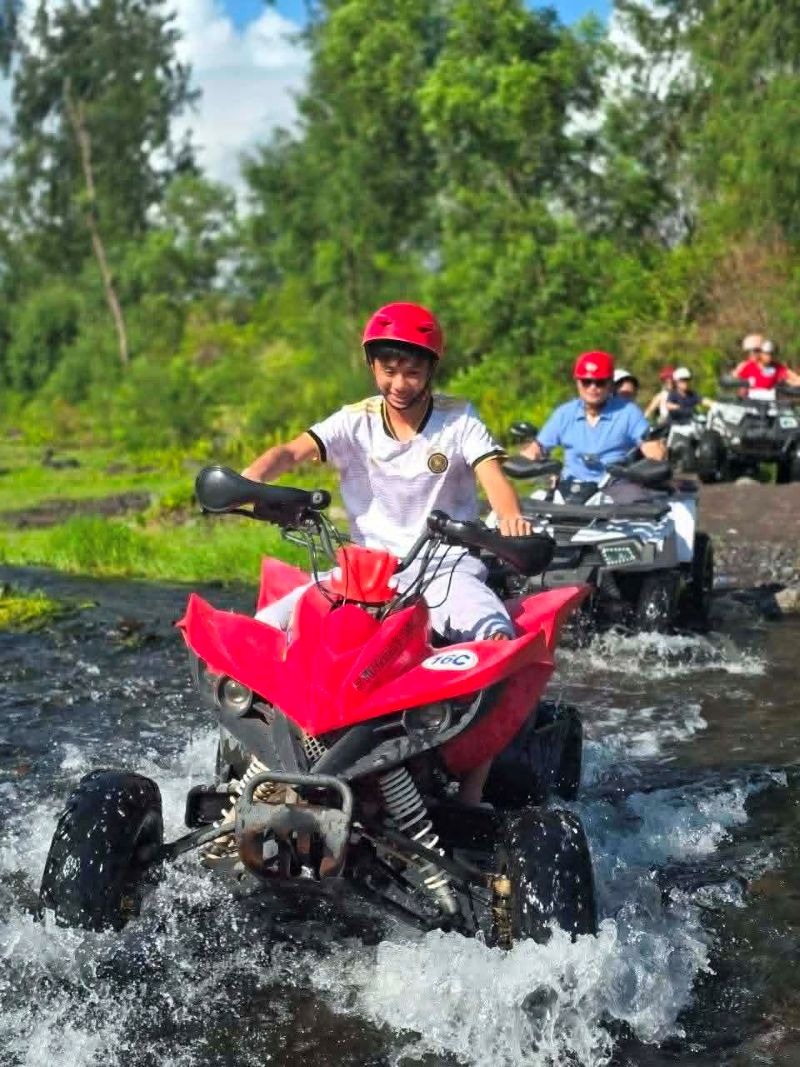
An ATV ride over streams
Next adventure was ATV or all-terrain vehicle ride. The boys had fun driving and felt grown-up revving over a stream, while I had a cool drink back in the coffee shop. Mayon was still hiding in the clouds.
Next on the agenda was a drive-by to see my cousin Agnes before heading to Donsol. We had not seen each other for decades! They had a house in Juban, and we were playmates in the summer of our young lives. Now we are in our 80s, and it was good to see each other again. The apos dutifully took the “new” lola’s hand for a blessing as I introduced them and my children.
Lunch was at Socorro’s at Sumilang Lake. One is supposed to see the reflection of Mayon on the lake at a certain time. Now Mayon was slowly peeking through the clouds. They had a pasalubong store where I got my favorite Mazapan de Pili. Then the long drive to Donsol, 44 km away.
Elysia Resort Hotel welcomed us with cold drinks decked with flowers on a very hot day. Fragrant flowers were strewn on the bed and bathroom. There was even a carved logo on the coconut shell of their cold buko juice. Food was served in an open-air dining hall by the sea. It was a beautiful, clear night sky with stars and constellations!
The next day was butanding day. So much excitement early in the morning! Son-in-law Bastie and I stayed behind. They had only three hours to see the whale sharks. Unfortunately, they had no such luck, although they did see dolphins. They were about to go when Edhel spotted three tails, but they quickly dove back into the deep.
We were running late. Everyone was supposed to be packed and ready so we could have lunch in Juban, 86 km away.
Kinunot na pagi or stingray, laing, Bicol express, pinakro (boiled green bananas)—all with gata or coconut cream! Glad she didn’t put too much spicy sili
We arrived in Juban two hours late. Ludy Lasala welcomed us with a spread of Bicolano food we ordered, like kinunot na pagi or stingray, laing, Bicol express, pinakro (boiled green bananas)—all with gata or coconut cream! Glad she didn’t put too much spicy sili. She also served pancit bato (no stones, but she told me it comes from Barangay Bato), grilled fish, and fried chicken for the kids.
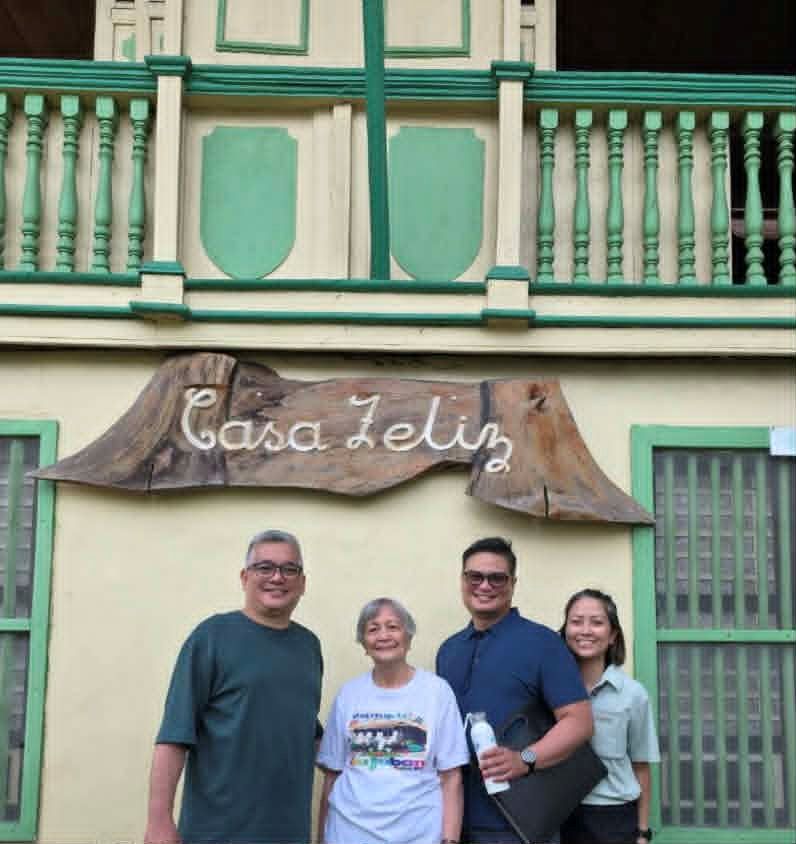
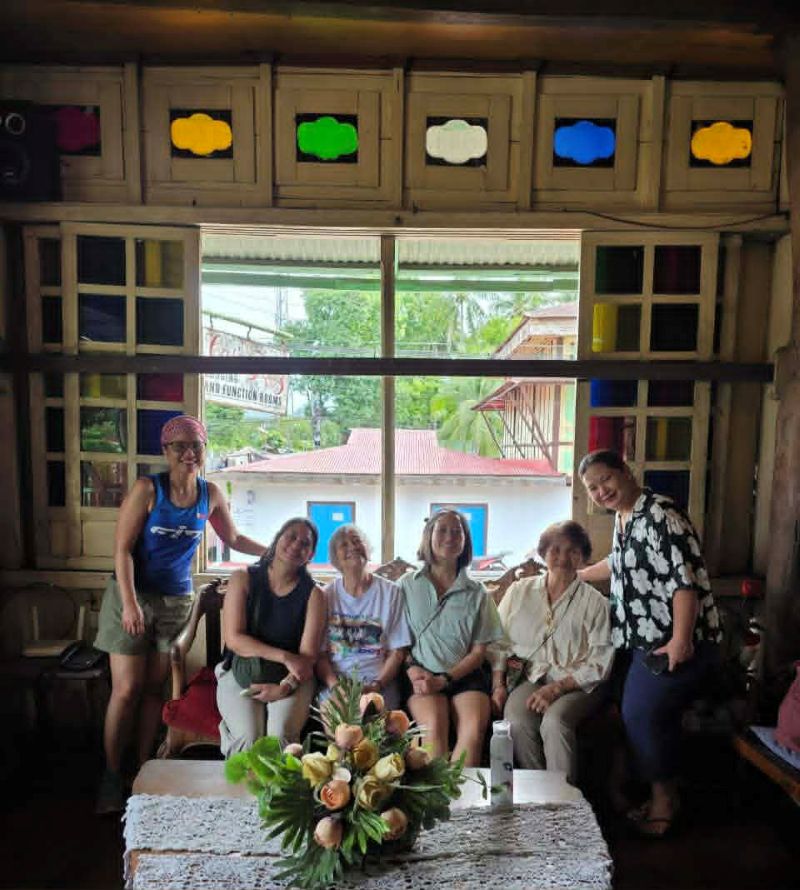
In the author’s grandfather’s ancestral home in Juban
This house of my grandfather on Grajo Street, named after Don Leoncio Grajo, was built in 1898. He was a lawyer and member of the Fifth Philippine Assembly. My mother Lourdes and her sister Laura were born in that house. The initials “LG” are carved at the corner of the house and atop the door inside. Its posts are tree trunks, and the floors made of narra planks. It has a wide window sill to accommodate three sets of windows: capiz, louvres, and multicolored glass panes.
Today Casa Feliz is a bed and breakfast run by the Lasalas. They had it restored to its original design with the help of the government. I am so glad my grandchildren got to see this place, where I have many memories.
This house of my grandfather on Grajo Street, named after Don Leoncio Grajo, was built in 1898. I am so glad my grandchildren got to see this place, where I have many memories
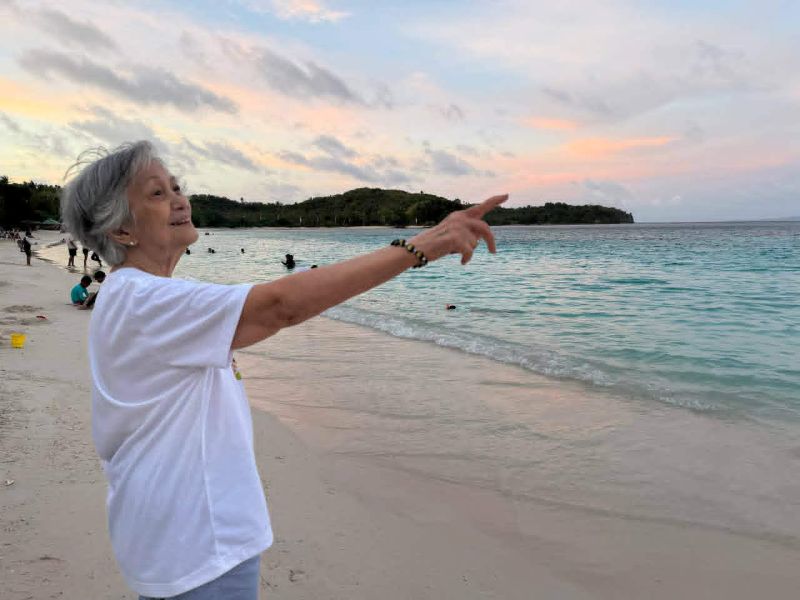
On Subic’s pink beach
We were not able to stop by the many natural springs in Juban. Although the Matnog Port was just 40 minutes away (59 km), we had to catch the last boat to Subic pink beach. The pinkish hue of the sand is attributed to crushed red corals. The last time I was there in 2014, it was just a two-hour day trip. It was pristine. There was nothing but the pink sand. But now there is Arcadia Hotel, tents everywhere, huts occupied by people cooking their own meals, several karaokes blasting at the same time!
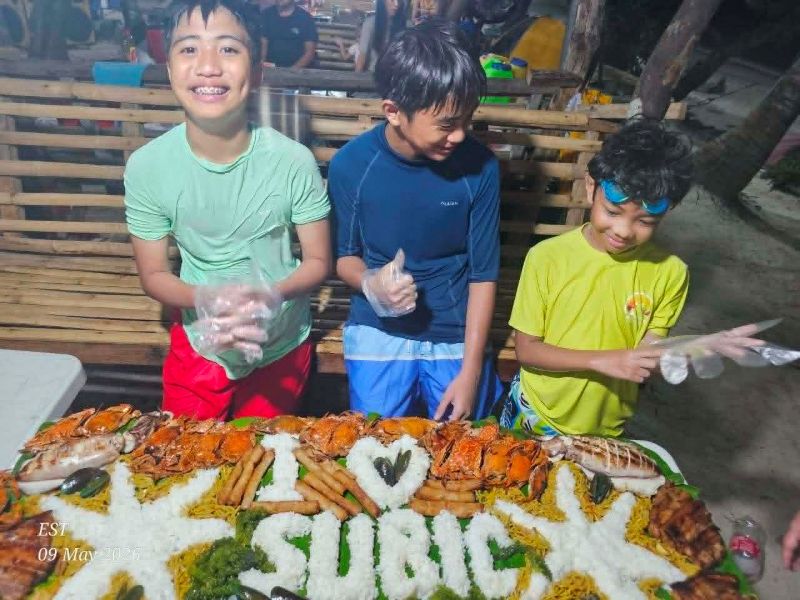
A seafood boodle fight
Anyway, Jim arranged for a boodle fight for the family dinner. Leon thought it was a game. But the food wasn’t bad, and we were given plastic gloves. But then I worried about all the plastic stuff going into the sea.
But what we were not prepared for was the ‘family room,” where seven of us would stay. Two double beds of steel with thin mattresses. We could make do with those accommodations, but horrors! The toilet didn’t flush, but the shower worked. And there was no lavatory! It was a nightmare! I hardly slept. The next day Edhel thought she was dreaming, only to wake up and say, “Oh no! We’re still here!” We all quickly headed to the beach.
It was still early, but the beach was already full of people. I noticed a lot of “content creators” doing their thing in front of their mobile phones, twirling and dancing. Two young ladies in a transparent fiberglass kayak rowed seductively in their bikinis, while my youngest daughter Jo and I tried to walk along the shore. The three boys were busy building sand castles. I noted most of the tourists were Bicolanos and a few foreigners. I thought it was good that the locals have a place to go.
Soon my daughter Mariel and husband Bastie, my eldest son Mike, and wife Jac joined us in the breakfast hut reserved for us. They too did not sleep well, as the karaoke blasted on the whole night.
What left the pink beach etched in our minds was my unfortunate fainting spell during breakfast, probably the confluence of lack of sleep, standing on the beach under the sun, and the noise pollution of two karaokes. It was good that I had three doctors with me—Jim, Edhel, and Bastie. I was more embarrassed and bewildered with what happened. The barangay managed to call someone with a blood pressure monitor, and they were surprised to find competent doctors at my side. Thank God I just hit my head on the bamboo table with no broken bones when I fell on the sand.
“You had us all worried,” Hugo whispered to me. That was Sunday, May 10. I didn’t know it was Mother’s Day when Jim handed me notes from Leon and Hugo on the beach. I just put them inside my bag. But when I read Hugo’s note, there was a line I couldn’t understand. He told me he remembered my story about the hole in the floor of our house in Manila when I was a baby during the war. The hole was made by a bomb that did not explode. “What if it exploded? Then there won’t be Dada or us!” he explained. His note ended with “And do you know how rare you travel with us? Very very little. Hope you’re safe all the time.”
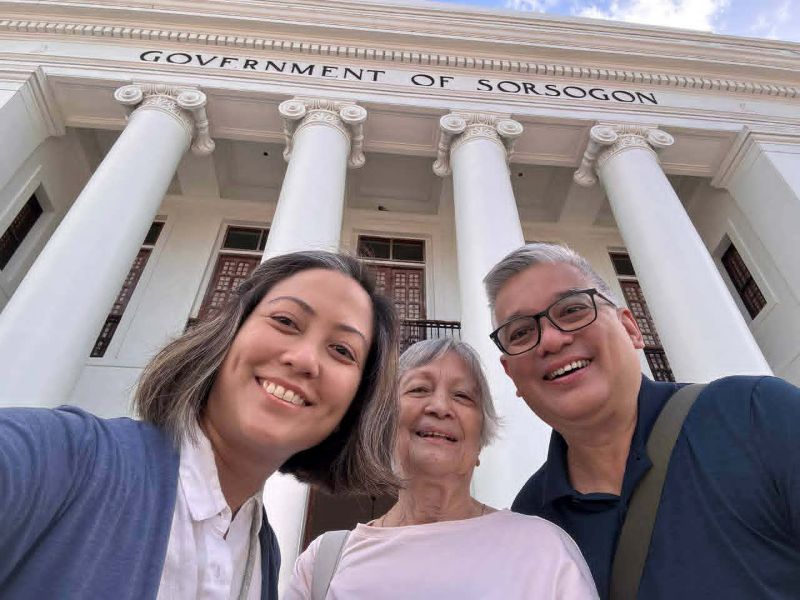
Before the municipal hall of Sorsogon City
Finally, the two boats that would bring us back to Matnog Port arrived, and the vans were waiting to bring us to Sorsogon City, more than an hour away (66 km). We did not stop to see the hot springs or Bulusan Lake along the way, exhausted as we were by our experience.
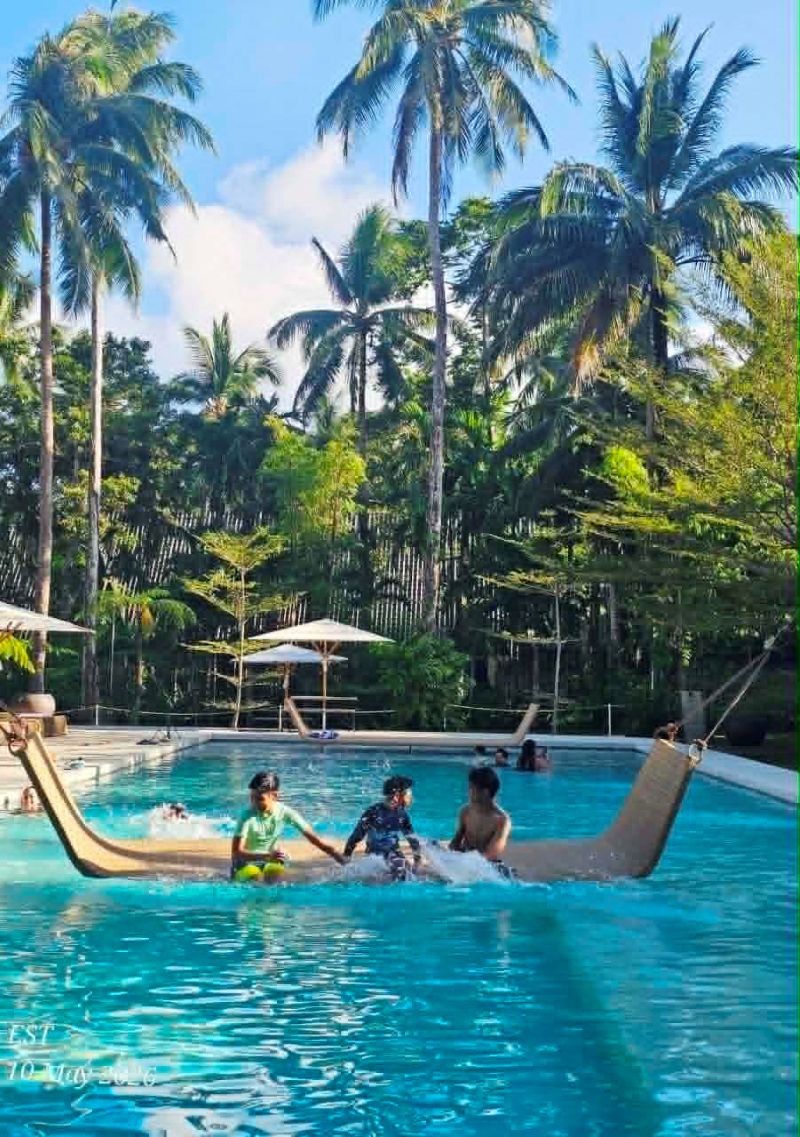
Siama Hotel, Sorsogon City
In Sorsogon City, we couldn’t wait to see our hotel, the famous Siama Hotel of leading furniture designer Milo Naval. And it was, in Henry’s own words “luxurious” as he rolled on the bed of our room with a classy bathroom where everything worked! Our room opened to the swimming pool with a long rattan duyan (hammock) in the middle of it. The boys wasted no time swimming.
Because of the great ambiance, no one wanted to go to the city and eat dinner. There was complimentary merienda and breakfast, too.
The following day Mike, Mariel, and I headed to the city government. I got the documents I needed, and we had time to see the Museo, which used to be a jail. It had a well-documented history of Sorsogon. We learned many things. I wish we could have brought the apos, as well.
That was our last day, and we had to get back to the airport in Albay, an hour’s travel away. By the time we boarded the plane for Manila, lo and behold, Mayon showed up in full glory, from the tip to its spread-out skirt—the perfect cone, now with rivulets where lava flowed. Plus, a rainbow across the sky!
Edhel said it all in the family chat: “Thank you Lord for this precious time with Lola O and family.”


