
Photos by FRANK PICTURES
(The Brahma Kumars Center for Spiritual in Tagaytay will hold its Inner Peace, Inner Power retreat| July 24 to 26 Learn to meditate, reconnect with the self and God in a pure atmosphere Registration link: https://forms.gle/BvsRTG8hMsvgkLns7
It also offers “Transforming Lives, Transforming Teams” and “Live Better and Work Better: Mental Wellbeing for Sustainable Success” might just be what you need. You and your team or your whole company deserve to recharge, reconnect, and grow together. By request contact 0917 891 3575)
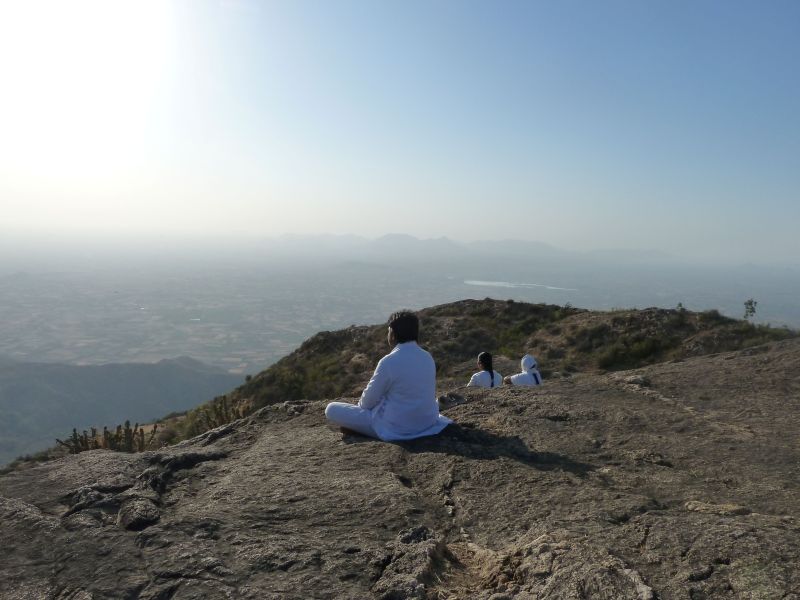
From the stone deck at Sunset Point in Mount Abu, the Rajasthan plains spread out below in a patchwork of fields, roads, and scrubland fading into the horizon. As the afternoon sun turns golden, the vehicles below look tiny from above.
For the thousands who visit nearby Madhuban, the headquarters of the Brahma Kumaris nestled in the Aravalli hills, the view carries a deeper meaning. It reflects one of the movement’s central teachings that life’s challenges can seem smaller when viewed from a higher perspective.
Madhuban, which means “forest of honey,” is comprised of several complexes. The spiritual movement began nearly 90 years ago in Hyderabad, in what is now Pakistan, and has since expanded to more than 110 countries. Known for its teachings on Raja Yoga meditation, it attracts students from around the world seeking greater self-awareness, inner discipline, and personal growth.
The movement traces its origins to 1936, when a wealthy diamond merchant named Dada Lekhraj Kirpalani underwent a series of spiritual experiences that prompted him to leave business life behind and establish a small spiritual community in Hyderabad. Later known as Brahma Baba, he gathered men, women, and children into a group called Om Mandali. At a time when women’s roles were largely confined to the home, the community placed women in positions of leadership and emphasized meditation and spiritual discourse over ritual.
The group moved from Hyderabad to Karachi before the Partition of India, and eventually relocated to Mount Abu in 1950 after the creation of India and Pakistan. Amid the cooler climate and rocky terrain of Rajasthan’s hill station, it established what would become the Brahma Kumaris World Spiritual University. Today, the organization describes itself as one of the world’s largest women-led spiritual movements, with meditation centers stretching from Makati to London and Nairobi.
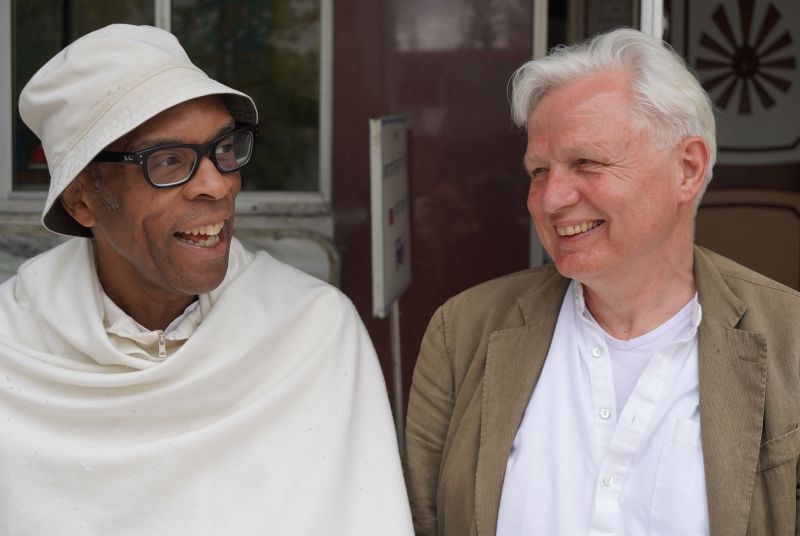
Retreatants from different continents bond.
For many visitors, however, the appeal of Madhuban lies in the atmosphere they encounter upon arrival. Retreat participants often describe a two-week stay as feeling like a return to a parental home, a place where daily concerns seem to loosen their grip.
Among those who have spent decades helping shape the institution is Mohini Panjabi, Brahma Kumaris’ chief administrative head. She sees evidence of the Divine not in grand displays, but in the smooth functioning of a community that hosts thousands of visitors each year. She points to the precision of its operations, the careful use of resources, the hospitality extended to guests, and the willingness of the Madhuban residents and volunteers to serve with love.
“The Creator may not be seen physically, but His creations continue to sustain us,” said Sister Mohini.
That philosophy finds expression in projects scattered across the sprawling campuses. One is the Solar Farm, which incorporates Sustainable Yogic Agriculture, a program that combines meditation with natural farming practices. Another is India One, a solar thermal power and research facility spread across 35 acres near Abu Road. Using hundreds of parabolic solar dishes and thermal storage technology, the plant supplies power and steam to a campus that serves tens of thousands of people.
At Shantivan, the largest BK complex, a solar-powered kitchen can prepare over 50,000 vegetarian meals a day using a combination of solar energy and gas. Yet visitors often say the most memorable part of Madhuban is not its technology but its people. Meals are served with love. Desires are fulfilled before they are requested. Smiles seem to appear with unusual frequency. It has been said people come to Madhuban to learn meditation but leave having learned something simpler: to smile.
At Shantivan, the largest BK complex, a solar-powered kitchen can prepare over 50,000 vegetarian meals a day using a combination of solar energy and gas
I always stay at Pandav Bhavan, the oldest of the Brahma Kumaris complexes in Mount Abu. Passing through its gates, there is an immediate sense of calm. The building was once an old palace and stables before Brahma Baba acquired it. He lived here simply, in a small room with a mattress on the floor, until his passing in 1969. The sanctuary has since been called Baba’s Room. At its heart, it is almost like a reservoir of spiritual power. Over time, those who sit there find it easier to slow the mind, especially when thoughts feel crowded or restless. You leave the room speaking softly and sweetly.
Life in Madhuban follows a rhythm. Music plays gently through the corridors at 3:30 am, waking residents for the first meditation of the day. The atmosphere is pure and the world outside is quiet. By 4 am, several halls are filled with practitioners seated in silence, absorbed in meditation until 4:45 am. Afterward, there is tea made with cow’s milk and masala, followed by preparations for the morning class of spiritual discourse.
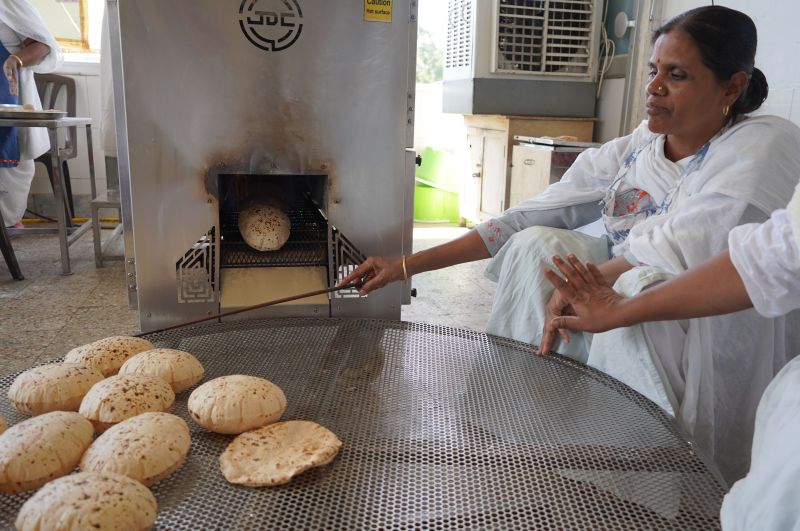
Puffing up ‘chapatis’
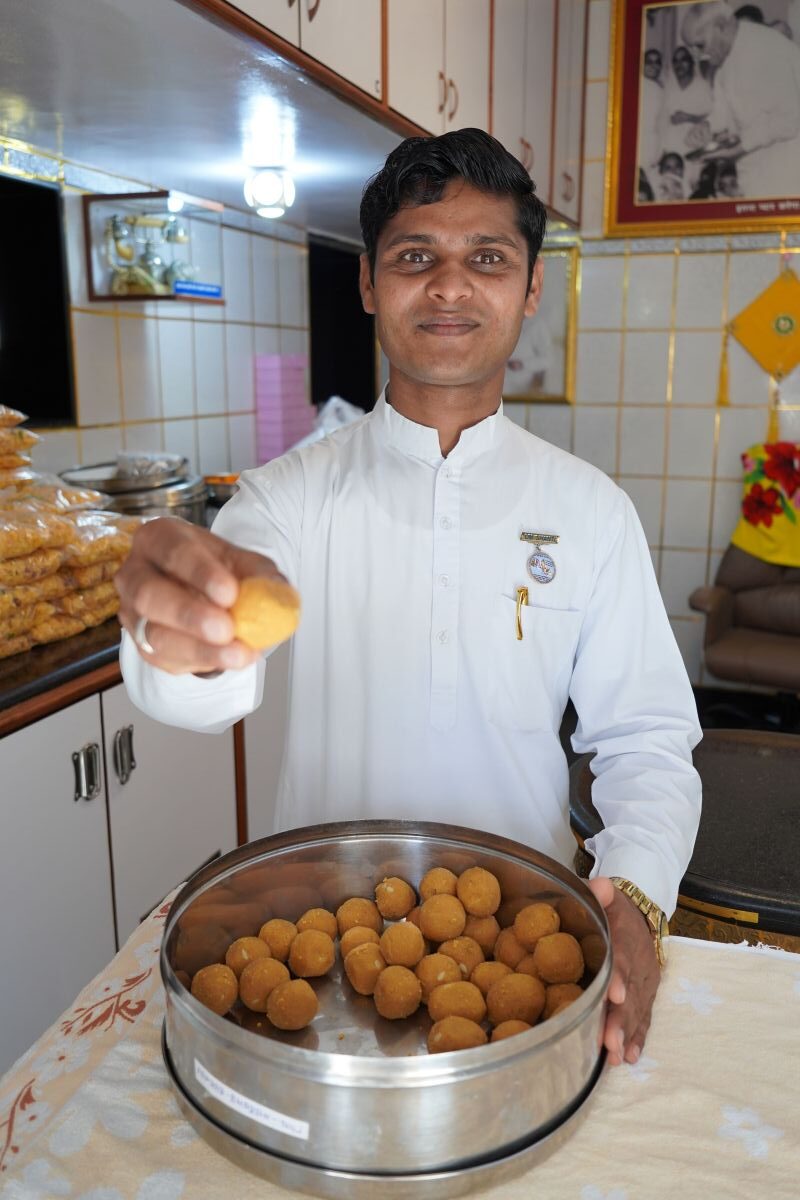
Distributing ‘toli,’ the Sindhi word for sweet, called ‘laddu,’ a ball of ghee, sugar, and chickpea flour, reminds the recipient of one’s sweetness.
In the kitchen, activity is orderly and unhurried. In one section, women shape dough into small, even balls before rolling them out into thin discs. At another station, cooks tend to chapati, unleavened bread, that emerges on a perforated tray. Each one puffs into a soft golden dome. Nearby, large pots are stirred steadily, filled with subji or mixed vegetables and dal, the bean soup that forms a staple of the daily meal. At the onset of summer, we enjoy variations of jackfruit or kathal—stir-fried, drenched in rich gravy, or slow-cooked in spices.
The cooking is done with silence. Conversations are minimal, replaced by attentiveness to the work itself. Many describe it as a meditation practice, where even preparing food is linked to maintaining a calm state of mind. Before being served, the meals are first offered to God in the meditation room, a ritual that frames eating not just as nourishment, but as part of a larger spiritual discipline.
The days are spent in lectures and workshops that often unfold as conversations among BK practitioners from different countries. Ideas are exchanged, with time given to reflection between each point.
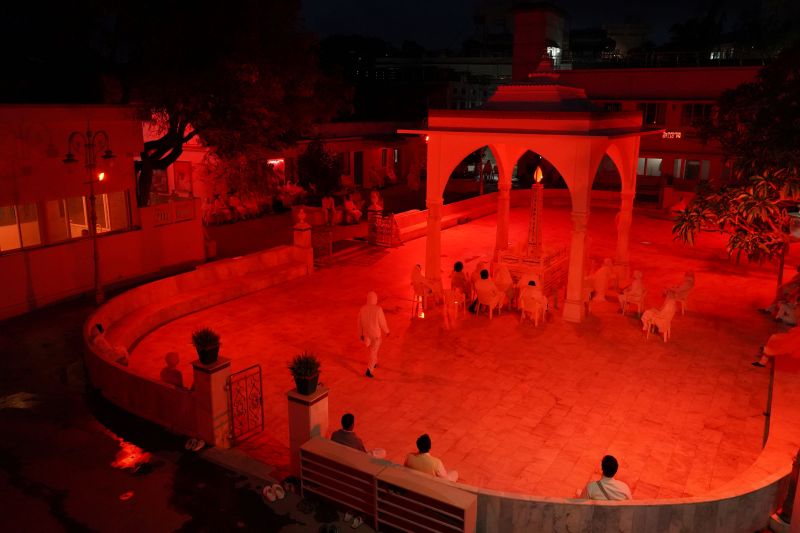
Tower of Peace, sacred meditation space where Prajapita Brahma’s ashes were kept
At dusk, the community gathers again for meditation in different spaces across the campus. One of the most striking is the marble courtyard of the Tower of Peace, where deep red light falls across the stone. Meditators sit in silence beneath a white canopy that houses the remains of the founder, creating an atmosphere that is both still and charged with meaning.
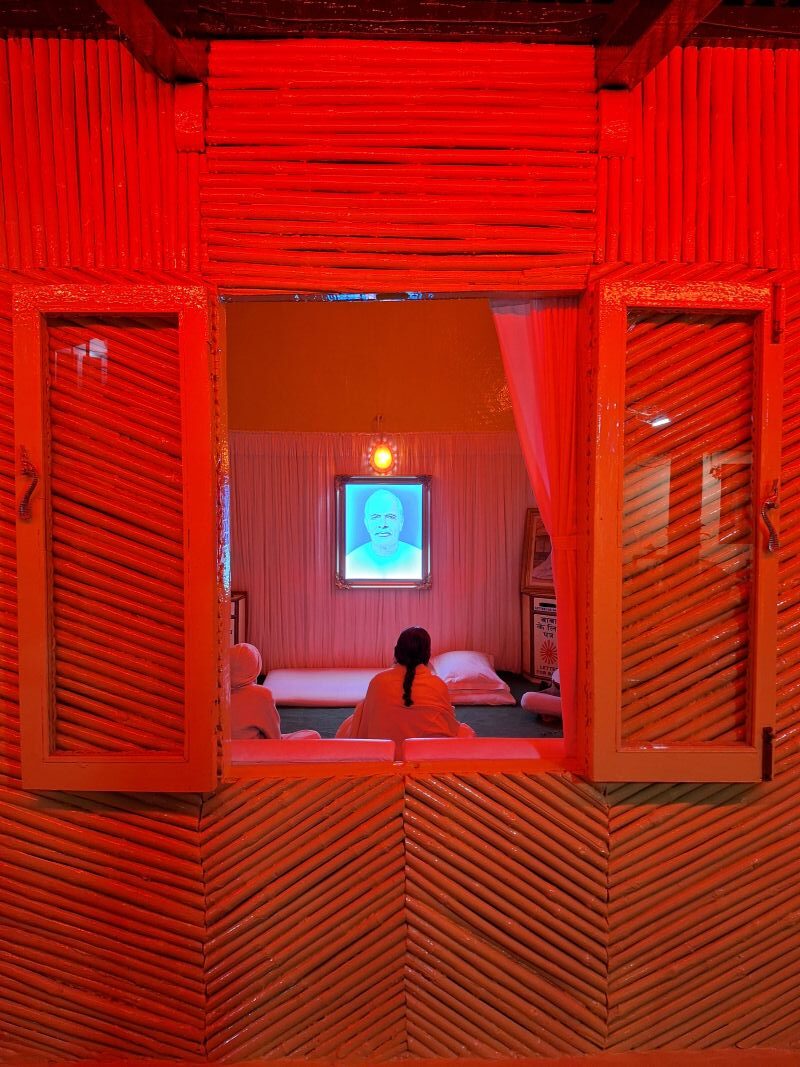
Meditation hut of the founder Prajapita Brahma
A few kilometers from Madhuban, another site holds a similar significance. Known as a powerful meditation point, Baba’s Rock is the rocky outcrop linked to the early period of Brahma Baba’s practice. On its sunlit granite surface, yogis sit in formation, their white clothing blending into a landscape of pale stone and open sky. From there, the view stretches across the plains.
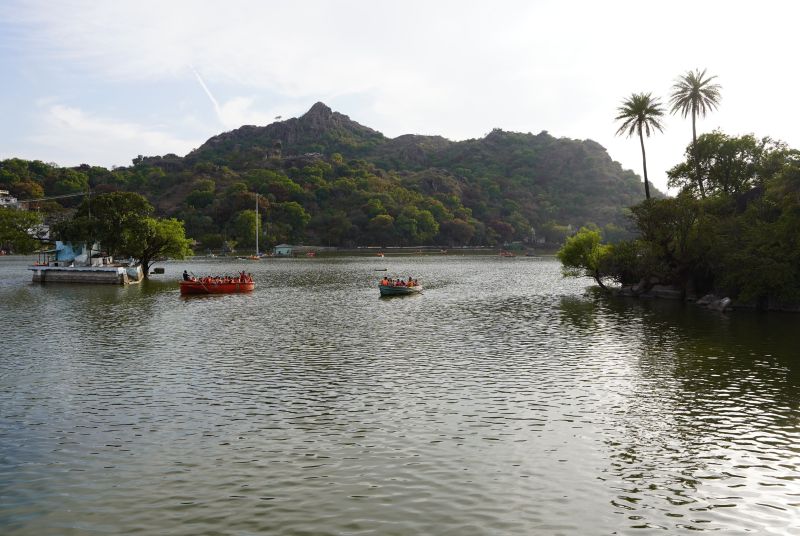
Nakki Lake
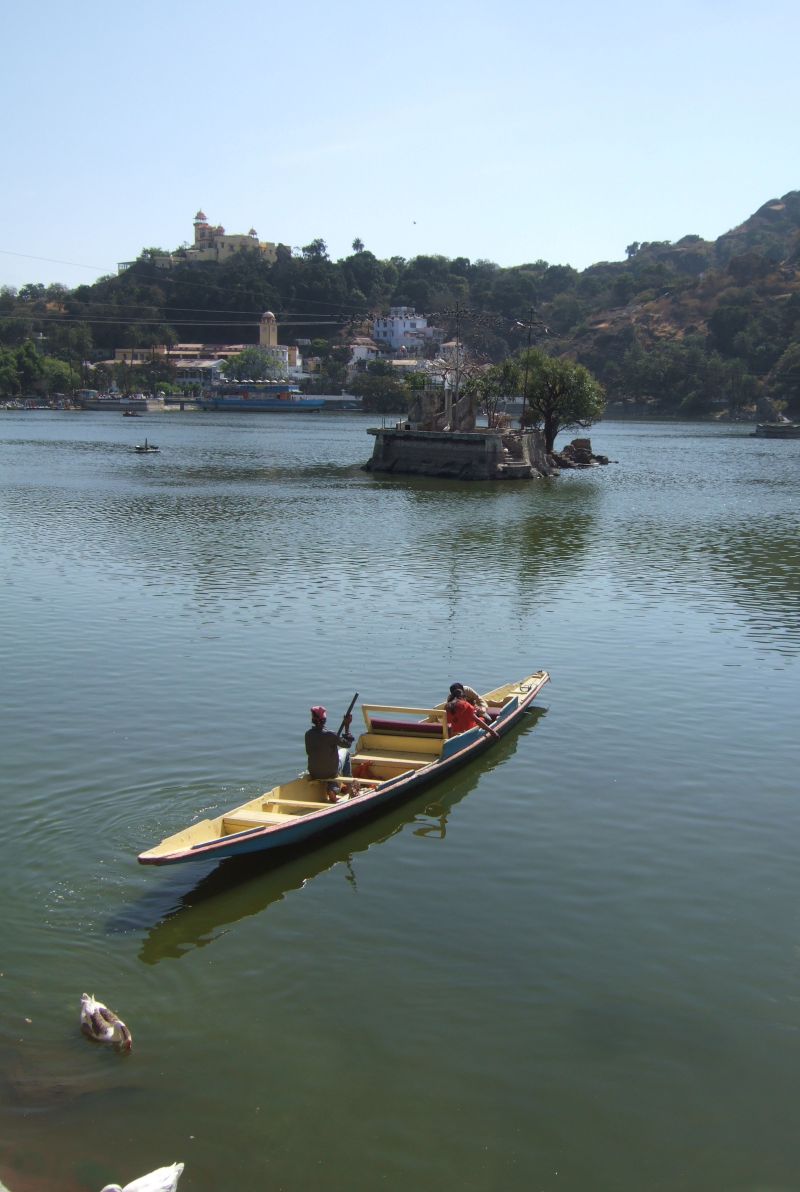
Boating along Nakki Lake
One of my favorite routines is walking around Nakki Lake at different hours of the day. At dawn, street lamps shimmer on still water, and swans drift across the surface. By afternoon, small boats move slowly across the lake against a backdrop of the jagged edges of the Aravalli Range. The light turns soft, shifting from orange to pale yellow as it reflects across gentle ripples. Shadows deepen along the surrounding hillsides, and the lake sits in a pocket of silence.
My visit last March came during an unusual moment. In the final week of February, several Brahma Kumaris teachers were preparing to return home when flights were abruptly cancelled following the outbreak of war in the Middle East. The disruption affected routes to Europe and the Middle East, and even some flights to the United States that passed through that region. Many were stranded and had to return to Madhuban, rebook tickets at stiffer prices, and wait for new departures, a process that stretched into several weeks.
The uncertainty extended into daily operations on the campuses. While larger facilities in the Brahma Kumaris network rely in part on solar-powered systems for cooking, they still depend on gas for many preparations. At Pandav Bhavan, where dosas, fermented pancakes, are usually made on gas stoves, the kitchen shifted to small electric hotplates as supply conditions tightened.
India’s broader energy vulnerability was a constant point of reference. The country imports about 85 percent of its crude oil, much of it from the Middle East. Any prolonged disruption in the Strait of Hormuz, or a sustained rise in global oil prices, can quickly feed into inflation and weaken the rupee. To manage that exposure, India has been diversifying suppliers, building strategic reserves, encouraging fuel conservation, and expanding alternative energy sources.
The country imports about 85 percent of its crude oil, much of it from the Middle East. Any prolonged disruption in the Strait of Hormuz can quickly weaken the rupee
Within the Brahma Kumaris, those global pressures were discussed in practical terms. Sister Mohini spoke of the need to prepare for the wider consequences of the conflict, including the possibility that disruptions in energy markets could linger even after fighting subsides. “Day-to-day life should have minimum facilities and comforts,” she said.
She recalled her first visit to Madhuban in 1958, when conditions were far more austere. Cooking was done on large brick stoves fueled by wood. Hot water was carried in heavy metal buckets to bathing areas, where it was mixed with cold water before use.
By contrast, the present-day campus runs on a mix of modern infrastructure and renewable systems, including solar-powered installations. Yet Sister Mohini suggested that the discipline of earlier years still holds relevance. Meals then were simple, she said, often chapati, dal, and vegetable subji. The physical conditions were basic, but the focus on meditation and daily routine created a different kind of ease.
“In those days, there were rocks around Pandav Bhavan where we would sit to meditate at night,” she said. “We practiced being an immortal soul. From that awareness, our strength and capacity increased.”
The next day, Brahma Baba encouraged them to experience a simple awareness: “I am a peaceful soul.” They would sit with that sentence for an hour at a time, repeating it in silence. “It helped us in our spiritual journey,” she said. “That awareness should be reflected in our words, our interactions, and our relationships.”
What would life look like if even basic comforts were stripped away, and if fossil fuels that were embedded in every stage of food production were gone? “I remember in the beginning, we had no car, nothing,” said Sister Mohini.
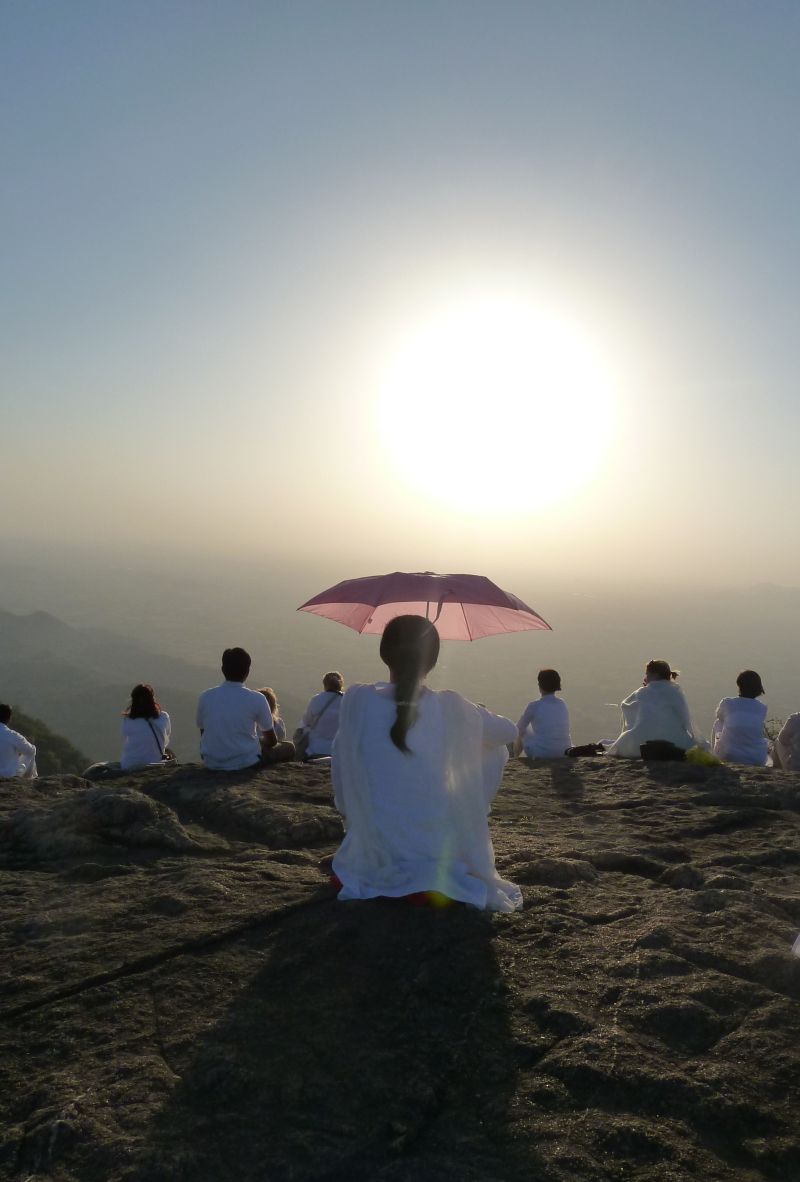
Yogi at Baba’s Rock
In those early years, she recalled, the senior yogi in charge of the kitchen would travel down to the Abu Road railway station to buy vegetables. The produce would then be carried back on the 28-kilometer climb to Madhuban along the winding mountain road—on foot.
Sister Mohini urged a return to that spirit of simplicity. She spoke of eating fewer meals in the event of food scarcity, walking instead of using cars in certain activities, and adjusting expectations ahead of future uncertainty. “As much as we can simplify our life, we will find it easier, and we will still be comfortable,” she said.
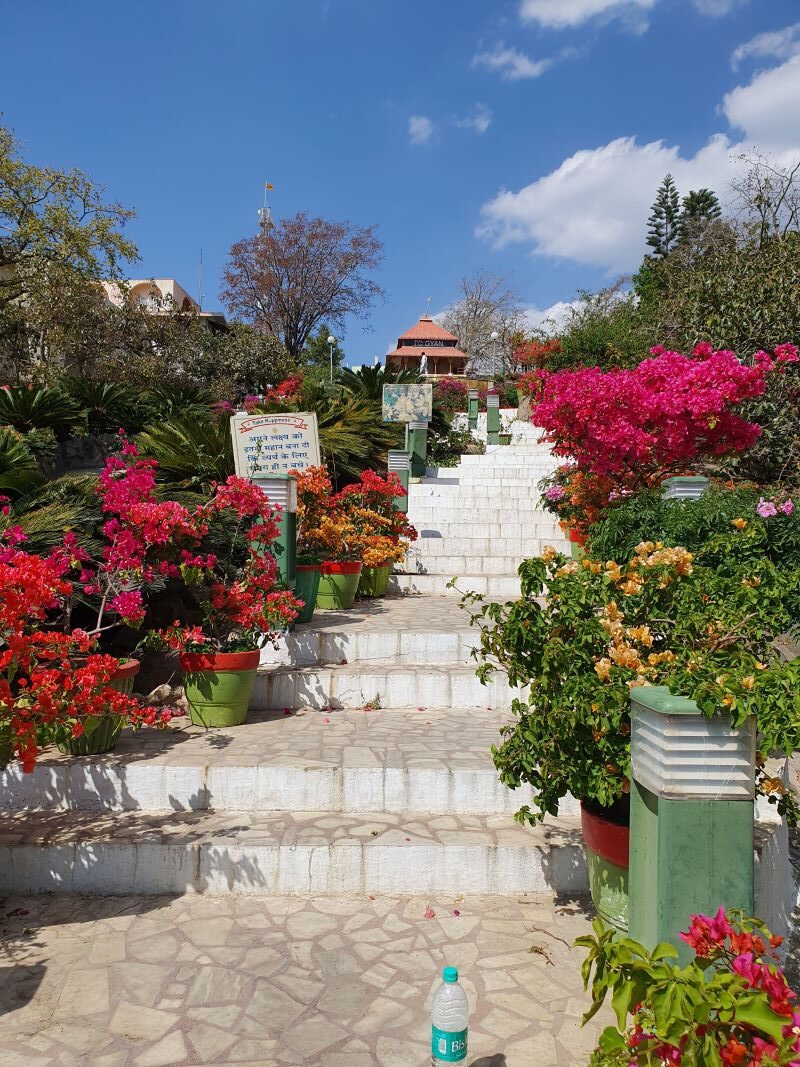
Stairway to heaven at Gyan Sarovar, Academy for a Better World
It was a reminder that, in this hill station above the plains, the idea of resilience is not only about weathering global shocks. It also reminds us of how little one needs to carry to keep moving forward.


