
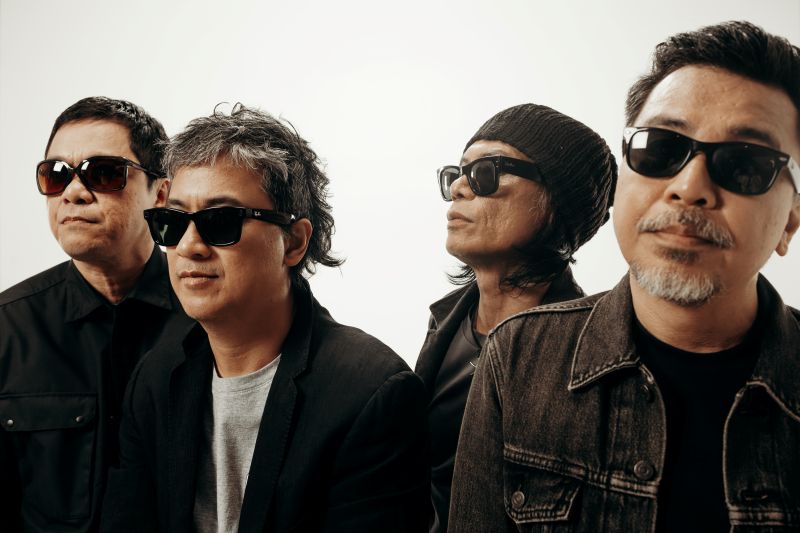
Veteran journalist Eric Caruncho, author of the seminal, now out-of-print Punks, Poets, Poseurs: Reportage on Pinoy Rock & Roll, attested, “If you look at the history from the ’60s to the present day, you can really divide it into two categories, ‘Before The Eraserheads’ and ‘After The Eraserheads.’ Because really, the Eraserheads changed everything.”
He went on to explain how the songs of the Eraserheads represented the dreams, aspirations and realities of the Filipino youth of their generation, which younger listeners continue to patronize.
“They were a unique phenomenon whose cultural impact and significance have never had a rival,” Caruncho added.
The quotes are not from his book, which for me is the only credible, unpretentious, and most excellently written reportage on the alternative band boom in the 1990s, or from any of his articles in the Philippine Daily Inquirer.
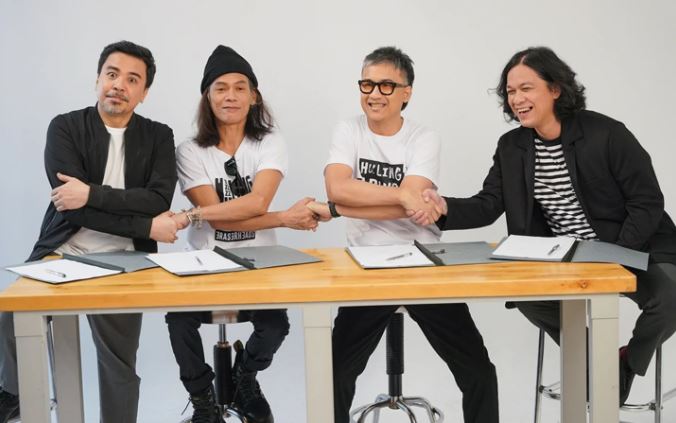
Buddy Zabala, Marcus Adoro, Ely Buendia, Raimund Marasigan in what looks like a contract signing event (Image from Eraserheads Combo On the Run Facebook page)
Caruncho, who has covered the music scene since the 1980s when he started writing for several publications, notably for Jingle Magazine, up to his retirement from the Philippine Daily Inquirer newspaper, was speaking before a camera in the documentary Eraserheads: Combo On The Run, now available on Netflix in 190 countries.
Directed and written by Maria Diane Ventura, the docufilm had its debut run in local theaters nationwide in the summer of 2025, was toured in cinemas in the US, Canada, Australia, New Zealand, and other countries, before it was released on Netflix, midnight of May 30, 2026. Ventura earlier told The Diarist.ph that there was some re-editing done on the theatrical version with additional two-minute-long scenes, from 139 minutes to 141 minutes.
On a more personal note, I can say I was there in the ‘90s and experienced the rise and fall of what many considered the greatest Filipino rock band of all time, often compared to The Beatles.

Ely Buendia selling pre-loved clothes at Sari Sari Bar (Photo by Totel de Jesus)
Though I’m about two to three years younger than main songwriter-guitarist-vocalist Ely Buendia, drummer Raimund Marasigan, bassist Buddy Zabala and lead guitarist Marcus Adoro, we all belong to Gen X.
If you’re a rock music fan, the 1990s was the best time to be a teenager transitioning into young adulthood because of the so-called alternative music band boom. It was that period when bands playing original materials were the ones embraced by listeners.
There were no YouTube and other streaming platforms then, so there’s no playback if you like to experience again the shows you’ve attended or have missed. You’d have to wait for replays on MTV, MYX, and other music channels, which seldom happened.
As how some Gen Xers described our generation, we are those who partied without smart phones and social media. Like the Boomers before us, we had “sex, drugs and rock & roll,” but since there’s not much of a record, no one will shame or envy us later on.
Though their songs continue to be patronized by succeeding generations and influenced younger musicians, the similarities between The Beatles and the Eraserheads were coincidental.
Both were active for a little over a decade, and defined a new era before they disbanded in a messed-up situation. As we all know, the Beatles’ case was worse, because there were legal battles after the breakup, officially announced on April 10, 1970 by Paul McCartney.
The similarities between The Beatles and the Eraserheads were coincidental. Both were active for a little over a decade, and defined a new era before they disbanded
With the Eraserheads, Buendia initiated the disbandment by sending an SMS to the other three, saying “It’s time to graduate,” based on existing articles, some time in March, 2002, and—to use Gen Z’s term—”ghosted” them afterwards.
Ventura corrected these earlier write-ups about the breakup. Via Facebook Messenger, she told The Diarist.ph that it was some time in the latter part of 2001 when the dissolution of the Eraserheads happened. It was not in 2002, because Buendia formed The Mongols in 2001 with Yanni Yuzon on bass, Jerome Velasco on lead guitar, and Bogs Jugo on drums. Perhaps what contributed to the confusion on dates was because for a few months, the Eraserheads continued without Buendia, inviting singer Kris Gorra-Dancel of the all-female band Fatal Posporos to take over because they had scheduled shows for the rest of the year.
Eventually, they changed the name, from E’Heads to Cambio, with additional members. At the time, The Mongols had been performing new songs composed by Buendia.
“Perhaps [the writers, reporters, music journalists] learned and wrote about it later on. There was already The Mongols in 2001. I can’t remember the exact month, since it’s more than 20 years ago but I am sure the actual breakup did not happen in 2002,” Ventura told The Diarist.ph.
Ventura, who was Ely’s wife and manager at the time, pointed out, “The Mongols’ name came after we visited the Museum of Natural History in New York, and that was the end of 2001. That was when I obtained my green card.”
“Ely’s text message to the three members may have initiated the transition, but planning what happened next took time,” she added.
This has been corrected in Combo On the Run, where the four members opened up on what led to the breakup and what happened to them after they formed their own groups.
Ventura interviewed them individually, and opening up to—as fans in those days called her—“Yoko Ono” was magical, something unthinkable when the breakup happened. The label “Yoko Ono of the Eraserheads” sounds funny and childish now.
It only shows there are no more animosities, that time heals. Even the Beatles didn’t have that opportunity. John Lennon already passed on when Paul McCartney, George Harrison, and Ringo Starr reunited to complete and record an unfinished song by Lennon, Free As A Bird, for the 1995 The Beatles Anthology album.
Though the British Fab Four were a global phenomenon, the Eraserheads’ fan base has always been the Filipino diaspora in North America, Middle East, and Europe, besides being well-loved in Singapore, Indonesia, Hong Kong, Taiwan, Japan, South Korea, and other neighboring countries.
As pointed out in the documentary, during the peak of the E’Heads’ popularity, with a little help from MTV, the song Ang Huling El Bimbo (The Last Dance), from their third studio album, Cutterpillow, won the MTV-Asia International Viewers’ Choice Award in 1997. The Eraserheads remains the only Filipino band that won in the said category, and MTV has since ceased operations in the Philippines.
Another example, the carrier single Julie Tearjerky from their 1998 album Aloha Milkyway, was a hit not only in the Philippines. As reported in Tatler Asia, it also topped the charts in South Korea, Hong Kong, Taiwan, Japan and Indonesia. Nowadays, it is being played a lot on TikTok.
Another comparison, closer to home, if the Juan dela Cruz band is often described as having revived Filipinos’ interest and love for original songs in Tagalog, unknowingly giving birth to OPM in the 1970s, nearly two decades later, the Eraserheads reignited the trend and revolutionized OPM with songs that were straight from the common Filipino experience, raw and honest.
RELATED STORIES
Pepe Smith, in his own words, one more time
While most of JDC’s originals were about getting high on drugs and alcohol, the Eraserheads freely expressed their thoughts without worries of censorship. You can relate to their songs, whether you’re a colegiala or a parlorista, a car buff residing in Forbes Park or a cargador at Manila North Harbor Pier 4.
It helps that Buendia, being the main songwriter, was a film major, and it shows in his songwriting technique. He writes songs like one conceives a story concept for a screenplay. He is very visual. Ang Huling El Bimbo is a perfect example, with a fairy-tale like beginning, middle, and a tragic ending. As fans would know, the name of the band is from the title of one of Buendia’s favorite films, David Lynch’s Eraserhead.
In using the language that a regular jeepney-riding, fishball-balut-isaw-eating student speaks, their songs set them apart from their contemporaries. With all due respect to Rico Blanco’s fans, let’s take for example his most popular love ballad, 214, released when he was with Rivermaya.
In using the language that a regular jeepney-riding, fishball-‘balut-isaw’-eating student speaks, their songs set them apart from their contemporaries
The lyrics: “The world could die, and everything may lie/Still, you shan’t cry/ ‘Cause time may pass, but longer than it’ll last/I’ll be by your side, forever by your side.”
This now-iconic ballad has one of the most captivating music ever written, but since the words were in English, you have to worry about the right pronunciation even if you sing it in videoke. It still has that Atenean sensibility.
Now, compare that with Buendia’s conversational inuman-session like songwriting style in Pare Ko. It also has that catchy acoustic guitar-accompanied music, but the words: “Oh, Diyos ko, ano ba naman ito?/ ‘Di ba? ‘Tang ina, nagmukha akong tanga/Pinaasa niya lang ako, letseng pag-ibig ‘to/Diyos ko, ano ba naman ito?”
The University of the Philippines (UP) in Diliman, Quezon City, has always been the cradle of student activism, and since the Cory Aquino presidency, has symbolized the return of democracy. The Eraserheads didn’t have to write about toppling a dictator, fighting US imperialism, or going to the boondocks to join the armed struggle and all that.
Professor Daphne-Tatiana T. Canlas of the Department of Broadcast Communication in UP Diliman was a freshman when the Eraserheads started as a college band in 1989. In the documentary, she said since it was only three years after the Edsa People Power Revolution, artists like Ely, Raimund, Buddy, and Marcus “didn’t feel stifled. They were not afraid anymore.”
Decades later, their alma mater would recognize their artistry and contribution to Philippine culture.

Marcus Adoro with family members during the UP Gawad Oblation awarding ceremonies (Photo by Totel de Jesus)
I was there when the Pinoy Fab Four was honored with the UP Gawad Oblation Award on Aug. 20, 2024, at the UP Executive House, though not to cover the event, but to get my vinyl copy of Ultraelectromagneticpop album signed by them. The award is considered the highest recognition given by the university to institutions and alumni, mostly in public service and business. A quick Google search would give us the names of tycoons like Manny V. Pangilinan, Ramon Ang, and Robina Gokongwei-Pe.
Ely, Buddy, Raimund ,and Marcus were each given the prestigious medal for their “enduring excellence as a band, reflecting the university’s commitment to promoting national pride and cultural excellence.”
In the song Ligaya, one of Ely’s witty lines goes “Gagawin ko ang lahat pati ang thesis mo, huwag mo lang ipagkait ang hinahanap ko.” Ironically, the four Iskolar ng Bayan didn’t graduate because aside from lacking the units to qualify, they also didn’t finish their respective theses.
Speaking before the intimate crowd of UP alumni and select media attendees, they said their medals have become their diplomas, and the UP Oblation Awards night was their graduation ceremony.
In 1996, the Eraserheads were already the biggest band when I started writing for a national paper, my first real job. There was a new section created for the youth, and I was given a free hand to write about the music scene.
Our small team was able to secure a Q&A session with the band, and it was the time when their song, Alapaap (Cloud), from their second album, Circus, released in 1994, was front-page news. There was a call to ban it from the airwaves.
As shown in Combo On The Run, this was when Senator Tito Sotto called out the band for the drug references in the song, specifically the alleged use of marijuana and hallucinogenic substances. Cloud, as the title suggests, is marijuana smoke that would make you feel like floating. Sotto, who chaired the committee on illegal drugs, summoned the band to appear in the Senate.
The band showed up early in the morning for the press conference, despite them not being morning persons. But as Adoro and Buendia said in the documentary, they decided to appear despite knowing it was all a farce, a media stunt. They felt the claws of censorship reminiscent of the martial law years.
Adoro recalled they were each given a cigar and invited to Sotto’s office because it was the senator’s birthday. There, they smoked the cigars and had drinks. Looking baffled, Adoro said, “What a circus!”
Fidel V. Ramos, who was known for smoking Cuban cigars, was then President of the Republic. In the documentary, Caruncho mused, “Imagine if that song came out during the Duterte administration.”

The pre-show stage design of ‘Ang Huling El Bimbo the Musical’ in 2023 (Photo by Totel de Jesus)
It wasn’t mentioned in the documentary, but there was the massively successful Ang Huling El Bimbo The Musical, produced by Full House, the resident theater company of Newport World Resorts. Using the discography of the Eraserheads, it tackled extra-judicial killings and impunity.
It was staged during President Rodrigo Duterte’s term, running for two straight years, 2018 to 2019, with a total of 115 performances. As a fundraising event, it was streamed for 48 hours, from May 14 to May 15, 2020, on ABS-CBN’s social media pages, gathering seven million online viewers. Reportedly, it raised more than P12 million for the ABS-CBN Foundation.
AHEB was restaged at Newport Performing Arts Theater (NPAT) from April to July 2023, making it the most successful, record-breaking original Filipino musical by Full House Theater Company.
Following AHEB, there have been other jukebox musicals using the songs of bands that started in the ’90s. One was 9 Works Theatrical’s Liwanag Sa Dilim (LSD), which used the hit songs of Rico Blanco, staged in the summer of 2025 at Carlos P. Romulo Auditorium in RCBC Building, Makati City. Another was Full House’s Burugudunstuytugudunstuy: The Parokya Ni Edgar musical, staged at NPAT from April to June in 2024.
They weren’t as well patronized as AHEB, ending their first runs with no promise of restaging. I can conclude the songs of the Eraserheads made the big difference. Initially, AHEB was lambasted by critics, the same way LSD and Burugudunstuytugudunstuy were pilloried in the reviews. AHEB forged on after its first run (from what I remember, with a little help from Floy Quintos, who came in to rewrite the script and serve as dramaturg) and logged in a total of 175 shows.
In Combo, though there was no mention of the Cory Aquino presidency, it begins with reference to the end of the 20-year-long first Marcos administration and the emergence of a new counter-culture that didn’t worry about censorship or threats of being jailed, of disappearing at night and never being seen again for being outspoken about the ills of the government.
Like in the Star Wars films’ opening crawl, we quote the brave, in-your-face, troll-magnet intro text of Combo On The Run: “In 1989, three years after the Edsa People Power Revolution, which overthrew Ferdinand Marcos Sr.’s martial law and restored democracy, the Eraserheads were formed at UP Diliman. The culture was ripe for new emerging artforms.”
Adoro, Buendia, Marasigan, and Zabala were teenagers like us who realized there was no such thing as absolute power and there’s reckoning for authoritarian and corrupt leaders.
Adoro, Buendia, Marasigan, and Zabala were teenagers like us who realized there was no such thing as absolute power
Then and now, the band has been earning the ire of the powers-that-be. We quote again Combo On The Run’s intro crawl: “In 2022, more than 20 years after the band’s untimely breakup, the country once again finds itself in political turmoil when the son of former dictator Ferdinand Marcos won the elections.”
A few days before the global release of the documentary on Netflix, Ventura and Buendia, who were co-producers of Combo, emphasized that artists have a responsibility to use their influence in telling their truth.
“I personally think artists should speak up, of course,” Buendia said during the talk-back session after the one-day only advanced screening of the docufilm at Ultra Cinema in Newport Word Resorts not so long ago. “It depends on the values of the artists. There are music artists who are fine letting their music speak for themselves. Especially if their music is political na to begin with, like Bob Dylan,”
He was answering a question from a group of media people and some respectable and sensible vloggers: Should artists remain apolitical fencesitters or be involved in the discourse?
“We also have artists like Jim Paredes, for example, whose music is inherently political, and he’s very vocal about his political stance. I think that’s everyone’s right. Syempre, iba na usapan pag dating sa fans,” Buendia said.
“A lot of fans get turned off, ‘pag naging sobrang political na ‘yung person, though I don’t see anything wrong with it, especially with me, na lately lang naging vocal about my preferences for president. For people with other preferences, I guess, there’s no right or wrong,” he added.
He was referring to the 2022 national elections, when he openly endorsed then presidential candidate, incumbent Vice President Leni Robredo.
“I also don’t believe that you should take that against an artist. That you just keep on being an artist and we don’t need to hear your views. Unless of course you agree with those views,” Buendia said.
“And even if I don’t agree with an artist’s views, he or she should keep being an artist. Just because artista ka lang or singer ka lang,” he added.
Ventura added: “I’ve been a witness to the trajectory of Ely’s career. I’ve been managing him for more than a decade. He’s always been apolitical and remained that way until 2022 when he felt the need to speak up. I think that was actually the right time to speak up because that was the time when people needed to hear.
“There’s no right and wrong way to go about it. But I think it’s pretty noble to use your platform or whatever influence you have to say what you think is the right thing because you want to impart knowledge, and you want to share whatever wisdom you have,” she said.
Incidentally, for first-timers, the first few scenes in Combo On The Run (spoiler alert) start with a social media dare. There was a viral tweet in social media platform.
On Sept. 28, 2021, Buendia answered a fan named Ben Demapitan, who tweeted, “May pag-asa po kaya magkaroon ng E’heads reunion?”
Buendia answered, “Pag tumakbo si Leni.” There was no stopping #pagtumakbosileni from becoming viral. At the time, Robredo was reportedly considering to run instead for a local position in Camarines Sur.
Robredo tweeted her answer with three running emojis. On Oct. 7, 2021, she announced her bid for the presidency.
In later interviews, Buendia said he was half-serious with his tweet. He became the target of online attacks and trolling by the Marcos-Duterte supporters, saying he was “laos na,” or he’d suffer another heart attack if a reunion happens again. Even the Eraserheads were trolled, mocking their “endless reunions.”
(In their first reunion on Aug. 30, 2008, Buendia almost had a second heart attack. He clarified it was exhaustion, not a second heart attack, but while in the hospital, the doctors found a clog in a vein that needed to be cleared. His first and only heart attack happened during a provincial gig in Laguna on Jan. 6, 2007, when he was playing with his other band, Pupil. He was 36 years old at the time.)
Despite coming from the trauma of the pandemic, political polarization became another deadly virus for Filipinos. Unfollowing, unfriending and blocking friends, even relatives on social media, were common.
The Eraserheads’ third massive reunion titled Huling El Bimbo happened at the SMDC Concert Grounds on Dec. 22, 2022. I was able to attend it with my teenage daughter. She was the one who insisted that we watch it. It was like a transition, because I saw the first two reunions nearly two decades ago with her mother. There were so many teenagers in the audience, and I realized they were living proof that even Gen Z has embraced the Eraserheads’ music. It was also there that Buendia announced the group will no longer have reunion concerts, because “we are here to stay.”
Despite massive trolling and calls for a boycott, Huling El Bimbo was attended by an estimated 100,000 fans onsite, with another quarter of a million around the world watching on streaming platforms.
It was the tail-end of the COVID-19 pandemic and they reunited not only for the fans who needed healing, but, as the docufilm says, also for the band members themselves.
A bit of history. Prior to their 2022 concert, they hadn’t played together for six years. There was a small concert on Aug. 30, 2016 for a private event at the Makati Shangri-La, organized by PLDT and Smart Communications to launch a new product. Officially, their second reunion was Eraserheads: The Final Set on March 7, 2009, at the SM Mall of Asia Concert Grounds, in which PLDT-Smart was also a major sponsor. They also had a worldwide tour after that, but part of the contract was that they were not supposed to play together for 10 years on Philippine soil, they could not be seen on stage, so the binding agreement expired in 2018. But since it was PLDT-Smart who sponsored the 2016 gig, there was no problem.
“I supported Leni first and foremost because I thought she was a really a good candidate. And she’s from my hometown,” said Buendia, whose family hails from Naga City.
‘I supported Leni first and foremost because I thought she was a really a good candidate. And she’s from my hometown,’ said Buendia
Being a Nagueño was also the reason why he agreed to act as the lead character in the 2025 Cinemalaya film Padamlágan. Directed by Jenn Romano, the story is about a father (played by Buendia) whose son, a student-activist doing social work in the barrios, mysteriously disappeared during the 1972 Colgante Bridge collapse in Naga City.
RELATED STORY
Cinemalaya: ‘You are important because we need stories that document history’
“Leni is the first candidate I really supported because I believe in her, her values,” he explained.
As part of their Huling El Bimbo World Tour, for the next two years until 2024, the Eraserheads performed in key cities in the US, Europe, Middle East, Australia, and New Zealand.
After two decades, the Eraserheads global following has naturally increased in numbers. These fans have stable careers and for sure, they can afford high-priced concert tickets.
Ventura, being an award-winning filmmaker herself, knew at the time knew that there was a documentary to be made from all that was happening. “It’s important to introduce their story to the generations who probably weren’t there when it all happened,” she said. “There’s a lot to be shared. They were ready to tell their stories. I think the story of the band was also cathartic for me, and I wanted to experience it through them and not from anyone else,” she added.
Buendia chimed in, saying “Sa tingin ko, the band actually wanted to tell their story already, dahil maraming haka-haka about what happened. They started to become like shadows lurking on our heads. There’s the question, what did you guys do?
“Matanda na kami, and sometimes you really wanna tell your story to the next generation and along the way, impart some wisdom and knowledge,” he added.
“When we did the tour, we had to work with each other again, which was a tough thing. Kasi nga, it’s not the same anymore. We still have different goals in life. We decided to do the thing we didn’t do before which was, we talked it out, and it really helped a lot,” Buendia said.
The docu captures snippets of their world tour after the Huling El Bimbo concert at the SMDC Grounds. They were shown having dinner, visiting tourist sites, singing in a videoke room while having drinks, just having a good time like old friends do.
Marasigan said he realized he had never asked the other three to have dinner since 1989. Adoro added that the bonding moments after the shows during the two-year-long Huling El Bimbo tours outside the country were like making up for the lost dinners and, half-jokingly, he said, “This is the part where I cry.”
Ventura knew she had to include the issue on Adoro’s estrangement with one of his daughters, singer-recording artist Syd Hartha. In 2019, she accused him of alleged physical and verbal abuse. Adoro has since reached out and apologized in public.
Buendia said Adoro’s personal issues that dragged him and the Eraserheads as a group into the controversy were among the reasons why he said in a podcast interview in 2021 that he and the other three were “never friends.” He explained it was his way of dissociating himself from Adoro.
Though Buendia may have been humble enough to say it, being a member of the Eraserheads or any popular group, there’s an inherent responsibility to be a good example to your fans. Though rock stars are known for their excesses, there’s no justification for bad behavior if people, especially younger fans, look up to you.
Marasigan said he reached out to both parties and advised Adoro to seek professional help, go into therapy. Marasigan said it seemed Adoro did something like that. During the pandemic years, Adoro released original compositions on his YouTube channel. He also revealed returning to an old passion, painting, and has since held solo exhibits and joined group art shows, with the Eraserheads as the main subject of his works. Before their world tour after the Dec. 22, 2022 concert, he even told The Diarist.ph of his wish for a group art exhibit with Buendia, Zabala, and Marasigan.
RELATED STORY
What Marcus Adoro wished for before the Eraserheads’ US-Canada Tour
In 2025, Buendia showed, as a solo artist, he can still compose songs that can capture the hearts of the new generations. His second solo album Method Adaptor, released in 2024, had several hits like Bulaklak Sa Buwan (about fake news and disinformation), Tagpi-Tagping Piraso (about lost love and moving on) and Kontrabando (inspired by an LVN Pictures black-and-white noir film of the same title). He has also been busy with his own record label, Offshore Music, of which he is CEO.
“I am still writing music and steadily putting up music. I just released a new song, Ate, and am busy with Offshore Music in supporting younger artists,” he said.
On being a producer, which is a kind of a sensitive role since he’s also a musician, he said, “There’s always a compromise, but you don’t need to be too greedy. I am not pointing any fingers. Please don’t twist what I am trying to say,” he said, laughing.
On being a producer, which is a kind of a sensitive role since he’s also a musician, Buendia said, ‘There’s always a compromise, but you don’t need to be too greedy’
“It’s just the reality. People need to earn money, but that gets in the way of also protecting the artists, who are your collaborators. You are in this together, and that has been the philosophy of Offshore Music, we always try to do the right thing with regards to money. We think of the artists first.”
With regards to the new batch of younger musicians, Gen Z, he said they will succeed because technology is a big help now. “There are a lot of factors that favor young artists. There’s even a school offering subjects on composition, recording, the whole ensalada that you can take. Of course, the first thing that comes to mind is their commitment to their craft. The new bands, they are very professional. I think all in all it’s good. They found their voice and they know what they want…
“It was very different during my time. Today is a far cry from what I’ve been used to in the 1990s. It was always just rock ‘n roll…bara-bara. The veterans like Florante and Rico J. Puno would tell us we will survive by playing live concerts. I think, it’s still the case, being part of that industry. I guess I’m from both sides, as producer and artist,” he said.
He has good words for the other three E’Heads.
“I’ve always been a fan of their post E’Heads output. (With Raimund’s band), I love Sandwich, all of their albums are topnotch. Marcus Highway came out with one of the best Pinoy Rock albums ever,” he said.
“Buddy (who still plays with Moonstar88) hasn’t been as prolific as the other two guys but he is truly one of the geniuses in the band, aside from me,” he added, laughing. “Musically, he gave the E’Heads that sort of…how do you call it…credibility.”
After the closing credits in Combo On The Run, like in Marvel movies where there’s a short teaser scene on what’s next, the band is shown in a studio playing the instrumental version of Get This Love Thing Down, the song they planned to record and play live in the thrice-postponed Electric Fun Music Festival (EFMF) concert, also at SMDC Festival Grounds.
EFMF was supposed to be the follow-up homecoming major show after their Huling El Bimbo tour. Originally scheduled on May 31, 2025, EFMF was postponed to Oct. 18, 2025.
A few weeks before the said date, it was announced by the producer, WEU, the same company behind Huling El Bimbo 2022 concert and subsequent world tour, that EFMF had to be postponed again and tentatively rescheduled to 2026.
The reason given was “complex, unpredictable challenges” that involved “political instability, economic uncertainty and growing climate related concerns.”
As of this writing, it’s the third quarter of 2026 and still no announcement has been made.
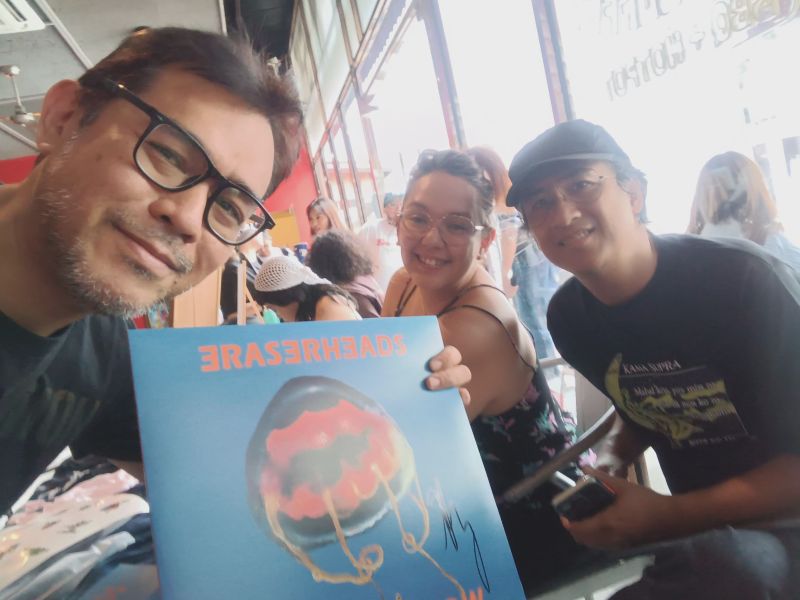
The author with his first copy of the ‘Cutterpillow’ vinyl album after Ely Buendia signed it. Also in photo: Audry Dionisio of Offshore Music, taken by the author at Sari Sari Bar in Makati City
Not so long ago, in one event in Sari-Sari bar in Makati City, which is reportedly co-owned by Buendia, I asked him about Get This Love Thing Down. It wasn’t easy to corner him for an interview, since it was an Offshore Music event for the remastered edition of Cutterpillow on vinyl. Released in 1995, Cutterpillow is considered the biggest selling album not only of the Eraserheads, but of any Filipino band. In 1995, it had sold 400,000 units in cassettes and CDs. But I felt I really needed his answers.
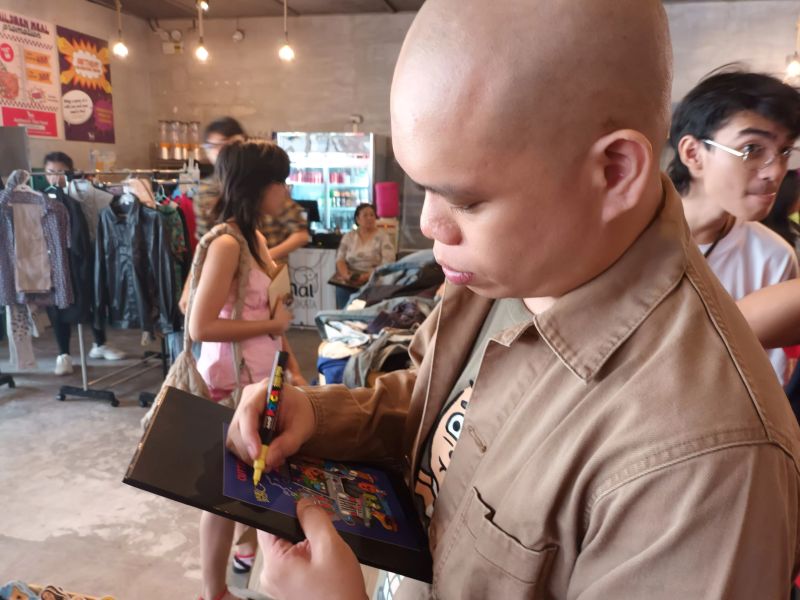
Cartoonist-author Tarantadong Kalbo, real name Kevin Eric Raymundo, signing my copy of ‘Cutterpillow’ tribute artwork done by him (Photo by Totel de Jesus)
“Mag-e-eBay ka siguro kaya bili ka ng bili,” he told me, with a smile, as he signed my third plaka of Cutterpillow. Buendia’s answers gave me an insight how he collaborated with the other three in finishing and polishing a song he composed.
“I wrote it when I was in second year college at UP Diliman, at the Molave dorm,” Buendia told The Diarist.ph as he stood up to stretch his arms and legs while the Offshore Music executives went to the comfort room.
“I think, I finished the initial version around 10 to 15 minutes. I had the guitar riff then I let Raimund hear it. He added the bridge. I had a hard time, mag-isip na makumpleto. ‘Pag ganun kasi, lagi kong binabato sa kanila,” he said.
I read somewhere that the song was supposed to be part of the first bootleg album, Pop U, then was shelved and didn’t make it to the succeeding commercially released albums. I asked him why.
“We didn’t include it in Pop U, because ‘yung tipong…hindi ako masyadong solved sa areglo, hindi lang may kulang, may parts na di ko trip. Pero, we played it once,” he said.
He was referring to a gig at Galo’s Bar on Sucat Road (Dr. Santos Avenue) Parañaque City on April 15, 2000, videotaped by someone name Tim Batac, digitized and uploaded on YouTube by a fan using the name Schizo for his The Schizo Archives channel.
Get This Love Thing Down sounded like a slow version of The Beatles’ Helter Skelter. It was the first song in the set and in the video, Buendia is heard telling the audience it was meant for their next album, referring to the then yet-to-be recorded Carbon Stereoxide. Still, the song wasn’t included.
So, what about the teaser video at the end of Combo, where they are jamming in a studio, playing Get This Love Thing Down?
‘Yung version na ‘yun, parang the mature version, masaya kami lahat. ‘Di nga kami nag-usap-usap, basta alam na namin kung ano gusto namin i-record. Nalaman namin ang problema.”
Before his attention went somewhere else, I asked him about another “reunion,” or rather, a major concert with the other three E’Heads. He said, “There’s no plan yet.”
For now, I think it’s enough for for millions of fans and new converts to enjoy Combo On The Run. In a more recent follow-up interview, Ventura told The Diarist.ph she had “roughly 100 versions over the course of three years.”
“One of the most difficult jobs was in the post production, in choosing which footage got killed, which ones were kept. There was a lot of footage I really felt sad for removing, like interviews with Paolo Valenciano, who directed the 2022 Huling El Bimbo Concert, and guest performer Gary V., and there was a portion about Francis M. It was heartbreaking to have to leave them on the cutting floor,” she said.
“My guiding light is the four of them. I wouldn’t have the film if the four of them didn’t participate, if they didn’t allow themselves to be vulnerable and share their stories. I have to thank every member for that,” she added.
‘I wouldn’t have the film if the four of them didn’t participate, if they didn’t allow themselves to be vulnerable and share their stories,’ said filmmaker Ventura
At the end of the day, she said, “I am just a servant to the narrative, and I have to make sure that what makes it to the final cut serves the narrative and honors the commitment to the actual story.”
More important, she realized, “The film felt like a catharsis—like growth. It was roller coaster of emotions and I tried my best to look at it, objectively.
“The filmmaking process showed me how brilliant they are. They are very eloquent, articulate, and very sensitive. That sensitivity was something that was inspiring for me ,because not a lot of people allow themselves to feel that discomfort in showing their vulnerability. It was courageous for them. And that definitely has changed my view on their legacy. By knowing them as people.
“It was powerful and inspiring for them to revisit the past because not a lot of people really want to do that. It’s very uncomfortable to confront your past, the hard things that have happened, or the suffering you’ve went through, but actually that is what you need sometimes for you to get to the other side of things, which is healing.
“Which is why I think it’s important that we have a film like this about quintessential men, rock stars, the people that we look up to, that kind of process unfold before our eyes because it gives you access to that part of yourself that you don’t want to access.”
We asked her since there was so much footage that wasn’t included, maybe five years from now she’d do a part two and a part three of Combo, like how Peter Jackson condensed the 60-hour once-unseen studio footage of The Beatles in 1969 by Michael Lindsay-Hogg in the three-episode documentary Get Back?
“Ahhh, maybe? Who knows. But for now, I need to take a sabbatical from the trauma of documentary filmmaking,” she said, with a laugh emoji.
And I think the healing journey goes on for the band from a generation that was able to cope with the aftermath of martial law and the conjugal dictatorship behind it.
Once in a while, like wounded superheroes on a break, they come out of their caves to perform together and perhaps in their own little way, provide some temporary relief to fans who live in a country that is always teetering on self-destruction.


