
Videos and photos by Liana Garcellano
‘Hanbok, Reborn as Art’ runs until Sept. 26, 2026, Mondays to Saturdays, 9 am to 4 pm, at KCC on 59 Bayani Road, Taguig. Admission is free.
To appreciate the hanbok— “han” refers to Korean, “bok” to clothing—one can admire it in historical K-drama series, which I do, or dive deep into its history, which I did three years ago, when I attended the lecture Threads of Tradition: A Celebration of Korean and Philippine Traditional Attires in Intramuros, Manila. It was presented by the Korean Cultural Center in the Philippines (KCC) and the National Commission for Culture and the Arts.
The guest lecturer, Dr. Sun Jung Woo, an assistant professor in Korean studies at Ateneo de Manila University, said the hanbok originated from the Three Kingdoms Period (57 BC–668 AD) when the kingdoms of Goguryeo, Silla, and Baekje occupied the northern, southeastern, and southern parts of the Korean Peninsula, respectively.
Woo said the hanbok gained prominence during the 1986 Seoul Asian Games and 1988 Seoul Olympics alongside a new awareness among Koreans of what it means to be Korean, and was catapulted further to the global stage when K-Pop groups BTS and BLACKPINK wore it.
Fast forward to 2026: The hanbok is experiencing a renaissance in Hanbok, Reborn as Art, an exhibit featuring 18 contemporary Korean artists reinterpreting it through various media.
Said Myungohk Lee, director of Savina Museum of Contemporary Art: “Hanbok is not a fixed heritage frozen in the past, but a living cultural asset that is constantly being reinterpreted and expanded through its encounters with contemporary art and modern culture.”
The exhibit is being presented by KCC, Savina Museum of Contemporary Art, and Korea’s Ministry of Sports, Culture & Tourism. It has opened in China, Kazakhstan, and Nigeria, and will premiere in Malaysia this year.
Singer and gayageum player Jubora reinterpreted the hanbok through her own composition Le Cottage, which she played on a 25-string gayageum in the July 9 opening of the exhibit. Per Google, Le Cottage was inspired by Jubora’s stay in a 250-year-old traditional hanok of the same name in Gangneung, a city known for “the hanbok experience,” in which tourists can rent and wear a hanbok and walk around in a quiet urban setting.
Jubora had the audience singing Le Cottage with her, but not before she prepped everyone with deep breathing and humming three different melodies with their eyes closed. Thankfully, the “collaboration” resulted in a wonderful note. She also performed her other original compositions—The Moment, Day Trip, and Arirang.
Gayageum is a traditional Korean zither with 12 or 25 strings stretched across a wooden soundboard. It’s played with the right hand plucking and strumming the strings and the left pressing, pulling, and bending them to create nonghyeon, the instrument’s distinct vibrato.
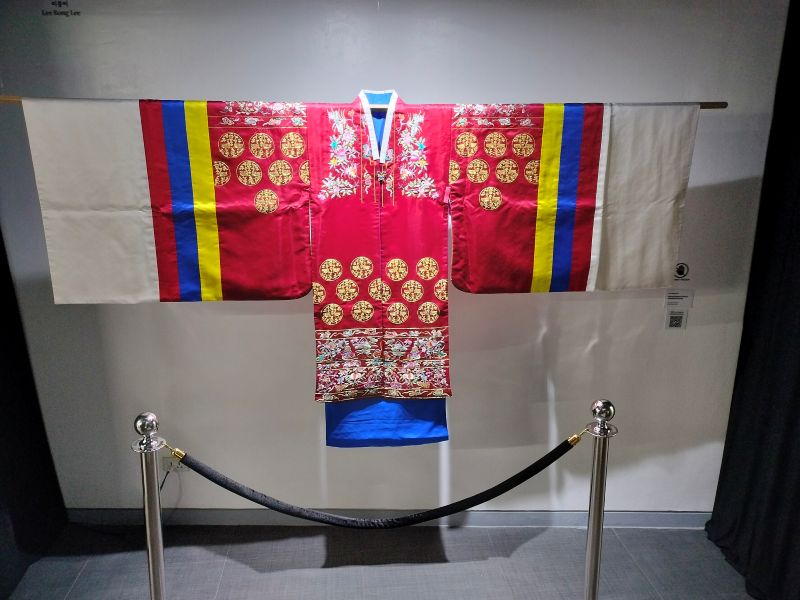
Lee Bong Lee’s ‘Hwarot’
Hwarot (the traditional royal bridal robe) by hanbok artisan Lee Bong Lee is displayed outside the gallery’s entrance on the fifth floor. It seems to pay homage to the hanbok’s illustrious past while acknowledging modern iterations. She recreated the traditional Korean ceremonial garment by hand-stitching the 220 x 180 cm robe with a silk thread following the ancient needlepoint techniques inscribed in historical texts, according to the notes on artists.
‘Hanbok’ artisan Lee Bong Lee recreated the ‘hwarot’ or traditional royal bridal robe by hand-stitching the 220 x 180 cm robe with a silk thread
Historically, the hwarot was worn by princesses of the Joseon Dynasty, like Princess Bokon (1818–1834), the second daughter of King Sunjo and Queen Sunwon. Bukon married at 11 and her husband was bestowed the title Prince Consort Changnyeong. Her robe features embroidered motifs of fertility, happiness, harmony, longevity, and prosperity, i.e., flowers (lotus, peony, and chrysanthemum), fruits (pomegranate and peach), and butterflies.
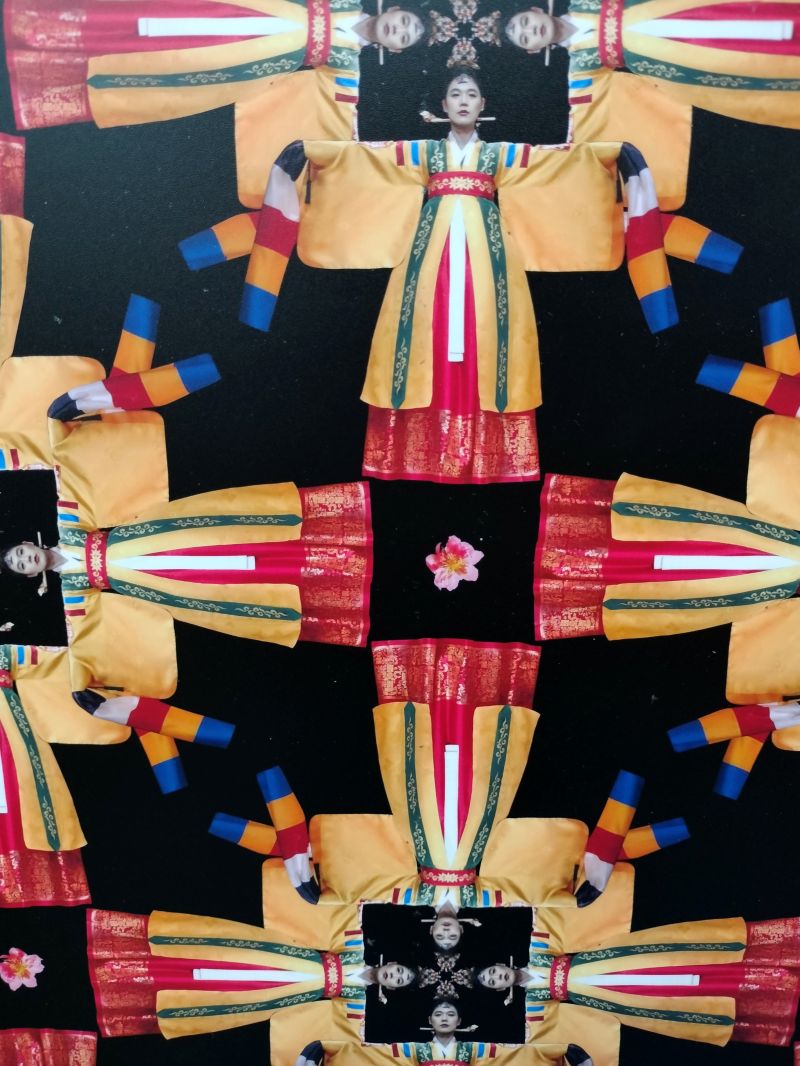
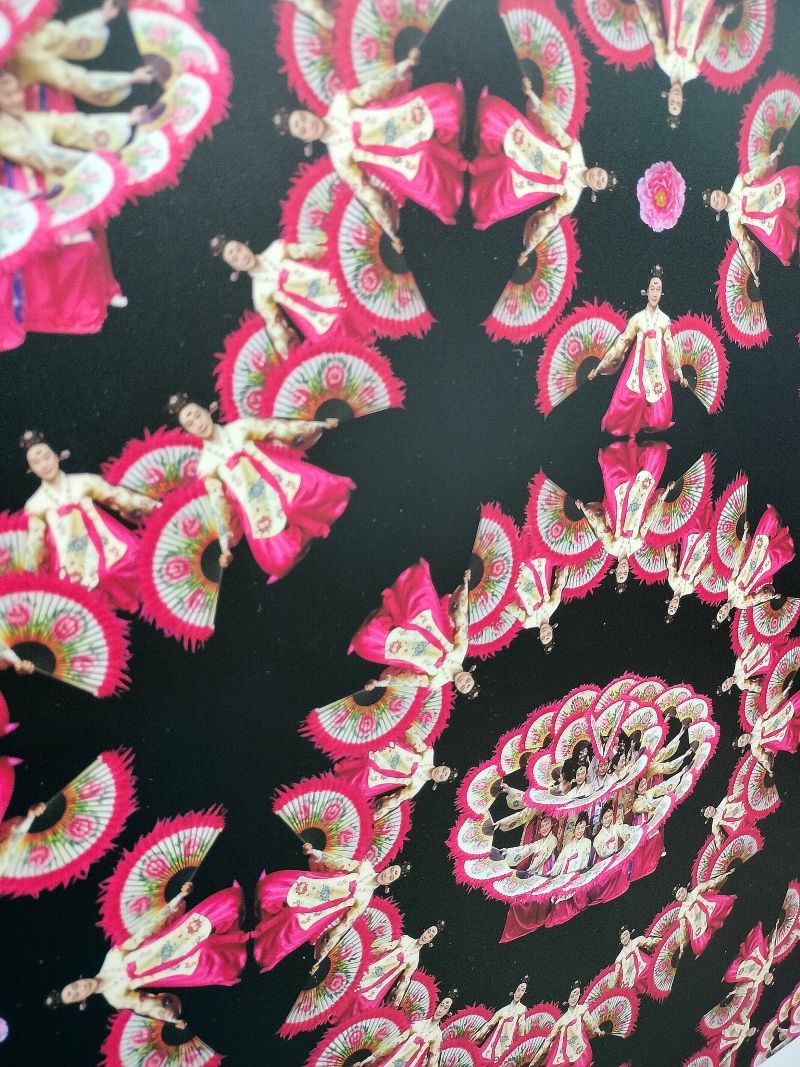
Lee Jun Geun’s digital artwork reveals mini ‘hanbok.’
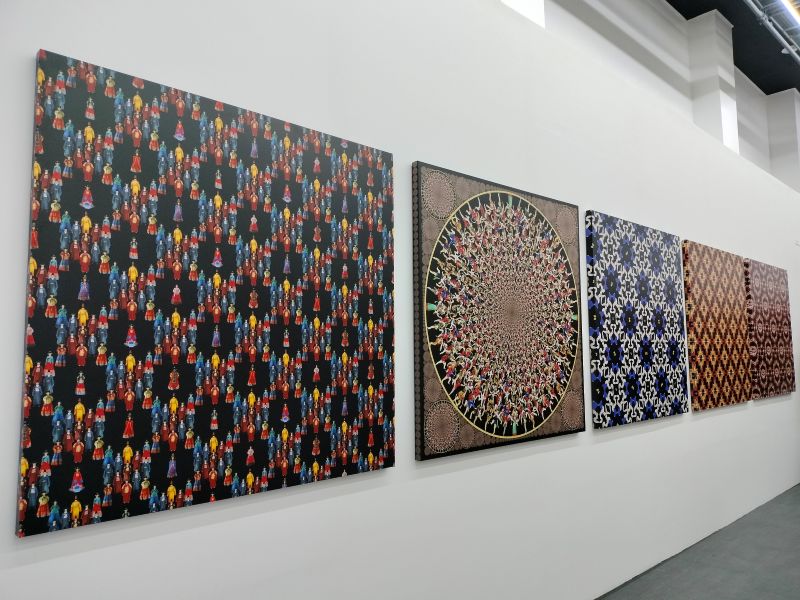
In contrast, Lee Jung Geun’s Feast– Gungjungmuyong uses photography and digital editing in reconstructing the hanbok worn in traditional dances, concerts, and events. The hanbok’s intricate details are visible when one looks at the five artworks up close. Conversely, viewed from a distance, the works are a huge hanbok kaleidoscope.
Savina Museum curator Han Sang Ik explained, “Lee photographed people doing traditional dances and programmed AI with those photographs to create a pattern…and used his own face on all the people created in the process.”
Installation art is done in three different ways. IUM combines historical memory, traditional clothing, and AI-generated media in a 184-second video titled Princess Deokhye’s True Portrait | Deok-hye’s Hidden Self.
The rectangular screens mounted on the wall show the parallel lives of the real Princess Deokhye (1912–1989) and the fictional character Sein in black and white, and color respectively. From my research, Deokhye was the daughter of Emperor Emeritus Gojong and a court lady employed at Deoksugung Palace’s kitchen, and was the Korean empire’s last princess. The notes say Sein, wearing a hanbok and shoes inspired by the belongings of the princess, depicts Deokhye with a better life. (Sein means “one who comes from beyond the world.”)
Lee Don Ah’s lenticular artwork Preciousness–Silla Dynasty shows the hanbok’s past and present, with images of the Goguryeo tomb murals, a golden crown from Cheonmachong Tomb, and traditional hanbok merging with cosmic landscapes and geometric forms, per the notes. The moving images emphasize the hanbok less as a historical artifact than a living, evolving cultural heritage.
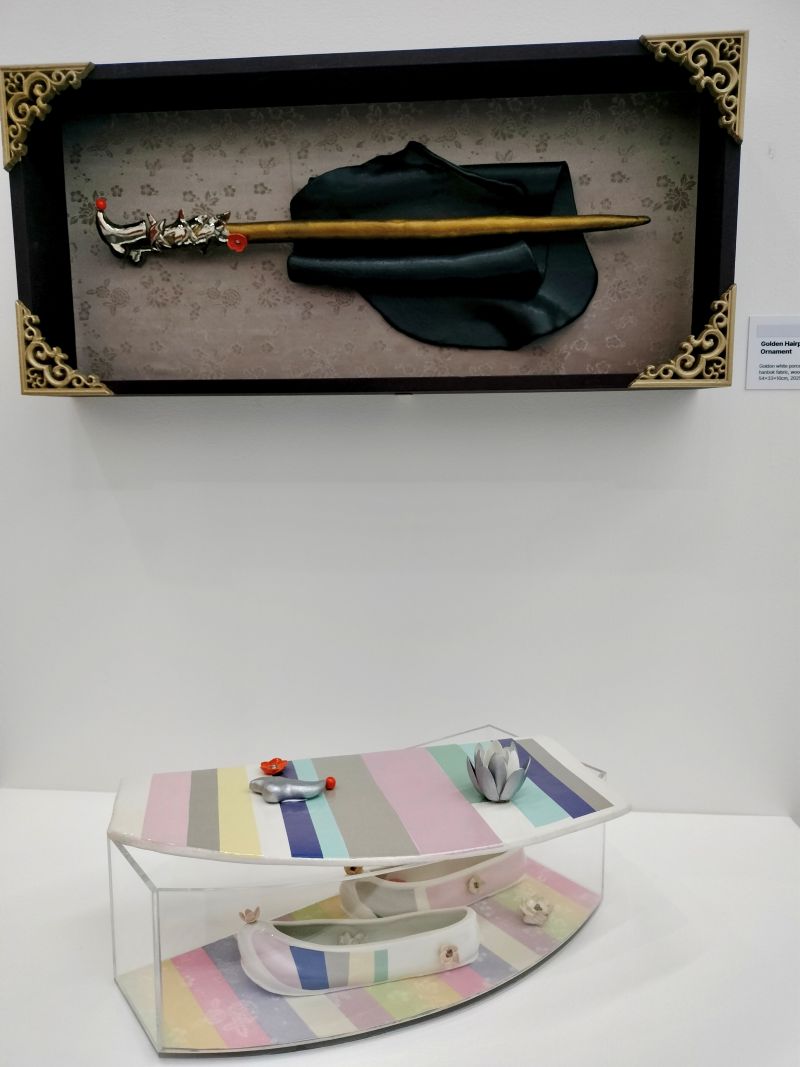
Kim Sun Mi’s ‘Case with Multicolored stripes and flower shoes colored glaze’ (below) and ‘golden hairpin with Beoseon ornament’
Ceramicist Kim Sun Mi (or Mee) reinterprets the traditional festive Korean clothing and accessories through contemporary ceramic-making using white porcelain clay, crystalline glaze, gold, platinum, and hanbok fabrics, per the notes.
In her Case with multicolored stripes and flower shoes colored glaze, the traditional flower-patterned shoes, socks, and floral designs evoke the anticipation of Korean holidays. Meanwhile, the golden hair pin with Beoseon ornament depicts feminine beauty through a textile-adorned golden hairpin.
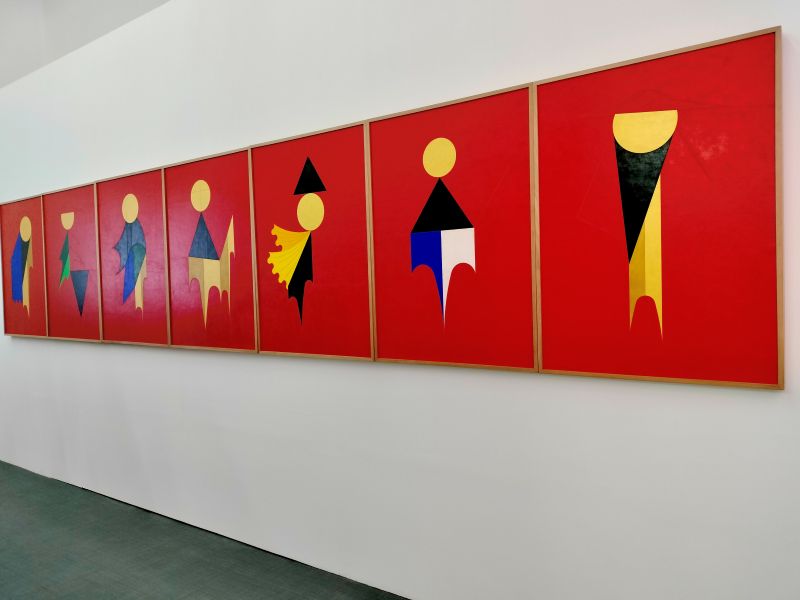
Yang Dae Won’s ‘Love-Red’
Yang Dae Won has 10 artworks on display. Love–Red is composed of seven paintings done on Korean paper with soil, acrylic, and linseed oil on cotton. The other three are Lover–Sonyeon Jeonheung (The Boy’s first love), Lover–Chunsaek Manson (Spring in Full Bloom), and Lover–Wolha Jeongin (Lovers under the Moon)—all done on hanji on cotton fabric with acrylic, red clay powder, and linseed oil.
He explores the hanbok’s beauty and Korea’s five traditional colors (blue, red, yellow, white, and black) through the theme of love, according to the notes. He turns lovers into symbolic figures, combining the flowing curves of traditional clothing with linear forms to represent the tears of joy and pain that love brings. Although his works celebrate the hanbok’s brilliant colors, they also remind viewers that such colors were once off-limits to ordinary people, and question the relationship of beauty, desire, and illusion.
The ‘hanbok’s’ evolution from national attire to cultural heritage, fashion item, and artwork is a remarkable—and enviable—achievement
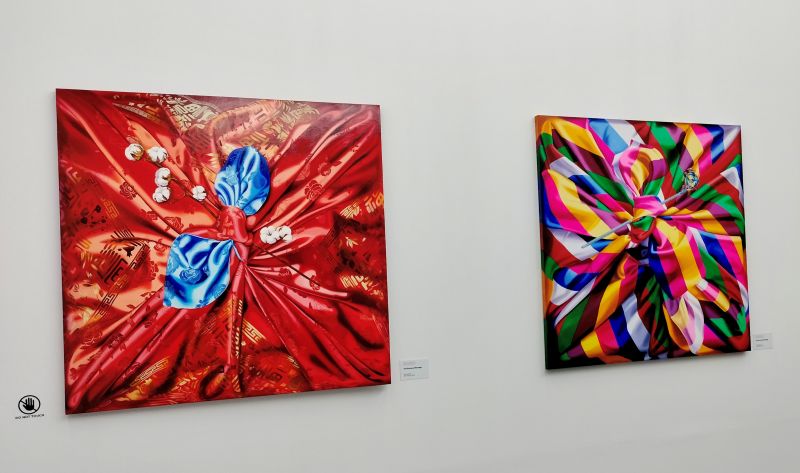
Kim Si Hyun’s ‘The Precious Message’ series
Kim Si Hyun gives the nondescript bojagi—Korean silk/sheer ramie wrapping cloth—a make-over in her hyper-realistic, oil-on-canvas series The Precious Message. She adapts the hanbok’s colorful striped sleeve patterns to the bojagi, which, with its adaptability, wraps objects of varied shapes and sizes, per the notes. The wrap cloth is a metaphor for openness and inclusion, and symbolizes cultural communication and diversity while carrying the hanbok’s wishes for happiness, health, and good fortune.
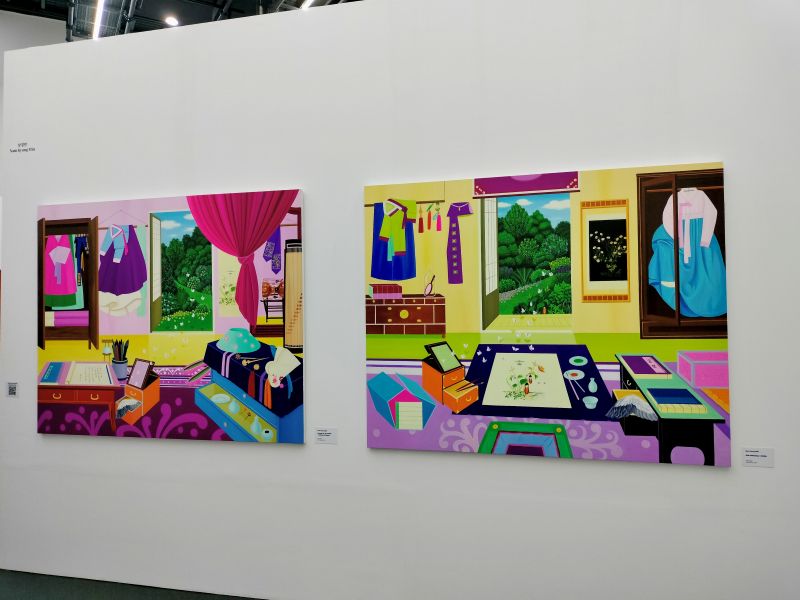
Nam Kyung Min’s ‘The room dedicated to Hwang Jin-I’ (left) and ‘Shin Saimdang’s atelier’
Nam Kyung Min honors two Korean women from the Joseon Dynasty with her oil paintings on linen. They are poet and courtesan Hwang Jin-i and artist Shin Saimdang, who pursued their ambitions despite social limitations, according to the notes. The works reference self-reflection, dreams, friendship, and aspiration through symbolic elements like mirrors, wings hidden in drawers, insects, and flowers.
The notes say she painted Hwang Jin-i’s elegance and brilliance through the traditional garments, accessories, and books in The room dedicated to Hwang Jin-i. In contrast, she highlighted Shin Saimdang’s intelligence and dignity in the clothes, painting tools, and artworks in Shin Saimdang’s atelier.
The hanbok’s evolution from national attire to cultural heritage, fashion item, and artwork is a remarkable—and enviable—achievement. Hanbok, Reborn as Art spotlights its resiliency and determination to keep Korea’s culture intact. Likewise, it’s a timely reminder to people not to let cultural heritage symbols fade away and ultimately deny future generations their culture and identity.
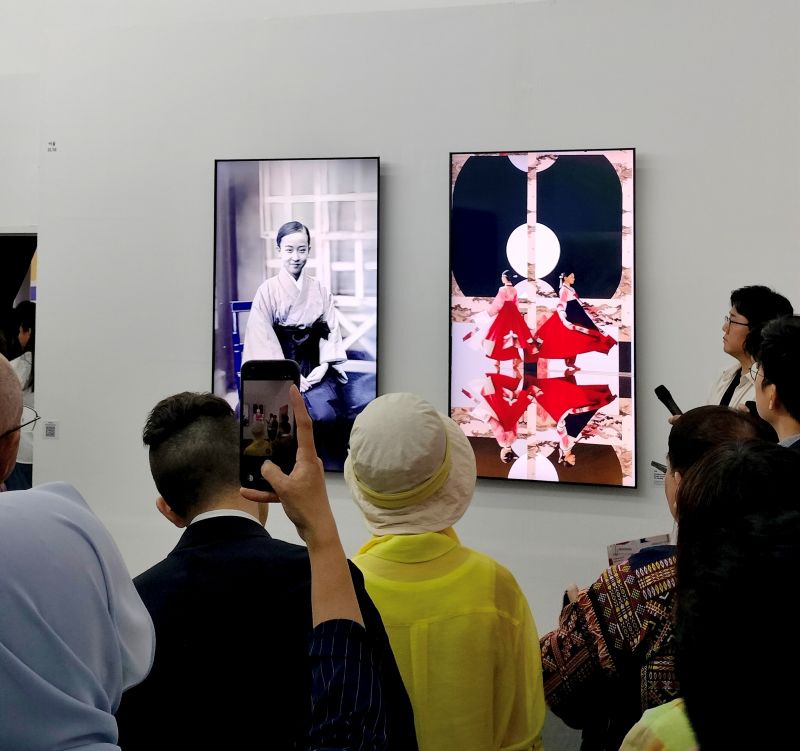
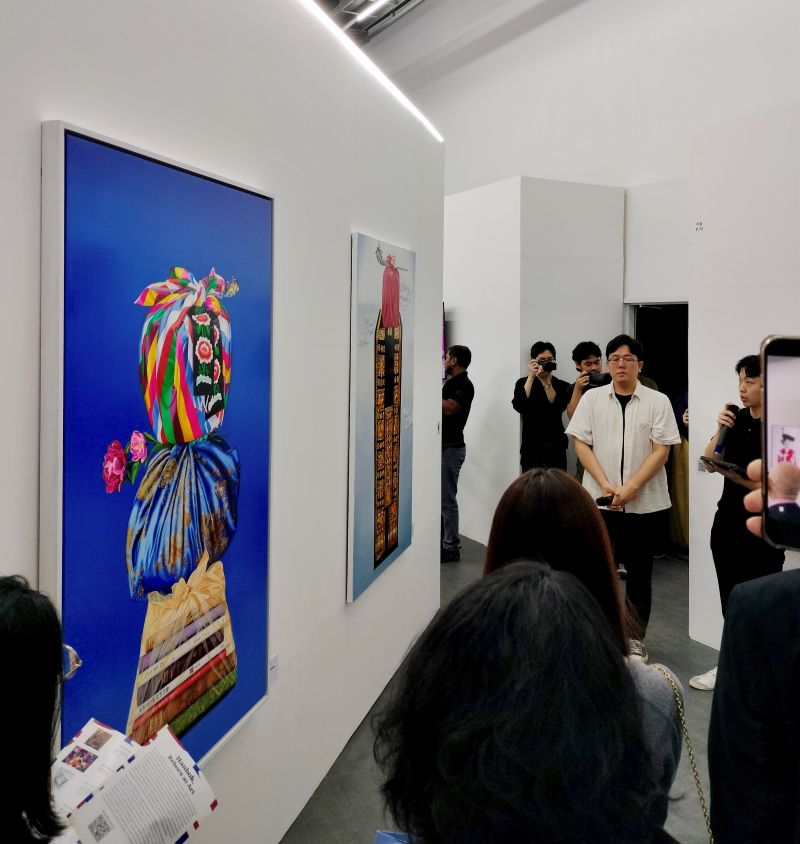
Guided tour of ‘Hanbok, Reborn as Art’ after the musical performance
‘Hanbok, Reborn as Art’ runs until Sept. 26, Mondays to Saturdays, 9 am to 4 pm, at KCC on 59 Bayani Road, Taguig. Admission is free. The exhibit also features an interactive kit for visitors to make and bring home a mini-‘hanbok,’ as well as a ‘hanbok’ experience corner where visitors may try on a traditional hanbok every Friday starting July 24. Groups interested in a free guided tour of the exhibition should e-mail info@koreanculture.ph.


