
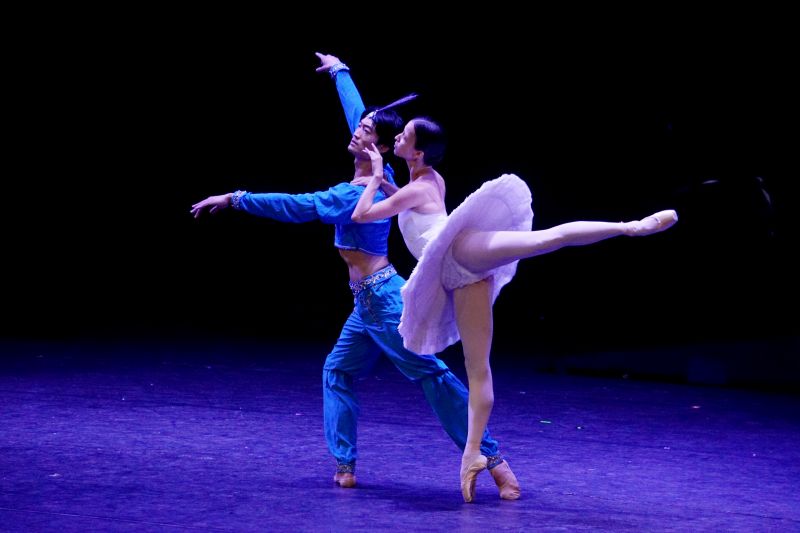
Photos by Teddy Pelaez
Ballet Manila’s La Bayadère runs Aug. 14–16, 2026 at Aliw Theater, Pasay City.
In the weeks leading up to Ballet Manila’s season ender, La Bayadère, a reel began making the rounds online. In it, Shamira Drapete, in the role of Gamzatti, the Rajah’s daughter and Solor’s betrothed, sits regally before Abigail Oliveiro’s Nikiya, the temple dancer who is in love with the same warrior. What follows is a confrontation between the two rivals, with Gamzatti clearly gaining the upper hand.
Lisa Macuja Elizalde, Ballet Manila’s artistic director and CEO, turned the mime scene into a comic blow-by-blow commentary, narrating the encounter like a ringside announcer calling a boxing match. The reel, featuring the alternate cast, pulled in a million views on Ballet Manila’s social media platform that day. It was Elizalde’s cheeky running commentary on two women fighting over one man that made the centuries-old ballet suddenly feel like something audiences could have fun with.
In the press conference, Elizalde was asked whether La Bayadère was a good entry point for audiences new to the classics. Not necessarily. She said Swan Lake, for instance, has many of the same elements, including a large cast, mime, character and national dances, and demanding showcases such as the pas de trois and grand pas de deux.
La Bayadère has its own crowd-pleasers. Elizalde pointed to the Golden Idol’s show-stopping solo, its spectacular leaps and turns performed by a danseur covered in gold. In the parasol dance, women weave across the stage carrying parasols. But what really draws her to the ballet is the plot built around a love triangle, and the Rajah’s manipulation of Nikiya.
“If a first-timer comes to watch La Bayadère, they see the whole story unfold and you become a balletomaniac,” she said. “You fall in love with ballet because it is so dramatic and exciting.”
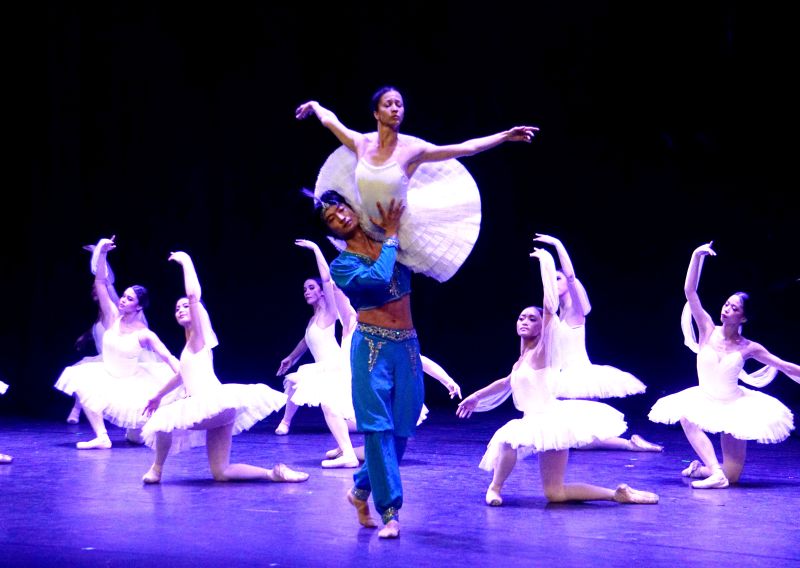
Over-the-shoulder lift
Elizalde considers La Bayadère one of the most beautiful and complete full-length ballets, even giving it edge over Swan Lake because of its drama.
In a press preview, Ballet Manila offered a glimpse of the third act, a sequence driven by grief, obsession, and demanding technique. The scene opened with a grief-stricken Solor, portrayed by Korean guest artist Kimin Kim, seeking refuge in an opium pipe. As the drug took hold, his longing for the departed Nikiya gave way to a hallucinatory vision, her figure multiplying across the stage.
Ballet Manila has another advantage beyond its large complement of dancers. Elizalde credits Russian imports Alexander Kurkov and Natalia Raldugina, whose coaching brings the Russian school of ballet into the studio. Kurkov was a principal dancer with the Kirov-Mariinsky Theatre for two decades before becoming a teacher and coach. Raldugina danced with the same company and went on to work as a ballet coach.
A ballet master or mistress is the outside eye that polishes technique, preserves the choreographer’s intentions, and helps dancers find the drama in the movement, from studio rehearsals to opening night.
For La Bayadère, that Russian lineage matters. The Vaganova tradition places equal importance on classical technique, musicality, and the expressive use of the body, qualities that become especially visible when an entire corps has to move, breathe, and respond as one.

Lisa Macuja Elizalde flanked by Kimin Kim and Renata Shakirova
The real come-on, however, is the pairing of guest artists Kimin Kim and Renata Shakirova, who both return to Ballet Manila after Don Quixote last year. Both bring the pedigree of the Mariinsky Ballet, but their approaches to La Bayadère are quite different.
Born in Seoul, Kim trained at the Korea National University of Arts under former Mariinsky dancers Vladimir Kim and Margarita Kulik, who grounded him in the Russian Vaganova tradition. After winning top international competitions, he joined the Mariinsky Ballet in 2011 and, four years later, became the first foreign principal in the company’s history.
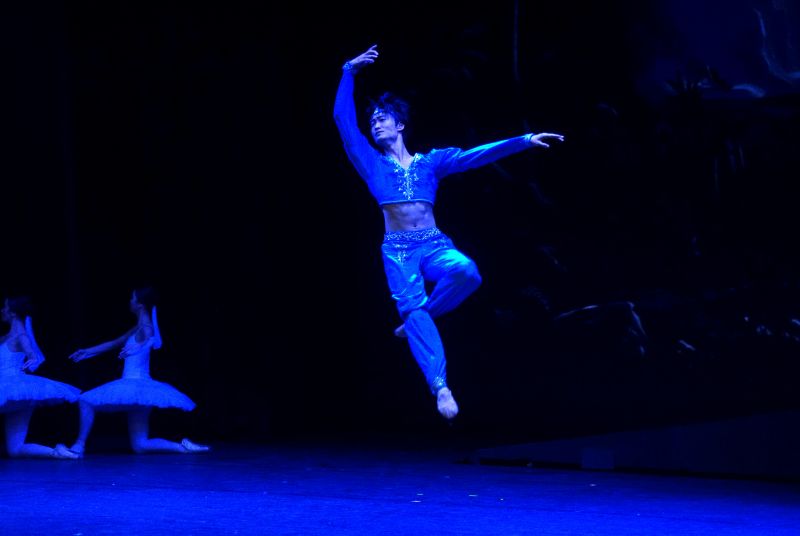
Kimin Kim suspended in the air
Onstage, Kim combines soaring athleticism with Mariinsky refinement. In the air, he achieves an effortless weightlessness, hanging at the peak of his grand jetés and scissor jumps before landing with soft control. His turns carry speed and clean alignment, while his bravura technique remains anchored in musicality and a noble presence.
Kim readily relates to the ballet’s central love triangle, having once gone through a breakup
His Solor, however, is not all about the fireworks. Kim takes an almost Method approach to the role, drawing on personal experience to get inside the warrior’s emotional conflict. He readily relates to the ballet’s central love triangle, having once gone through a breakup when a girlfriend left him for a close friend. The heartbreak is now a distant memory, but he channels that past betrayal into his performance, using real-life pain to give Solor’s conflict an immediate emotional weight onstage.
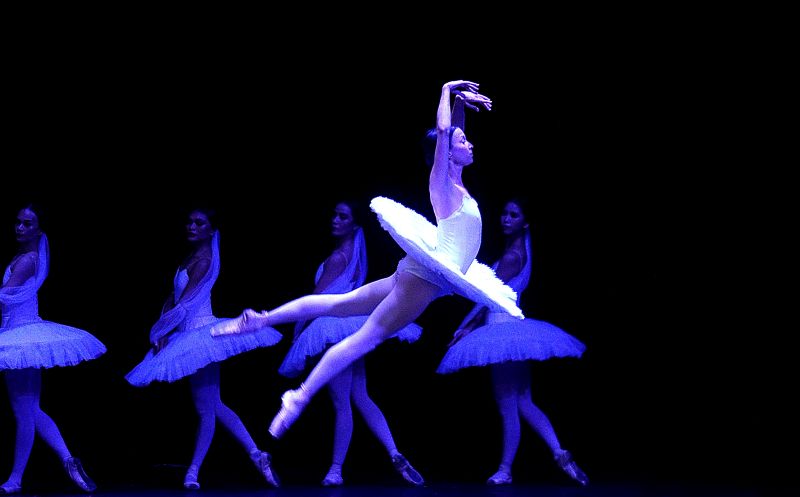
Renata Shakirova is airy and lyrical.
Shakirova comes from a different but equally strong Russian ballet lineage. Born in Tashkent, Uzbekistan, she studied at the prestigious Vaganova Ballet Academy under Tatiana Udalenkova and graduated in 2015. While a student, she performed roles with the Mariinsky Ballet, including Cupid in Don Quixote, and joined the company upon graduation. Shortly after, she made a high-profile principal debut as Kitri and won first prize alongside Kimin Kim on the Russian television series Grand Ballet in 2016.
Promoted to principal dancer at the Mariinsky in 2024, Shakirova has built a reputation for sharp musicality, rapid footwork, and a fiery, fearless stage presence. Her explosive speed is anchored on pristine Vaganova placement, moving easily between high-brio classical roles, Balanchine neo-classics, and dramatic contemporary works.
She has also performed both of La Bayadère’s leading female roles, acquiring an unusual perspective on the two rivals. Shakirova sees something of her own temperament in Gamzatti’s strong personality. Nikiya, whose story is shaped by devotion and betrayal, requires her to move far beyond her usual disposition.
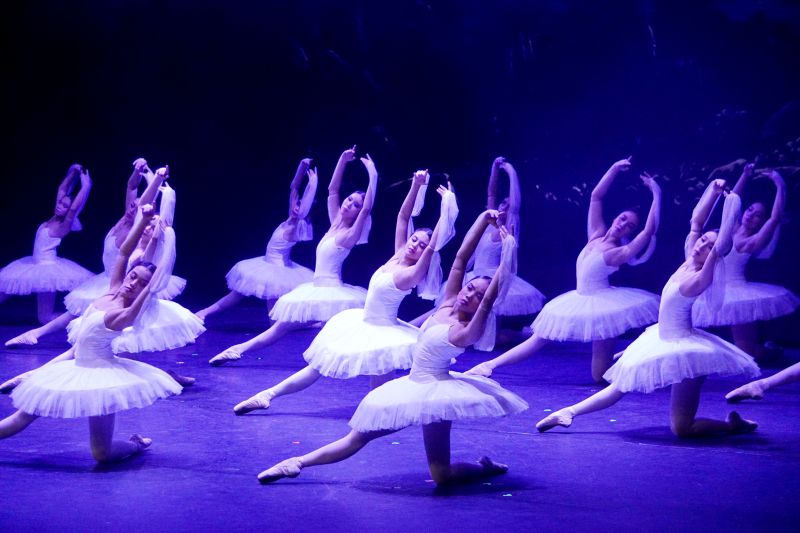
Ballet Manila’s strong corps de ballet in ‘The Kingdom of the Shades’
To bridge that gap, she relies on being a good listener, tuning in to the music, her partner, and the immediate moment. From there, she allows the emotion to flow through the performance rather than trying to impose it.
For Kim, partnership is at the heart of his work. While a solo technical mistake can keep him awake at night, letting down a partner causes him far greater distress. With Shakirova, that anxiety disappears. He finds dancing with her effortless, guided by her eyes, which convey every cue. Her technique, musicality, and emotional presence make his own responses feel instinctive.
Shakirova describes their chemistry onstage as immediate and unfiltered. Every moment in La Bayadère is heightened by Kim’s generosity as a partner. Having absorbed his phrasing and nuances since their earliest rehearsals together a decade ago, she now finds dancing with him second nature. She lets the drama unfold naturally for both dancers and the audience.
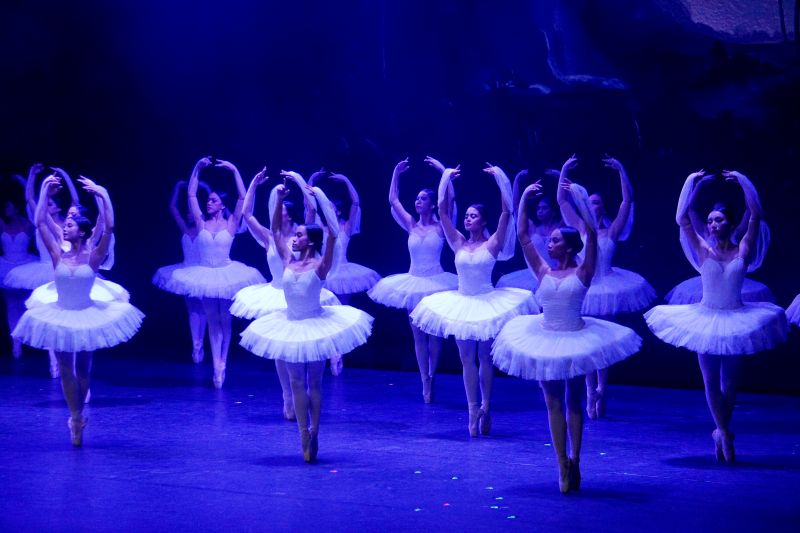
Precision ensemble work in ‘The Kingdom of the Shades’
Together, they give La Bayadère what every great ballet needs–dancers who make the technique disappear into the story.
Ballet Manila’s ‘La Bayadère’ runs Aug. 14–16, 2026 at Aliw Theater, Pasay City. Tickets are available through Ballet Manila or at Aliw Theater.


