
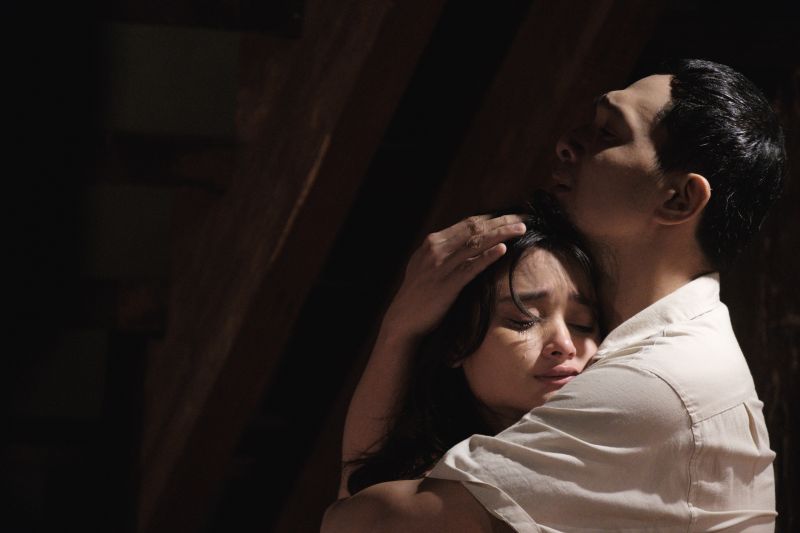
‘El Fuego del Alma’ runs Aug. 21, 22, 23 at Sine Pop, 14 St. Mary, Quezon City.
One might call this production serendipitous, where theater material and space found themselves in what was not quite happenstance. Theater director Mark Mirando and property owner Carlson Chan didn’t just make do with what was at hand, but, in fact, went beyond expectations, creating an unusual yet ideal environment for the maiden production of the theater group Porvenir, and the directorial debut of Mirando.
El Fuego del Alma is Tennessee Williams’ Summer and Smoke lyrically translated to Pilipino by Eljay Castro Deldoc. It was a linguistic fit for the theater space, an adaptively reused, good-sized family home once owned by Sotero Pasion Eugenio and his wife Lourdes Sabas Sequi. “I have many wonderful and tender memories living there,” says their son, Pedro Eugenio, their family having lived there for 70 years, in a chat with TheDiarist.ph. “I’m happy to see that it has been restored beautifully.”
Adaptive reuse, although it has been in practice in age-old civilizations, took root in the Philippines only in the early ‘70’s as a counter-movement to the demolition of ancestral homes and old structures deemed worthless, when in truth, preserving them became a precious physical record of structural heritage. Heritage groups have long been advocating this practice since then.
All over the country are living specimens of the efforts, as seen in the Syquia Mansion in Vigan, Ilocos Sur, now a Living History Museum; Balay ni Tana Dicang in Talisay, Negros, a house museum displaying beautiful period furniture, decorations, and objects; the Goldenberg Mansion, now an events place; the Rizal Park Hotel, once the Agricultural and Commerce Building; and the First United Building, now a creative hub, once the 1928 Perez- Samanilio Building, just to name a few.
The Eugenio house, now known as Sine Pop, is one of the more recent adaptively reused homes that has found its niche as a cinema, events, and theater space.
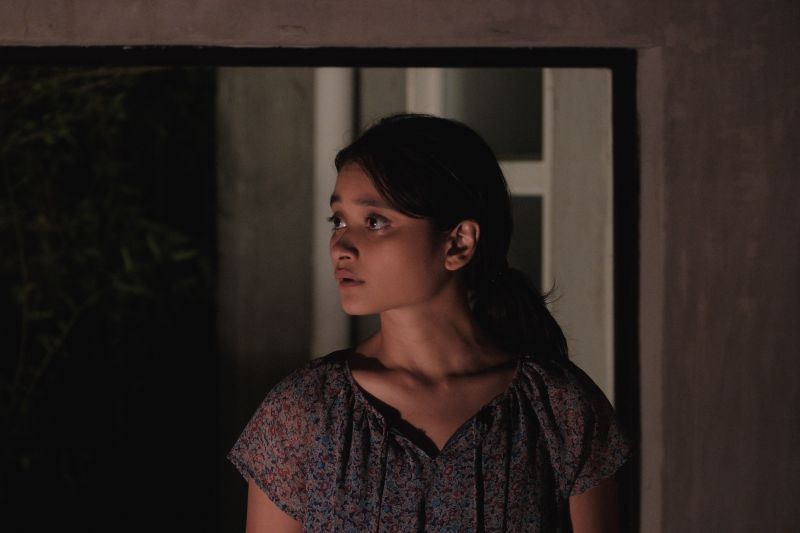
Nour Hooshmand as Alma
As fate would have it, the construction of the house was completed in 1948, the same year Tennessee Williams finished writing Summer and Smoke, a bittersweet story of an unmarried minister’s daughter, named Alma, obsessively protecting her purity and morality under threat of sin, and yet getting sexually attracted to a hedonistic, sensual young doctor, Juanito, who lives for the flesh. Their “spiritual romance” is a case of look but do not touch, flirtation with repressed lust within. When Juanito makes physical advances, Alma rejects him. But when Juanito’s life is shattered by tragedy when his father is shot, it drives him to seek spiritual perspectives, leading him to evaluate his life, leading to transformation.
Alma, on the other hand, decides to abandon her repressions, giving in to her physical desires. Ironically, in finding themselves, they lose themselves. Juanito’s attraction shifts to Rosa, whom he eventually marries, leaving Alma distraught and broken. It’s a love that was never meant to be, unrequited both ways.
As the theater piece reaches its denouement, the sense of place suddenly seems to weave in tune with the plot, just as the characters’ personas switch, yet still remain antithetical.
The repurposed architecture of the house, as sanctioned by its proprietor, Carlson Chan, suddenly lends itself to space and time in consonance with the theatrical action. The recycled wooden pillars and wood grille ceiling, the rough cement on the walls, even the repurposed bedposts serving as door pulls on the glass doors, contribute to a specific time and place. The lush bamboo forest for a garden creates a chiaroscuro effect as the leaves sway in the wind and rain, transporting the audience to where and when this sort of plot thickening could have possibly taken place.
Because the structure itself is familiar to many who have experienced living in or at least knowing this kind of space, whether it is a grandparents’ home or where one actually lived, there is a qualified, tangible reason for landscape and memory.
“My first encounter with the space was magical,” Mirando says, ”because so many of its existing materials already resembled what I had been imagining for the world of the play…Nature, for instance, is an important part of the play’s scenography…so when I saw the bamboo garden at Sine Pop, it immediately made sense to me as part of that world.”
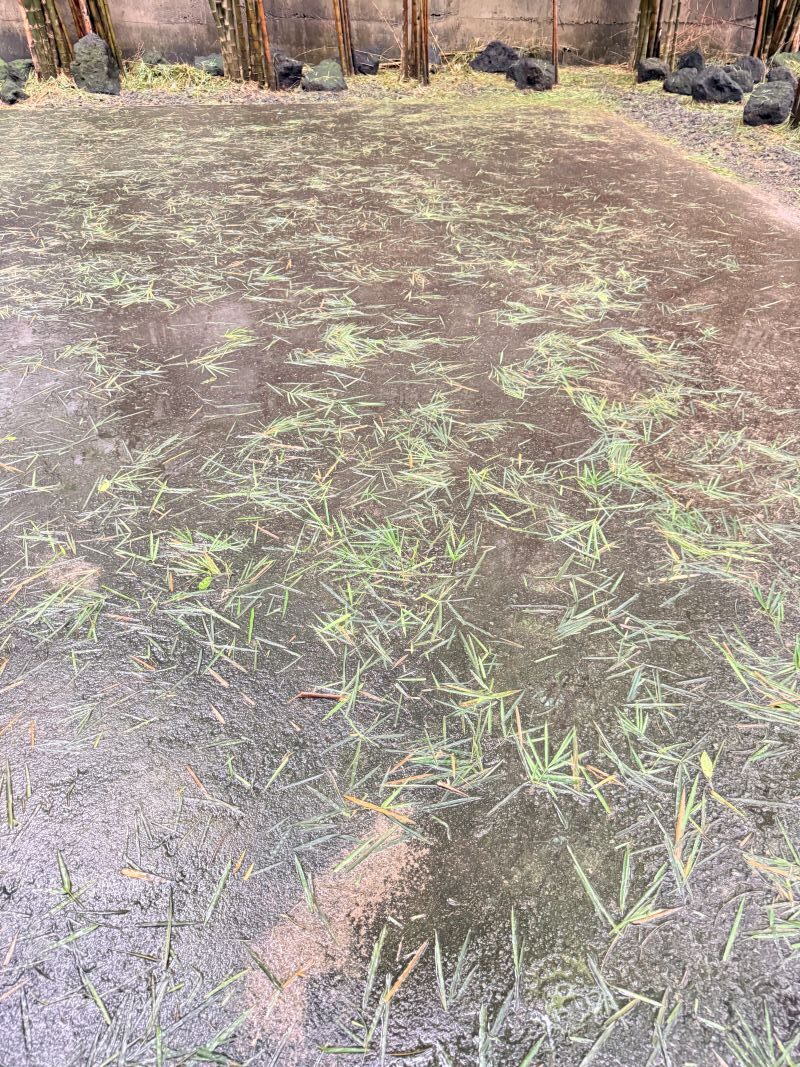
A walk of bamboo leaves
The exterior, which includes the garden of tall bamboos, as seen through the wide panoramic glass, adds to that sense of theater-on-the-round, except that instead of the audience being around the set, it is the set, in this case a living, swaying bamboo forest, that bounds the audience on two sides, making it an up close and personal theater.
When dialogue from the outside is done by the actor to an actor inside, the audience becomes part of the action, an eyewitness, an integral part of the play. Director Mirando doesn’t miss the opportunity to encase that, just as he makes use of the unusual “non-proscenium” set-up of the performance space.
This play, though it is the debut of Mark Mirando, does not identify him as an experimental rookie, as he is trained in devised theater, which, he explains to TheDiarist.ph, “places equal importance on the ensemble, the space, the performers, improvisation,” as discovered in the rehearsal room.
He explains that devising theater taught him that “limitations could actually become part of the creative process…appreciating architecture, particularly old houses, and recognizing their potential as tools for storytelling…that has become an important foundation of my spatial and compositional language as a director.”
Although Carlson Chan initially did not envision the adaptively reused residence as theater space— it came as afterthought to his original plan for a cinema, Sine Pop. However, with the resounding success of its maiden production of six sold-out performances, Chan now clearly sees a bright future for Sine Pop as an innovative theater venue.
A big part of the success of El Fuego del Alma is its superb cast of fresh and seasoned gifted actors and actresses: Nour Hooshmand, Harriette Mozelle, Opaline Santos, Madeleine Nicolas, Sandino Martin, Vincent Pajara, JP Lopez, Sheryl Ceasico, Ingrid Joyce, Janna Cortes, Tristan Bite, and Johnny Maglinao, comprising Porvenir under director Mark Mirando.
The group is in for a future of superb theater productions, just as Sine Pop stands as an innovative venue for intimate, private cinema showings. It’s a fresh, new approach to life’s diversions. To see is to believe.
‘El Fuego del Alma’ runs Aug. 21, 22, 23 at Sine Pop, 14 St. Mary, Quezon City.


