
León Gallery’s The Magnificent September Auction 2026 will be held on Saturday, 12 September 2026, 2 p.m. The preview exhibit is running September 5 to September 11, from 9 AM to 7 PM, at G/F Eurovilla 1, Rufino corner Legazpi Streets, Legazpi Village, Makati City.
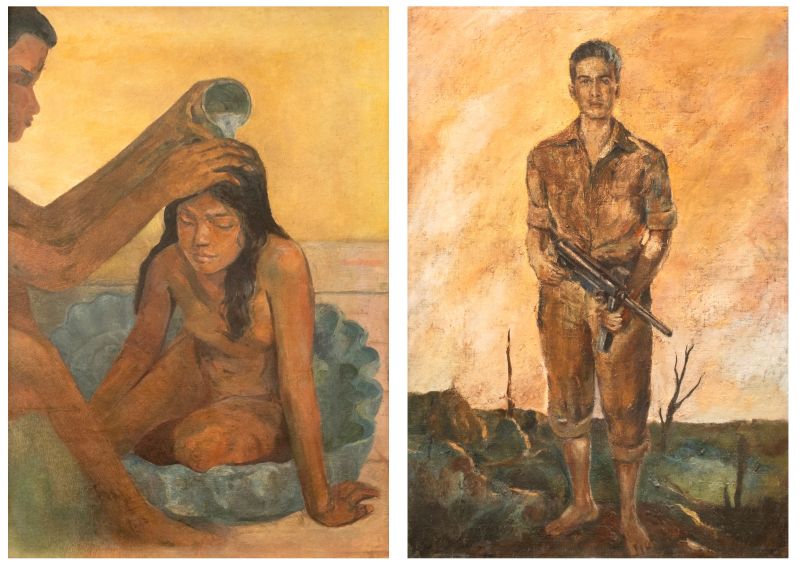
Resurfacing today, after 81 years, is this rare, two-sided wartime masterpiece, painted by Anita Magsaysay in her maiden years, featuring a handsome portrait of Old Manila high society gentleman, Don Bernardino “Banding” Ramos Hernandez, Jr., as a young guerilla soldier in World War II.
The work is the only known wartime masterpiece painted on canvas by Anita. It is a highlight of León Gallery’s The Magnificent September Auction on Sept. 12, 2026.
Anita Magsaysay-Ho’s out-of-the-ordinary practice of painting back-to-back on a single canvas or board began in the war years, when scarcity was the “new normal” and survival a daily necessity. These works, painted between 1943 and 1945, towards the end of World War II, were created by Anita in their family residence on Villaruel Street in Pasay, a few blocks away from the Church of Our Lady of Sorrows along F.B. Harrison Street.
Young Girl Bathing was painted sometime between 1943 and 1944, before Anita and her family made that great escape to the mountains of Montalban, Rizal, taking refuge in the house of a family friend, Dr. Cueto, in the early months of 1944. The Magsaysay family evacuated to Montalban when news of the impending return of the American forces under General MacArthur and the imminent battle for Manila’s liberation spread like wildfire across the city. In Montalban, Anita continued painting, this time on recycled boards, since materials were scarce. She created palette-knife landscapes and scenes of everyday wartime.
Young Girl Bathing is an innocent portrait of a girl being given a bath in a batya (a traditional Filipino tub) by a woman who must be her mother. The composition is rustic, with an earthy palette, echoing Botong Francisco’s Gauguin-inspired early works and carrying a post-impressionistic flair. The composition shows Anita’s early modernist inclinations, which she acquired in 1937 at the School of Design (Atelier of Modern Art) under the modernist patriarch, Victorio Edades. There, Anita discovered the styles and techniques of Paul Cezanne, Pierre-August Renoir, Paul Gauguin, and Henri Matisse, among others.
Anita recalled in her memoirs that when food became expensive in Montalban, her family returned to their Pasay home toward the end of that same year. She recalled learning from her father, Don Ambrosio (who visited them once in a while in Montalban, given his responsibilities as general manager of the Metropolitan Water District), how their houseboy took good care of their garden, growing “vegetables, eggplants, tomatoes, beans, squashes, and camote.” Given their abundant supply of homegrown food, Anita’s mother, Doña Amalia Corpus, told her family that it was time to “go home.”
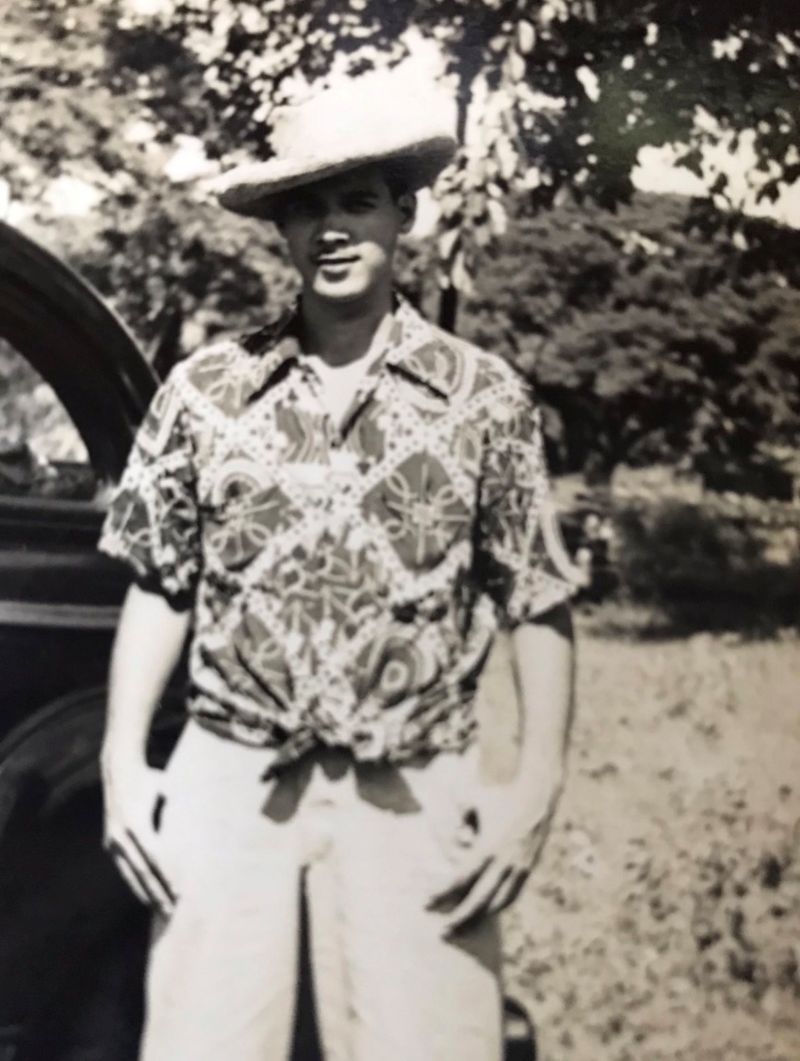
Photo of Bernardino “Banding” Hernandez as a young man after WWII, circa 1940s. © Natty Hernandez McKernan
Back in their Pasay home, Anita reunited with her remaining oil paints, brushes, and canvases. It was likely during this time that she painted, on the back of the first work, a portrait of the young and handsome Bernardino “Banding” Ramos Hernandez, Jr. as a guerrilla soldier, around 18 to 19 years old.
In a correspondence with León Gallery, Natividad “Natty” Hernandez-McKernan, Bernardino’s daughter, said that Anita, whose Corpus side of her family were close friends to the Hernandezes, was “thrilled that my father had joined the guerrilla movement” (the young Anita seemingly had a “happy crush” on the dashing Bernardino). The Hernandezes lived in San Juan Street in Pasay, near the Magsaysay residence in Villaruel Street.
Isidra Reyes described Banding’s portrait in the León Gallery catalog as “wearing a guerilla uniform with pants that are folded just below the knee. He is barefoot. On both hands he holds a Thompson MIAI, a modification of the famous American Thompson submachine gun developed by John T. Thompson during WWI. This modification dates back to 1943. Banding’s rugged movie star looks recalls Leopoldo Salcedo and Mario Montenegro playing guerillas in war movies in the 1940s-1950s.”
Banding Hernandez was born on May 11, 1926 in the Hernandez family home in San Juan Street, Pasay. He was one of Don Bernardino Alvarez Hernandez, Sr.’s seven children from his third wife, Natividad “Naty” Legaspi Ramos, who hailed from Meycauyan, Bulacan.
According to Reyes, Don Bernardino was “a man of prominence.” He was born in Corregidor on July 5, 1859 to a full-blooded Spanish teniente de la marina, Don Bernardino Sutil Hernandez, and a mestiza española, Doña Januaria Martina Mejares Alvarez. Bernardino was educated at the Ateneo Municipal, the Colegio de San Juan de Letrán, and the University of Santo Tomas.
Wrote Reyes, “When Ateneo de Manila celebrated its golden jubilee in 1910, he was one of the school’s distinguished alumni together with Manila Mayor Felix Roxas and Pedro Paterno among others.”
Don Bernardino Sr. also became an editor and publisher of the Spanish language newspapers, La Opinion and El Comercio. He also became a member of the board of directors of the pioneering banking institution, Banco Espanol Filipino from 1908 to 1909, and its successor, the Bank of the Philippine Islands, from 1911 to 1912. He sat on the powerful board of directors with other prominent members of high society, such as Mariano Limjap, Felix Ma. Roxas, Juan J. Tuason, and Gregorio Araneta.
Reyes noted that Banding “was only eight years old when his father died, leaving his widowed mother, Natividad, with seven children to raise and take care of. His daughter, Natty remembers her Lola Naty as a feisty, good-looking woman whom she adored and had a great influence in her life.”
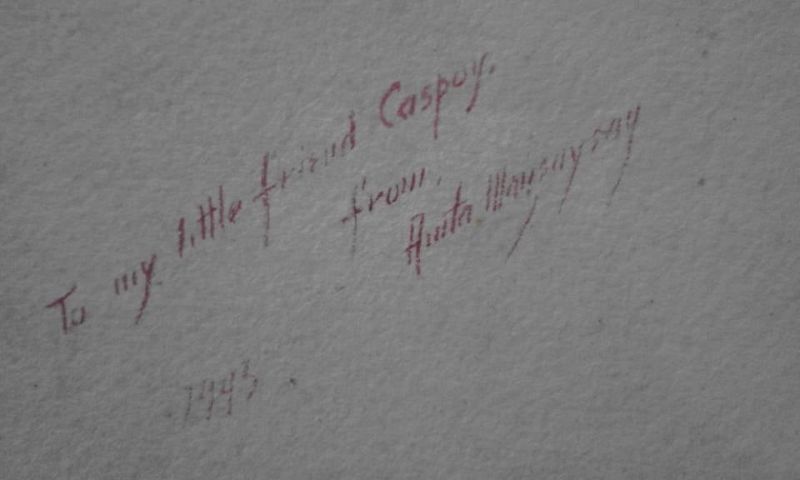
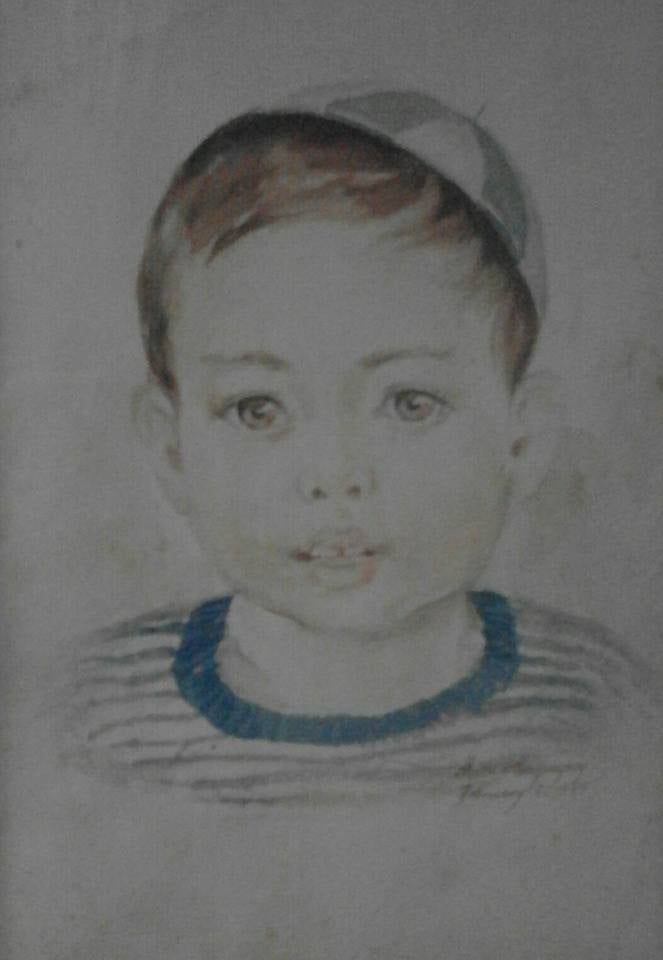
Anita’s watercolor portrait of Caspoy, Banding’s nephew and the son of his older sister Carmen
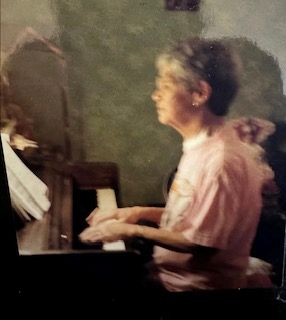
Carmen Hernandez playing the piano that was gifted by Elenita Magsaysay Corpus-
Bolipata, a relative of Dona Amalia Corpus Magsaysay, Anita’s mother
The Hernandezes and the Magsaysays maintained close ties even during the war. On Feb. 2, 1945, a day before the Battle of Manila, Anita painted and gifted the family a charming watercolor portrait of Caspoy, Banding’s adorable nephew and the son of his older sister Carmen, who was a piano teacher at the nearby St. Scholastica’s College along Leon Guinto St. in Malate, Manila. Carmen was also gifted a piano by Elenita Magsaysay Corpus-Bolipata, a relative of Doña Amalia Corpus Magsaysay, Anita’s mother. Elenita was the mother of the well-known Bolipata siblings: Jed the pianist, Chino the cellist, Coke the violinist, Plet the painter (and would become the wife of a titan of contemporary Philippine art Elmer Borlongan), Non the lawyer, and Rica the writer.
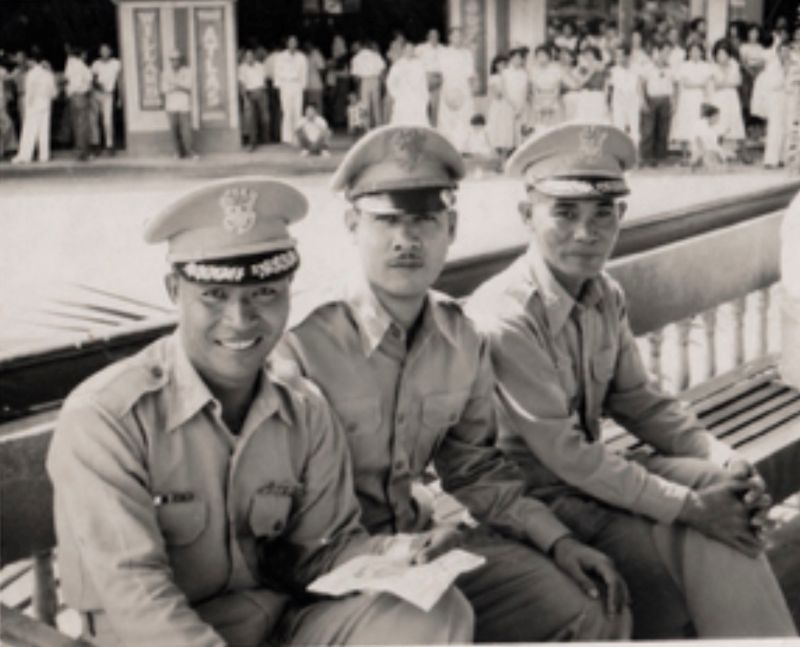
Banding (middle) with army buddies
In the post-war era, Banding continued his military service as a soldier for the Philippine Army. He also became the aide-de-camp of senator and later Vice President Emmanuel Neri Pelaez, who was a relative of Banding’s wife, Concepcion “Nena” Fernandez Neri. When he retired from the bureaucracy, Banding immersed himself in civic obligations as a noted Rotarian.
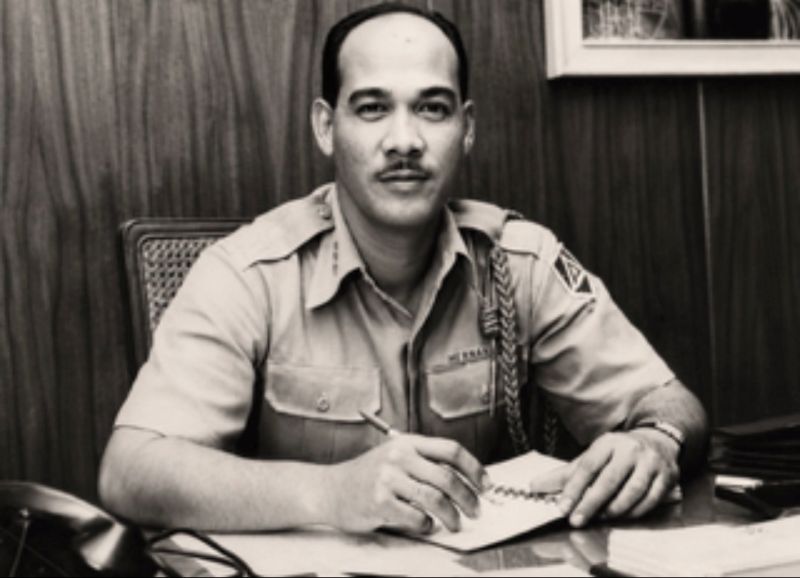
Bernardino Ramos Hernandez, Jr. as aide-de-camp of senator and later Vice President Emmanuel Pelaez. © Natty Hernandez McKernan
Natty, as Reyes put it, “recalls that the portrait was always with the family wherever they lived. She always joked that it was like her Papa was keeping an eye on his family with the machine gun in his hand, ready to shoot invaders.”
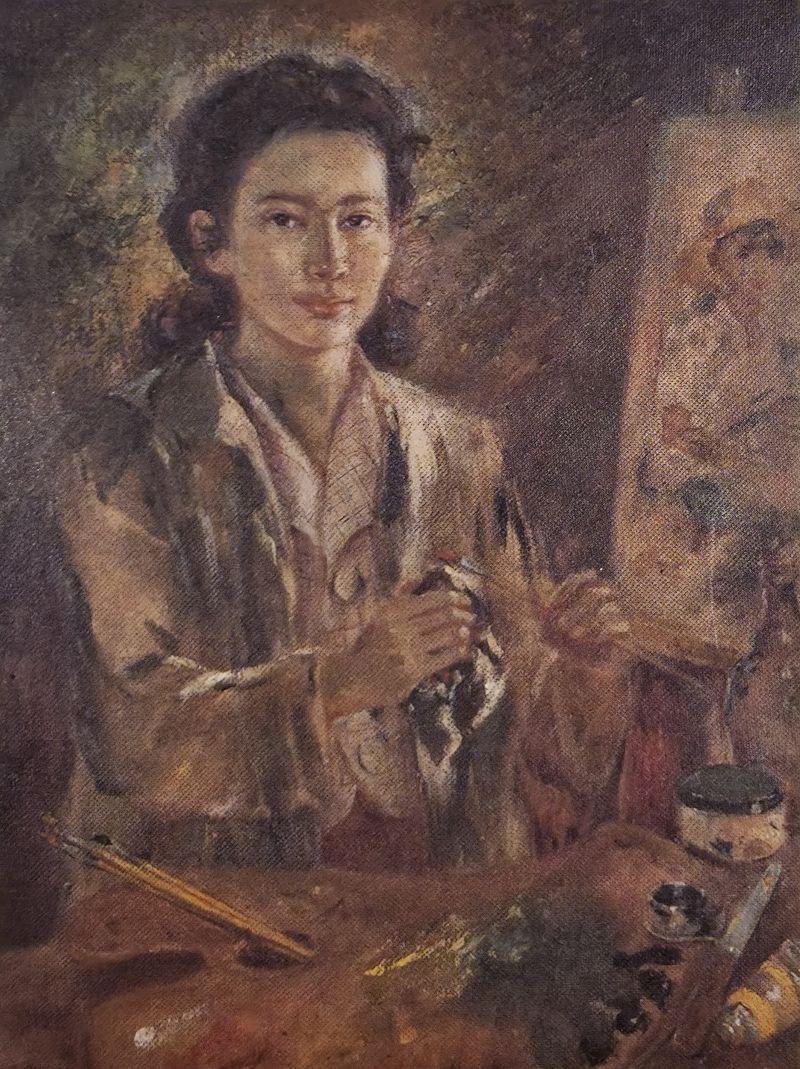
The maiden Anita Magsaysay in 1944. Self-Portrait, 1944 (oil on bristol board Private Collection). © Reproduced in the book Anita Magsaysay-Ho: Isang Pag-Alaala
The painting of a young girl, paired with Bernardino’s portrait, may have reminded young Anita of that valiant act of serving and fighting for the nation; she even praised in her 1944 poem the “brave youth that struggle,” exalting these warriors of the motherland in their resolute endeavors for an invigorating return to pleasant, peaceful times, further emphasized by the warmth and solace exuded by the earthy tones.
Interestingly, Anita’s cousin, Ramon Magsaysay, who would be President, founded and led the Western Luzon Guerrilla Forces, which operated in Central Luzon and organized a formidable army of 10,000 men by January 1945.
This two-sided painting is the only known work on canvas Anita created during the war, as she painted mainly on wooden boards during this period.
The works also evoke Anita’s memories of the last months of the Pacific War. In her memoirs, she shared that she and her family were elated upon hearing the news of MacArthur’s landing in Leyte (October 1944). But this joy proved short-lived when they learned of the Japanese plans to set the city ablaze in their final retreat.
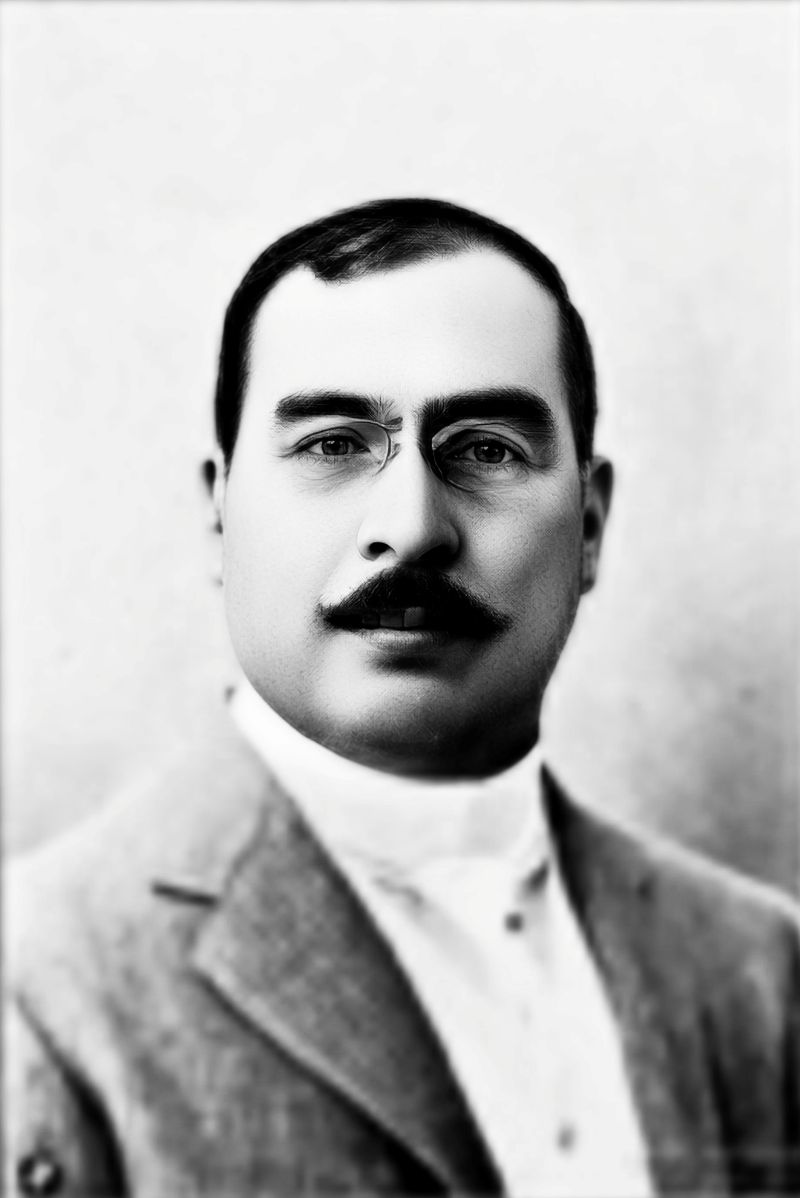
Portrait of Don Bernardino Alvarez Hernandez as proprietor of Libreria de Bren in Calle Magallanes 10, Intramuros, Manila © Natty Hernandez McPortrait of Don Bernardino Alvarez Hernandez as proprietor of Libreria de Bren in Calle Magallanes 10, Intramuros, Manila together with his first wife, Paz Bren. Source: Natty Hernandez McKernanKernan
“News reached us that American tanks were already in Pasay. Our good neighbors, the Alfonsos, advised us to go and leave our home as they learned that the Japanese had planned to burn our area that night. We brought as many valuables as we could carry. We set off for the house of a friend called Dr. Veloso who was on Dominga Street. We locked up our house and walked carefully through a mined road, towards Libertad Street until we reached the house of the good doctor.”
“That night,” Anita continued, “we could see the fires burning in Pasay and turning the sky red in the vicinity of our Villaruel home.” Luckily, the Magsaysays’ house was spared, leaving this painting intact, a cultural survivor in the ruins of war.
León Gallery’s The Magnificent September Auction 2026 will be held on Saturday, 12 September 2026, 2 p.m. The preview exhibit is running September 5 to September 11, from 9 AM to 7 PM, at G/F Eurovilla 1, Rufino corner Legazpi Streets, Legazpi Village, Makati City.
To browse the online catalog, visit https://leon-gallery.com/. For further inquiries, email info@leon-gallery.com or contact 8856 2781. Follow León Gallery on their social media pages for timely updates: Facebook: www.facebook.com/leongallerymakati and Instagram: @leongallerymakati.


