
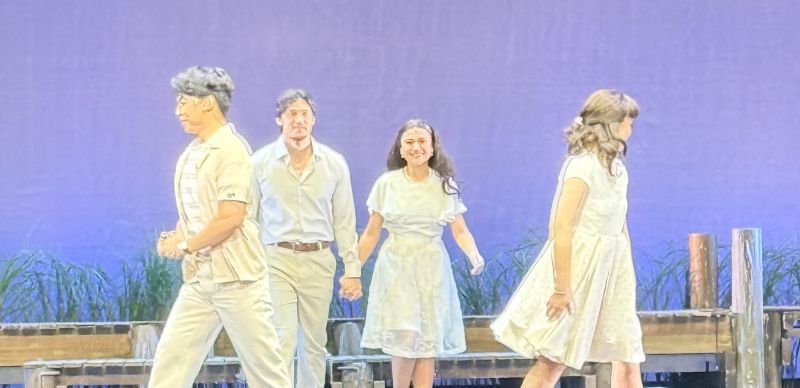
‘The Notebook: The Musical’ by Theatre Group Asia runs until Sept. 20, 2026 at Samsung Performing Arts Theater, Circuit Makati. Tickets are available through TicketWorld.
The Notebook is simply a love story of a couple who fell in love as teenagers, but were separated by circumstances beyond their control, the girl getting engaged to another man. Despite their separation, with the man’s letters left unanswered, romantic destiny brings them back together. They end up growing old together.
Plotwise, it’s a simple teleserye. However, the staging gives an edge to this tearjerker, heart-thumping storyline. The curtain rises to reveal an empty stage, save for a table at the corner where a couple is seated, the man, Noah, reading a book to Allie, his wife.
The theater piece is structured in such a way that the viewer is made privy to three generations of a single storyline, even in the absence of traditional chronology. In the end, however, everything makes sense and completes the big picture.
To achieve this, more than the acting and singing talent of the cast, there is a need for distinct and precise coordination among the production team members—the director, the lighting designer, the production and set designer, and the choreographer or movement coach—for a fluid and unified staging.
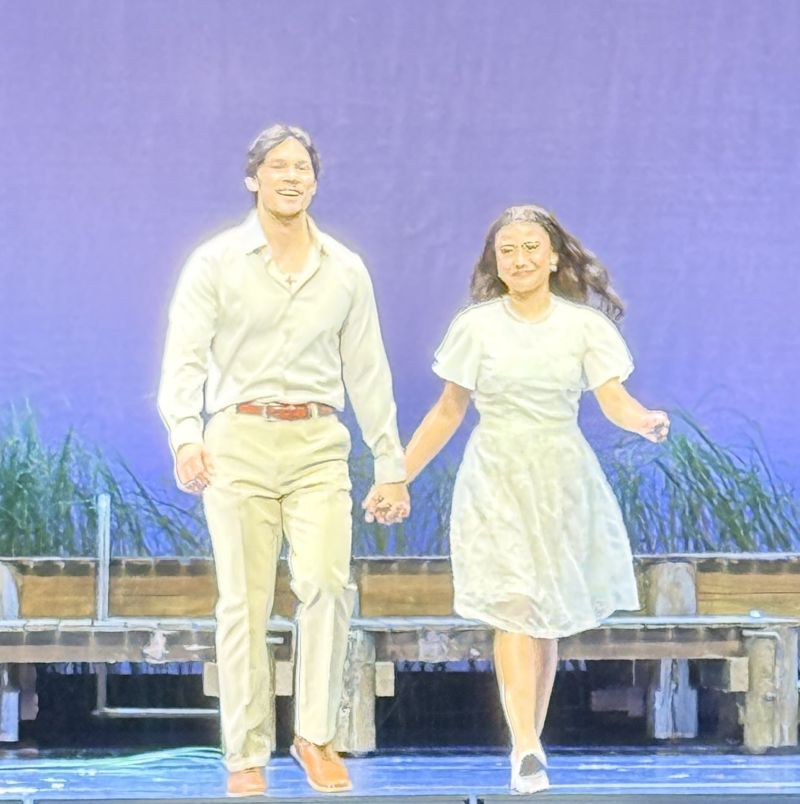
Laurence Mossman, Morisette
First, there is the triple casting of two lead characters, Noah and Allie, a husband and wife, acted out by three pairs of actors, representing a young couple, a middle-aged couple, and an old couple. The plot is established by the aging couple in the twilight of life, with Allie, the wife, beset with Alzheimer’s disease, and her husband, Noah, who reads to her a book in the hope that it could bring back memories.
At times, all three generations are onstage, where alternately, they recall their younger selves, trying to pinpoint perhaps their weaknesses and strengths, almost reflecting on what could have been, how they are living with past triumphs or mistakes. At the center of the plot is the emphasis on memory, demonstrated by Allie’s condition.
The non-linear plotline opened up options of interpretation to the production staff.
For sets, there was a movable American period house. In the movie, it’s like a plantation house. In this production, it could pass for a post-modern structure. The house’s shape is important for movement, so perhaps boxy would be the most logical shape.
In given moments, the house splits in half, or fourths, depending on the action of the characters. The lighting design is not the usual spotlights nor shin-buster lights. It plays a big part in pushing forth emotions, moving in time with the music’s sympathetic tearjerkers.
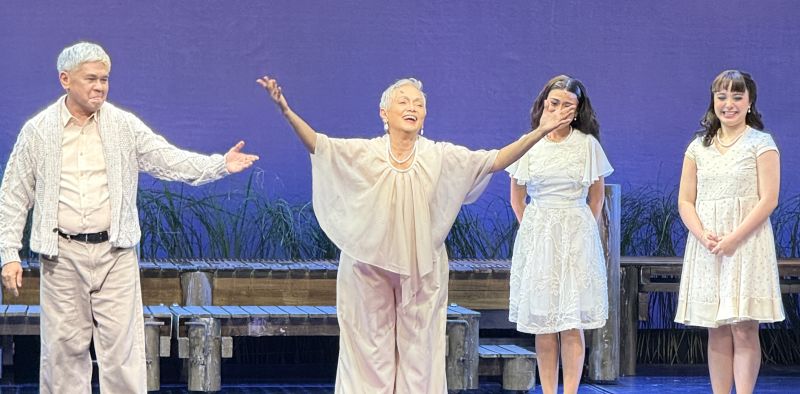
Rody Vera, Celeste Legaspi
Young director Nicholas Polonio is adept at moving the plotline along with the technical aspects, to the score. The older characters—OPM icon Celeste Legaspi and veteran actor and playwright Rody Vera—proved their theatrical experience as they delineated their characters with ease, devoid of pretension, reflecting their mature years, while at the same time allowing the audience to feel the restriction and burden of old age.
The struggle of each pair is not the sentimental love, but how to hold on to what they have despite the circumstances.
Among the three pairs, the biggest challenge faced is the absence of memory. The songs alone cast a shadow on that struggle: Leave the Light On by the middle Noah, We Have to Try by the younger couples, and It’s Not Easy, clearly hinting at the struggle with the uncertainty of emotions.
The audience breathes a sigh of relief when, through the older Noah’s dogged effort to consistently read the book to Allie—in fact, a notebook, a diary—bits of recognition and remembrance start flowing back. When she holds Noah’s hands, she recalls his touch and repeats, “You are my husband, you are my husband! I know your hands!”, recalling the words of preacher Dawson Trotman that “thoughts disentangle themselves when they pass through lips and the fingertips.”
That fleeting moment of recognition is followed by a heart-wrenching duet sung by Rody Vera and Celeste Legaspi as the old Noah and Allie, with dramatic hesitation, followed by the painful reality of impending death: “It’s like a dream, within a dream, within a dream…where do we go, when do we go? When do we disappear, where do we go? Help me, Noah, help me while I’m here…”
They go to sleep together, perhaps uncertain if they will once more see daylight.
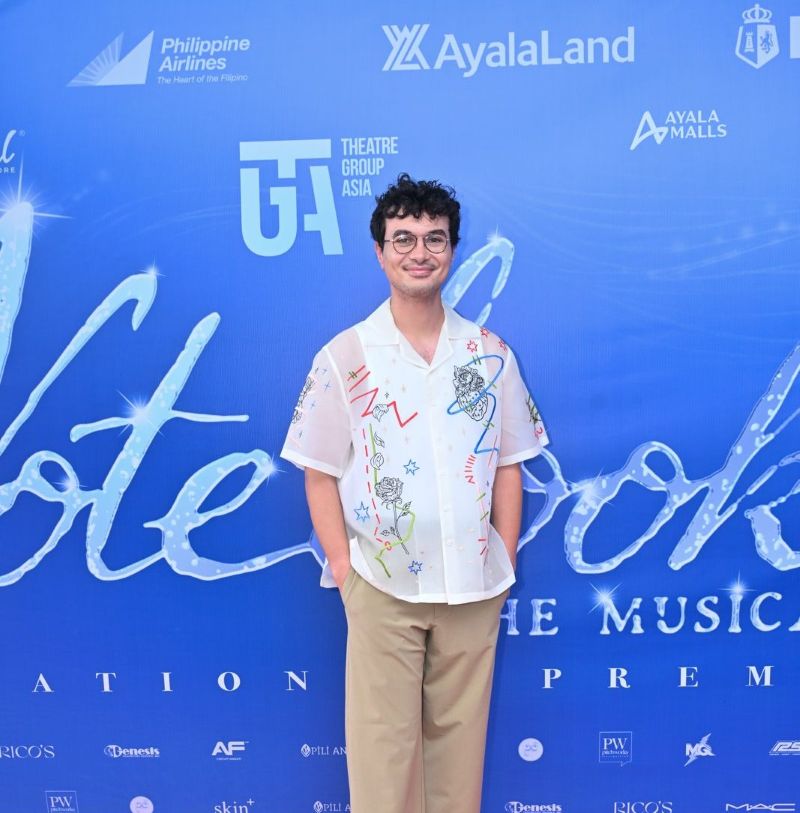
Director Nicholas Polonio
Director Nicholas Polonio, lighting designer Cha See, production designer Miguel Urbino, choreographer JM Cabling make up the crew. Altogether, the production by Theatre Group Asia is a bit of creative genius by a production group collectively unafraid of crossing the line. Instead, they deliver a cutting-edge, thought-provoking, emotion-filled theater that is much more than a simple tearjerker.


