

Award-winning playwright Frank Rivera says he started concocting fictional stories when he was a four-year-old growing up in Paete, Laguna. His knack for storytelling began when he became engrossed in the comic books of his older siblings. He couldn’t read yet, so he’d invent his own plot which, to his four-year-old eyes, seemed compatible with the comic book illustrations. He recited his stories with gusto. He captured an audience that primarily belonged to his age group, friends in the neighborhood.
Hence, not only was an author born; it was the start of Frank Rivera’s passion for the performing arts. He’s long been esteemed for his works as playwright, director, actor, and music composer. He’s been consistent in the themes he wrote about: social inequality, political statements, cultural heritage. With such credits, he should be named a National Artist.
“But don’t make this story about me,” he reminded me when I went to meet him at Shangri-La Plaza Mall. He was attending the book launch of The Quiet Man, a critique by long-time cinephile Noel Vera on the works of the late film director Mario O’Hara. Rivera and O’Hara were old friends and colleagues, and he was invited as guest speaker. When he spoke at the podium, everyone listened. A man of the theater, he has a commanding stage presence.
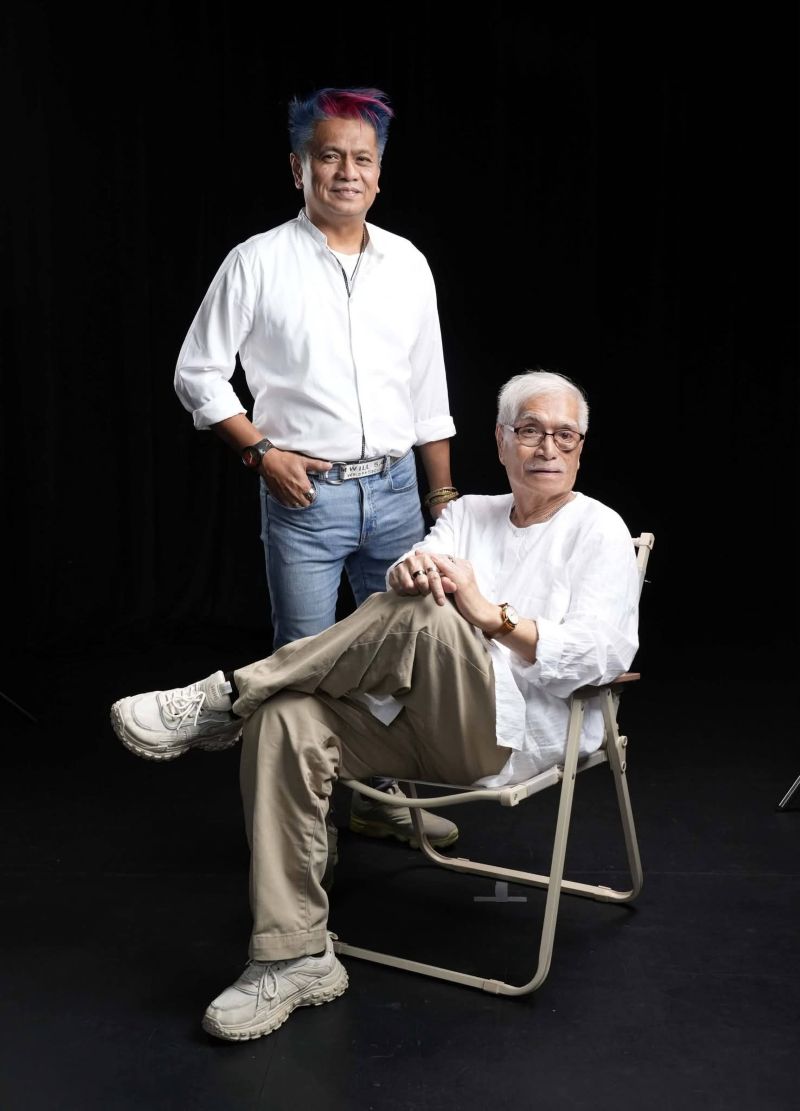
Director CJ Andaluz and author Frank Rivera
“Just write about the play,” he told me. He was referring to Ambon, Ulan, Baha, a zarzuela he authored in the 1970s. Best described as an “ethno-pop-rock-modern zarzuela,” it’s being restaged by the Metropolitan Theater (Met) and Pixel Arts Media Productions. Frank Rivera’s friend CJ Andaluz is artistic director of Pixel Arts. He’s directing this new production. He’s cast CJ Novato and Thea Astley as the romantic leads.
Ambon, Ulan, Baha is a love story in a fictional barrio, a romance set against an environmental disaster caused by rampant logging.
CJ Andaluz says its themes remain relevant as the world now faces the devastating effects of climate change. “The play focused on environmental issues long before the term ‘climate change’ became a crucial concern. The title is also very timely, what with the flood control scandals and heavy flooding dominating headlines,” he said.
Others might accuse the production of cashing in on the country’s current political and weather situation. On the contrary, this return engagement had been in the planning stages for almost two years already. “The people at the Met had been wanting to present a musical with an environmental theme,” Andaluz said. “So I suggested Ambon, Ulan, Baha. It was last staged at the Met in 1992. It was the theater’s final production prior to its closing. At that time, Frank was artistic director of the Met’s resident theater company, Teatro Metropolitano.”
There were problems with the funding of the upcoming show, hence the one-year delay, he explained. The setback, however, may have been a blessing in disguise. The return engagement comes in time for the 50th anniversary of Frank Rivera’s original play. Its homecoming at the Met makes for a perfect golden jubilee.
CJ Andaluz was involved in the 1992 show as an-all around production assistant. “I was very young. I was just a saling–pusa as I was just starting out in theater. But I made many friends during that run. Frank is one of them. We have since collaborated on many projects; documentaries, theater, and even mounting a touring production of Ambon, Ulan, Baha,” he said.
As he knows the play by heart, he’s been given carte blanche by the author for this restaging. “Frank has a hands-off policy. He gave me a free hand to update certain plot points to make them more in tune with current events. The music was also rearranged to come up with a more ethno-pop sound,” he said.
As he knows the play by heart, director CJ Andaluz been given carte blanche by the author for this restaging
The show’s musical director Pipo Cifra composed additional songs. Most of the original ones were composed by Frank Rivera himself. For the maiden production, one song each was written by Emilio Nicolasin Jr. (the original male lead) and the late Philip James Tremedal.
The new staging is also a showcase of traditional chants courtesy of Rosie Godwino Sula, whose mastery of T’boli chants earned her recognition as a Gawad Manlilikha ng Bayan (National Living Treasure).
With the latest theater technology now available to him, Andaluz is making use of sophisticated lighting and visual effects that promise to give audiences a new and visually exciting zarzuela experience.
Originally titled Kaingin, the show was written by Rivera as a straight play, as part of a trilogy called Hawla. He staged it when he was conducting theater workshops at the Mindanao State University (MSU). During his stint there, he co-founded a cultural group called the MSU Sining Kambayoka. Showcasing Maranaw culture and traditions, the group is noted for its extensive use of the colorful malong for both costumes and props. It continues to champion Maranaw folklore, and mount shows that feature Maranaw chants and dance.
“At that time, I was very much against the Marcos dictatorship,” Rivera said. “I wrote plays that criticized the regime. Hindi ako hinuhuli because the stories were disguised as folklore.”
Kaingin, however, was the first of his works that wasn’t an indictment on the dictatorship. Two years after its debut in 1976, the original play was retitled and expanded into a full-length zarzuela.

Musical theatre stalwarts Onyl Torres, Sweet Samaniego Buchanan, Nazer Salcedo, and Sharmaine Santiago
The cast of this current iteration is remarkable. CJ Andaluz personally handpicked the cast members, majority of whom are not just colleagues but old friends, as well. It’s a reunion of sorts because many of the performers took part in previous productions of Ambon, Ulan, Baha. It’s a who’s-who of Philippine theater; Anton Juan Jr. plays the villain, the nefarious logger consumed with greed. In supporting roles are musical stalwarts Sweet Samaniego-Buchanan, Onyl Torres, Nazer Salcedo, and Rendell Sanchez, among others.
Even the actors playing the townsfolk are stage stars in their own right. Jerome Ferguson played the title role in last year’s musical Pilato. Phil Panganiban had earlier played the lead in the two-character play The Moon and the Bakunawa. For them, no role is too small. Their love for theater and Frank Rivera’s work is immeasurable. “I’ve worked with most of them before. They’re my suki,” said Andaluz.

Dynamic villains Vladimir Manio, Anton Juan Jr., and Rendell Sanchez
He’s working with the young leads for the first time, and he is already raving about their performing abilities. “The characters they play don’t have complex personalities. The leading man has to be simpatico. I already had my own ideas about how they should play their parts. But when they showed me their own interpretations, I was impressed. They were better than what I had in mind,” he said.
Leading lady Thea Astley is a prolific songwriter and has a thriving television and recording career. She was also in recent productions of Rent and Once On This Island. Her marquee name should boost ticket sales.
CJ Andaluz’s namesake CJ Novato has more than an ample amount of gravitas to make iconic characters like Crisostomo Ibarra (in the musical Liwanag sa Dilim) vividly come to life. We got to speak to him before he started rehearsals with the rest of the company at the ballroom of the Met. Novato admits to having been unfamiliar with Frank Rivera’s work, but once he read the libretto, he was amazed by the story’s timely theme. “This was actually written 50 years ago, when nobody cared about our environment. I like the character I play because he’s the only person who cares,” he said.
As a versatile singer who can stretch himself to be a baritone up to a certain point, and tenor also up to a certain point, he’s thrilled to be singing the songs of the zarzuela.
“It’s always been my dream to be in a zarzuela. In Liwanag sa Dilim, we sang the songs of Rico Blanco, so medyo nakukulangan pa ako. But Ambon, Ulan, Baha gives me a rare chance to perform songs that are in my range. And Pipo Cifra’s arrangements make it really worthwhile,” he said
The interviews at the Met offered me a chance to watch the show’s youthful dancers rehearse. All of them are members of the Malabon City-based cultural group Tanghalang Bagong Sibol. They appear to be serious artists who have 100 percent commitment to the show. Being from flood-prone Malabon, Ambon, Ulan, Baha is a musical they can really identify with!
‘Ambon, Ulan, Baha’ goes on stage at the Met on September 26 and 27. The gala show is on the 26th, while performances will be held at 10 am, 2 pm, and 7 pm on the 27th. Tickets are available at ticketnation.ph.


