
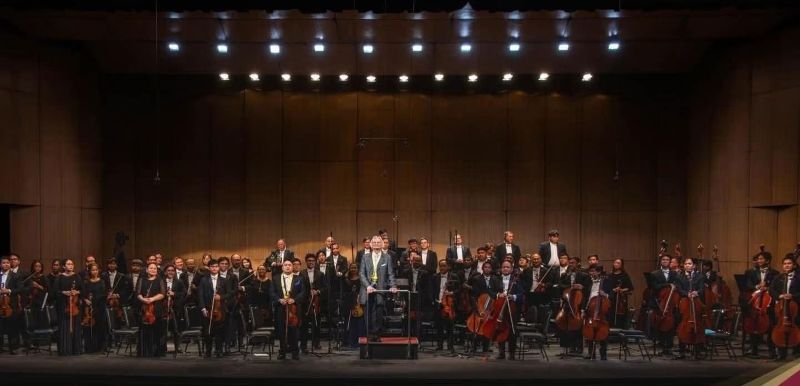
The Philippine Philharmonic Orchestra (PPO) opened its 42nd concert season, dubbed Modulatio, with its initial concert, Da Capo, last Friday, September 25 at the Samsung Performing Arts Theatre. Pianist Martin Garcia was the featured soloist, with Maestro Grzegorz Nowak,as principal conductor of the PPO.
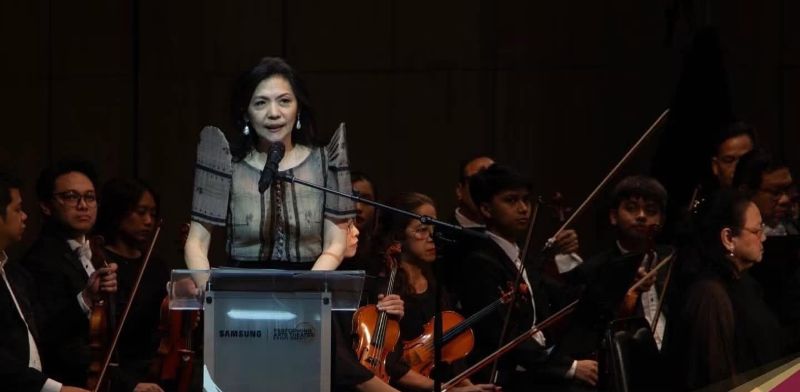
CCP President Kaye Tinga gives opening remarks.
Cultural Center of the Philippines (CCP) president Kaye Tinga gave the opening remarks as she welcomed the audience. She told the audience that beyond its translation, “from the beginning,” Da Capo as the theme for the concert “carries a deeper meaning.
“To begin again,” she continued, is “not to forget the past. It is to return to it with new experiences, new perspectives, and renewed inspiration.” She emphatically said that for the last four decades, the PPO has been “an important part of the cultural tapestry” of the country that “has brought audiences all over the country and abroad closer to the great works of orchestral canon while demonstrating the remarkable artistry of Filipino musicians.”
She expressed CCP’s grateful appreciation for the audience support, thanked PPO musicians and Maestro Grzegorz Nowak, and looked forward to the PPO’s 43rd concert season return to the CCP’s Main Theater.
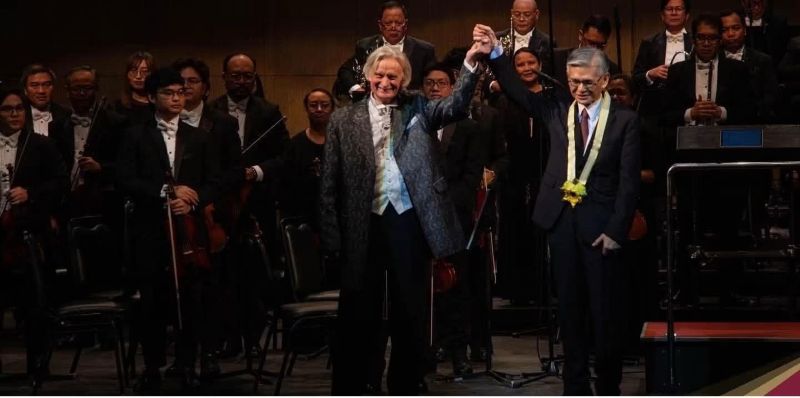
Maestro Nowak acknowledges composer Jeffrey Ching.
PPO’s program was momentous as it featured new works. First to be performed was Jeffrey Ching’s Sinfoniettina on G-C for Mozart Orchestra, which had its world premiere. Next was Carl Czerny’s Symphony No. 6 in G minor, which had its Asian premiere!
Beethoven’s Piano Concerto No. 5, sub-titled Emperor, completed the program with no less than Martin Garcia on piano as the featured soloist. Pianist Garcia bagged both First Prize at the Cleveland International Piano competition and Third Prize at the International Chopin Piano Competition in the same year, 2021.
All the three featured works that made up the program are tied up with the elegant and balanced form of the classical style. Jeffrey Ching’s Sinfoniettina was instructive in the understanding of musical works molded in the classical tradition. The work, as stated in the program notes, was “inspired” by a YouTube talk, “How Every Marvel Hero Got their Powers Explained in 15 Minutes”! And indeed, listening to it was instructive!
It explains a symphonic work that “grows” out of two notes, the “falling fifth, G-C”, as the witty composer said in his notes in the program. Composer Ching emphasized the cardinal rule in symphonic composition: “maximum effect out of minimal means,” which implies minimal use of instruments or complex chord changes, but providing maximum symphonic effect. The falling fifth, he said, is continuously transformed through different devices that the composer employs, such as sequence, syncopation, augmentation, acceleration, and the like, “reiterated in different keys and instruments and combined with fresh themes similarly derived from the G-C.” The title, “sinfoniettina,” is a further diminutive of “sinfonietta,” a miniature symphonic work.
The process is gloriously disclosed in PPO’s wonderful playing that created a neo-classic ambiance, under the authoritative command of Maestro Nowak. Near the end one heard the bassoon played the falling “G-C” that the entire work is based on. Unmistakably, it refers too to the initials of the composer, “Geoffrey” being the original spelling of “Jeffrey,” and C, the first letter of the composer’s surname. The program notes bore the name: Geoffrey Ching. Indeed, what a witty, charming work!
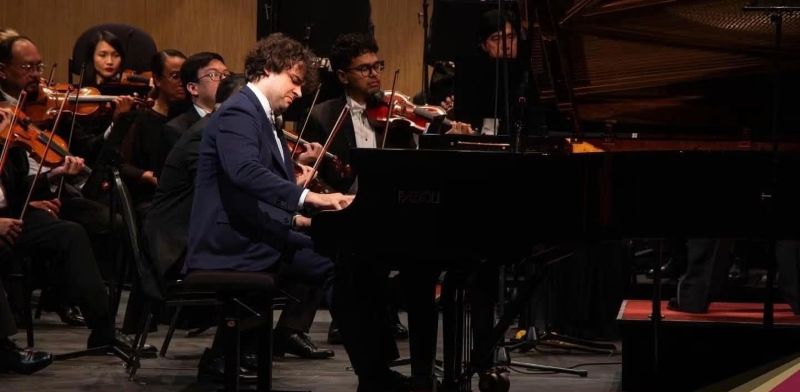
Pianist Martin Garcia
Pianist Garcia cut an authoritative stance as he sat on the piano. After the dramatic opening chord of Beethoven’s Fifth Piano concerto, he ran his agile fingers on the Fazioli piano keys and elegantly played the opening cadenza expressed in rapid arpeggios, scales, and trills. The PPO played with brilliance the long orchestral portion of the first movement marked by a broad, march-like theme, before the pianist entered. The dialogue between the orchestra and the piano was done with utmost sensitivity that made for sensible listening. The classical stylistic nuance of the piece was kept to the hilt. The pianist struck pleasing and refined tones that exquisitely revealed adherence to the classical style: elegant and refined.
In the brief second movement, Garcia played with delicate charm. He sang his lines that towered like a meditative hymn, as the orchestra hushed its tones.
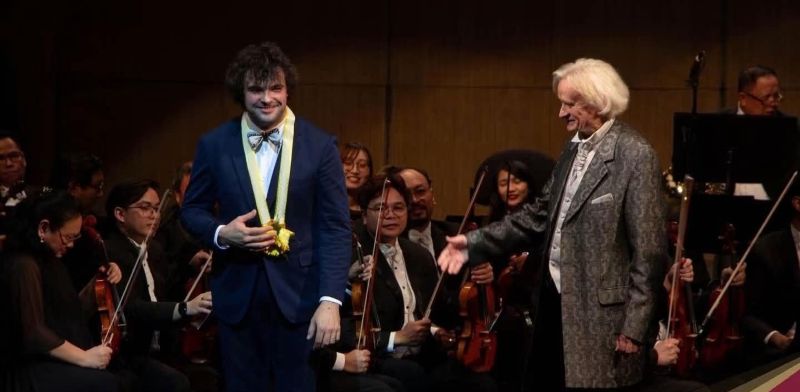
Pianist Garcia with conductor Nowak
Then without a pause, his fingers delicately announced the last third movement that tackled the energetic rondo theme. Garcia carved out elegant and brilliant tones with that exuberant trill near the end, until he played some delicate figuration (with the soft playing of the timpani), and played together with the orchestra to end the concerto in the home key it was written in.
Thunderous applause followed, punctuated with shouts of bravo, prompting the amiable pianist to make some curtain calls. He sat at the piano and played Moritz Moszkowski’s Etincelles (Sparks), and showed his virtuosity through the piece’s staccatos and brilliant finger passages
Carl Czerny’s Symphony No. 6 in G minor, which had its Asian premiere, is a four-movement piece composed in the romantic era, but its musical style is rooted in the classical style.
This writer found more information online beyond Czerny’s profile in the souvenir program. Indeed, PPO Conductor Grzegorz Nowak is credited for this piece’s resurrection. Following his discovery of its manuscript in Vienna, he prepared its score for its performance and world premiere recording in 2004–2005 with the SWR Radio Orchestra Kaiserslautern in Germany. Manila, through the CCP, is greatly favored for being the venue of its Asian premiere.
Czerny, of course, is widely known for his piano exercises, such as the schools of velocity and dexterity. The said symphony in review, scored in four movements, exudes a classical character, though it was written in 1854, during the Romantic period, 1839–1900. Beethoven was his teacher, and this particular work showed Beethoven’s influence.
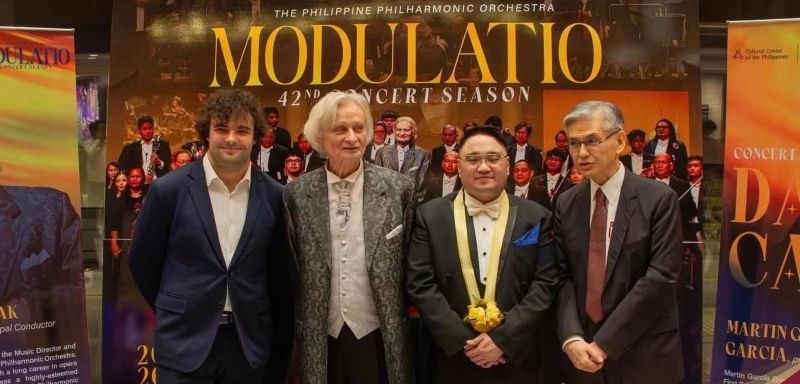
Pianist Martin Garcia, conductor Grzegorz Nowak, artist in residence and concertmaster Diomedes Saraza, Jr., and composer Jeffrey Ching
Magnificently, the PPO, under Maestro Nowak, surged through the four-movement work with such compelling drive and ardor. It was, indeed, gratifying to listen in rapt attention to the PPO, as conductor Nowak led it to great heights of symphonic performance.
Congratulations and mabuhay!


