
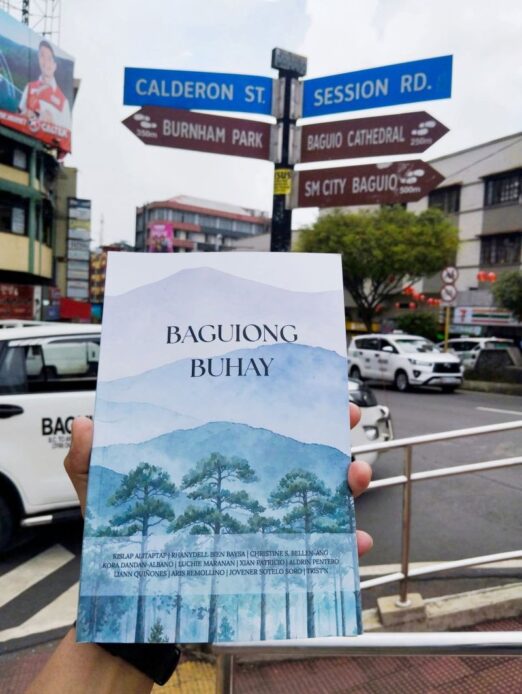
The recent launch of the English and Filipino anthology Baguiong Buhay awakened memories of my own family’s decision to move from Manila to Baguio on my eldest daughter Kimi’s seventh birthday in 1992. There we were—she, her four-year-old sister Ida, me, and a desktop computer occupying its own Victory Liner seat. The head of the family had gone ahead with the moving trucks to Lower Brookside, Baguio. Husband Rolly and I were reconciling after a separation of a few months. Baguio was ideal for a fresh start.
The contributors to the anthology, except for one, settled by choice in this city, embracing it despite its sprawling urbanization, its maddening monsoon season (the last one lasted more than 40 days), its dwindling forest space, etc. No amount of negative etceteras can persuade these resettlers from ever returning to their points of origin—anywhere in the archipelago from Bauan, Batangas to Nueva Ecija, from Dasmariñas, Cavite to Tondo, Manila. Indeed, Baguio is that melting pot of people seeking second, even third, chances.
That has always been its history. Not only is it home to indigenous peoples of the Cordillera, it has attracted American colonial masters and old-timers, Japanese and Chinese seekers of a new life, migrants from nearby provinces of La Union, Abra, the Ilocos provinces, and Pangasinan. It is also the sister city to Marawi, which accounts for its Muslim residents.
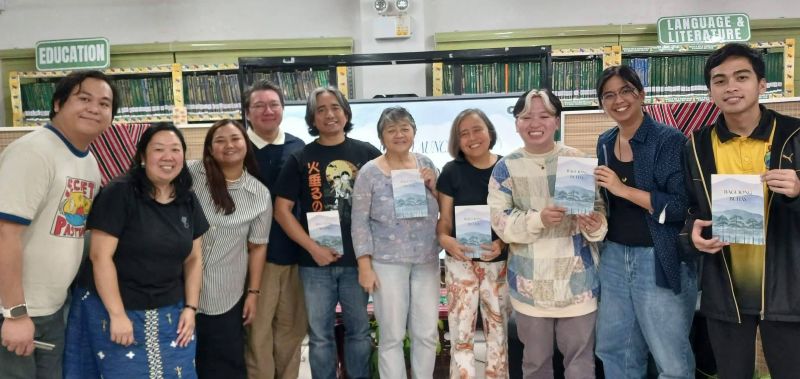
Some of the authors (from left): Aldrin Pentero, Christine Bellen-Ang, Lian Quinones, Aris Remollino, Kislap Alitaptap, Luchie Maranan, Kora Dandan-Albano, Trist’n, Sara Vishnu Albano, and Jovener Sotelo Soro (Photo by Tioan Medrano)
Some authors started as university students, then decided to stay on. Poet Aldrin Pentero, one of the moving forces behind the book, was just taking a breather during the pandemic, then decided to stay for good. Poet-artist Kora Dandan-Albano thought it would be a good idea to keep their college-age eldest daughter company in the city, and grew roots here.
As Prof. Junley Lazaga of the University of the Philippines Baguio said in his message at the launching at the Baguio City Public Library, “Baguio as a home city is particularly difficult to write about. It is easy and hard to love Baguio. And precisely because it is so particular to each of us, writing about this place—this city of rainy September afternoons and of foggy aspirations—is anything but easy. It is not a simple undertaking. Let alone publishing a book about it. Which makes this book, by this group of writers, truly commendable.”
The book can be credited, too, for its boldness in tackling a subject like male prostitution in Burnham Park in the years when it was still unfenced and poorly lit. In Xian Patricio’s Siyudad sa Ilalim ng Mga Pino, the narrator gallivants at night in the dim park to seek out the services of a male masseuse and even a one-night stand. What follows are scenes out of a film noir with the lovers or the one being serviced being urged to masturbate to reach an ejaculation.
But, as Lazaga said, the book also features romantic vistas of “the fog coming down from Mt. Sto. Tomas, the golden sunsets, the cut flowers and fresh produce from La Trinidad, Tuba, and nearby provinces, and—perhaps most importantly—the comfort that community brings.”
He said this is the wonder of the book. While thinking that one is reading of the experiences of other narrators, one slowly realizes that one is reading about oneself. “By sharing their most intimate selves, the writers of Baguiong Buhay allow us to rediscover Baguio as our own—personally and collectively. And this brings us to the beautiful problem at the heart of the title.”
He called the title “a brilliant and multi-layered play on language. May bagong buhay. May buhay sa paraang Baguio. At may Baguiong buháy. The title allows Baguio to enter the phrase bagong buhay, and in doing so, it suggests a life renewed, a life transformed, a life that begins—or begins again—in this city. But ‘Baguiong buhay’ can also lead us toward another sense: life in Baguio, the lived experience of being here, of inhabiting and being inhabited by the city. And then there is ‘Baguiong buháy’: Baguio as alive; Baguio as vibrant. Baguio as a place that continues to move, change, resist, accommodate, surprise, disappoint, nurture, and call us back.”
Lazaga said the title “is not exclusively paronomasia—a pun based on similar sounds. It can become a malapropism, the deliberate or mistaken substitution of one similar-sounding word for another. It can become a double entendre; as socio-political critique. And perhaps it is even more than these technical categories. Because the title does something that language at its best always does: it gives us another way of seeing. And perhaps that is also what this anthology does. It gives us another way of seeing Baguio.”
The writers, he said, “offer us Baguio as remembered, Baguio as inhabited, Baguio as left behind, Baguio as returned to, Baguio as loved, questioned, endured, discovered, and rediscovered.”
The anthology came to be only in April 2023 when Pentero was added to a group chat by Albano which was created by Luchie B. Maranan for writers who moved to live in Baguio. He recalled, “We started chatting and decided to meet to talk about our writing and just be a support system for each other. We then talked about working on an anthology to feature works about our lives here. I suggested the title Baguiong Buhay in one of our meetings.”
The small group met regularly to do workshops online, in coffee shops, work spaces or anywhere someone would offer their home to host the group. They would bring food and have a potluck.
Although it was not easy to gather the manuscripts since everyone had their own lives, livelihood, advocacies, and writing projects, they felt that their commitment to the book was locked in when Maranan mentioned the project during her talk at this summer’s congress of the Unyon ng mga Manunulat ng Pilipinas.
Pentero felt like “since it was already announced, it would be a shame to not push through. It was a group effort. It would not be possible without everyone’s help and contributions. Even with the production, printing, launch. I’m proud of us 11 and what we were able to accomplish with the help and support of nice people and the community that we were lucky enough to be a part of here in Baguio.”
The other contributing writers are Kislap Alitaptap, Rhanydell Bien Baysa, Christine S. Bellen-Ang, Liann Quiñones, Aris Remollino, Jovener Sotelo Soro, and the poet who likes to be simply known as Trist’n.
Copies of Baguiong Buhay are available at Mt. Cloud Bookshop (lower ground, Tulip Apartelle, 3 Recto Road, Baguio City) and on Shopee Philippines and Lazada online stores.


