
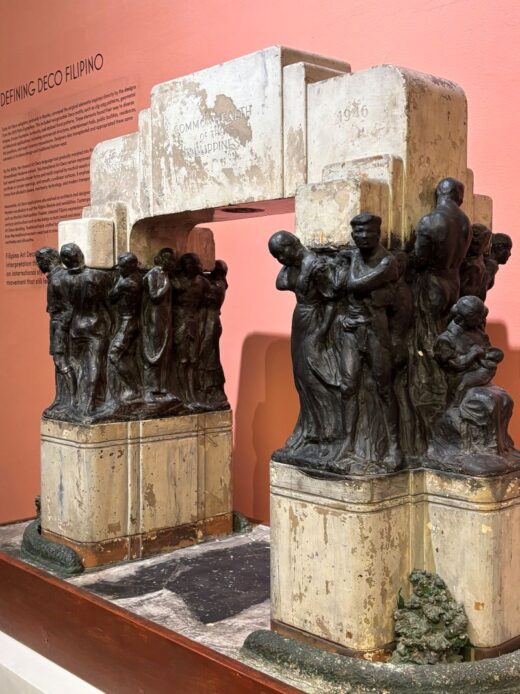
‘Art Deco: Modernity and Design in the Philippines, 1925–1950’ has been extended to 25 Oct. 2026, at Galleries VII and X of the National Museum of Fine Arts in Manila.
It has been years since Ivan Man Dy started documenting anything that had to do with Art Deco. Residing in Old Manila, he would see Art Deco in many forms in the spaces and places he would walk through daily. His interest was perhaps heightened during his involvement as a member and officer of the Heritage Conservation Society, whose mission involved intervention in the demolition of significant heritage structures, some of which had Art Deco elements such as the One Meralco Building and the Jai Alai. These were sadly demolished, supposedly for “development,” but to this day, they remain wasted empty spaces where significant heritage structures used to stand, some of them with elements of Art Deco.
In 2020, he published the output of his diligent research in a book, Deco Filipino: Art Deco Heritage in the Philippines. And now, with Art Deco: Modernity and Design in the Philippines, 1925–1950, an exhibit of 300 pieces collected from all over the country occupying two galleries at the National Museum, one can only imagine Ivan’s sheer delight.
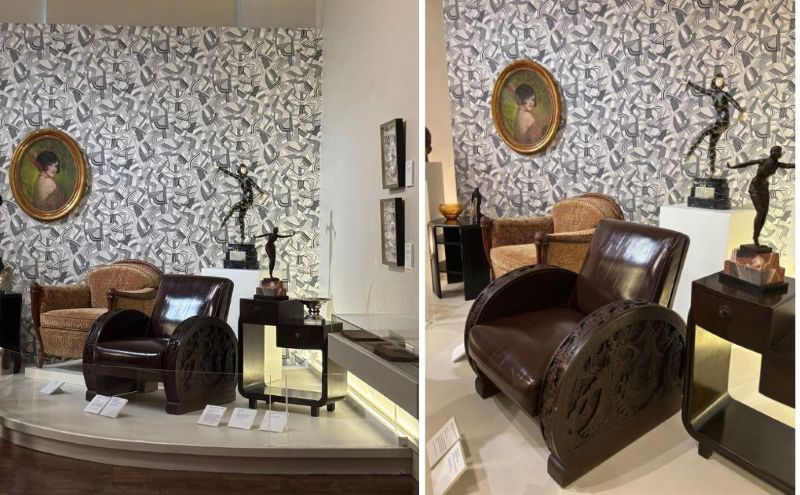
At center, a Chinese-style Ambassador chair, circa 1930s, made of narra wood with leather upholstery (from the Dr. Jose Corteza Locsin Ancestral House Collection); beside it, ‘The Girl,’ circa 1930s, a wax-coated bronze sculpture on a marble base attributed to Romanian artist Demétre Chiparus, whose work was typical of the French Art Deco style (From the Palacio de Memoria Collection)
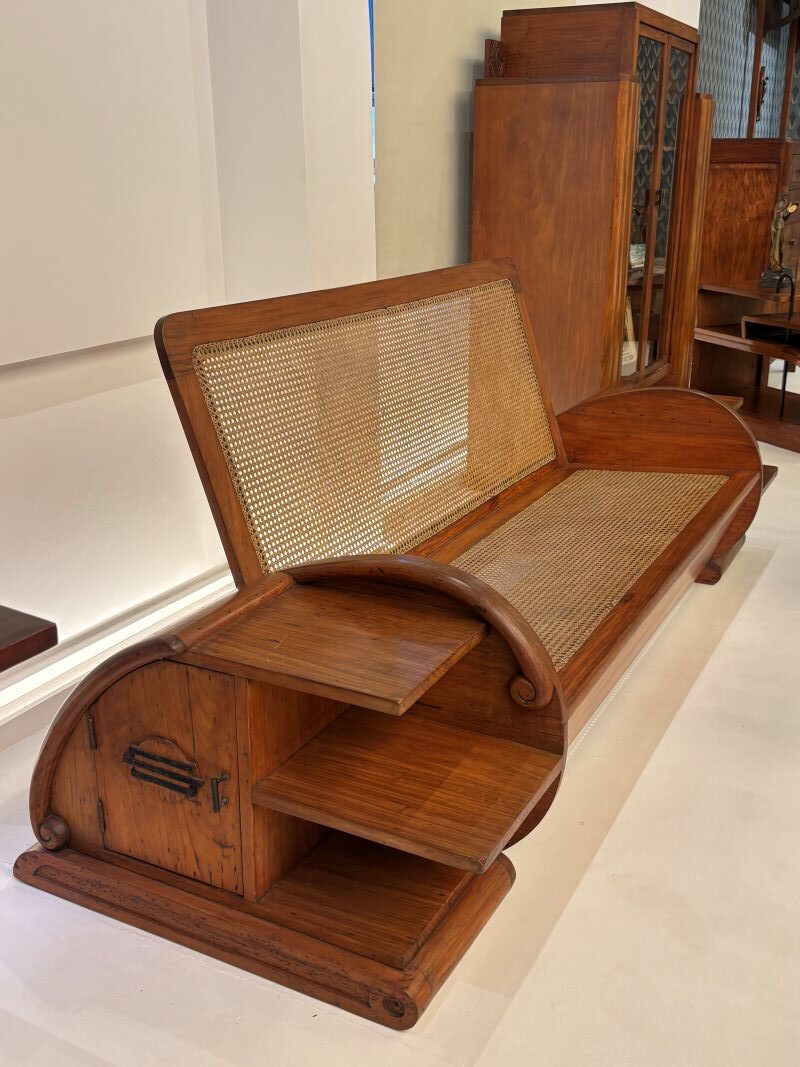
A sofa with built-in side tables, circa 1930s, made of narra wood and rattan, done in the Streamline-Moderne style with ‘solihiya’ weave, sideboards, and nautical-inspired accents (From the Dr. Gerard and Jo-Ann Salgado Collection)
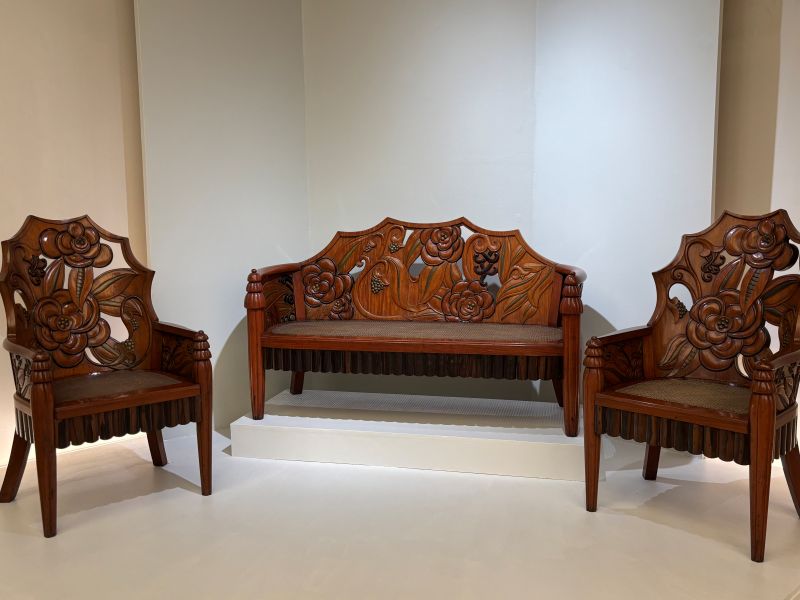
Gonzalo Puyat & Sons Co. set of seating furniture, undated, narra and ‘kamagong’ wood, rattan, and gold paint, featuring gilt details and ‘solihiya’ weave (From the Marquez Collection)
Art Deco was a design concept brought to the Philippines in the late 1920s by Filipino architecture students who were sent to the US and Europe as government funded-scholars, known than as pensionados. Among them was architect Juan Arellano, who pushed the design concept even further by collaborating with an Italian sculptor, Francesco Riccardo Monti, on a government project, the Metropolitan Theater of Manila, which, to this day, still stands on its original lot. Both artist and architect were the first to adapt the mixed genres of these two art forms in a structure. Apart from Arellano, the other key figures of the period were Andres Luna de San Pedro, Juan Nakpil, Pablo Antonio, and Tomas Mapua. In essence, the new concepts they brought back left behind the European Baroque/Rococo influences of the Spanish colonial period in numerous Philippine structures, and embraced the clean geometric shapes and clean lines of a modern style.
Art Deco: Modernity and Design in the Philippines: 1925-1950 is a journey through time visualized not just through architectural elements, but also in furniture pieces, fashion, graphics (like book and magazine covers), and house decoration. Some of us may have had grandparents whose furniture in their residences resemble what is displayed in this exhibit. Seeing the pieces spotlighted at the National Museum may make us think back to how little we thought of them back then. Displayed as part of this collection co-curated by Ivan and Miguel Rosales, we see the pieces wholistically as a significant influence, marking a specific period in Philippine design history.
“We selected items that stood out and reflected the Art Deco style strongly,” Rosales said. “They needed to be visually strong examples and had to be in good condition. There is a wide range of objects representing furniture, fashion, industrial design, the fine arts, architecture and interiors, and they each had to contribute to the experience as a whole, coming together to explain Art Deco in the Philippines.”
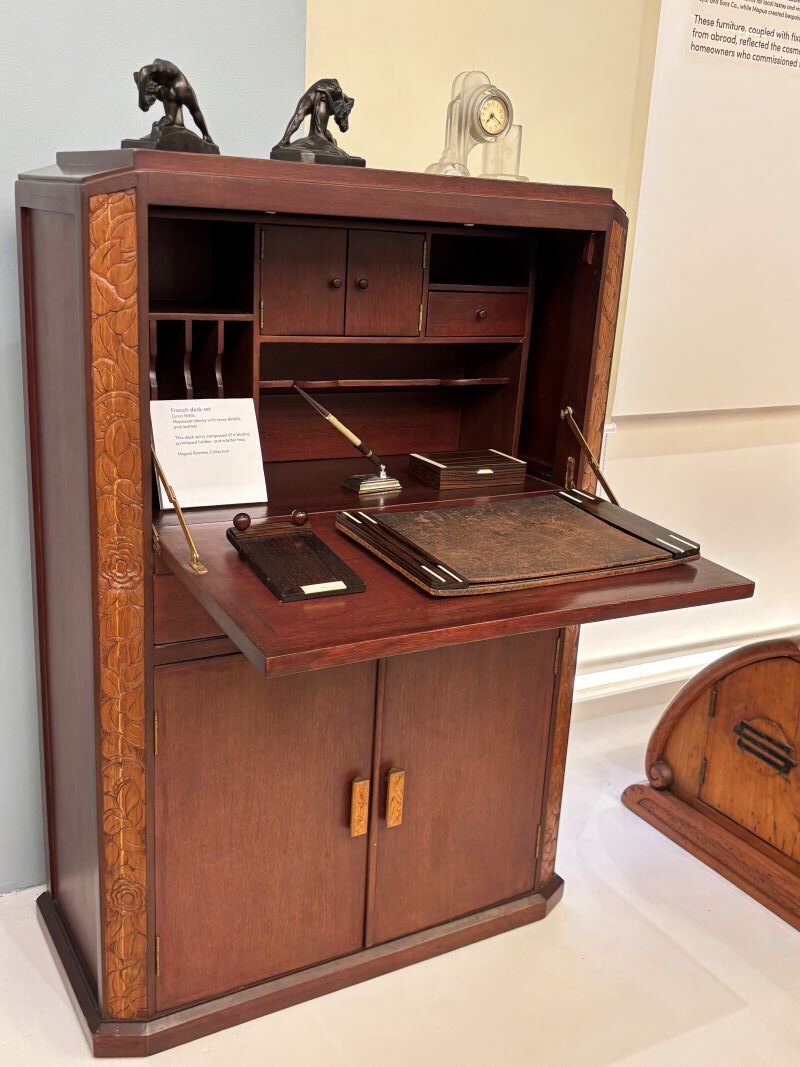
This wooden ‘escritorio’ (writing desk) with stylized relief accents from 1934 was used by Tomas Mapua, the first registered architect in the Philippines and founder of the Mapua Institute of Technology in Manila. (From the Tomas Mapua Residence Collection)
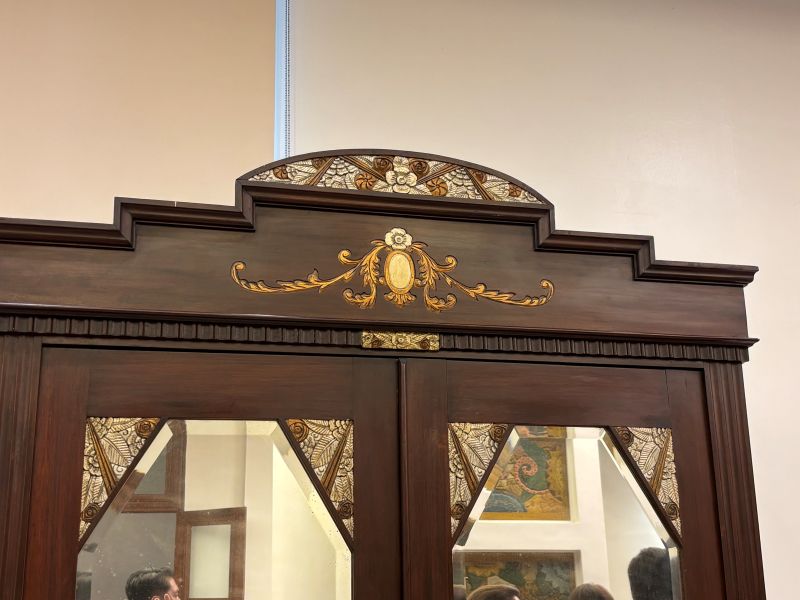
This ‘aparador’ (armoire) of wood and glass, circa 1930s, features an inlaid wood pediment, fluted corners, and beveled mirror glass. It was once owned by Carmen Aguinaldo, first wife of first Philippine president Emilio Aguinaldo. (From the Emilio Aguinaldo Shrine Collection)
Between the 1920 and 1930s, Filipino designers created what became referred to as Philippine Art Deco, which utilized mother-of-pearl pieces inlaid in wooden furniture, mostly cabinets, with Art Deco motifs. Local fruit and flower motifs were carved in indigenous wood like narra or kamagong. There was the use of solihiya, a traditional Filipino weaving pattern using strands of rattan or cane. The woven pieces were usually used for a backrest or a seat, perhaps to counter the tropical heat. Art Deco furniture designs didn’t just carry geometrically straight lines. Chairs with semi-circular arms and backrests made up one design that was stunningly witty, seen in many homes of that era.
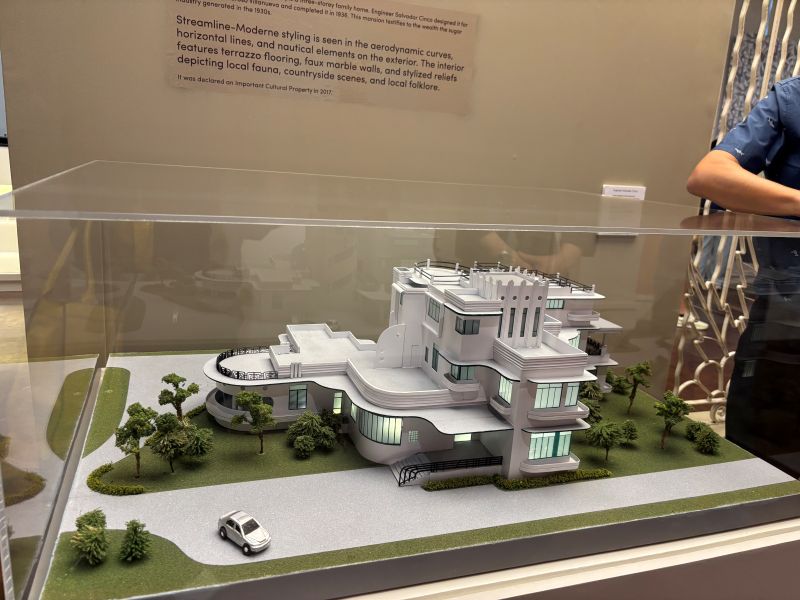
The Generoso Villanueva mansion in Bacolod, or ‘Daku Balay,’ is a three-storey family home designed by Engr. Salvador Cinco for sugar baron Generoso Villanueva and completed in 1936. It is a testament to the wealth generated by the sugar industry in the 1930s, and was built in the Streamline-Moderne style as seen in the aerodynamic curves, horizontal lines, and nautical elements. The interior features terrazzo flooring, faux marble walls, and stylized reliefs depicting plants, countryside scenes, and local folklore. The mansion was declared an Important Cultural Property in 2017.
In architectural design, banana and coconut leaves made of carved wood or stucco were used as accent elements in buildings, as seen in the scale model of the Metropolitan Theater. Fruits are the design highlight in the theater’s interiors, with its arches featuring plaster casts of mangoes and bananas, with banana leaves and abaca as the interior’s corner accents. Other details of buildings are reliefs and decorative objects for structures like the First United Building and the sadly demolished Capitol Theater, with geometric floral designs using a Filipino aesthetic. The inclusion of Philippine elements created a hybrid design which Filipino innovation can claim as its own.
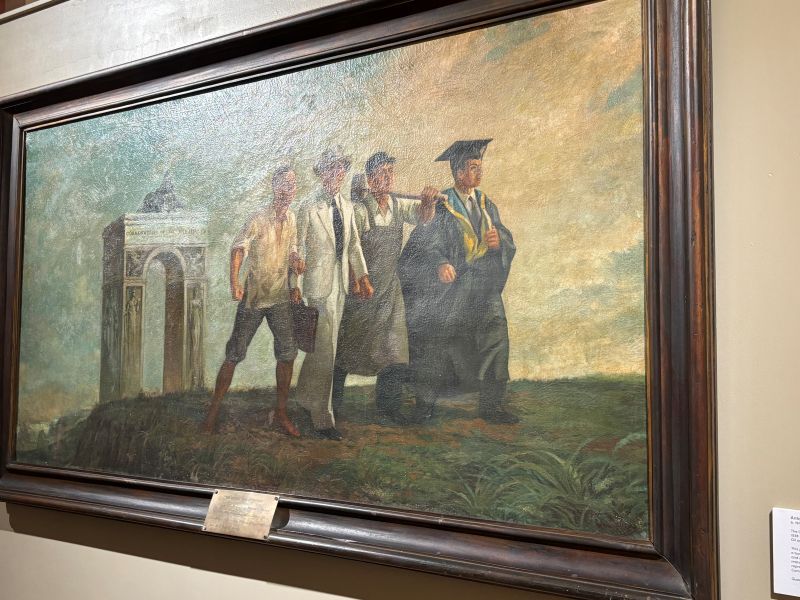
‘The Commonwealth’ by Antonio Dumlao, oil on canvas, 1938, a painting depicting a farmer, a businessman, an industrial worker, and a graduating student, all marching from a triumphal arch representing the Philippine Commonwealth of 1935 (From the Quezon Memorial Shrine Collection)
Prominently hung on the museum walls are more architectural details, mostly done in pre-cast plaster, produced by a company that still exists today, the House of Precast founded by master ornamentalist and sculptor Conrado de Leon. De Leon’s father worked with the famed sculptor Don Isabelo Tampinco, whose designs can be seen in numerous heritage structures. Among the sculptors whose work was generated at the factory were Francesco Monti, the aforementioned sculptor whose work decorated Juan Arellano’s design for the Metropolitan Theater. Some molds of Monti’s work, which he did for several buildings in different provinces, are rumored to be stored at the House of Precast.
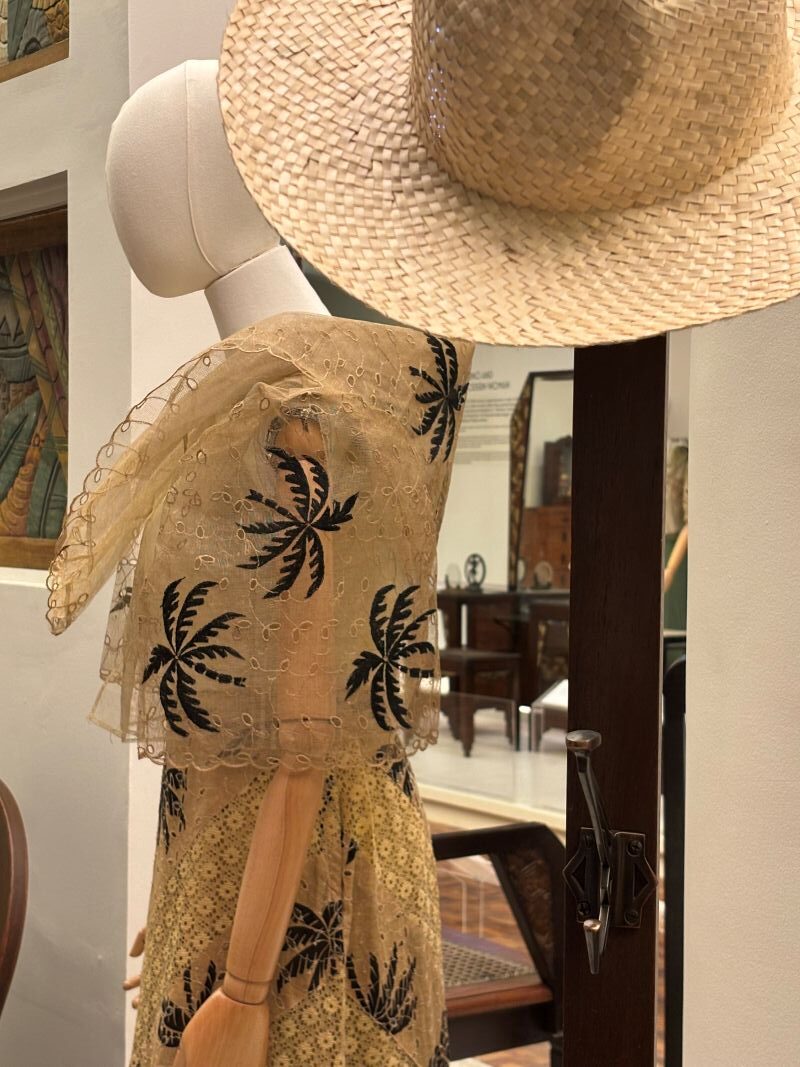
The traditional ‘terno’ sleeve is showcased in a more streamlined pattern, with the once wide butterfly sleeves reduced in size
In the exhibit’s fashion section, the traditional terno’s original shape is showcased in a more streamlined pattern with the once wide butterfly sleeves reduced in size, creating a slimmer silhouette. The textiles used also carry geometric shapes and lines, recognizable Art Deco motifs in the fabric. A large collection of historical garments and accessories carries the geometric shapes integrated specifically in the jewelry. Among the ternos dated 1940 are the embroidered garments of Doña Aurora Quezon, wife of President Manuel L. Quezon, and Maria Agoncillo Aguinaldo, second wife of Emilio Aguinaldo. The collection of clothing with stylized geometric, linear, and structured patterns is indicative of the eventual morphing of the terno into the baro’t saya.
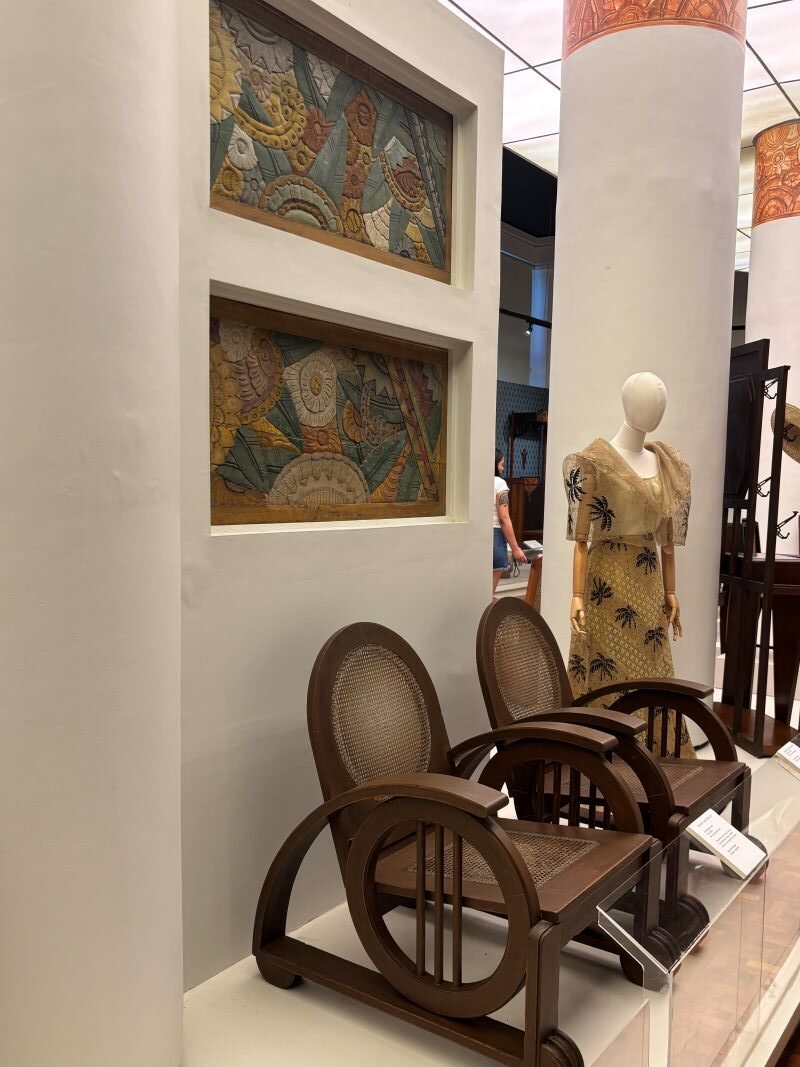
A vignette featuring plaster architectural accents, ‘solihiya’ chairs, and a period ‘terno’
A setting for the garments is a boudoir with a dresser and a collection of antique hairbrushes, mirrors, and other “glamour” paraphernalia. Bias-cut sayas in crepe fabric are draped on the mannequins. On the walls are photographs of Carnival Queens, colegialas with their pouf hairstyles, and even cosmetics of the era. Other items of the period like clocks and radios served as extra paraphernalia to set the period ambience.
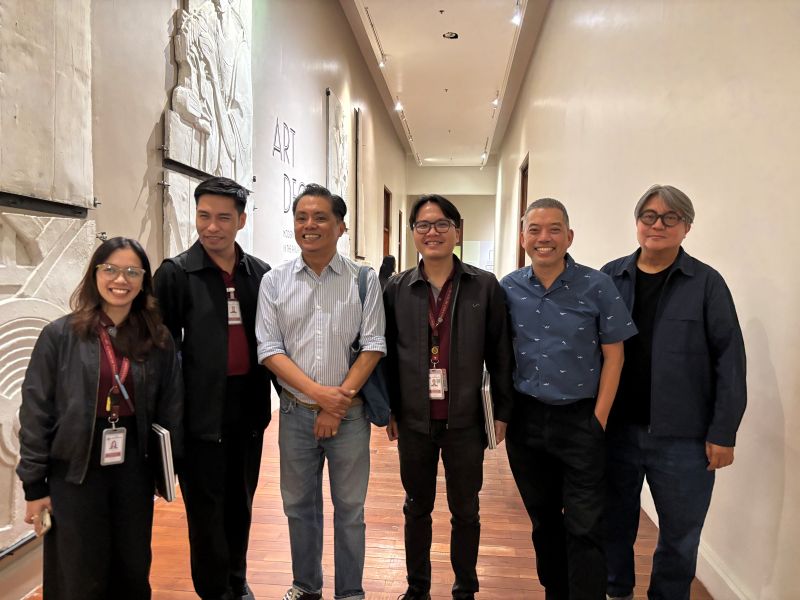
National Museum team behind the Art Deco exhibit, with Ivan Man Dy second from right
After viewing the exhibit through the two galleries, it is not enough to refer to a visit to the exhibit as a “walk-through,” as the items on display prove to be a nostalgic trigger for those who actually experienced the era. At the very least, for those familiar with the objects defining the era and seeing them all together, it is like going backwards through a time tunnel, which Ivan Man Dy made possible.
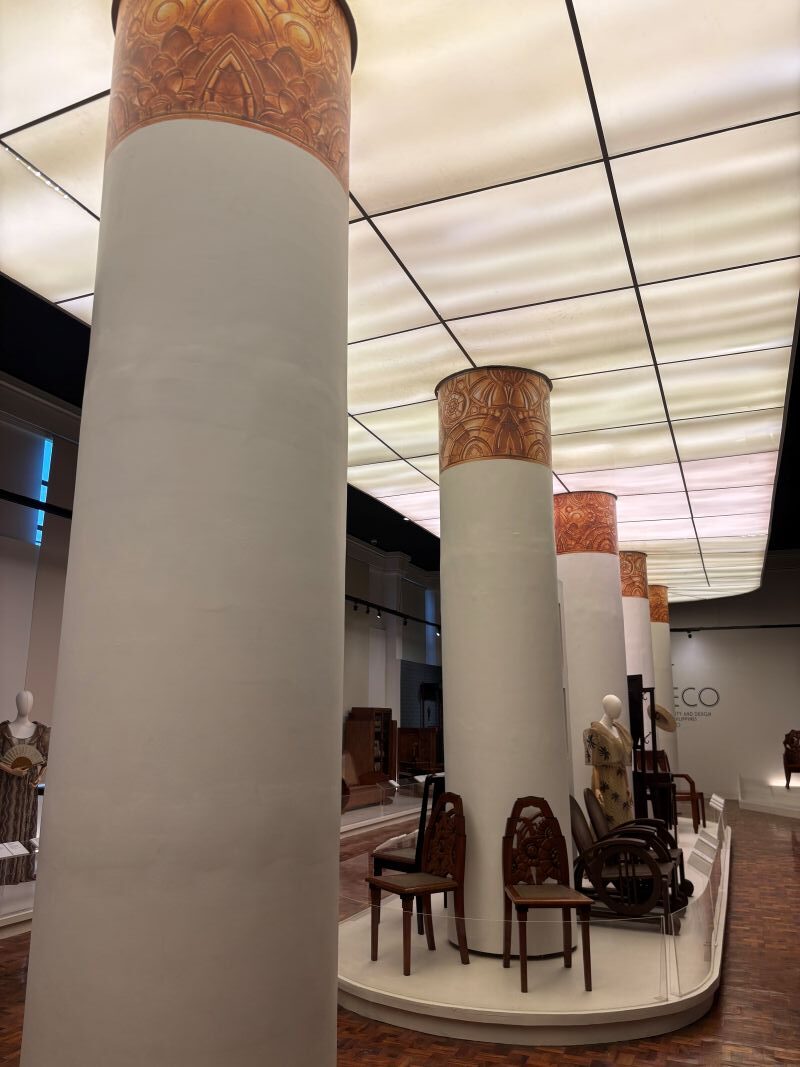
Columns from Art Deco period anchor the setting of Art Deco exhibit at National Museum.


