
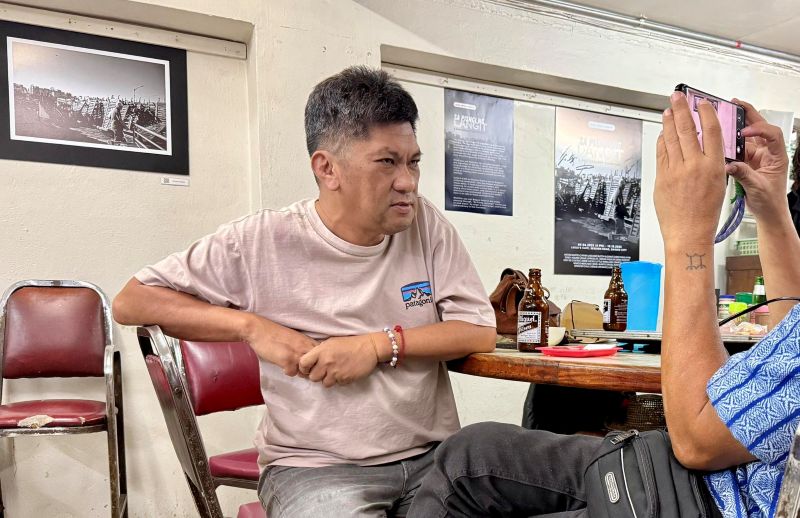
If one had to locate Frank Cimatu, the easiest way is to go to Luisa’s Cafe ,where he and his cohorts go for the Erwin Heusaff–highlighted food, the coffee, and occasional drinks of varying percentage. All that comes with the day job, him being one of Baguio’s stalwarts in journalism, the ones that keep late nights with phones buzzing at all hours.
Recognition of his frankly other but non-othering writings—as poet, fictionist and essayist—keep coming though. The first big break was the Best First Book Award in 2021, then the Palancas, a Procyon Award, and now the Unyon ng mga Manunulat ng Pilipinas (UMPIL) Gawad Balagtas Award as Best Poet in Filipino and English.
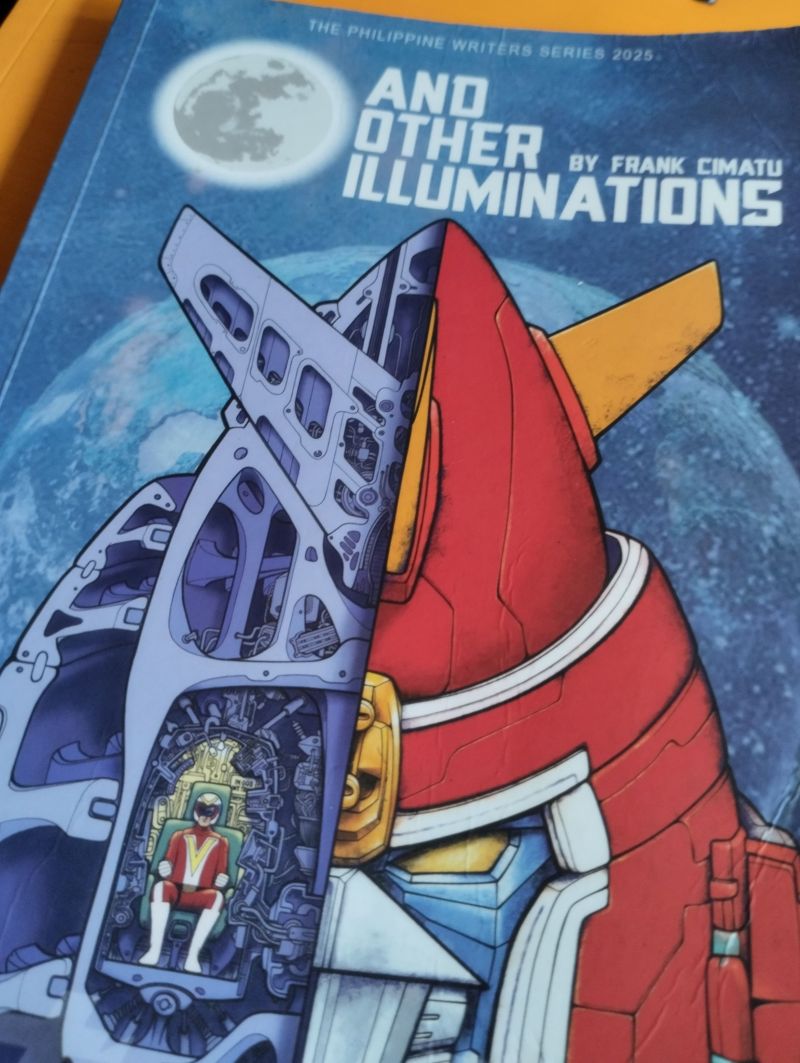
Cover of Frank Cimatu’s latest book of poems
What must Cimatu be thinking? Is he on ego trips now? When friends greet him on Facebook for these awards, the classic reply from him is “Ha!”
I have a clipping of a column that he wrote in 2018; the title is “My Ucab Moment.” He had visited a leader in Keystone, the community that once opposed Benguet Corporation ‘s open-pit mines. Ucab, even then, he says, was “a wasteland”: no electricity, no trees, the clay in their mountains once thought to be a sign of gold. And so Cimatu cites the “kadangyans eating out of gold plates and cutleries,” those hills “mined out, hundreds of gold ingots shipped out of the country ever since the Americans came.”
Also, there was the connection to Keystone for Mrs. Kelly who had married the prospector who “started Kelly mines and Keystone.” The mines thrive but the community struggles at survival, like the attempts at mulberry growing because of the suffocating industry dust. “Go in the summer and you’d think you’re in the Gobi.” In heavy rains, the wasteland is sunk in mud.
In the story, Cimatu is stuck in heavy rains, the last jeepney out might have left and he goes through existential angst, thinking “why did I decide to write,” choosing to go for the “unglamorous things…human rights violations, mining, environmental degradation.” He refers to “the dead and missing…the Defiant Ones.”
But in the story there is Cimatu, stewing: “Why am I doing this, I asked a mangy dog in the waiting shed. We were the only living things in sight. I was telling myself if there’s a good time to leave, it was now. Leave this shit, I decided.”
Then he hears children going home from school and singing Salidummay in the rain, one of them the daughter of his friend, the community leader. Turns out that Cimatu had given them a cassette tape of songs like Salidummay; his office had produced the recordings.
The girl sees Frank and says: “Nagkita kayon ken ni Daddy…Usarem toy payong ko. Nasayaat ka kanu.” (You are a good man, her father had said.)
Cimatu writes: “I was stunned by what she said. I told myself, I’m not a good man. A sorry day in the Ucab wasteland, and I was on the verge of crying…The jeep didn’t come. I walked in the rain with the borrowed umbrella and decades later, I am walking still.”
This, too, is poetry. Cimatu’s signature is on reportage like that, occupying abbreviated narrative space but memorable for its illumination. We receive Cimatu’s work as a way of seeing, unmistakable for insight, the language all his own, the craftsmanship, the imaginative play, the heart.


