
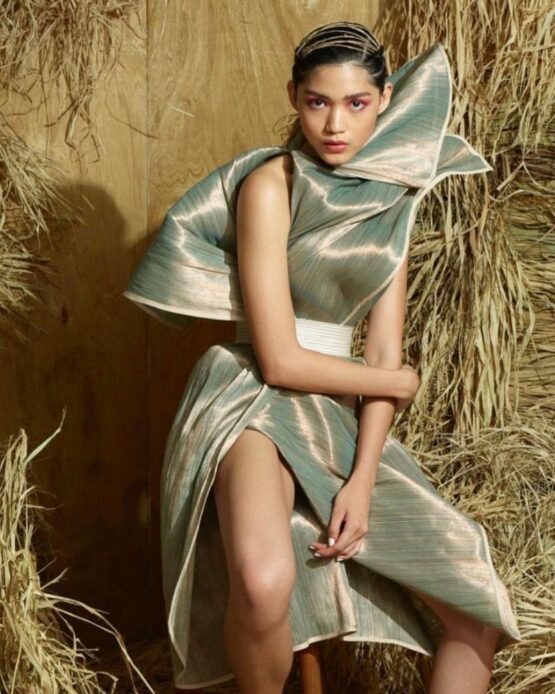
At the turn of the millennium, a veteran couturier made a pointed observation during a conversation among designers. Rajo Laurel, he said, had yet to develop a distinctive design language of his own. The criticism came despite Laurel having trained at New York’s Fashion Institute of Technology, and for years having assisted Louie Mamengo and Pepito Albert, who taught him the techniques of fashion, business savvy, and people skills, and his growing roster of prominent clients.
Today, 33 years into his career, Laurel is revisiting that question. What are his house codes—the recurring motifs, colors, silhouettes, construction, materials, and textures that define his work? “Perhaps Archivo is a way of finding out. That’s probably also one of my essays, by doing this fashion show, by trying to recall what I did, and then perhaps, are they able to answer that? I myself question that,” he says.
On October 24, Saturday, at the Marriott Grand Ballroom, Archivo will trace these elements through clothes from Laurel’s extensive collection of past runway shows, dating back to 1993. The show will cap the current Fashion Week Asia, which has featured designers from Vietnam, Indonesia, Hong Kong, Taiwan, South Korea, and Malaysia.
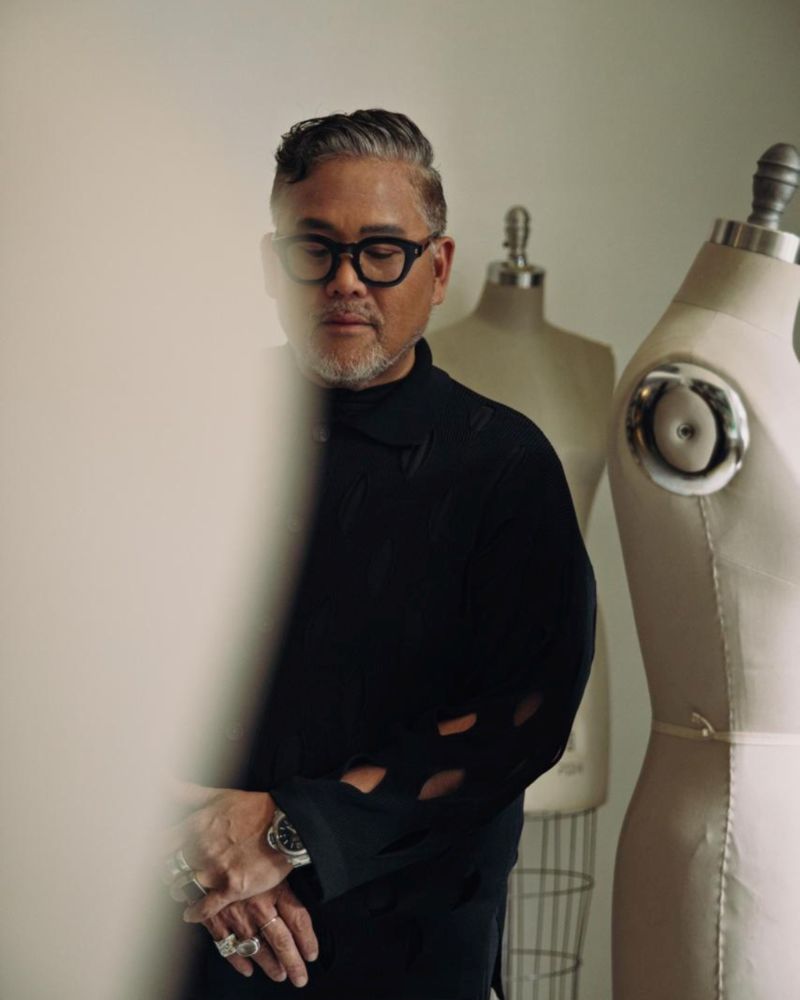
Rajo Laurel
Laurel’s archive occupies an entire floor of his building in Makati. The collection includes garments, invitations, films, and photographs from his fashion shows, preserving a record of his work across three decades. “We photographed the clothes, numbered them, and then we’re digitalizing most of them.
“I’m looking at my past work through a contemporary lens. What I’ve realized is that there are certain pieces from my body of work that are worth looking back at. The whole collection is nostalgic in that sense,” Laurel says. The clothes, however, have been updated to appeal to Gen Z.
Laurel’s journey from one seamstress and one sewing machine to a flourishing fashion enterprise is often told. Today, his business spans custom clothing, ready-to-wear and corporate uniforms, the last of which generates the most revenue. His mother, Virginia Teves Laurel, instilled financial prudence, while his sisters Venisse and Angela brought management and marketing savvy to the business.
Their influence helped turn Laurel into a fashion force; his mother, who came from one of Negros Oriental’s prominent families, shaped his sensibilities. Her children spent summers in the province, where they absorbed genteel Visayan ways, a slower pace of life, and a love of nature. That understated charm has served Laurel well with both clients and the press.
Today, he runs his business from a multistory building, with design teams supporting his various labels. One line, however, remains firmly under his control. “The custom wear is my baby. Nobody touches that,” he says.
While design teams support his various labels, one line remains firmly under his control. ‘The custom wear is my baby. Nobody touches that’
While other designers questioned his distinctive style and ambitions, Laurel pursued further training, heading to London in 2003 for a 10-month postgraduate program at Central Saint Martins.
He also built a reputation for partnerships long before they became an industry staple. “I was very proud to be one of the more accessible designers, primarily because I had a lot of collaborations even before collaborations actually happened. I was the very first designer that SM got to design their Parisian shoes,” he says.
Laurel went on to create the first designer capsule collection for Plaids and Prints, notebooks for National Book Store, cakes for Red Ribbon, and mattresses for Uratex. His next ambition is closer to home. “I’m manifesting that one day I will design the uniforms for Philippine Airlines,” he declares.
Family support, good timing, and a willingness to diversify helped him build the business. As a late Gen Xer, Laurel, now 55, also bridged the gap between an analog childhood and the digital, social media-driven generation. In the 1990s, he found himself dressing some of the country’s biggest stars at the height of their fame.
“I was able to dress up the zeitgeist of these women in the ’90s,” he says, citing Kris Aquino, Sharon Cuneta, and Regine Velasquez. “The machineries of those women helped to catapult my career.”
Laurel became Regine Velasquez’s official designer, creating some of the singer’s most memorable concert looks. For R2K: The Concert, which celebrated her 20 years in show business, Velasquez sang On the Wings of Love while suspended in midair, her flowing yellow butterfly gown billowing. At another milestone, she welcomed the new millennium atop the iconic fountain of The Peninsula Manila in a striking royal purple gown with sweeping fuchsia and red-orange panels fanning out into a train. The asymmetrical bodice, with its single shoulder strap and intricate beading, added to the celebratory drama.
Laurel also gave Sharon Cuneta a signature look which became one of his codes. While Cuneta was hosting The Sharon Cuneta Show, he introduced the “slide,” an asymmetrical neckline inspired by the off-the-shoulder shirts of society maverick Louie Cruz. “I was very inspired by Louie Cruz’s off-the-shoulder shirts. I actually made one for Sharon, it became her signature,” he says. Decades later, Laurel is still dressing Cuneta, including for her current teleserye, Honor Thy Mother.
Kris Aquino, meanwhile, was a fixture on television, and Laurel dressed her in bold colors for shows such as the game show Game Ka Na Ba? Each collaboration gave him a chance to develop a look that suited the personality in front of the camera, whether a singer commanding a concert stage or a host connecting with a television audience.
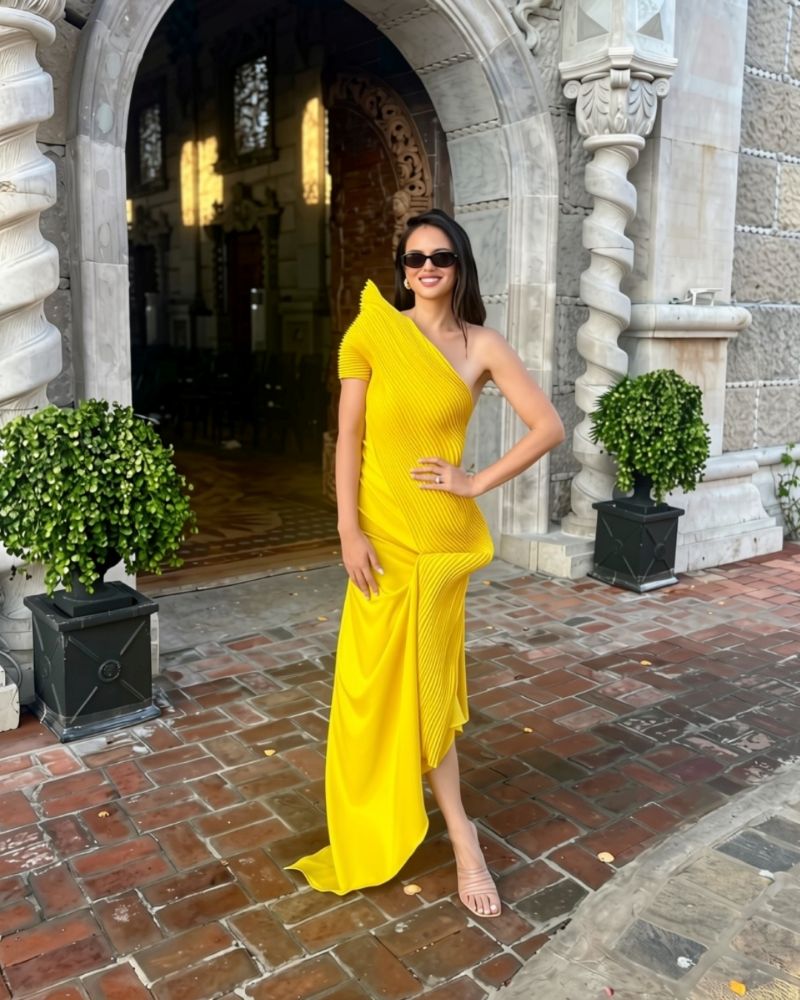
Georgina Wilson in pleats
That instinct for dressing women in ways that amplify their presence continues today. Model-entrepreneur Georgina Wilson-Burnand wore a canary-yellow gown with a sharp fan fold at the shoulder that swept diagonally across the torso into a gathered waist. The skirt opened into asymmetric pleats, giving the dress movement without sacrificing its clean lines.
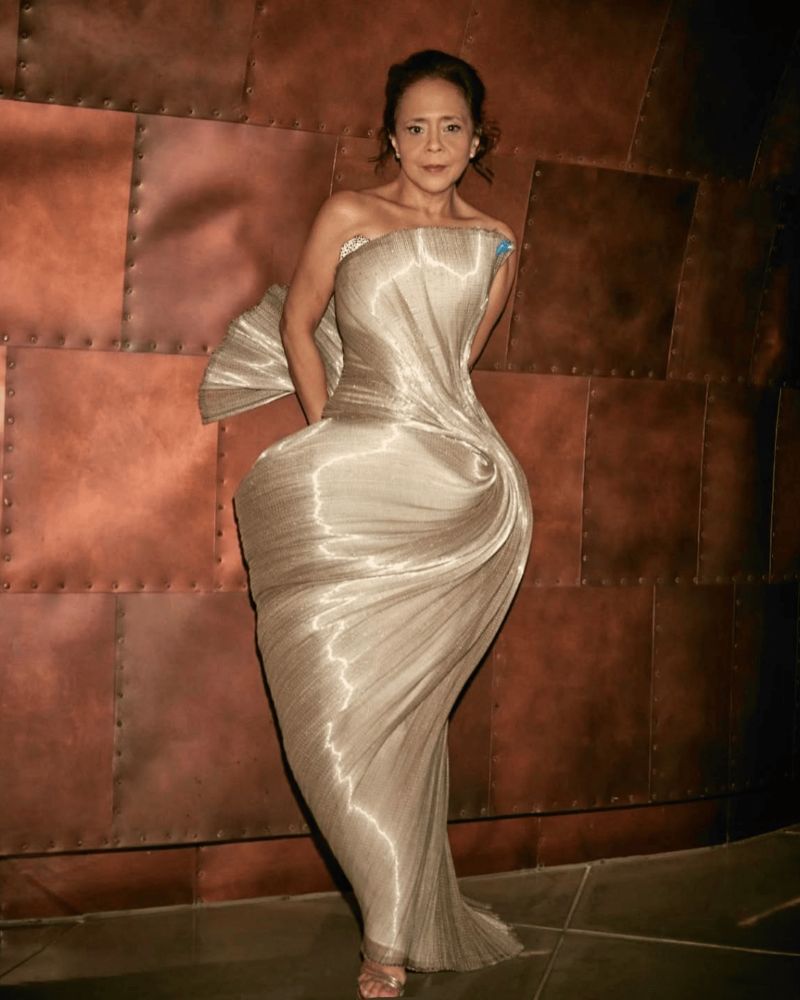
Dolly de Leon in the Alon dress for BAFTA
For actor Dolly de Leon’s appearance at the British Academy Film and Television Arts (BAFTA) show, Laurel created the iridescent metallic Alon dress. Built over an internal corset, the crinkled fabric spiraled around the hip before opening into a pleated fan and a floor-skimming mermaid tail.
His designs have also made their mark beyond the red carpet. Laurel brought crochet back into the spotlight with a beach dress worn by Vanessa Hudgens for a photo shoot. A decade before sheer bridalwear returned to fashion, he dressed Iza Calzado in a see-through lace gown for her beach wedding.
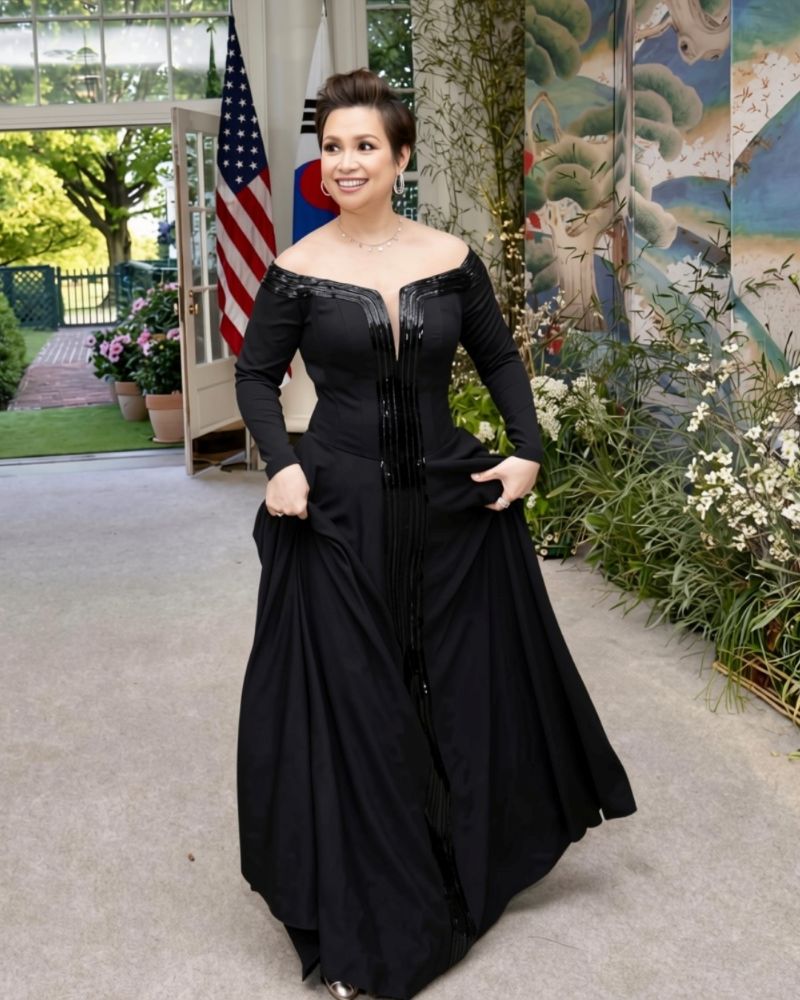
Lea Salonga at a White House performance during the Biden era
His affinity for performance goes back to his theater roots. Laurel grew up around theater but preferred making costumes to performing in them. That connection continued with Lea Salonga (his castmate in The King and I in 1978), whom he dressed in an off-the-shoulder, figure-slimming black gown for a performance at the White House during Joe Biden’s presidency.
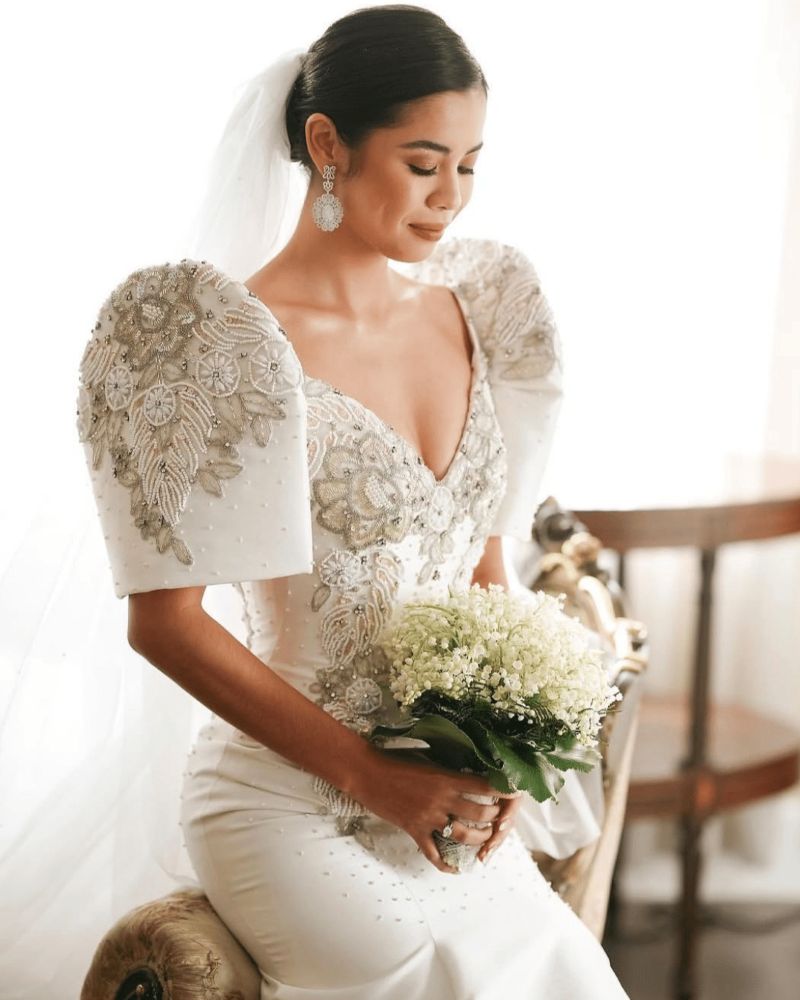
Ella Pangilinan in a reworked Pitoy Moreno bridal gown
Laurel has also found ways to connect with a younger generation while honoring fashion’s past. Digital creator Ella Pangilinan’s wedding gown began as an heirloom, originally designed by Pitoy Moreno for her mother, actress Maricel Laxa. Laurel reworked the silhouette and repositioned the beadwork to suit Ella’s personal style, refreshing Moreno’s embroidery without losing the spirit of the original. The result brought three generations of fashion into one dress.
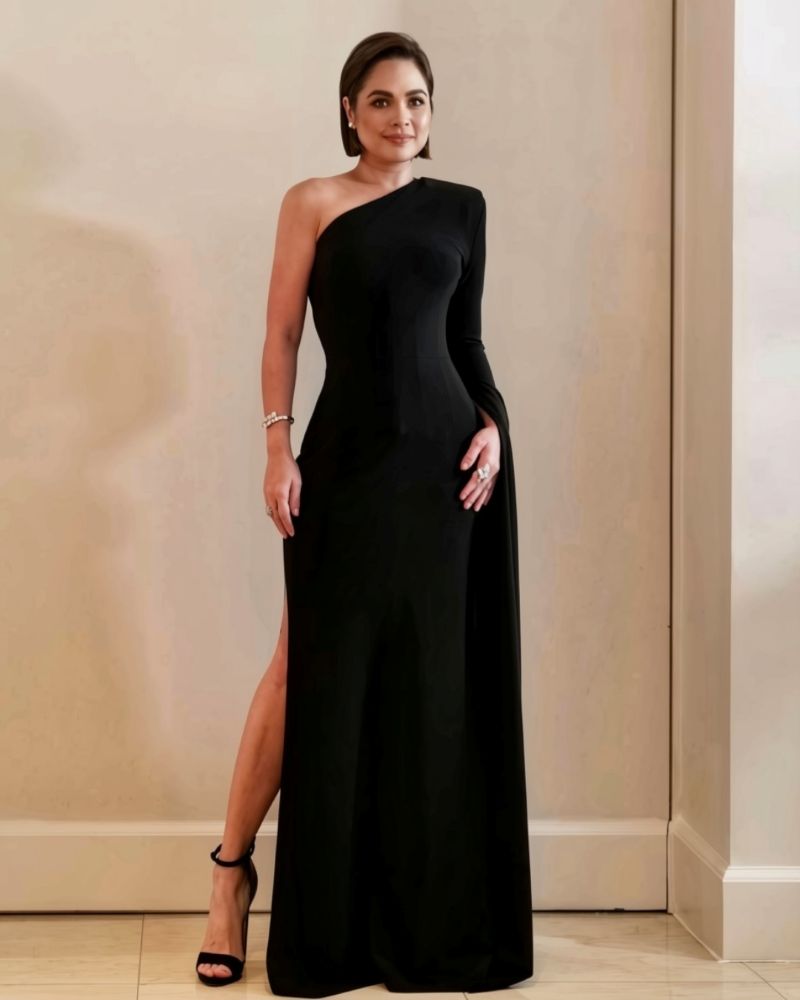
Judy Ann Santos in Rajo’s signature one-shoulder style
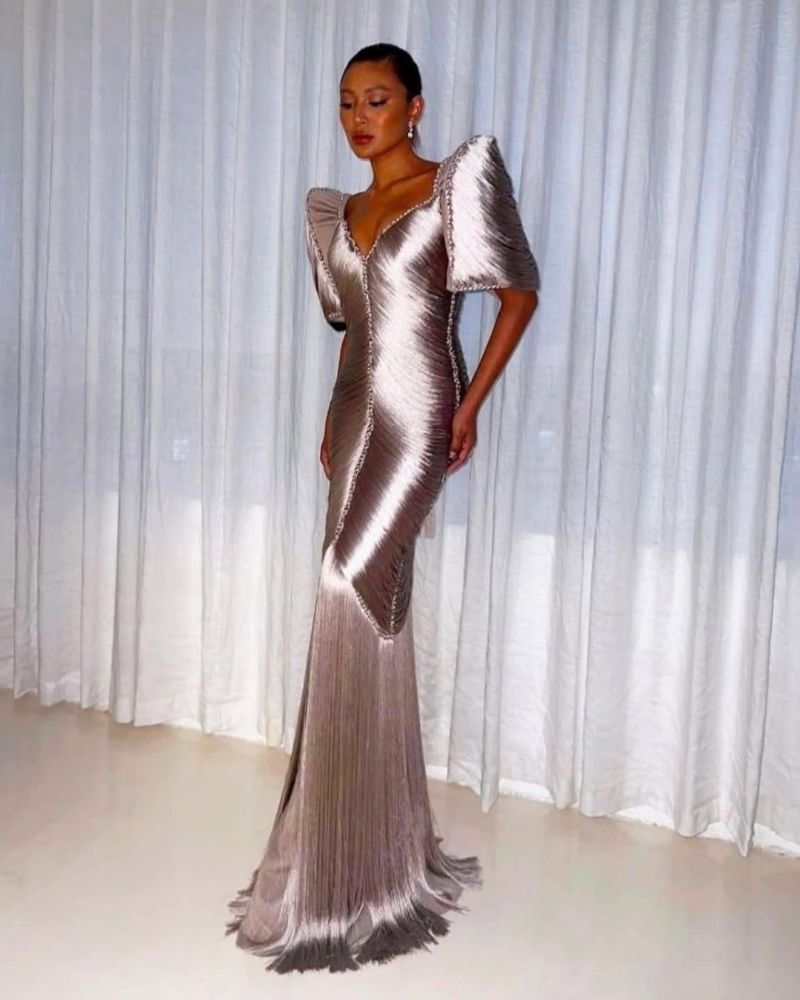
Nadine Lustre in a ‘terno’ with individual strands of metallic threads
Fashion watchers might attribute Laurel’s restless creativity to his Gemini birth sign, but his work defies easy categorization. He makes versatile, sculptural clothes that invite a second look, favoring avant-garde experimentation over rigid minimalism or conventional elegance.
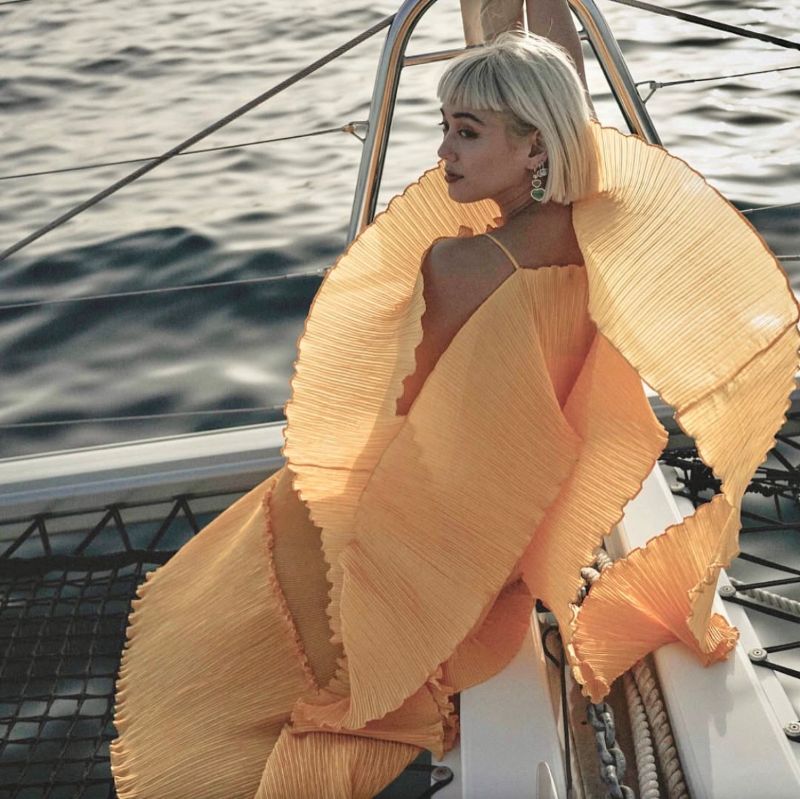
Kim Jones in micropleats
Movement is central to his designs. Sharp tailoring often meets soft draping in a single garment, while micro-pleats, origami-like folds, kinetic fringe, and gathered fabric bring texture and life to the silhouette. His clothes shift with the wearer, catching light and air as they move. Even at rest, they seem poised for motion.
One design takes its cue from the saranggola or traditional Filipino kite. High-shine metallic fabric is shaped into crisp, wing-like panels across the bodice, while a layered sash defines the waist. The split skirt fans out in geometric angles, giving the structured silhouette lightness.
Another plays with volume and texture. The strapless column, made from native material, has a sculptural bodice formed from three-dimensional diamond pleats, supported by internal boning. Below, fine pleats open into a fan-like construction that gives the skirt a dramatic sweep.
Such pieces draw on a deep personal archive. “I’m one of the few designers, apparently, who has mostly a complete set of their clothes from the day I started. In fact, one dress is from my very first show in 1993, and we’re going to be inspired by that,” Laurel says.
The payong dress was made early in his career when money was tight. “I didn’t have much money starting out, so I used umbrella material,” he says. With a slit reaching all the way to the bust, the dress made its debut at the former Mars disco in Makati in a show directed by Robbie Carmona, who will also direct Archivo.
Making do with what he had became a defining habit. He would gather retazos, or fabric scraps, and piece them together into patchwork. What began as a practical solution has taken on new meaning in an era of sustainable fashion. “When you’re a young designer with limited resources, you use what you have,” he says.
One version, Love Letter, is especially personal. Unable to part with the barongs worn by his late grandfather and father, he salvaged pieces of the garments and worked them into new creations.
Resourcefulness also led him to experiment with unconventional materials. In 2008, when people were transferring their music collections from cassette tapes to CDs, Laurel found another use for his stockpile of tapes. He wove their magnetic ribbons into fabric.
What began as thrift has evolved into a philosophy of sustainability. “I never wanted to throw things away,” he says. Early on, when he couldn’t afford much fabric, innovation was a necessity. “Like any Filipino designer, ingenuity comes from necessity.”
Some things haven’t changed. “My mom still gives me an allowance,” he says with a laugh.
Looking back is not simply an exercise in nostalgia. Laurel sees it as a chance to take stock of a career built over 33 years, drawing on the goodwill he has earned along the way.
“After 33 years, it’s basically, for me, time to look back. I’m very inspired by the saying, ‘Ang hindi marunong lumingon sa pinanggalingan ay hindi makakarating sa paroroonan (He who does not look back at his past will never reach his destination).’” It captures the thinking behind Archivo, Laurel says, as he revisits the work that brought him here while looking toward what comes next.
“Fashion is cyclical,” Laurel says. Trends come and go, but certain themes and techniques keep resurfacing in his work. For Archivo, he and his team are restyling some pieces, bringing back others, and remaking a few to see what still speaks to women today.
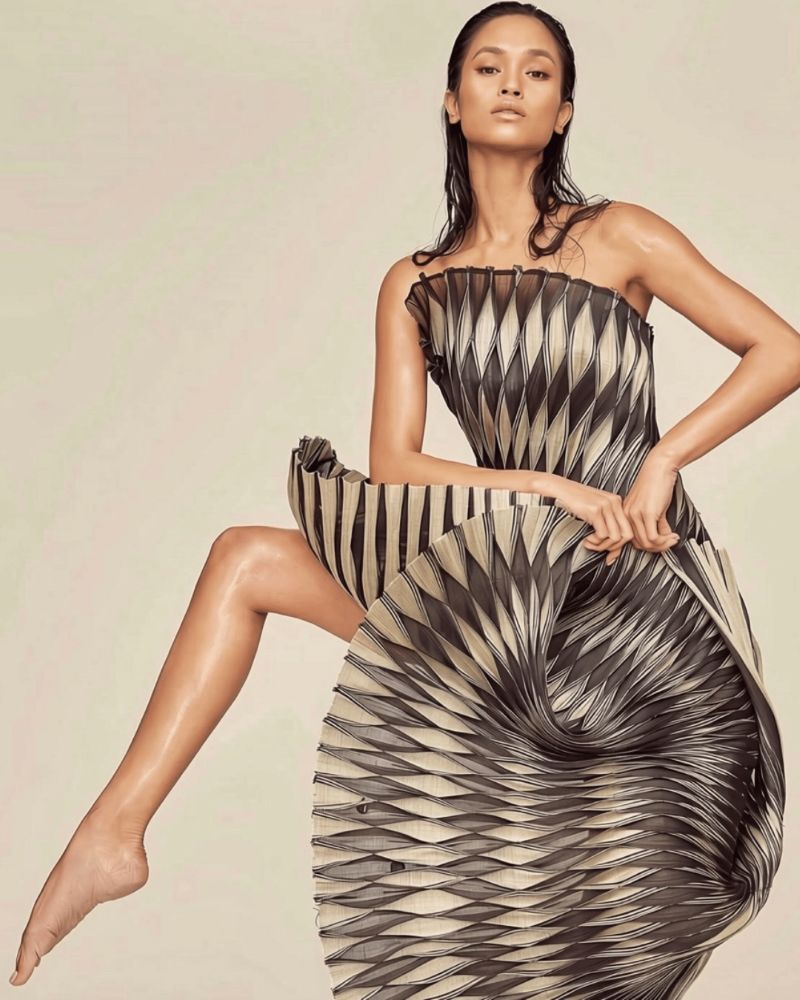
Archipelago Collection in ‘Tinalak’
The collection revisits techniques he developed early in his career, when money and materials were scarce.
His interest in weaving was nurtured by the late Narda Capuyan, a Baguio-based nurse who turned her hand-knitting hobby into a mission to revive Cordillera weaving traditions, transforming traditional techniques into contemporary products for international markets. Capuyan taught Laurel to build a loom and weave with threads, skills he is revisiting for Archivo.
The collection will also showcase the sculptural silhouettes, embroidery, and hand-beading that have long been hallmarks of his work. One new technique is reverse embroidery, in which the underside of the stitching becomes the visible surface. The rough, irregular threads create a more abstract pattern.
Laurel is bringing back his signature micro-pleats, too. The narrow, vertical folds gather around the neck like a collar, framing the face. “Women love it because it frames their faces,” he says.
His exploration of Filipino textiles extends to menswear. He is working with raw silk, piña, Ifugao blankets and silk chiffon, along with hand-beading and Yakan weaving. The pieces also reflect his interest in gender-fluid fashion, moving traditional materials beyond familiar categories of dress.
Trade fairs and exhibitions such as Likha and Habi introduced him to Filipino weavers and their work. Since then, he has looked for ways to bring local textiles into contemporary fashion while retaining their character.
“I like being undefinable. As a creative, you’re always evolving. The moment people think they’ve figured you out, you’ve stopped growing.”


