
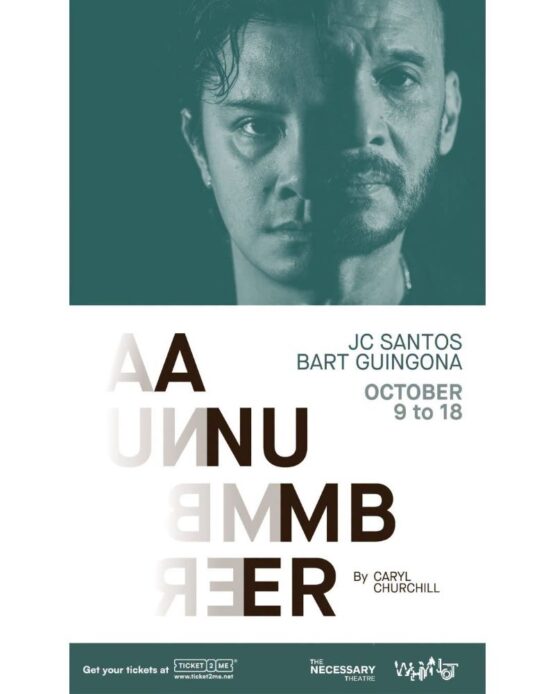
‘A Number’ runs until October 18 at WHYNoT, 4/F Karrivin Studios in Makati City. Tickets are available via Ticket2me.
WITH its heavy themes of identity, family trauma, and the lies that fracture relationships, A Number hinges on the unraveling of truth through fierce, riveting confrontations. In JC Santos’ directorial debut, this two-hander delivers these tensions with emotional force, building toward a central question that lingers beyond the stage: Can anyone ever be truly replaced?
Written by Caryl Churchill, the play explores how each person is unique, no matter how similar one may seem to another, and how the connections we form can never be exactly replicated.
Santos brings to life the perverse aftermath of a choice Salter (played by Bart Guingona) makes: a guilt-ridden father who turns to the unprecedented possibilities of technological advancement to right his wrong and give himself a second chance at fatherhood.
After losing his wife, Salter abandoned their only son, Bernard, amidst his grief. He eventually agreed to have his son cloned, raising Bernard 2 as the child he believed he should have been a better father to. But the institution responsible for the experiment had illegally created multiple copies of the original Bernard. Among them is Michael Black, who Salter gets to meet only later.
For Santos, who takes on the demanding task of portraying the different clones, this distinction becomes especially important. He must embody characters who share the physical identity while allowing each to emerge as a person in their own right, with distinct temperaments, experiences, and ways of relating to their father. The challenge lies not simply in making each clone look or sound different, but also in revealing how people who appear identical can still be fundamentally unlike one another.
The play opens with an exchange between Salter and his beloved Bernard 2, who reveals that he knows about the cloning experiment. From the outset, Santos gives Bernard 2 an unmistakable sense of innocence and youth, so his initial response to the truth is shaped more by curiosity and wonder than fear. Their conversation moves disquietingly between the unnerving implications of the revelation and moments of lightheartedness, as Bernard 2 treats the prospect of meeting the other copies almost like an adventure. Unafraid of the encounter, he even jokes that it could feel like a party, pointing out that the other copies are, after all, also Salter’s sons.
This lightheartedness gives way to a sharp contrast in the following scene, as Santos delivers a sinister portrayal of the embittered first son, Bernard. With nothing more than a black coat to signal the character change, Santos transforms his presence, delivering his lines at an aggressive pace and turning his words into near-physical attacks as he demands answers, or perhaps an apology, from his father.
Yet the performance works best when the anger reveals the hurt beneath it. Bernard is not simply a bitter man lashing out at Salter, but a son grappling with the betrayal of learning that his identity has been replicated without his knowledge, and that his father has attempted to make amends for abandoning him by raising another version of himself.
To portray him as merely hateful would risk reducing him to a villain, obscuring the grief and resentment that make his confrontation with Salter so devastating. Santos instead gives his hostility an underlying vulnerability, allowing the audience to recognize the wounded son beneath it all.
Guingona meets Santos’ performance with an equally layered portrayal of Salter, revealing the conflicting emotions and carefully guarded truths that define the father. He is at once a loving father who comforts his son, a concerned parent, a grieving and regretful husband, a secretive man, and a cunning one driven by the temptation of money.
In both revelations with his sons, he brings up the possibility of suing the hospital. With Bernard 2, it becomes a way to resolve the violation of his identity, while with Bernard, it serves as an escape from blame.
Through these exchanges, Guingona captures Salter’s greatest fault: that a person can never truly change if he never truly faces the consequences of his choices.
But perhaps what makes Guingona’s performance most compelling is his ability to portray the conflicting feelings of loving and resenting someone at the same time. Salter calls Bernard “disgusting,” yet sees him as the “perfect” son, so leading him to clone him instead of just having another child.
What makes Guingona’s performance most compelling is his ability to portray the conflicting feelings of loving and resenting someone at the same time
The minimalist stage design that WhyNot develops with multimedia artist Miguel Uy reinforces the play’s themes of identity and duplication. Four mirror panels, two on each side of the stage, serve as metaphors for the unsettling experience of seeing someone who looks exactly like you.
But more than this, they also emphasize Salter’s self-serving attempts to justify his choices. In one telling moment, Bernard stands behind a panel as Salter tries to reason his way out of the chaos he has created. Surrounded by reflections, Salter appears to be arguing with himself, as though he is merely trying to convince himself of his truth. Lighting designer Martin Miranda heightens these confrontations, using light and reflections to intensify the tension and play up the illusions.
Projectors mounted overhead display abstract images resembling dividing cells, accompanied by Frankie Lalunio’s sound design. While these elements add visual and auditory texture, the projections seem to serve little purpose beyond hinting at the science behind the story. The otherwise uncluttered stage could also benefit from clearer distinctions between locations to establish the circumstances of each scene and the limitations shaping the characters’ actions. This is particularly apparent when Bernard 2 fears that the original Bernard is coming after him and might kill him. Despite proudly professing his love for his second son throughout the opening scene, Salter shows little urgency in response during this moment. A clearer sense of the characters’ surroundings could have helped justify his inaction in the face of a threat.
These questions of identity and connection come to a head when Salter finally meets Michael Black. Unlike Bernard and Bernard 2, Michael feels less like a fully realized person than an embodiment of the possibilities and consequences of cloning. Salter’s eagerness to connect with him comes across as too immediate, leaving little room for their relationship to develop. Still, this encounter suggests that Salter has yet to come to terms with his grief. Even after everything that has happened, he continues to seek in another person the connection he once had with his son, as though another version of Bernard might finally offer him the chance to make up for what he has lost.
The play ends on this uneasy note, leaving the audience to consider whether Salter is truly seeking to know another person, or simply trying to recover yet again a connection that can neither be replicated nor replaced.
‘A Number’ runs until October 18 at WHYNoT, 4/F Karrivin Studios in Makati City. Tickets are available via Ticket2me.


