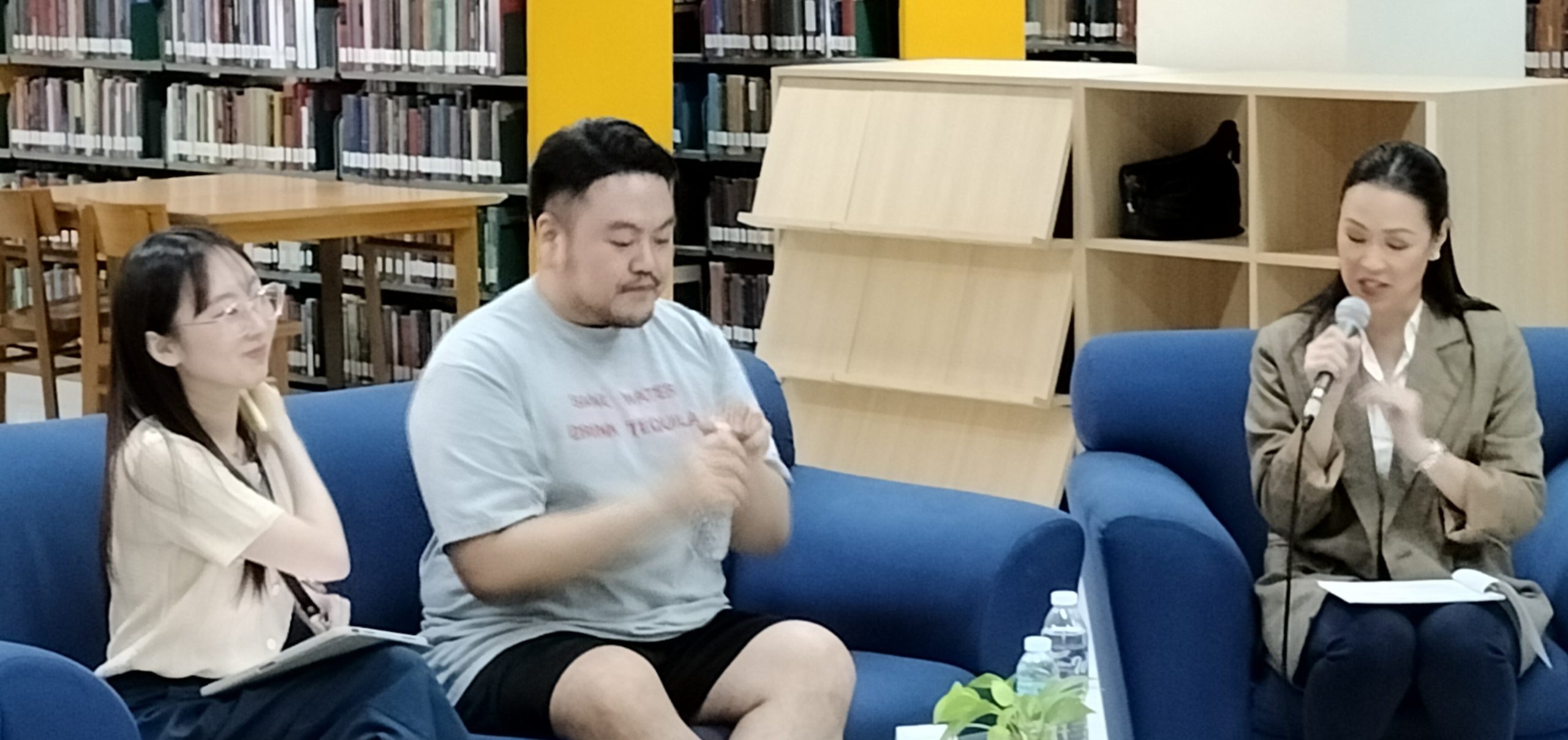
If the speaker in Conversations with the Author Park Sang Young had been a K-drama actor or K-pop idol, Ateneo de Manila University last Sept. 13 would have been packed with shrieking fans. But writers seldom have that explosive effect on people, even if Park’s English-language debut novel of 2019, Love in the Big City, is internationally acclaimed.
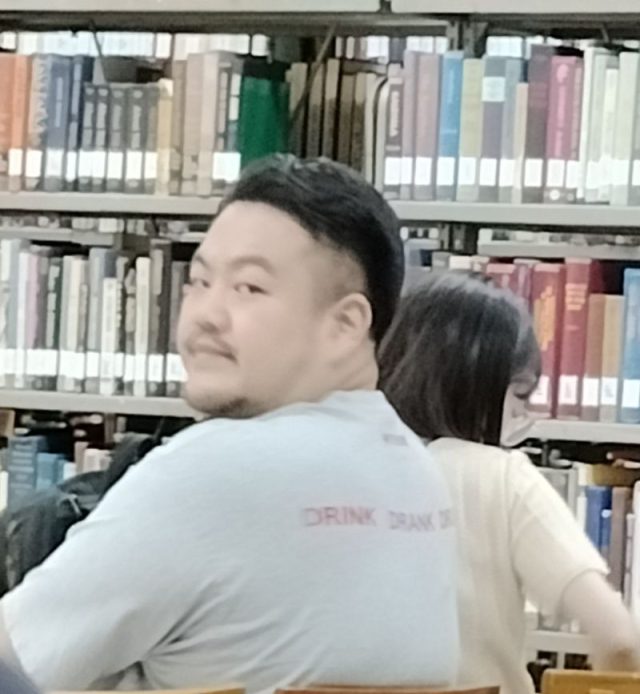
There were no screams, but Park raised eyebrows nonetheless. He arrived way past the scheduled 2 p.m., which could be blamed on Manila’s Friday-afternoon traffic. Then his attire—T-shirt, cotton shorts, and sneakers—was too informal for the K-drama dress code of “smart or business-casual.”
Conversations was organized by the Korean Cultural Center (KCC) in connection with its ongoing celebration of 75 years of friendship between the Philippines and South Korea. For September, KCC went literary.
Park had been largely under the radar despite his story, Searching for Paris Hilton, winning the 2016 Munkakdongne New Writers Award. Worse, critics scoffed at him for supposedly not being a “100 percent serious literary writer” and for catering only to women readers, as if it were a bad thing. It was schadenfreude for Park when he went on to win awards—Young Writer Award, Heo Gyun Literary Award, and Shin Dong-Yeop Literary Award—and was long-listed for the 2022 International Booker Prize and 2023 Dublin Literary Prize. Significantly, for three consecutive years, Korean authors have been Booker Prize nominees: Bora Chung in 2022 for Cursed Bunny, Cheon Myeong-Kwan in 2023 for Whale, and Hwang Sok-yong this year for Matter 2-10 (thebookerprizes.com).
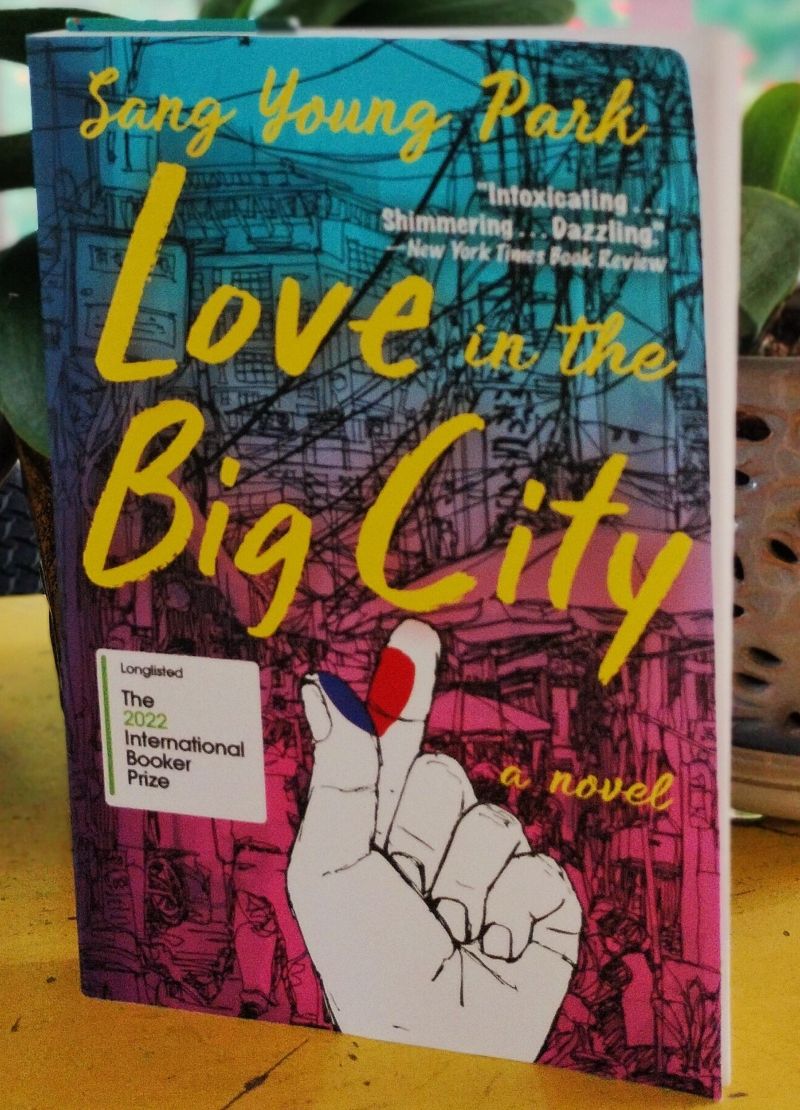
It wasn’t like Park was fixated on avenging himself or setting out to win accolades when he wrote Love… But the recognition is a frisson of excitement for Park, who unabashedly says he’s a pioneer of queer fiction in Korea, given the number of works with LGBTQ themes being published after Love… came out.
The recognition is a frisson of excitement for Park, who unabashedly says he’s a pioneer of queer fiction in Korea
“I wanted to be a writer,” Park said through a translator. “I didn’t win a lot of contests back then, but that’s part of the process. I never expected people to like what I wrote. I wrote freely.”
The former magazine editor and Seoul resident contended: “Every writer has his/her island or own special characteristics. I wanted to create my unique island. Some people suggested I write something universal to be popular, but I didn’t want to. I write deeply and uniquely from the heart.”
Still, he doesn’t altogether eschew universality. The Sungkyunkwan University graduate, who majored in French, asserts that writing fiction is about pursuing one’s uniqueness and being aware of life’s universality.
The LGBTQ community’s rallying cry of acceptance is Park’s template for Love… that he injects heavily with humor. “Professionally, it’s a weapon to use in saying serious things,” he explained. “There should be humor if the story’s heavy and sad. A queer is like a heterosexual person, a normal person, and that’s shown through humor.” On a personal level, Park uses humor when he’s “feeling down.”
Love… is a TV situational comedy in print with the irreverent characters at odds with society’s norms. Young and his best friend Jaehee are marginalized Koreans whose actions steer the storyline into black comedy. For example, in sharing a flat, they invent fictional roommates to keep gossipmongers from outing Young and labeling Jaehee the pejorative “loose woman.” Additionally, Jaehee has a screaming match with a doctor, after which she runs off with his 3D uterus model. He had lectured her on morality when she tried scheduling an abortion in his clinic.
Before the iconoclastic Young and Jaehee, Park had namesake character Director Park, a failed filmmaker, giving the novella The Tears of an Unknown Artist, or Zaytun Pasta (2019) the black comedy tone. Park dreamed of making it big with a queer movie that wouldn’t “flaunt his queerness like a medal or objectify it in a melodrama,” but ended up working for a queer film production company where he reported unauthorized uploading of the company’s adult film.
Park humorously details fictional Park’s relationships with soldier Wangsha Chanel and “fake gay” arch rival director Oh Choong-sik. During their military service, Park nicknames the soldier after his obsession with Chanel fragrances. Post-military service, in a drunken state, they steal microphones as payback for their shortened hour-long karaoke session. Meanwhile, Park has his revenge on Oh, who’s three sheets to the wind, by sending him in a cab to a commercial complex instead of his house.
The interest in Love… began peaking when word spread of its yet-to-be-shown K-drama series and film adaptations. Park revealed that he had received offers for a series and movie of Love… in 2019, but that it was difficult to launch them because of the controversy surrounding the queer genre.
Propitiously, the projects got underway. Park is thrilled with the series, writing the script from beginning to end, and retaining the essential parts of Love… while letting go of some details. Nonetheless, the control he has over the protagonist’s development has him establishing a connection between writer and narrator. That’s one point.
“The most important relationship in writing is between the narrator and writer, when the people feel that they’re real and are one,” he said.
Park has readers witnessing Young’s development: his naivete about love in Part 1; obsession with a lover in Part 2; facing love’s painful reality in Part 3; and living life after love in Part 4.
Here’s the second point: With the series’ script, he explores the theme of social discrimination experienced by both straight and queer in Korea. He describes the pressure on Young living with society’s rejection and his embarrassment about his sexual orientation. Also, he raises the dilemma of women like Jaehee who reject their traditional identity and role. Their predicament is aggravated by their living under one roof when they’re not married.
It’s a different case with the film. Park said he was livid when the directors changed the novel’s storyline without his permission. But the 36-year-old novelist didn’t hold on to his anger upon seeing the improvements in the storyline; he learned “that cooperation is a good thing.” Actually, he’s psyched about the film because one of its main stars is K-drama royalty Kim Go-eun, who had expressed interest in appearing in it. (He’s crossing his fingers that the series and film will have a Philippine premiere.)
Park is psyched about the film because one of its main stars is K-drama royalty Kim Go-eun; he’s crossing his fingers that the series and film will have a Philippine premiere
Writing helps Park cope with Korea’s social prejudices in living his life. Likewise, it enables him to put across the message that queers are just like heterosexuals going through a gamut of emotions when life disappoints or becomes unjust. He vividly describes this in Love… with Young’s “hospitalization” by his mother, who, points out Park, believed that her son’s identity should be hidden from the world. Young’s conversion therapy leaves him deflated and estranged from his mother.
In The Tears…, director Park sums up his and Wang Chanel’s undistinguished lives with stoic acceptance: “We’re just a couple of queers who laughed and drank and had sex and were going to die. And nothing more, not now, not ever.”
Queers have an ally in Park who’s living and loving without misgivings. His Love… has become an unofficial guide to navigating life in Seoul and any of the world’s other big cities. Interestingly, he said the big-city trope is a character on its own that reflects daily city life, and exhorted the LGBTQ community to express themselves, to express the love they feel.
Indeed, hiding one’s feelings of love go against the basic tenets of living. Love is a strong emotion that knows no age, gender, or schedule. Most importantly, as Park declared, it’s transformative, shaping people into who they are today. Finding love in the big city is epiphanic, and can eventually lead one to come to terms with life and one’s self.