
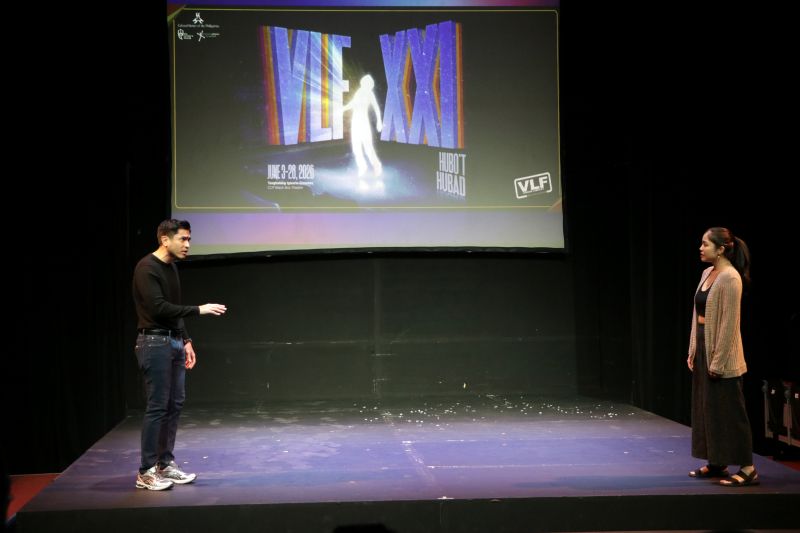
VLFXXI runs from June 3 to 28, with showtimes at 2 and 8pm (plays) and 5 pm (Staged Readings, etc.) at Tanghalang Ignacio Gimenez, Cultural Center of the Philippines Complex, Roxas Blvd., Manila
COMEDIAN-director John Lapus wasn’t happy (to say the least) when the play he had submitted to the Virgin Labfest (VLF) in 2018 made it only to a staged reading. Still, he narrated in animated fashion, he watched the plays despite the rejection. But his feathers were truly ruffled in the process, and he quietly ranted in Filipino at the incredulous moment: “Why were those plays accepted?!?”
Undeterred, he submitted a play again in 2019, and met the same result. But the third time proved to be the charm. This year, his play Taksyapo! is among VLF’s 12 “untried, untested, and unstaged” scripts by eight debuting dramatists and four returnees. Taksyapo! is about two strangers in Tarlac who discover an unexpected connection while exchanging stories of love and disappointment in a rage booth.
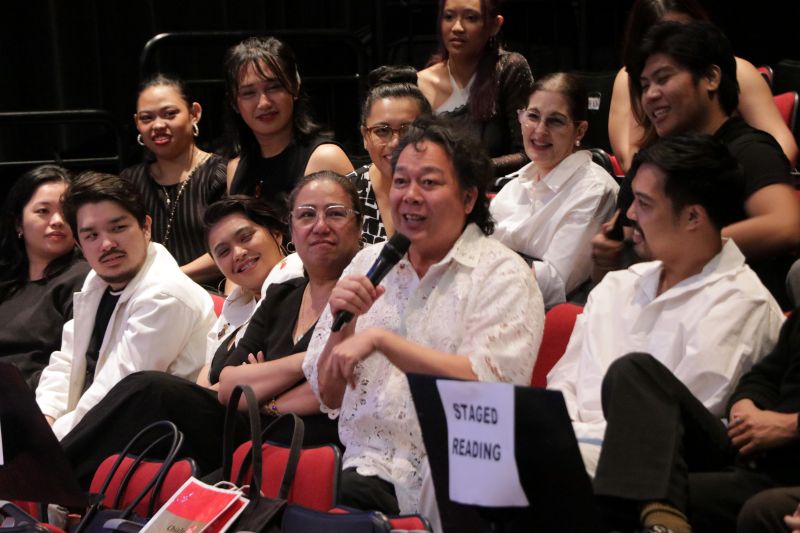
John Lapus relates how he felt at being excluded from Virgin Labfest 2018. (Photo by Kiko Cabuena)
Lapus was one of several playwrights who talked about the scriptwriting workshop at the VLFXXI: Hubo’t Hubad press conference at Tanghalang Ignacio Gimenez, Cultural Center of the Philippines (CCP) Complex on May 19, 2026.
For 21 years now, VLF has been honing the skills of emerging and established playwrights, directors, actors, and designers, and gathering them in an annual festival. For this year, VLF picked hubo’t hubad (stark naked) as theme, which focuses on how people covered in layers of identity, memory, and vulnerability reveal themselves.
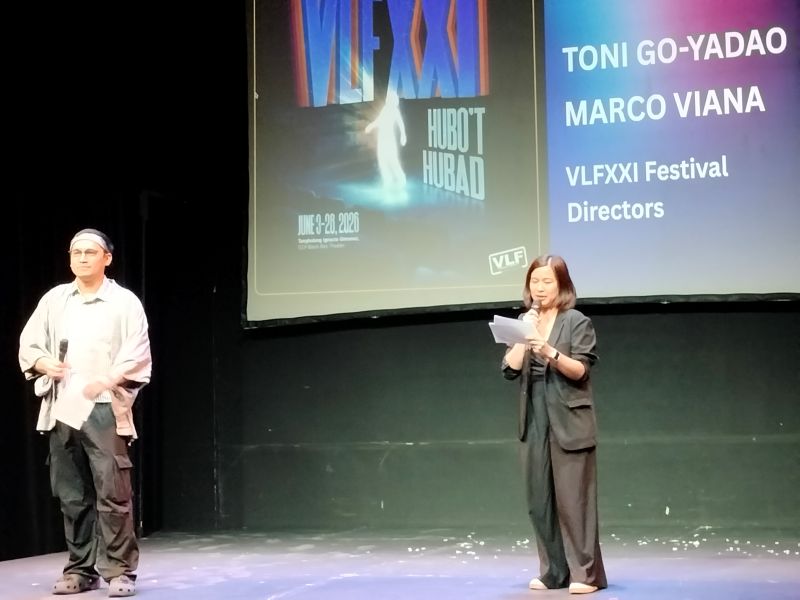
Media preview hosts Toni Go-Yadao and Marco Viaña (Photo by Liana Garcellano)
Media preview hosts Toni Go-Yadao and Marco Viaña described the theme as a celebration of adulthood and storytelling without restraint.
In her opening remarks, CCP president Kaye Tinga underscored the theme as validly capturing VLF’s maturity and artistry in its 21 years while continuing to harness the magic of theater and the arts.
“The playwrights serve as testaments to VLF becoming a talented community of individuals devoted to nourishing our nation’s cultural tapestry,” she added.
CCP vice president and artistic director Dennis Marasigan said VLF is the cornerstone of Philippine theater, with screen and theater actors coming together. He went on to explain that VLF has lasted this long because it’s a pivotal program of CCP, and thus the institution makes sure “there’s always a budget” and maintains VLF’s strengths and identity.
CCP makes sure ‘there’s always a budget’ and maintains VLF’s strengths and identity
Writers accepted at VLF have their scripts assessed and reassessed by mentors like Rody Vera, VLF founder and seasoned playwright and director. Vera reading their work and questioning them about it was what the writers found nerve-racking. The incessant probing, the chipping away at the barriers set up around their secrets, had some of them quaking in their boots.
In the end, the writers came to realize that the scrutiny made their scripts better, stoked their excitement, and opened their eyes to the differences between scriptwriting and acting out the script.
Vera said the scripts that underwent script development found their voices. He also said those who faced rejection didn’t mean their scripts lacked value.
Gab Mactal said she wrote many drafts of Lualhati and appreciated her fellow scriptwriters and cast mates for helping her thresh out details. She said she was relieved that her characters were now out of her head and sitting next to her. (Actresses Banaue Miclat and Jackie Lou Blanco joined Mactal in the section for playwrights and actors.)
Floyd Scott Tiogangco, author of Patayin ang mga Surot, said he has learned that playwriting is a collaborative effort, and can’t wait for his play to be staged. Jerom Canlas, who wrote Footprint, expressed eagerness for the process and excitement at seeing his batchmates emerge as playwrights.
Elijah Felice Rosales, who penned Human Rights Story of the Year, said he’s not used to the attention because he normally asks the questions, not answers them. He said he has watched VLF plays because of the incentive of receiving a higher mark in class. Interestingly, he became a VLF writing fellow in 2023.
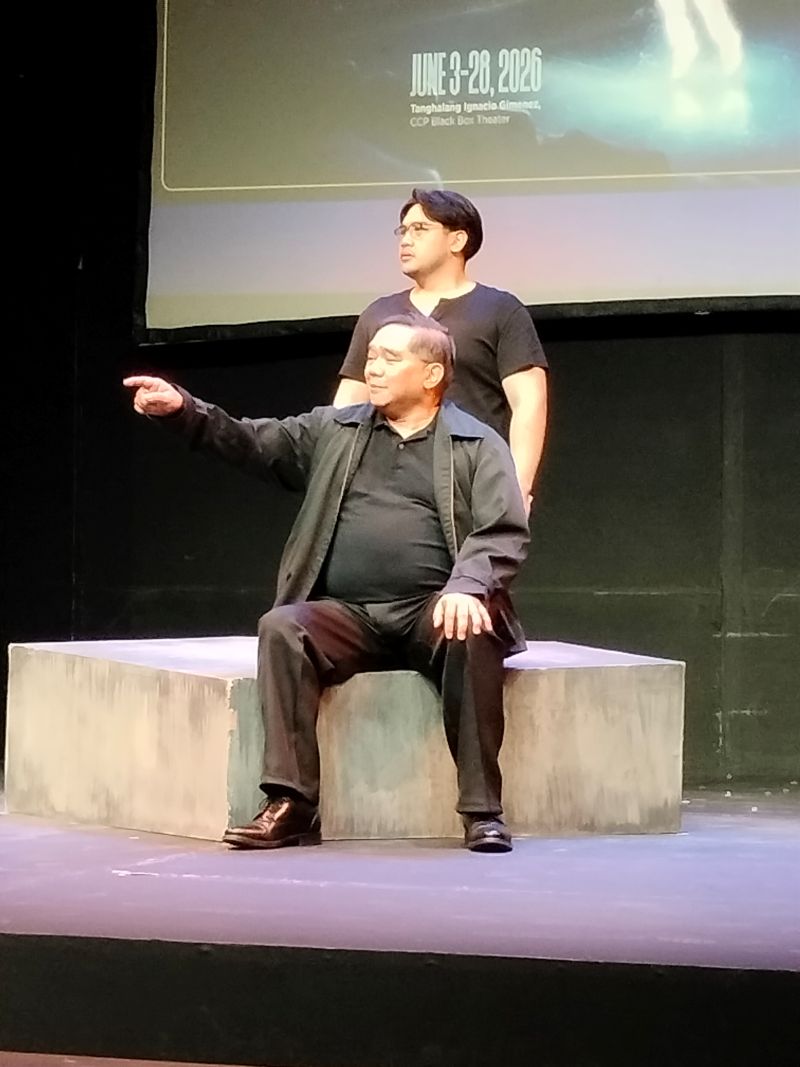
John Sanchez (standing) and Dennis Marasigan play father and son in ‘Elehiya’ (Photo by Liana Garcellano)
Two plays were previewed at the media event. Rosales’ Human Rights Story of the Year focuses on extrajudicial killings (EJKs) through the journalists in disaccord: Ish (Justine Peña) and Doy (CJ Navato), who’s against her winning the international award. Dustin Celestino’s Elehiya is a montage of conversations between a father, Gardo (Marasigan), and his son, Ed (John Sanchez), that never take place.
The long journey of Lapus’ work from staged reading to production raised the question of what makes a script VLF material.
“I have a tambiolo (lottery drum) at home,” Vera said in jest. Turning serious, the veteran theater actor said it was challenging and exciting to read the thousands of scripts VLF receives. He expressed thanks that there are now three others with him on the selections committee, and admitted that pinning the exact criteria wasn’t easy because of changing circumstances.
Having said that, Vera continued that on a personal level, he is drawn to scripts without a linear narration and that depict experiences he hasn’t heard of. Rarely discussed historical events pique his interest, he said. He also goes for “nicely written dialogues, whether for romance or boys’ love,” or a situation that looks like a typical scenario on the surface but isn’t.
Host Viaña added another criterion: new insights on a subject like EJKs as perceived by journalists, and the comedic side of mental health in Lapus’s script.
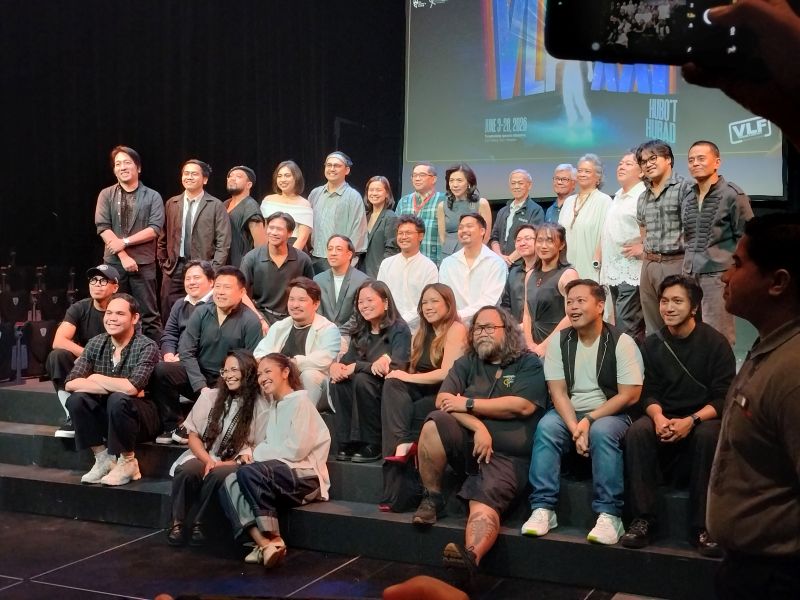
Marco Viaña, Toni Go-Yadao, Dennis Marasigan, and Kaye Tinga with the scriptwriters, actors, and directors of ‘VLFXXI: Hubo’t hubad’ (Photo by Liana Garcellano)
The plays are grouped into five sets of three.
Set A: Tengang Kawali includes Tiogangco’s Patayin ang Mga Surot, with a couple exterminating bugs just as “Oplan Tokhang” started; Anthony Kim Vergara’s PASSWORD123, PILIPNAS123, where the lead character questions his profession as cyber security expert and being a Filipino; and Rosales’ Human Rights Story of the Year.
Set B: Kapit Tuko showcases Alab Usman’s Haram, with three queer Muslims navigating faith and love across borders and barriers; Mactal’s Lualhati, showing a philosophy teacher (formerly a nun) and Lualhati meeting again; and Neil Arkhe Azcuna’s Balos, with a wounded fighter upending the lives of medical workers in a small Marawi hospital.
VLF founder and seasoned playwright and director Rody Vera reading their work and questioning them about it was what the writers found nerve-racking
Set C: Balat Kalabaw has Ron Evangelista’s She’s Electric, with a reformed womanizer and friends discussing the sexual and philosophical nature of relationships; Faith Ferrer Lacanlale’s Betamax chronicling a woman’s descent into madness and her family’s dark history; and Dustin Celestino’s Elehiya.
Set D: Pusong Mamon features Jerom Canlas’s Footprint, on a grieving family’s tragedy and unspoken feelings; Gerald Manuel’s Buhaghag, depicting a young woman’s dilemma—self-preservation or self-destruction—after being trapped by a long-haired enigma; and Lapus’ Taksyapo!
Set E: Dilang Matalim revisits Ade Valenzona’s Polar Coordinates, Rolin Cadallo Obina’s The Late Mr. Real, and Siege Malvar’s Presidential Suite #2. Polar Coordinates has a math student facing a failed exam, a fragile family, and feelings for his tutor; The Late Mr. Real has an estranged couple in a COVID-19 isolation facility dissecting why their marriage failed; and Presidential Suite #2 finds the children of a senator—accused of money laundering and convalescing from a heart attack—discussing how to salvage the family’s reputation.
VLF further encourages people’s interest in theater through Staged Readings, Theater Talks, Playwrights’ Fair, and the Writing Fellowship Program and Showcase. Staged Readings highlight Jose Victor Torres’s Mga Tatsulok and M. Manalastas’s The Devoured (Set 1); Manang by Dingdong Novenario and Suor by Rafael Jimenez (Set 2); and Ang Kasalan by Juan Ekis and Ang Huli by Jay Fernandez (Set 3).
The two special staged readings are Ihot Sinlay Cihek’s How Romantic: A Guide to Modern Pangcah Life by Taiwan International Play Reading Festival (TIPR) on June 10, and Prison Dancers by the Canada-based National Art Centre on June 21 and 24.
Theater Talks’ forums feature Cheng-Han Wu from TIPR on June 11; Jin Yim and Cui Yin Mok from Asian Producers’ Platform on June 18; and Takuya Maehara from Shizuoka Performing Arts Center on June 25.
For the Playwrights’ Fair, Vera moderates “Saan Ang Tagpuan? The Space and Time Elements in Emerging Plays in Bikol, 2018-2026” by Sari Saysay on June 13. Author-playwright Glenn Sevilla Mas facilitates “LAB-AS: Sustaining the Craft and the Future of Visayan Theater” by Tanya Lopez on June 27; and playwright-scriptwriter Liza Magtoto presides over “Herstories: On Hosting the WPI Conferences” by Dessa Quesada-Palm on June 28.
The showcase of the VLF Writing Fellowship Program—a two-week training on dramatic writing—is also scheduled on June 28.
VLFXXI runs from June 3 to 28, with showtimes at 2 and 8pm (plays) and 5 pm (Staged Readings, etc.). Tickets are ₱1,000 (regular) and ₱1,200 (premium), and Festival Passes are ₱4,000 (regular) and ₱4,800 (premium). To buy, visit the CCP Tanghalang Ignacio Gimenez Box Office (tickets and passes), Ticketworld and Ticket2ME (tickets), and CCP Facebook page (Festival Passes).


