


Pacita Abad died of cancer in 2004 at age 58. (Photo from the Pacita Abad Art Facebook page)
The 60th International Art Exhibition in Venice, titled Stranieri Ovunque–Foreigners Everywhere, was open to the public from April 20 to Nov. 24, 2024, at the Giardini and the Arsenale in Venice, Italy, curated by Adriano Pedrosa and organized by La Biennale di Venezia. It was a massive gathering of artists from different nations, addressing diverse subjects, but all under the theme of inclusivity, and against different experiences of discrimination due to race, gender, even status in life.
The title has several meanings, Pedrosa noted in the exhibit statement. “First of all, that wherever you go and wherever you are, you will always encounter foreigners—they/we are everywhere. Secondly, no matter where you find yourself, you are always truly, and deep down inside, a foreigner.
“Artists have always traveled and moved about, under various circumstances, through cities, countries and continents, something that has only accelerated since the late 20th century—ironically a period marked by increasing restrictions regarding the dislocation or displacement of people,” elaborated Pedrosa, a Brazilian curator and artistic director of the São Paulo Museum of Art, in his curator’s notes. “The Biennale Arte 2024’s primary focus is thus artists who are themselves foreigners, immigrants, expatriates, diasporic, émigrés, exiled, or refugees—particularly those who have moved between the Global South and the Global North. Migration and decolonization are key themes here.”
To say I was proud of the Philippine representation in this global art event, which has been ongoing since 1895, is an understatement. The Philippines had a stellar first—and for a long time, one and only—participation in the Biennale in 1964, when National Artists Jose Joya and Napoleon Abueva represented the country. To her eternal credit, Sen. Loren Legarda famously brought up that question during the budget hearings of 2013: “Why is the Philippines not in the Venice Biennale?” She convinced the National Commission for Culture and the Arts (NCCA) and the Department of Foreign Affairs (DFA) to work on the Philippines’ entry to the 56th Venice Art Biennale in 2015. This would be Tie A String Around The World, curated by Patrick Flores, and featuring intermedia artist Jose Tence Ruiz and filmmaker Mariano Montelibano III. Filipino artists and architects—the art exhibition alternates with one on architecture each year—haven’t stopped wowing viewers since then. The Philippine participation at the Venice Biennale is a collaborative undertaking of the NCCA, the DFA, and the Office of Senator Legarda.
The Philippine Pavilion itself this year, titled Sa kabila ng tabing lamang sa panahong ito / Waiting just behind the curtain of this age, an installation of sculpture, video, light, and sound by artist Mark Salvatus and curated by Carlos Quijon Jr., was ingenious and multilayered in itself. Also this year, however, four women—all first-timers at the exhibition—made worthy representation at the exhibition with selected artworks.

Maria Taniguchi, ‘Untitled,’ acrylic on paper, 2023
Maria Taniguchi was born in Dumaguete, and is based in Manila. Her three paintings, part of a larger project devoted to abstraction, revel in ambiguity, textures, and surfaces that seem to change with the light. Intentionally propped against the wall rather than hung, this approach “produces an unstable flux, prompting viewers to perceive them as both image and object, abstraction and representation, sculpture and painting,” wrote curator Joselina Cruz.

Detail from Nena Saguil’s ‘Untitled (Abstract),’ 1972
Nena Saguil (1914–1994), pioneering Filipina modernist and abstractionist and painter of those trademark, mesmerizing cosmic circles, was born in Laguna but made Paris, France, her home. Dots and circles abound in subtle variations of color in her Untitled (Abstract) from 1972; “As one’s reading shifts between atomic and planetary associations, the artist’s singular geometries offer possible insights into the patterns undergirding worlds small and large,” wrote curator C J Salapare.
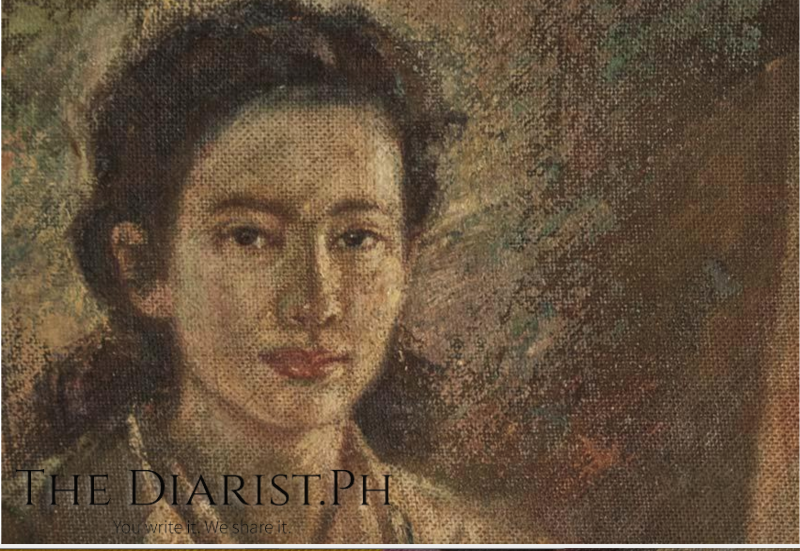
Detail from Anita Magsaysay-Ho’s ‘Self-Portrait,’ 1944
Just the fact that Anita Magsaysay-Ho (1914–2012) was the only female member of the Thirteen Moderns, those mavericks of Philippine contemporary art established in the 1930s, and led by Victorio Edades, assures her place in Philippine art history. She painted in the styles of social realism and post-Cubism, making her paintings of Filipino women more abstract than representational. Even her work, Self-Portrait (1944), literally blurs those lines, to mesmerizing effect. As Salapare wrote, “Her handling of paint—smeared, streaked, and often appearing to spill beyond flatness and form—results in varying effect, gesturing to a meta-commentary that never fully resolves itself. The figure on the canvas appears hazy, nearly inchoate, while the artist’s own visage is highly refined and luminous.”
Probably most dramatic and eye-catching, however, were the works of Pacita Abad (1946-2004), three large, wildly colorful works using her trademark technique, trapunto, which involves stitching and layering painted canvases and sewing on mirrors, beads, and other small objects for a rich, three-dimensional effect. Abad was Ivatan, born in Basco, Batanes, but eventually became an American citizen, traveling the globe in a career that spanned almost three decades. She memorably decorated the Metro Center subway station in Washington DC for three years, and her works are in public, corporate, and private art collections in several countries.

Visitors at the 60th Venice Biennale viewing Abad’s ‘Filipinas in Hong Kong,’ trapunto, 1995
Her three works captured quite powerfully the “stranger” and immigrant experience emphasized at the 2024 art biennale. Haitians Waiting At Guantanamo Bay (1994) is marked by prominent barbed wires, dark figures, and palm trees. Filipinas in Hong Kong (1995) juxtaposes the neon lights with the gatherings of kababayan. You Have to Blend in Before You Stand Out (1995), wrote Joselina Cruz, is “a large trapunto of a woman dressed in a sarong that matches a Yankees baseball cap and Bulls basketball jersey, illustrating the internal struggle that immigrants and their families experience when integrating in a new society.”

Pio Abad and wife Frances at the Turner Awards last December (photo from Pio Abad’s Facebook page)
In an interesting connection, I thought of Abad’s nephew and de facto custodian of her legacy, London-based, acclaimed artist Pio Abad, who drew a stuffed gorilla in a Hawaiian shirt in a portrait called Eddie, which graced the cover of the 2nd Night Tube cover of the London Tube Map. This was commissioned in 2017 by Art on the Underground, a project of the office of the Mayor of London. Pio, incidentally, was one of four artists shortlisted for the 2024 Turner Prize, one of the United Kingdom’s most prestigious awards, given by the Tate Gallery, for his exhibition, To Those Sitting in Darkness, shown until last September at The Ashmolean Museum in Oxford.
“Pacita always dreamt of being part of the Biennale, but I think if there was a Venice Biennale that perfectly encapsulated her work and life, it would be this one,” he told TheDiarist.ph in a text message from London. “Her art was a commitment to celebrating and honoring the lives of those on the margins of society, and the different indigenous communities she interacted with and learned from, so it was incredibly moving to see her work at the Arsenale.”
As yet another testament to Pacita Abad’s international recognition, Pio recounts how they had also just opened an exhibition of his aunt’s work—Pacita is the sister of Pio’s father, former Education Secretary Butch Abad—alongside younger emerging artists at the Karma International Gallery in Zurich, Switzerland. “Some people encountering her work for the first time were so shocked to find out she had passed away 20 years ago! They thought the paintings were made by the artist specifically for the exhibition! The vibrancy of her works and her omnivorous approach to material make the work constantly engaging, and that’s why it resonated with so many people.”
It was heartwarming to see Filipinas claim their much-deserved place among the world’s best, remaining relevant in the art arena of today despite the years. Here’s hoping more will bring their creations to light on this truly global stage in the future.


