
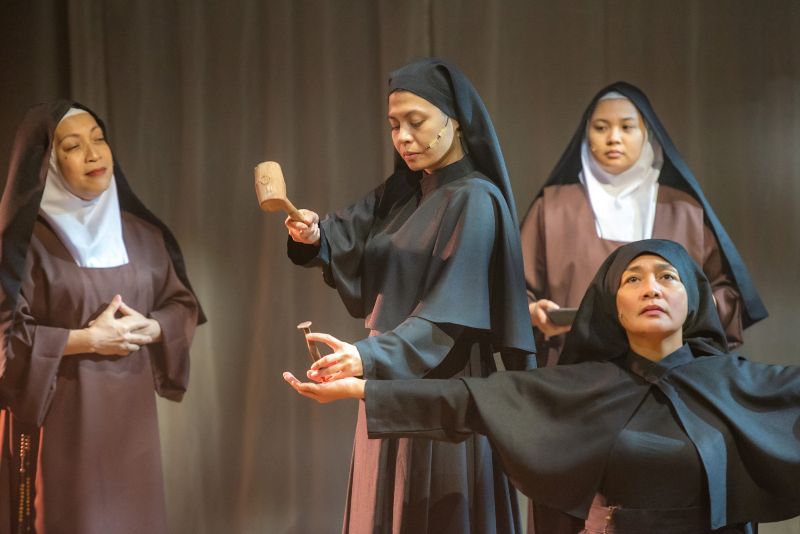
By the time you read this, all shows of Floy Quintos’ final work, Grace, will have been sold out. It’s entering its last weekend performance Sept. 13-15, 2024, of its 10-performance run at the Arete, Ateneo de Manila University, Katipunan Road, Quezon City.
That’s the bad news for theater-goers who want to catch up. The good news is, there’s a vintage Quintos play coming—Gironiere will be restaged. But we’re getting ahead of the story.

Floy Quintos and Dexter Santos in 2016 during their Dulaang UP days. (Photo by Dno Dmr)
Director Dexter Martinez Santos told TheDiarist.ph last September 5 that there would be no other performances after the 15th —no extensions for Grace, unless its producers squeeze in weekday shows so that those who haven’t seen it may have a chance. (The team behind Grace is not named Encore Theater for nothing.)
When Grace opened last May, its cast and the entire Encore staff were still in mourning, like the rest of Philippine theater and the culture community, trying to make sense of the sudden demise of Floy Quintos, their beloved mentor and friend.
Quintos, 63, succumbed to heart attack on April 27, 2024. The opening performance of Grace at PowerMac Center Spotlight Blackbox Theater at Circuit Makati was May 25. As Quintos’ unintended swan song, Grace had a highly acclaimed run, with a clamor for additional shows. It ran until June 23, 2024—a total of 18 sold-out shows, each with five-to-10-minute-long standing ovations.
Grace is considered Quintos’ final masterpiece. It reignited the curiosity of young Filipinos who were, until then, clueless about the reported apparitions and miracles of the Virgin Mary in Lipa, Batangas, in 1948, after World War II.
For non-believers, the story was a controversy more interesting than perhaps a Dan Brown novel adapted to film.

Garden at Our Lady of Mount Carmel Church, believed by the Catholic faithful as the site of post-war apparitions, in Lipa, Batangas
After watching Grace, some must have felt the urge to hop on the first bus to Lipa City in Batangas to attend Mass or say a prayer at Our Lady of Mount Carmel Church (Mary Mediatrix of All Grace) on P. Torres street, Barangay Antipolo del Norte.
Related Stories:
Why GRACE has powerful impact on me
Grace opens with a disclaimer—that Grace is fiction woven from the reported events from 1948 to 1951. Quintos’ research was based on journalist June Keithley’s book Lipa and on newspaper accounts of the apparitions and the pilgrimages. News clippings of these are projected onstage accompanying the scenes. At some point, it feels like a classroom lecture, but instead of slides, it’s the actors explaining the turn of events. But then, that’s the charm and magic of theater. You are hypnotized and drawn to another world.
Quintos pointed out that he developed and wrote the play independently over a period of three years—it was not a commissioned work or in any way was endorsed by the family of the novice Teresita Lat-Castillo or the Carmelite Sisters in Lipa.
The play gathered a few of the finest theater actors whom the late playwright-director had nurtured, trusted and loved. In recent years preceding Quintos’ death they have come to be known as Quintosian theater artists.
Stella Cañete-Mendoza plays the lead, Sister Teresing, as how she came to be called in history, the Carmelite novice who experienced the presence of the Virgin Mary and the shower of miraculous rose petals, which were believed to bear healing powers and the images of Christ and the Virgin.
In a predominantly Catholic country, Sister Teresing was regarded a living saint. It came to a point when the number of visitors or devotees coming from many parts of the country, if not the world, reached half a million. Even President Elpidio Quirino, then the head of the post-war republic, was among the visitors. It was not Sister Teresing who went to Malacañang, it was the other way around. Even Philippine Airlines, according to newspaper accounts, started direct flights to Lipa, Batangas.
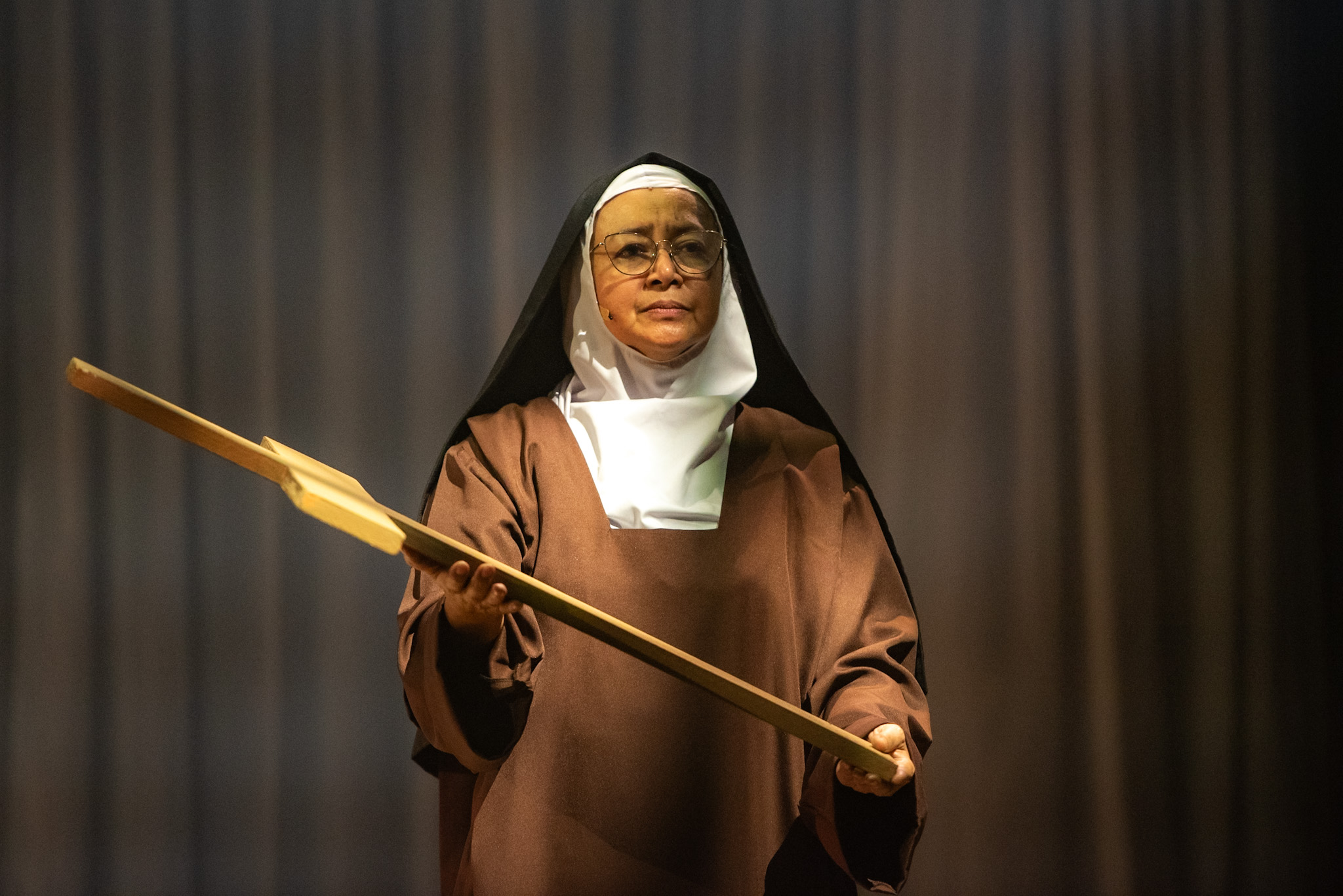
Shamaine Centenera Buencamino ass Mother Cecilia of Jesus (Photo by Vlad Gonzales)
This unintended celebrity starts to draw the attention of Church authorities in Manila who feel affronted when the Mother Prioress (played with a potent combination of vulnerability and fortitude by Shamaine Buencamino) stands her ground and refuses to send her novice to seek an audience with the papal delegate.
The consistently magnificent Leo Rialp plays Msgr. Egidio Vagnozzi, the Italian priest and papal delegate who would become the First Apostolic Nuncio to the Philippines. Take note, he came to spoil the party more than a year after the reported Lipa apparitions started. He was sent to Manila in March 1949 and was appointed by Pope Pius XII on April 9, 1951. He was received by President Quirino on June 20 the same year at Malacañang Palace.
Vagnozzi is portrayed as the racist and arrogant antagonist who orders an investigation into the Lipa miracles and into the veracity of Sister Teresing’s visions.
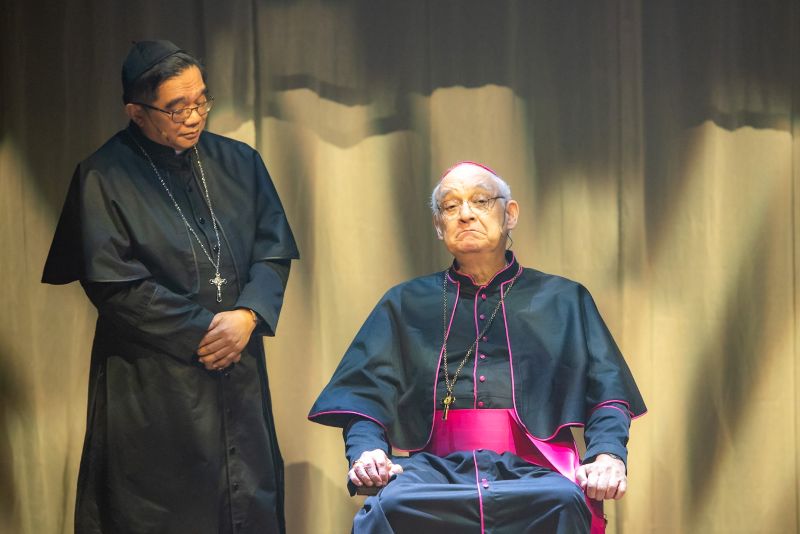
Dennis Marasigan as Msgr. Rufino Santos and Leo Rialp as Msgr. Egidio Vagnozzi (Photo by Vlad Gonzales)
The interpretations of each character by this select Quintosian cast, of course, are of the highest order. We are filled with indignation when the Catholic hierarchy led by Msgr. Rufino Santos (Dennis Marasigan) triumphs over Sister Teresing’s defenders, Mother Cecilia of Jesus (Shamaine Centenera-Buencamino), and Msgr. Alfredo Versoza (Jojo Cayabyab).
According to news reports, Versoza as bishop of Lipa was removed and replaced by an apostolic administrator, Msgr. Santos, who later became the first cardinal from the Philippines.
Amid the tension, we get comict relief whenever Frances Makil-Ignacio as Sister Agatha comes in to try and make sense of it all, as a simple-minded folk in her thick Batangueña accent. (“Paano magkakaron ng malaking blower sa simbahan eh wala naman kaming kuryente?”)
We are in awe of Missy Maramara as Sister Lucia, the character who makes Sister Teresing’s life miserable. Incidentally, just a week before Grace opened, she gave an amusingly captivating portrayal of the titular character in MusicArtes Inc.’s’ The Half-Life of Marie Curie. I was still reeling from her portrayal of a wine-sipping-scientist flawed character when I watched Grace.
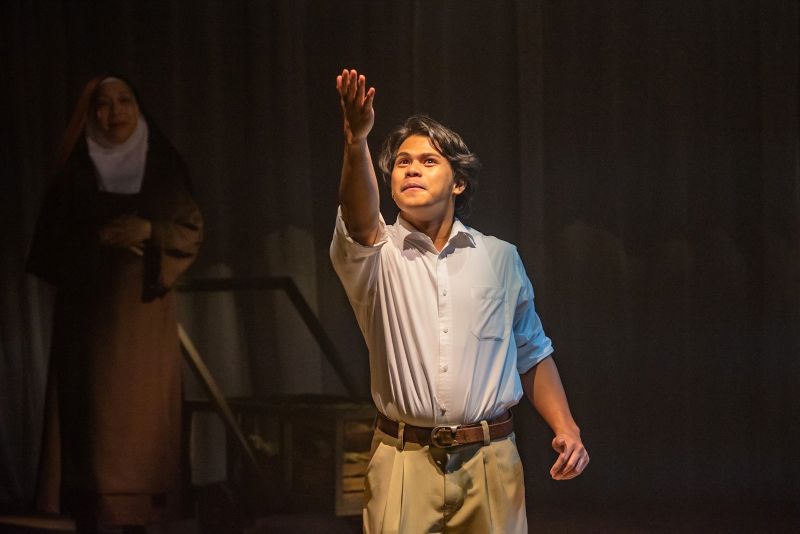
Raphne Catorce as Guillermo (Photo by Vlad Gonzales)
There is also the calm presence of Matel Patayon the nurse. Raphne Catorce plays Guillermo, the rogue man-on-the-street who becomes a taong simbahan, an all-around acolyte. His character reminds us of the fictional sugarcane farmhand named Anselmo, played by Kalil Almonte in Quintos’ Angry Christ.

Nelsito Gomez as Fr. Angel de Blas (Photo by Vlad Gonzales)
Nelsito Gomez, the artist Alfonso Ossorio in Angry Christ, is exceptional as the skeptical scientist-priest, Fr. Angel de Blas.
The minimalist set and stage design by Mitoy Sta. Ana, mostly white curtains—actually just white curtains—aptly compels the audience to focus on the actors. The music and sound design by Arvy Dimaculangan and the lighting by John Batalla create the mood without the need to exaggerate it.
All in all, Grace in the hands of Encore Theater successfully transcends Quintos vision, that is, to expose human frailty more than the flawed Catholic hierarchy.
At this point, we could only look back on a what-if situation. Had the Vatican put its imprimatur on the Lipa apparitions, in a country ruled by Spain for 300 years and where its colonizing influence is felt to this day, we could have had our own religious pilgrimage site like that of Our Lady of Fatima in Portugal, which had six reported apparitions by the Blessed Virgin Mary in 1917, or Our Lady of Lourdes in France, which had 18 apparitions in 1858.
In an in-depth commentary by Inquirer’s former arts and books editor Lito B. Zulueta, titled New inquiry sought into 1948 Lipa ‘apparitions, that ran in the Philippine Daily Inquirer on April 17, 2022, he wrote how “Marian devotees in Lipa have since questioned whether then Pope Pius XII ever confirmed the commission’s findings, arguing that the Vatican had not shown any document to prove the papal approval.”
We quote: “Relatives or associates of the bishops who participated in the Church inquiry have made sworn testimonies quoting the prelates as saying that they signed the negative judgment because they were forced to by Santos and the then apostolic nuncio, Archbishop (later Cardinal) Egidio Vagnozzi.
“In 1991, Jesuit Fr. Lorenzo Ma. Guerrero filed a sworn statement saying that his uncle, San Fernando Bishop Cesar Ma. Guerrero, who was a member of the inquiry, had told him of signing the 1951 statement ‘under duress.’”
‘In 1994, retired Borongan Bishop Godofredo Pedernal also filed an affidavit saying that…. he personally witnessed the shower of rose petals….’
There were witnesses back then who attested that the showers of rose petals were real.
Zulueta added: “In 1994, retired Borongan Bishop Godofredo Pedernal also filed an affidavit saying that while on a visit to the Carmelite convent in Lipa in 1948, he personally witnessed the shower of rose petals.
“Pedernal added that as a close confidante of Lipa Auxiliary Bishop Alfredo Obviar, he personally witnessed Obviar visiting Guerrero and the other members of the commission—Jaro Archbishop Jose Maria Cuenco and Nueva Segovia Archbishop Juan Sison—on their death beds and asking them why they signed ‘the declaration about the foolishness of the Lipa Carmel Sisters.’”
“The prelates, according to Pedernal, showed Versoza the petals they had kept as souvenirs of the apparitions and told him: ‘We were forced to sign.’”
During the May-to-June run of Grace, there were members of the audience who brought samples of the miraculous rose petals imprinted with images believed to be those of the Virgin Mary and Jesus Christ, which they said were keepsakes that belonged to their grandparents.
In 2023, the Catholic Bishops Conference of the Philippines (CBCP), under the order of the Vatican, prohibited the celebrations of anniversaries related to the Lipa Marian apparitions.
The Catholic Church has been mired in controversies, then and even in recent decades, mostly sexual crimes, as portrayed in films like Primal Fear (1996), The Magdalene Sisters (2002), Pedro Almodovar’s Bad Education (2004), Philomena (2013), Pablo Larrain’s The Club (2015), Spotlight (2016), and By The Grace of God (2019).
Just this year, the Vatican excommunicated Archbishop Carlo Maria Viganò, after finding him guilty of schism. The disgraced prelate, who has been a foremost critic of Pope Francis, was also a Vatican ambassador to the US, a post once held by Vagnozzi. We’ve read that immediately after Vagnozzi’s “tour of duty” in the Philippines, he was transferred to the US to serve as the seventh apostolic delegate from 1958 to 1967.
We can only find solace and relief in the thought that, amid the injustice of this world, we have something as grand though ephemeral as Grace. We can even hear Quintos himself saying, “Ay, move on na tayo, kapatid! (Let’s move on!) Message sent na!”
Which brings us to Gironiere.
As exclusively shared with TheDiarist.ph, director Dexter Santos said he was given a copy of the script of Gironiere. “It’s a scanned copy of the typewritten manuscript. It was emailed to me by a family member after I told them I’ve been wanting to read it. The hard copy is still with them, of course. It has 58 pages,” Santos said.
The play is about Paul de la Gironiere, a French naval surgeon who lived in JalaJala, Laguna, for 20 years in the 19th century, and who cultivated what was considered the first modern farm in the country. He also wrote two memoirs about his life in the Philippines, on which Quintos based his play. In 1989 it was directed by Tony Mabesa, who would become National Artist for Theater.
Gironiere was Quintos’ first play for Dulaang UP. In several interviews, Quintos said he might have a copy but he couldn’t remember where he put it, so the play could be lost forever.
As luck would have it, or could it be Quintos’ guiding one of his pamangkins, a manuscript was found in the baul and it was recently handed to Santos by a member of the Quintos family.
Gironiere was also the first play that award-winning actress Dolly de Leon acted in at Dulaang UP. She said in several interviews, amusingly, she only had one line: “Tigang ka lang (Your sex life is like parched earth).”
Santos told TheDiarist.ph he is very much excited to direct it, and he’s thoroughly studying the text.
Will it be for Encore Theater, Dulaang UP or other theater companies that seem to be “tigang” of brilliant, well-written, original materials like Quintos’? Abangan!


