
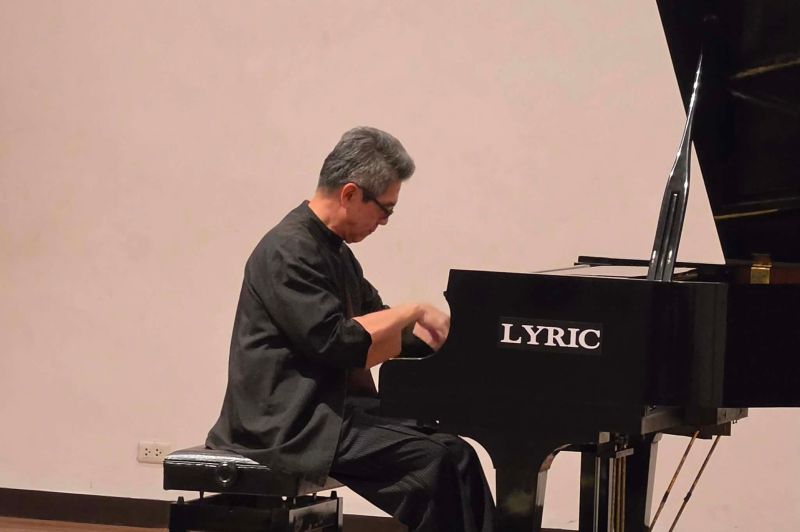
Pianist Albert Tiu stunned Manila’s music lovers who listened to his solo piano recital last Saturday, June 6 at the David Consunji Theatre in at the University of the Philippines in Diliman, Quezon City. His concert was for the benefit of the Piano Teachers Guild of the Philippines (PTGP).
He joined the faculty of the Yong Siew Toh Conservatory of Music (YSTCM) of the National University of Singapore in 2003, and is now a full professor in the conservatory. He won major prizes in international competitions across North America, Europe, Africa, and Asia, and stands at the forefront of Asia’s classical music as performer, recording artist, and educator.
For the first part of his program, he lined up works of two composers, Federico Mompou and Nikolai Medtner, which are rarely included in piano recitalists’ programs here in this country; his arrangement of National Artist for Music Ryan Cayabyab’s Kay Ganda ng Ating Musika and Francisco Buencamino’s Ang Larawan closed the first part of the program.
He played Mompou’s miniature works, Cancion y Danza, Nos. 3 and 5 with the usual Spanish flair, expressed in a quick manner with a dash of Spanish song and dance. In Medtner’s single movement, Sonata Reminicenza Op. 38 No. 1, he eloquently conveyed the poetic sense of nostalgia that the work was wrapped in, with brilliant lyricism.
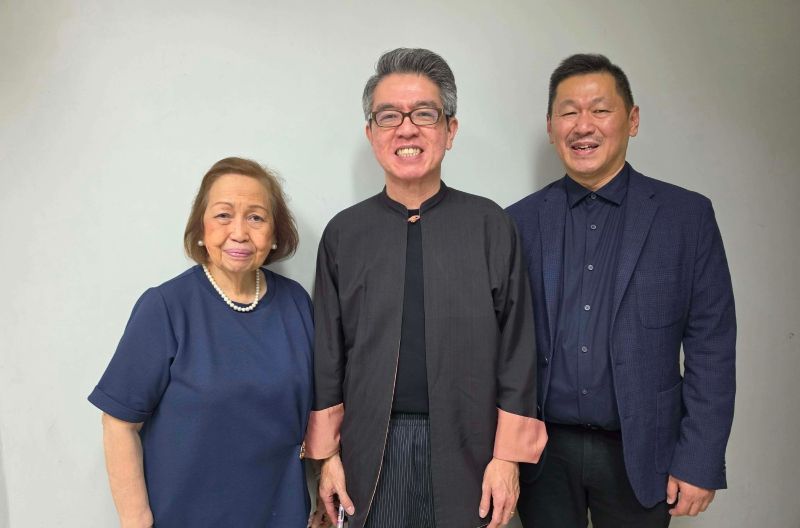
Souvenir pose: Albert Tiu flanked by Profs. Cecile B. Roxas (L) and Anthony Say (R)
He prefaced his playing of the next Philippine works with a short talk as he particularly thanked his former piano teacher, Prof. Cecile Basilio-Roxas of the Sta. Isabel Conservatory of Music, and classmate, Philippine Charity Sweepstakes Office (PCSO) manager Melquiades “Mel” Robles, for inviting him to play in this concert. He said that Mompou’s and Medtner’s works are rarely included in a pianist’s program, as traditionally, the works of Bach, Haydn, Beethoven, or Chopin are included, of course to show different stylistic nuances.
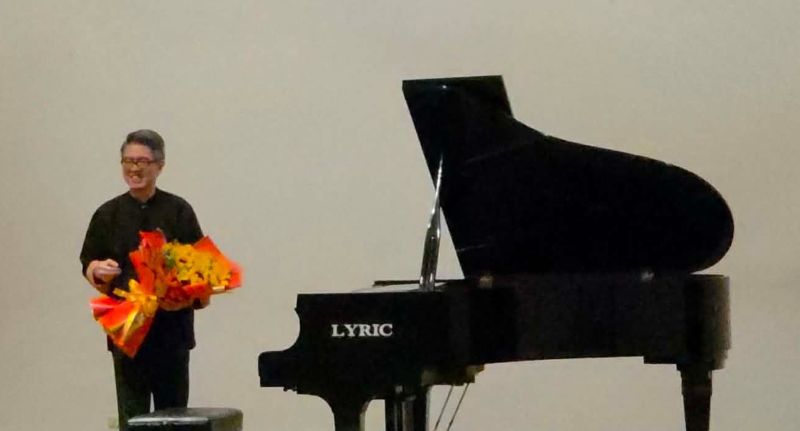
Albert Tiu gets a bouquet of flowers, acknowledges applause
He went on to thank, too, his former teacher in theory and harmony, National Artist for Music Ryan C. Cayabyab, for his exemplary teaching, and emphasized the importance of pianists understanding the works they are playing. He called theory and harmony the “building blocks” for performing pianists to analyze the works they play. He further said that it was while walking his dog one night that he thought of arranging his former teacher’s popular ditty, Kay Ganda ng Ating Musika, which won the Metro Pop Grand Prize in 1978, into an “Impromptu” in the style of Chopin and Schubert. And truly, one felt the skillful, fluid improvisation that pianist Tiu infused in the work. Thunderous applause greeted his playing at the end!
Tiu called theory and harmony the ‘building blocks’ for performing pianists to analyze the works they play
It was with such polish that he closed the first part of the program in playing the popular Buencamino’s piece Ang Lawaran. The audience listened intently as the pianist, with a dash of virtuosity, sank his fingers into the keyboard.
He mesmerized his listeners with his brilliant, even, and expressive tones, which pianists during the intermission that followed did not fail to comment on. “Lapat na lapat ang kamay sa keys” (“His fingers sank close to the keys”) was the unanimous comment. It was that technique that produced that warm and smooth sound that his adept fingers had created with firm control.
Listening to him in the second half of the program was even more gratifying. He demonstrated his full virtuosity in playing Rachmaninoff’s Piano Concerto No. 2 in C Minor, Op. 18. Here, he was both the soloist and the orchestra. He himself arranged the piece for solo piano, and played the entire piece with solid dispatch.
How he arranged such a piece into a solo piano was in itself a feat. Indeed, his knowledge of harmony and theory was at best exemplified in this work that he arranged. It was a taxing task to play both as soloist and collaborative orchestra, with fidelity to the original score, but he emerged triumphant at the end.
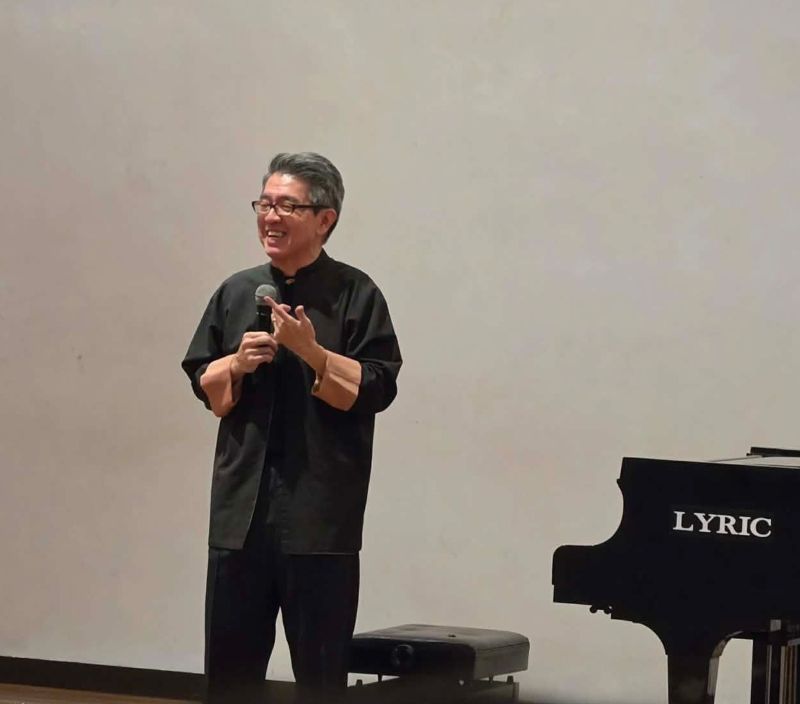
Pianist Tiu gives information on the pieces he will play
Pianist Tiu showed his utmost understanding of the piece which he conveyed through an eloquent combination of technical brilliance and emotional depth. Throughout the work’s three movement, he played with composure and brought out the lyrical character of the piece. Particularly interesting was the playing of the second movement, which pianist Tiu infused with such comforting emotional warmth.
When the familiar, moving theme that Tin Pan Alley made into a love song, Full Moon and Empty Arms, was played in the third movement with such expressive resonance, it was such a feat for the pianist, to have made such an interesting arrangement, with absorbing playing. And when those last four rhythmic four notes were sounded (that curiously sounded like “Rach-ma-ni-noff,” as if ina signature), pianist Tiu sealed his performance with sterling, virtuosic brilliance. The audience rose in ovation and gave thunderous applause!
Albert Tiu had to acknowledge several curtain calls before he finally sat at the piano and played the 18th variation of the same composer’s composition, Rhapsody on a Theme by Paganini Op. 43, used as theme song in the movie Somewhere in Time.
Bravo, pianist Albert Tiu! Congratulations, PTGP!


