
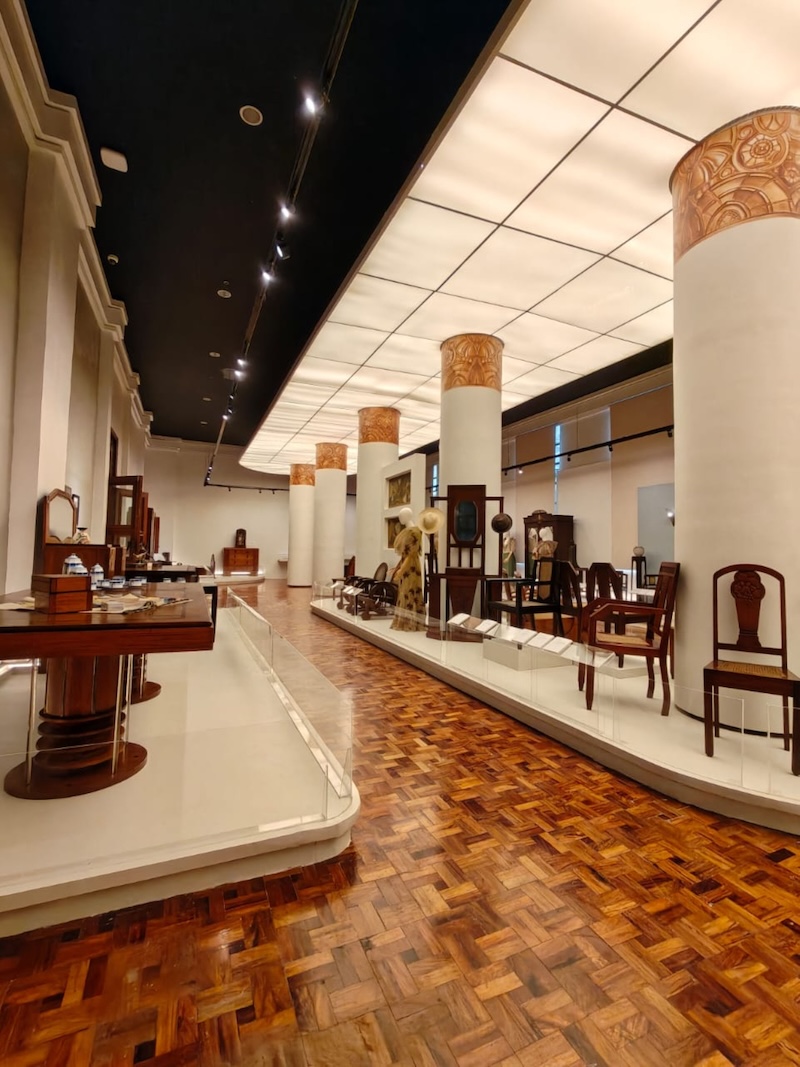
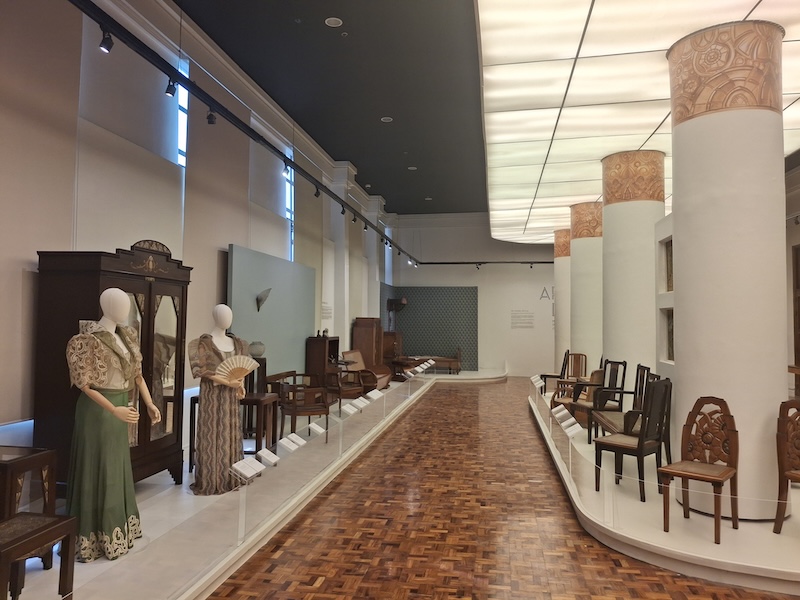
Art Deco chairs in special setting of wide columns and drop ceiling evoking the cruise ship look
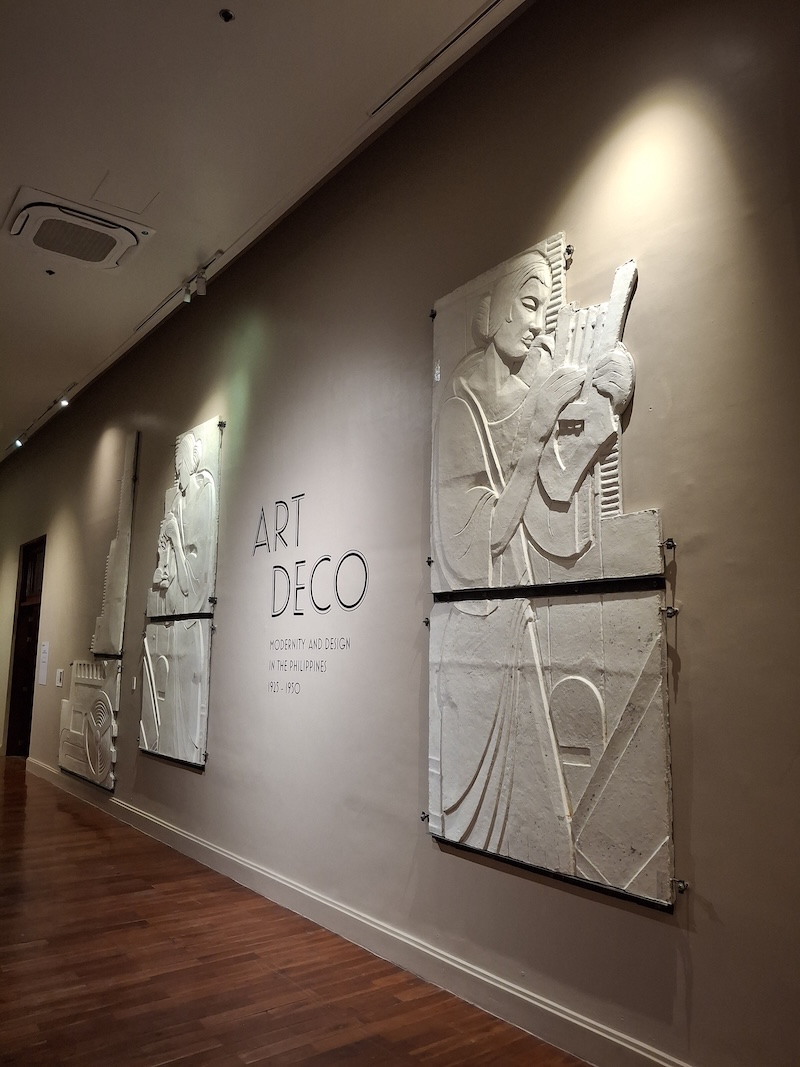
Art Deco: Modernity and Design in the Philippines 1925 to 1950 is running until May 2026 at the National Museum of Fine Arts, P. Burgos Ave., Ermita, Manila.
Near the entrance of the National Museum of Fine Arts’ Philippine Art Deco exhibit, visitors are greeted by Antonio Dumlao’s 1938 painting The Commonwealth. A farmer, a businessman in sharkskin suit, a laborer, and a fresh graduate stride beneath a triumphal arch designed by Guillermo Tolentino, who would later become National Artist. Dumlao captured the confidence of the era when the Commonwealth seemed poised for independence, progress, and technological lift.
A few steps away, Tolentino’s Art Deco vision for the arch takes shape in a small maquette. Commissioned by President Manuel Quezon, the monument combines classical proportions with the geometric streamlining and stylized figures typical of Art Deco. Sculpted representations of the archipelago’s ethnolinguistic groups raise a massive stone slab inscribed “Commonwealth of the Philippines,” a modernist interpretation of unity and collective effort. The design shows that even within a classical framework, Tolentino embraced the sleek lines, symmetry, and decorative rhythm of Art Deco.
The arch was never built. Funding ran out, critics dismissed Tolentino’s style as too modern, and World War II intervened.
Standing between Dumlao’s painting and Tolentino’s unrealized monument, visitors see both the optimism of the Commonwealth and the limits that kept it from becoming reality. It is a story the country knows well. A dream stalled—caught between economics, war, and the crab mentality that continues to undermine visionary projects.
As visitors step out of the National Museum gallery, the lesson feels current.
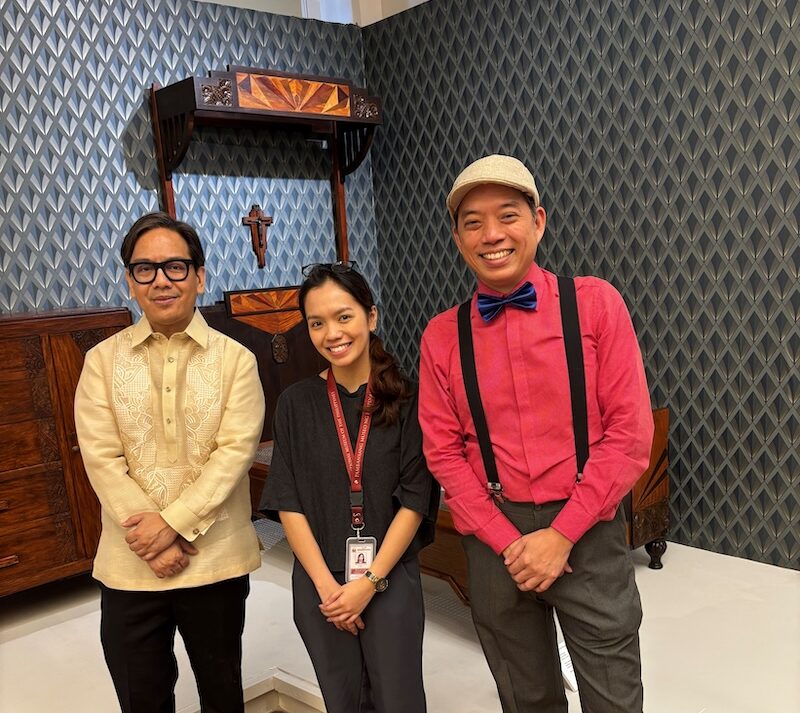
Co-curators Miguel Rosales (left) and Ivan Man Dy, both in outfits inspired by Art Deco period, with Badette Balaguer of the National Museum
Past the gallery’s lesson in political hope and hesitation, the exhibition widens into the larger story of style and influence. The visual display is the work of interior designer Miguel Rosales, who was invited to design and co-curate Art Deco: Modernity and Design in the Philippines 1925 to 1950.
The show aligns with the global centennial celebrations marking one hundred years since Art Deco reshaped modern taste. The 2025 programs in Paris drew huge crowds, a revival that once again placed the spotlight on the movement’s reach across Europe, the US, Africa and Asia. Manila was part of that wave in the ‘20s and ‘30s, and reenters the conversation now a century later.
The country sits on a largely unrecognized trove of Art Deco
Curator Ivan Man Dy attended the 2025 International Exhibition for Decorative Arts centennial in Paris, including a tribute to decorator Jacques Émile Ruhlmann at the Musée des Arts Décoratifs. Back home, he proposed mounting a Philippine counterpart and worked with the Architectural Arts and Built Heritage Division of the museum. Dy points out that the country sits on a largely unrecognized trove of Art Deco. Many Filipinos do not realize that perhaps an object or décor detail in their homes could be part of the Art Deco movement.
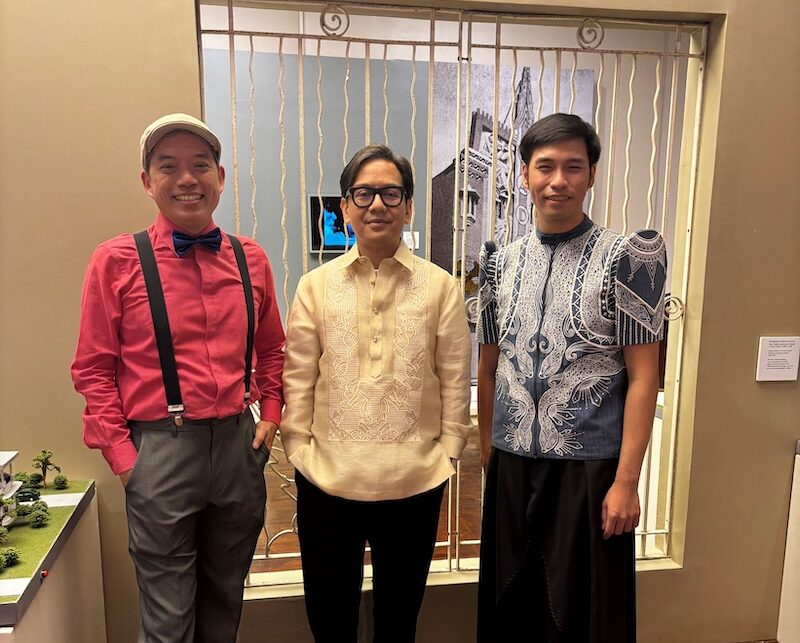
Ivan Man Dy (left), Miguel Rosales and John Brian de Asis of the National Museum in front of the grills salvaged from the home of National Artist Guillermo Tolentino
Dy notes that one of the earliest local figures in the Art Deco style was Andrés Luna de San Pedro, the son of Juan Luna. His Chapel of the Crucified Christ, built in 1927 for the Sisters of Saint Paul of Chartres, is among the earliest Philippine examples. Much of his other work has disappeared. Many buildings that survive today were designed by pensionado architects, Filipino scholars trained in the US, who absorbed the Western style. The Philippines did not have the resources to build monumental towers such as the Empire State Building, so architects adapted the international look to local context. At the time, Filipinos simply called it “modern.”
Hence, a section of the exhibit turns to the pensionado architects. The first gallery immerses visitors in the architecture and interiors of 1936 to 1938, when the streamlined modern style of Art Deco had fully arrived in Manila. Fernando Ocampo, one of the period’s most prominent architects, is featured for his designs of the UST Gymnasium. (He was also the architect of the UST Central Seminary and of the Manila Cathedral.) Beyond figures such as Pablo Antonio and Genaro O. Murillo, who helped shape the Art Deco landscape across Manila and the provinces, the models on display focus on buildings that show different variations of the movement in the Philippines.
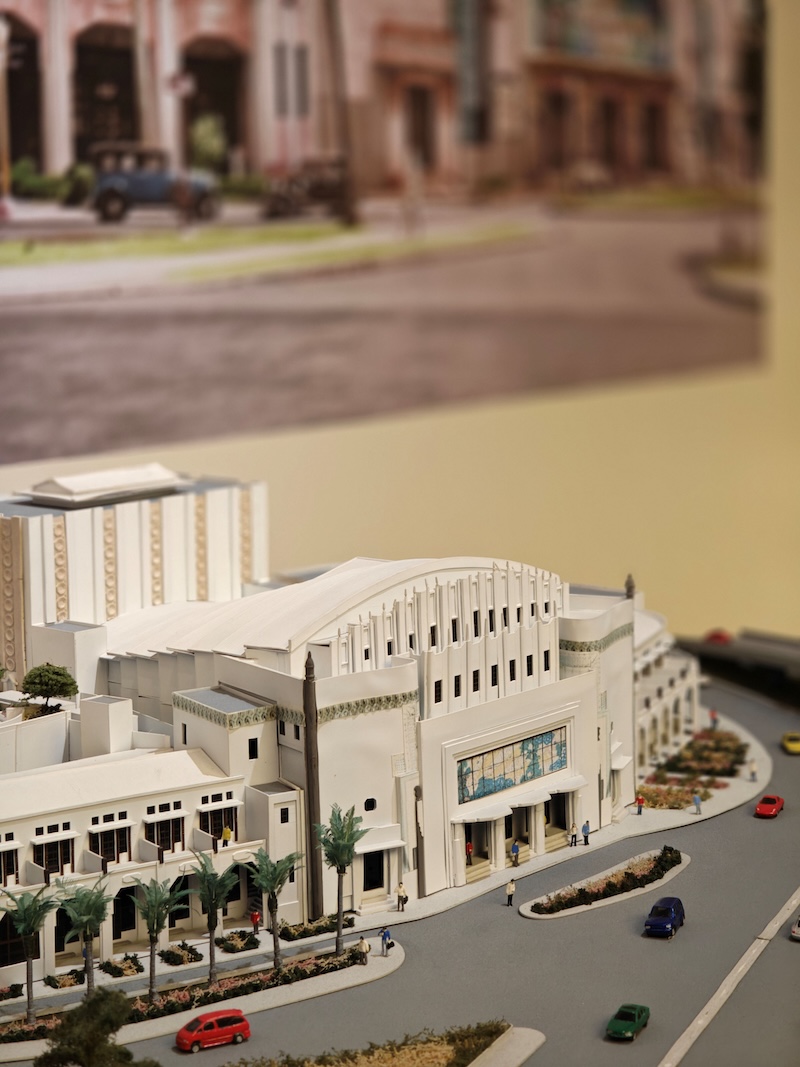
Scale model of Metropolitan Theater, the prime example of Philippine Art Deco
Juan Arellano’s Metropolitan Theater appears in its floral ornamentation and stylized foliage recalling the tropical optimism of pre-war Manila. The Generoso Villanueva Mansion in Bacolod, designed by the Italian architect Lucio Bernasconi, stands out for its curved façade and sweeping nautical lines, a nod to the streamlined style that referenced ocean liners of the period.
The Misamis Oriental Provincial Capitol in Cagayan de Oro, by Elizalde and Crosby Architects, presents a more restrained form, marked by strong verticals and clean symmetry that aligned with the civic Art Deco popular in American government buildings.
The exhibit opens with the sources of inspiration. Visitors first see a catalogue from the 1937 Exposition in Paris, discovered on Facebook, alongside a Muebles furniture catalog, pattern books and trade publications from Paris. Dy notes these were the equivalents of today’s Pinterest, offering endless ideas for interiors, furniture and décor. A facsimile of a 1925 Paris poster sets the tone, reminding viewers of the style’s origins.
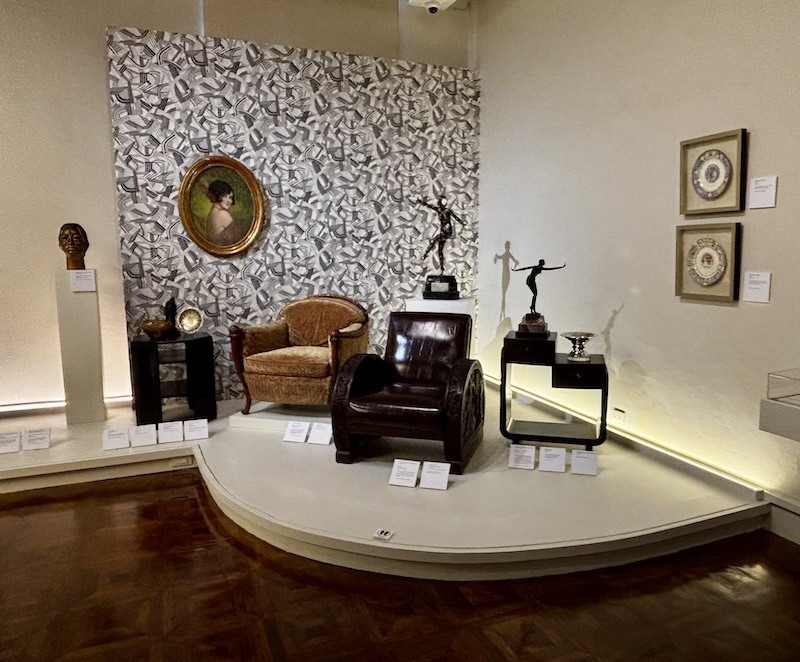
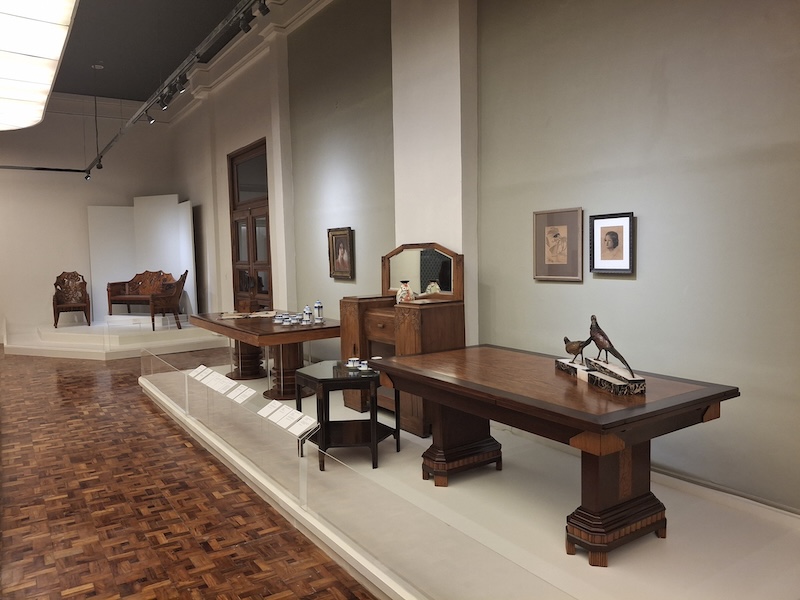
Accent wall with jazz prints sets the tone of the home setting of Art Deco leather chairs and sculptures.
To evoke an Art Deco ambiance, Rosales drew his palette from a transom salvaged from a demolished house in Bulacan. Dusty rose, a muted, warm pink, and a soft gray-green complement the neutrality of the base color, dove white. In one corner, jazzy black-and-white prints inject energy without literal reference, capturing the movement’s flair. Little ziggurats, small-step pyramid motifs common in Art Deco design, line the long shelf alongside radios and industrial design objects. These are objects for daily life–Bakelite cigarette dispenser, a chrome lighter, Swingline stapler, tape dispenser and a soft drink bottle named Crush with the Art Deco fonts.
On a table from the Legarda Mansion, a silver-plated centerpiece from the UK with Bakelite details stands beside a bronze sculpture by Chiparus. Nearby are an acid-etched amber crystal bowl by Daum and a metal dish by Claudius Linossier created using the dinaderie technique, a hammered metal process that adds subtle texture.
Snippets from the 1939 zarzuela musical, Giliw Ko, highlight the period’s cultural reach with its Art Deco sets. Considered an Art Deco artifact, the musical has been restored by the ABS-CBN Film Archives and the National Film Archives of the Philippines.
A window grill from Guillermo Tolentino’s house, lent by Dr. Jaime Laya, serves as the exhibit’s visual centerpiece. Nearby, a grill gate from the University of Santo Tomas gymnasium leads to a smaller gallery.
Busts of Commonwealth figures such as President Manuel Quezon and First Lady Aurora Quezon reflect Art Deco style through stylized features: angular planes, simplified lines, and slightly elongated faces that suggest elegance and modernity rather than strict realism. The abstraction, characteristic of the period, conveys personality while embracing geometric clarity, a hallmark of Deco sculpture.
An ebony and ivory desk set from Paris is displayed on the desk of Tomas Mapua, beside a suite of furniture that features carved plaques in ivory finish from the architect’s own home.
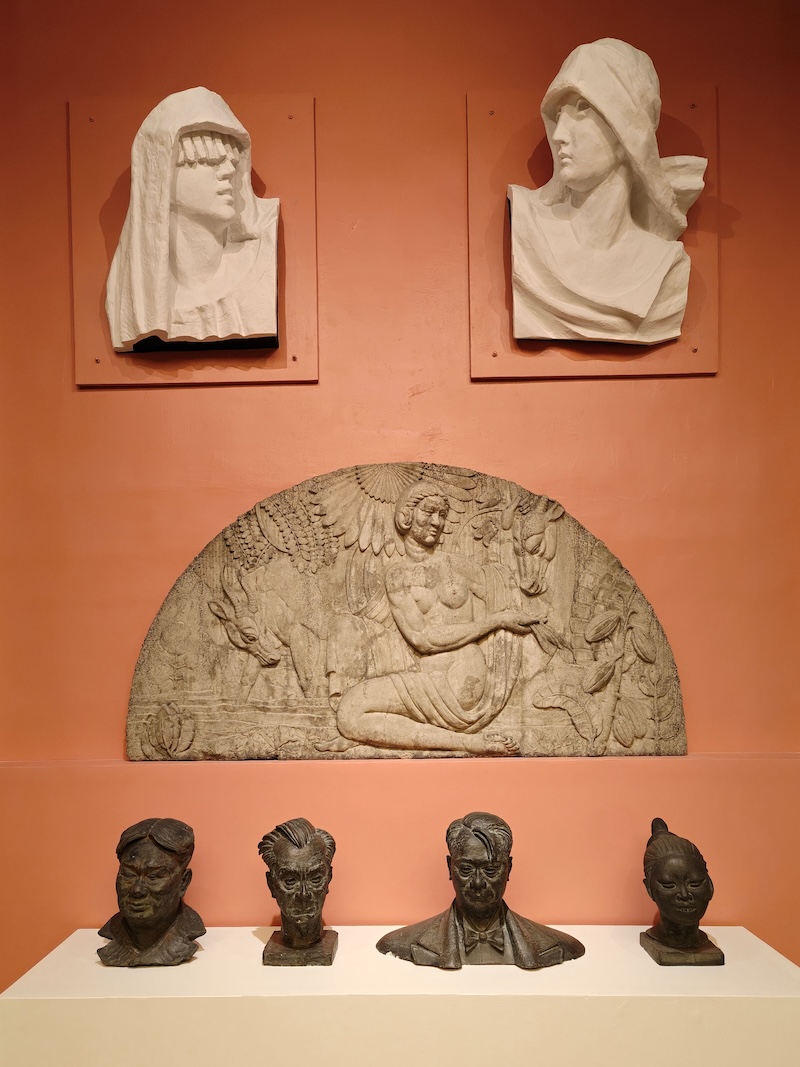
Bas reliefs by Francesco Monti, a lunette from the home of Tomas Mapua above the Art Deco busts
Sculptural works by Manila-based Italian sculptors Francesco Riccardo Monti and Severino Fabie, among the most sought-after artists of the era, stand alongside paintings and illustrations by Fabian dela Rosa, Dumlao, Pablo Amorsolo, and Dominador Castañeda.
Rosales drew inspiration from the grandeur of cruise ship interiors
The second gallery evokes the feeling of an Art Deco cruise ship. Structural posts are encased in round columns, their capitals echoing the vegetal motifs found in the newel posts of the Mapua house. Rosales drew inspiration from the grandeur of cruise ship interiors and Manila’s luxury Crystal Arcade, where streamlined curves and decorative capitals created a sense of elegance and movement. Drop ceilings, installed throughout, do more than conceal lighting: they frame the space, emphasize horizontal lines, and create the layered, streamlined effect characteristic of the period.
The furniture exhibit features chairs showing two characteristic movements of the style: flowing, curved and nature forms, and angular geometric designs, the latter reflecting the era’s fascination with speed, motion, and modernity. Some furniture pieces, such as those from the Marquez house in Sariaya, Quezon, have never been exhibited outside their original homes
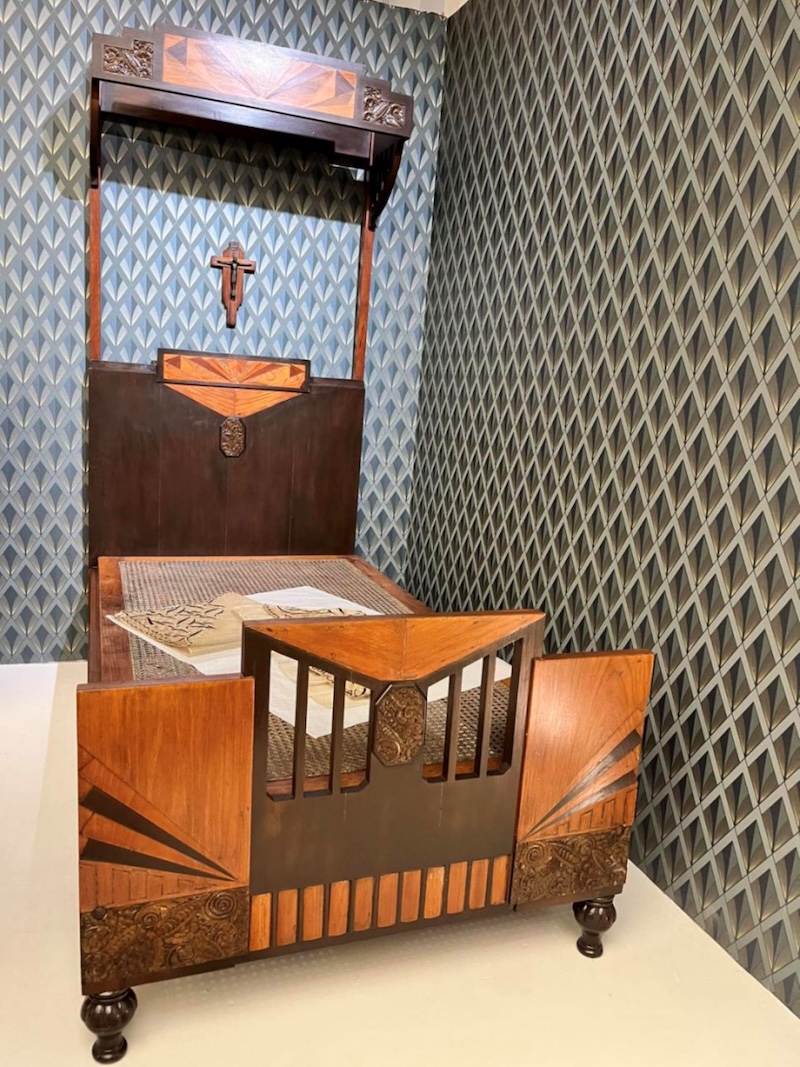
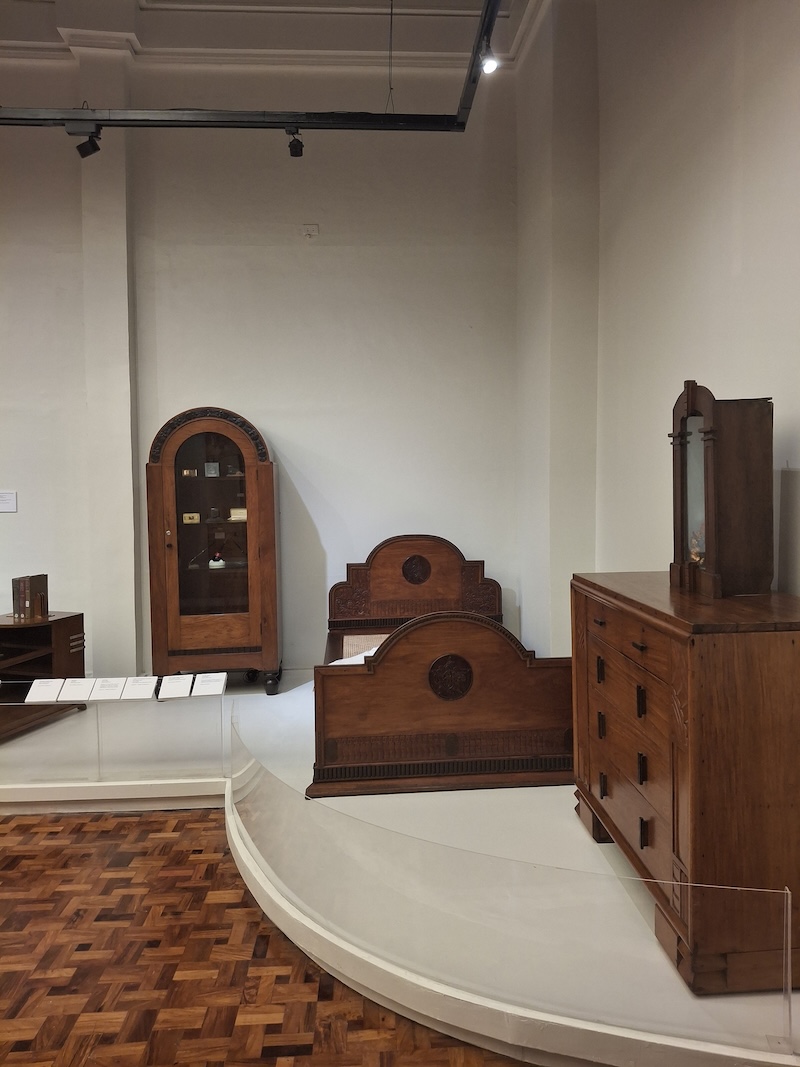
Half tester Art Deco bed on loan from Balay ni Dicang in Negros Occidental
An accent wall features peacock feather-pattern wallpaper with gold highlights, set against dove white, dusty rose, and cornflower blue. There is the half tester bed from the home of Enrica Lizares (a.k.a Tana Dicang). It has a canopy that extends only over the head of the bed rather than covering the entire frame, a design that creates both shelter and a sense of streamlined height. The piece, shipped from Talisay in Negros Occidental, carries the clean geometry and stylized lines that define the movement.
The curators also lent personal collections. Rosales contributed two brooches and two rings from Joyeria Nakpil, a jewelry shop that still preserves original sketches, and a photograph of General Douglas MacArthur’s wife, Jean, as its client.
Dy brought memorabilia, including plates from American expositions, such as the 1939 San Francisco fair and the 1939 New York World’s Fair. The graphics and patterns of these pieces reflect Art Deco’s luxury and sophistication, designed for those with the means to travel and appreciate design, whether in France, America, or the Philippines.
The gallery features exceptional chairs by Gonzalo Puyat, one of the most celebrated furniture makers of the era
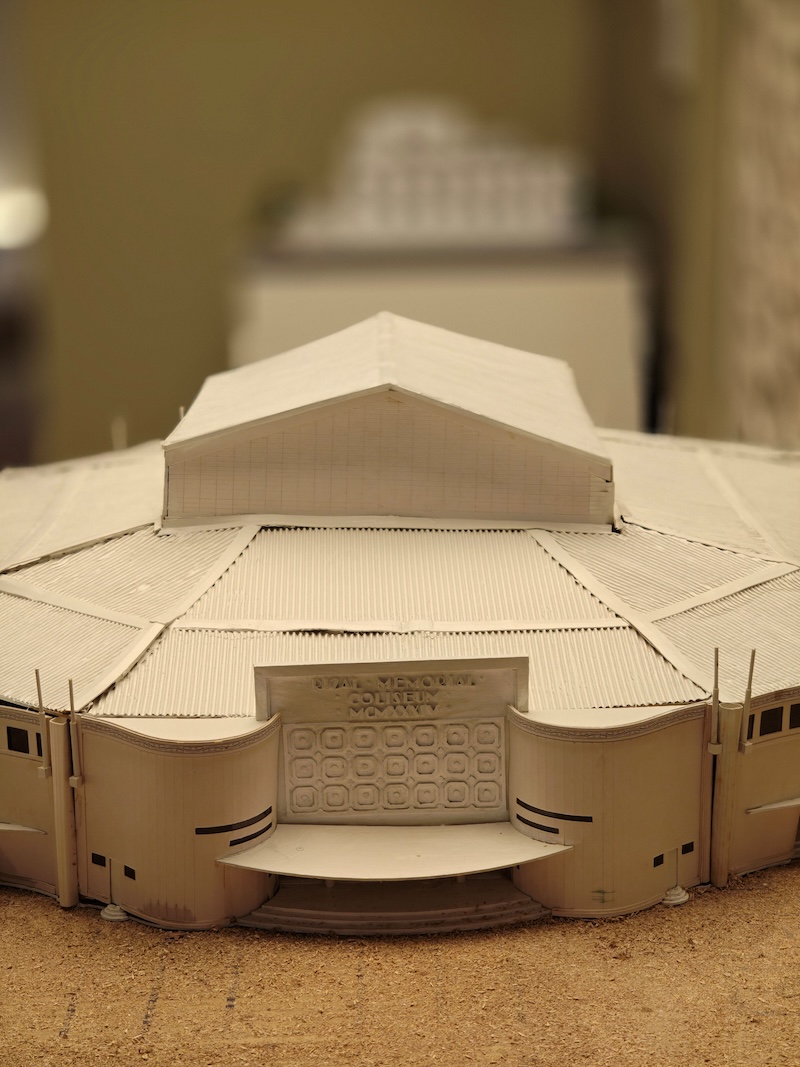
Scale model of Rizal Memorial Sports Complex, designed by Juan Nakpil, shows the streamlined Art Deco style.
The gallery features exceptional chairs by Gonzalo Puyat, one of the most celebrated furniture makers of the era, alongside pieces loaned by more than 40 collectors from Luzon and the Visayas. Several items come from Art Deco strongholds such as Sariaya, Quezon—home to the Gala–Rodriguez Ancestral House, completed in 1935 by National Artist Juan Nakpil. The furniture reveals the full vocabulary of Philippine Art Deco: stylized floral and bamboo motifs, fountain-head reliefs on legs and drawer fronts, sunburst and geometric carvings, and stepped ziggurat details inspired by American skyscrapers. Crafted from kamagong, narra, and other hardwoods, these pieces merge luxury with modernist form.
Chairs from various regional and stylistic interpretations demonstrate the movement’s range. Rarities such as the ebony-and-ivory leather desk set from the Marquez House display intricate inlays and rosette carvings as local craftsmen simulated European ivory plaquettes through expert manipulation of tropical woods.
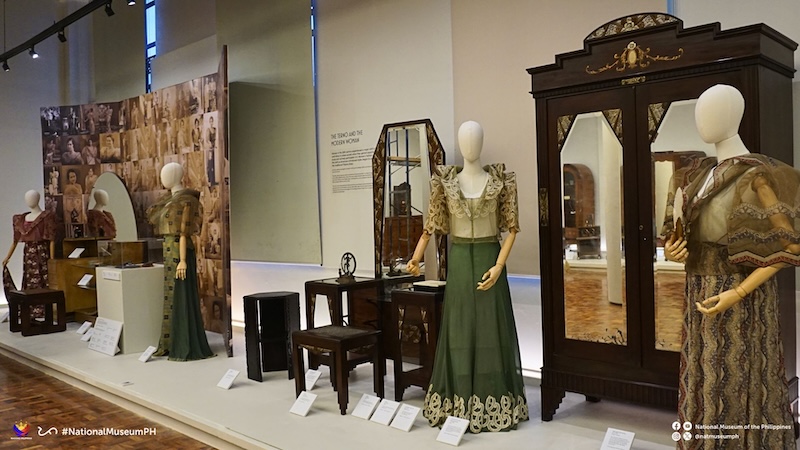
Fashion further reinforced the style.. Womenswear, represented by stylized ternos, carries the same streamlined modernity seen in interiors and furnishings, revealing how Art Deco sensibilities filtered into fashion. A full wall showcases enlarged postcards of Carnival Queens in ternos, from the collection of Alex Castro. These serve as visual context for the actual ternos on display.
Many come from the University of the Philippines’ Costume, Textiles, Interior Design department and the College of Home Economics Clothing Museum, a largely unknown collection. One notable terno is embroidered with Art Deco–inspired palm trees, while another belonged to Emilio Aguinaldo’s wife, Maria.
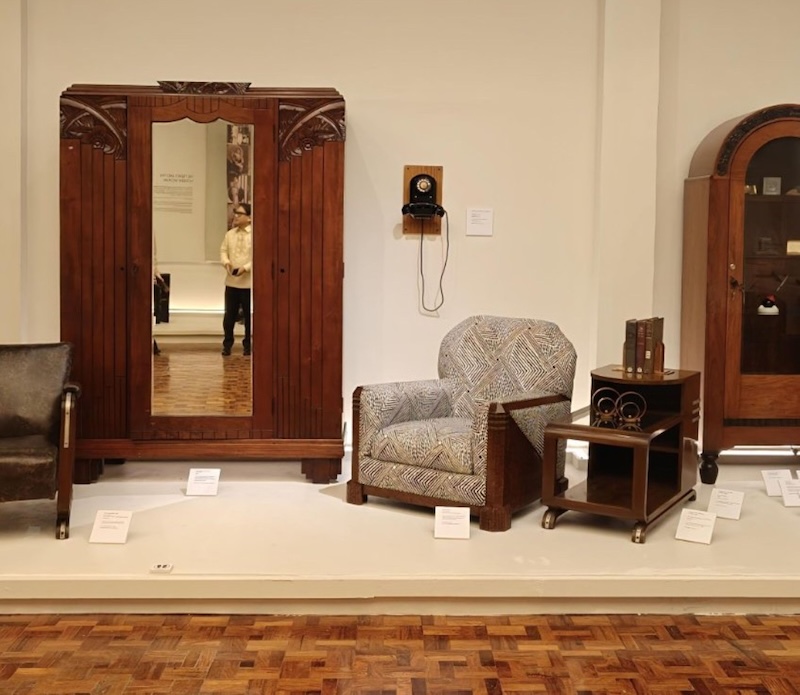
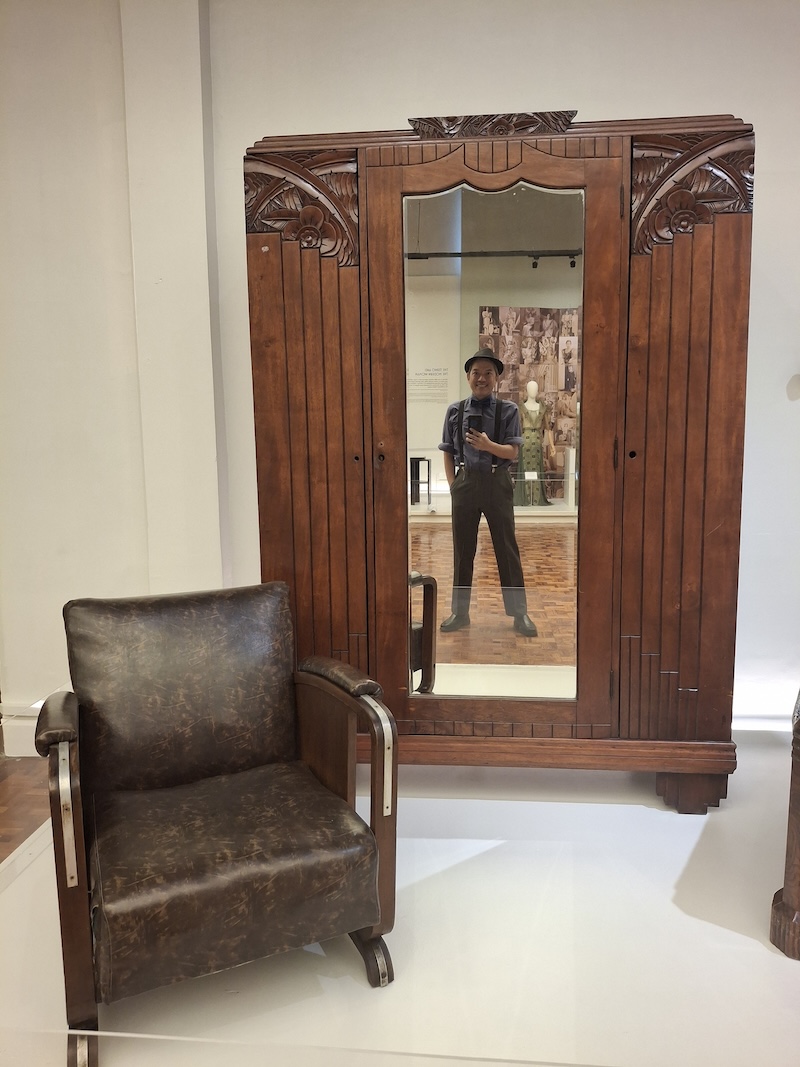
Aparador showcases local foliage carving, modern lines and ziggurat legs. The armchair upholstery shows the zigzag patterns of the era.
Nearby, a dresser and an aparador from the Aguinaldo Shrine demonstrate the period’s blend of practicality and ornament, grounding the fashion pieces in the domestic environments where the Aguinaldos once belonged.
The exhibit’s story is enriched by the broader context of Filipino Art Deco, which curator Dy has documented over the years of research and tours. In 2017, Dy received a grant from the National Commission for Culture and the Arts for his project, Deco Filipino: Art Deco in the Philippines, traveling across the country to document buildings, objets d’art, and even cemeteries from the period.
Home owners in the provinces often depended on local “Maestros”—master builders who could translate architectural plans, including the Art Deco style, into reality. On the other hand, affluent families in Manila could hire trained architects, often Western-educated pensionados, to design their homes in the latest style. This distinction shows how the style was both aspirational and adaptive, shaped by social and economic means.
Dy’s Art Deco walking tours in Manila give visitors a sense of the era’s detail and cosmopolitan spirit. International guests from Melbourne, Hong Kong, Shanghai, and Sydney have toured landmarks such as the Metropolitan Theater, Quezon Bridge and La Loma Cemetery. Dy likens it to birdwatching: visitors examine every element such as the curves, grillwork, stepped motifs, and geometric details with a fascination that turns familiar streets into an unfolding story of design.
Tours often extend beyond Manila to cities shaped by regional wealth such as Malolos, where the wealthy prospered from trade, rice and property; Bacolod, and Iloilo, where sugar magnates’ homes remain Art Deco treasures.
Dy notes how the era’s style filtered down: streamlined forms and geometric ornamentation adapted from international trends, yet bearing local materials, motifs, and sensibilities.
For museum visitors, the experience is both visual and historical—a chance to see how architecture, urban development, and social status intertwined to produce a Filipino Art Deco heritage.
The exhibit culminates with a pair of narra cigar boxes from 1950, placed atop Art Deco linens inherited from Rosales’ grandmother. The late-period pieces illustrate how the style continued to evolve while still integrating local materials and motifs. Across the galleries, the show demonstrates how Art Deco seamlessly blended foreign influences with local life.
It is a comprehensive portrait of how Filipinos lived, worked, and aspired during the first half of the 20th century.
The exhibit runs through May 31, 2026 at the National Museum of Fine Arts, P. Burgos Avenue, Ermita, Manila.


