
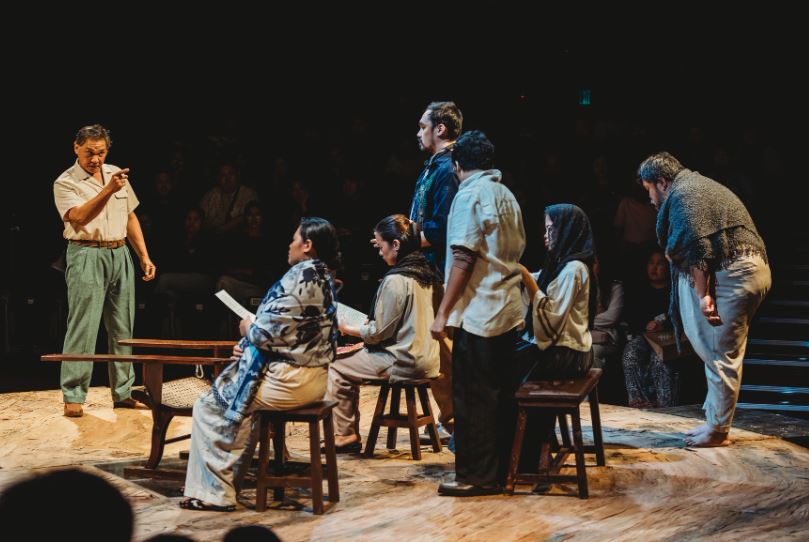
Balete is on its last weekend run Sunday, Oct. 6, 2024, 3 pm.Tanghalang Ignacio Gimenez (CCP Black Box Theater), Roxas Blvd., Pasay City.
There is a scene in Tanghalang Pilipino’s ongoing play, Balete, where painter named Marcelo, played by Marco Viaña, uses dance movements to create an artwork. He is having a conversation with the lead character, the incomparable Nonie Buencamino, who is playing three roles—Francisco the narrator, Young Kiko, and the father named Esperidion, addressed as Papang.
Instead of using traditional canvas, easel, paints and brushes, like what he did in TP’s Anak Datu playing National Artist Abdulmari Imao, Viaña, standing on a chair in the middle of the stage, points to his fellow actors Toni Go, Lhorvie Nuevo-Tadioan, Jonathan Tadioan, and the rest of the ensemble, like a puppeteer, to interpret his desired images using dance movements.
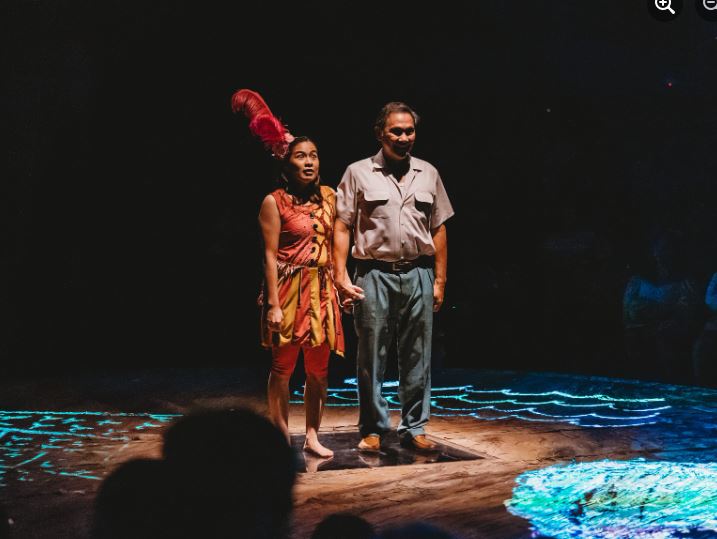
Toni Go and Nonie Buencamino in a scene from ‘Balete’ (Photo by May Celeste)
Background music is Pavarotti singing an excerpt from La Donna E Mobile (The Woman Is Fickle) from Giuseppe Verdi’s opera Rigoletto. Viaña sings the lyrics of the Tagalog bastardization of Verdi’s Hopiang ‘di Mabili.
The next scene has a melancholic, haunting violin music composed by music and sound designer Teresa Barrozo.
Visual arts interpreted in dance in theater is pure genius, and movement director Delphine Buencamino should be credited for that. She is also assistant director to Chris Millado, who has directed another groundbreaking TP production in Balete.
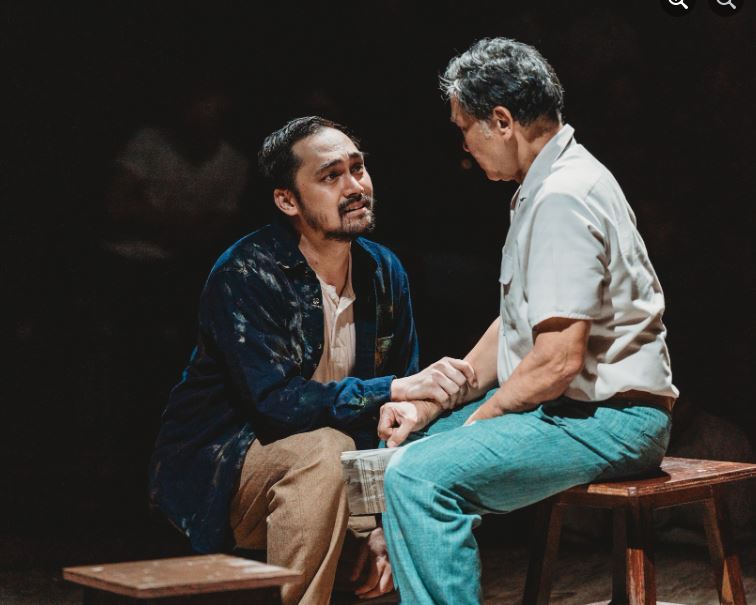
Marco Viaña as Marcelo with Nonie Buencamino (Photo by May Celeste for TP)
With a creative union of five artforms—visual arts, dance, music, theater and literature— the two hours become a moment of transcendence, without the audience marking time.
In this two-hour play, Nonie is the omnipresent character epitomizing what the late great mime artist Marcel Marceau said about the power of interpretation through body movements: “Mime can touch hearts in ways words never could.”
In a recent Messenger chat with TheDiarist.ph, Nonie said he had to do some extra core workout, lift dumbbells, do sprint and jogging. This fitness regimen started as early as November 2023, and he lost around 43 pounds.
The 57-year-old multi-platform, award-winning veteran actor is no stranger to dance. He recalled how in the late 1990s, in his late 20s, he joined Ballet Philippines’ La Revolucion Filipina by Agnes Locsin (who would be National Artist). He played Emilio Aguinaldo.
“She taught me for about four to six months. Crash course in modern ballet. She let me join rehearsals of Ballet Philippines,” he said.
La Revolucion Filipina is now considered a landmark piece of Philippine original ballet, performed several times especially after Locsin was conferred the Order of National Artist.
With his fitness regimen, Nonie trimmed down (from 38 to 35-inch waistline). “If I didn’t do these things, going into a healthier lifestyle, I wouldn’t be able to do Balete,” he said, laughing.
His performance has won acclaim from critics and theater lovers—a welcome return, since his last theater performance was in 2019, in Floy Quintos’ Kundiman Party.
Nonie is a pioneering member of Tanghalang Pilipino, and Balete is his major comeback in TP and theater.
The set design by Wika Nadera—whose father is prize-winning poet-performance artist Vim, and is thus no stranger to the magic of poetry in motion—uses the butaka as central metaphor. With its long arm rest, this traditional wood chair was to the hacenderos of a bygone era what the lazy reclining chair is to today’s couch potato.
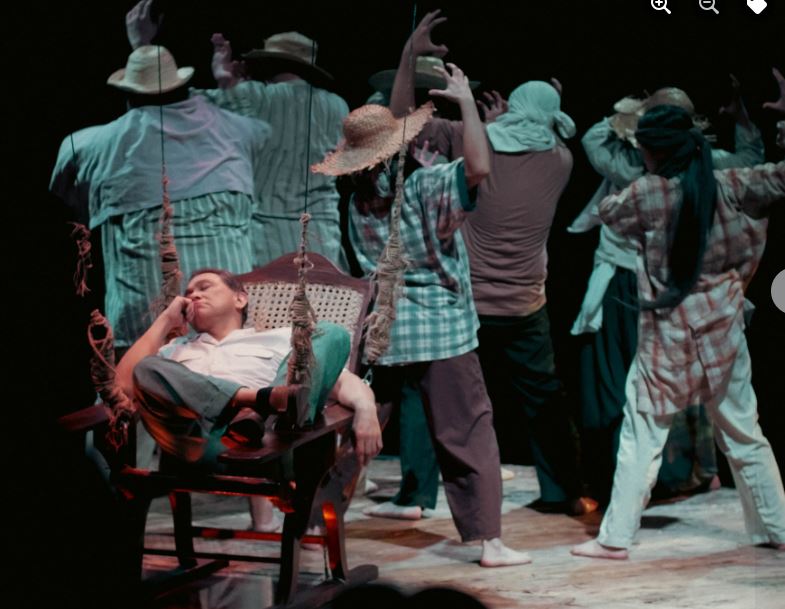
Nonie Buencamino, sitting on butaka, plays three characters. (Photo from Tanghalang Pilipino FB page)
Hats off to the costume design of Carlos Siongco, the projection design by JM Jimenez, the lighting design by Roman Cruz, and the valuable inputs of dramaturg Sabrina Basilio. In their production, we are brought inside the mind of National Artist (Literature) F. Sionil Jose, in a town in Rosales, Pangasinan, in the Commonwealth era.
Balete is a product of devised theater, termed by the TP Actors Company as “dulambayanihan.”
Directed by Chris Millado, the production honors three creators: National Artist for Literature Francisco Sionil Jose’s novel Tree, his autobiography Promdi, and Rody Vera’s original script also titled Balete that was staged in 2002 by (PETA) Philippine Educational Theater Association at Rajah Sulayman Theater.
Millado recalled for TheDiarist.ph how Balete was staged outside the main stage of Rajah Sulayman Theater, using the open space up front. Main prop was an inverted tree, its roots spreading out like frozen dead leaves.
He recalled how Sionil Jose was initially adamant about giving his approval for the adaptation, but after seeing the play, he praised and congratulated Millado, Vera and the PETA Kalinangan Ensemble for their excellent work.
Now, for the flexible Tanghalang Ignacio Gimenez (CCP Black Box Theater) that can seat 320, TP favored a theater-in-the-round set-up with a circular stage.
Tree is the second novel in Sionil Jose’s five-book saga about Rosales. Since Millado and the TP Actor’s Company decided to incorporate some details from the National Artist’s autobiography, Promdi, the devised play is something that lovers of Philippine literature and theater wouldn’t want to miss.
Kiko’s privileged life, his relationships with his family, his town mates, remind us of the typical hacendero heir who tries to make sense of the feudal society he’s born into.

The ‘butaka’ as main prop, central metaphor for feudalism in Philippine history (Photo by May Celeste)
There have been many “Kiko” in Philippine history, captured in major literary works. The most immediate that comes to mind is the short story, Servando Magdamag, by National Artist Ricky Lee. Though Lee’s story is set in later decades, right before the declaration of Martial Law, most of Servando’s struggles are similar to Kiko’s. The disillusioned hacendero son who dares raise the dirty finger at the ruling class he’s born into.
We won’t delve much on the plot. The books of Sionil Jose and Lee are out there for the interested audience.
Some find the play hard to understand, that it’s too intellectual, its sound and fury signifying a lot of things.
Here’s what two credible critics have written in their social media:
Gawad Buhay 2025 head of jury and theater critic Vincen Gregory Yu wrote after the opening weekend of Balete:
“Between Pingkian last March and the newly opened Balete, it’s truly been a banner year for Tanghalang Pilipino. I can cavil about the latter’s ending, but really, it’s the one, small imperfect spot in an otherwise terrific production….
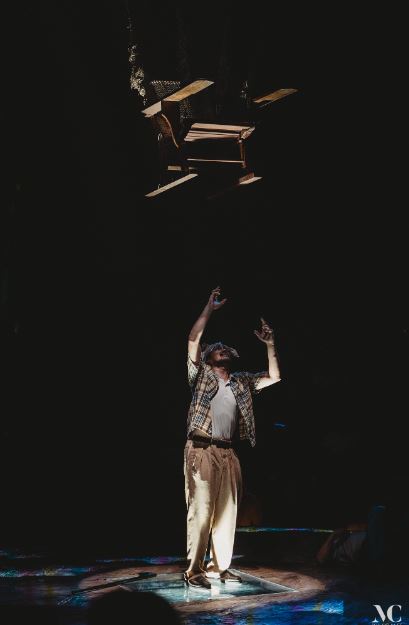
Marco Viaña as Marcelo commanding the ‘butaka’ (Photo by May Celeste)
“This play is above all a marvel of stagecraft. People become the set and soundscape, and movement is the main narrative driver, and the result is an astoundingly cohesive union of theatrical elements evoking the grand sweep of the novel as a literary form (an all-too-rare occurrence)….
“More than anything, the play is an act of remembering, as a son tries to make sense of the feudal monstrosity that was his father, who once lorded over the landless in the not-yet-solid north. It’s ‘haunting’ in the most anthropological sense made manifest on the stage, not only in the spectral comings and goings of the poor people that marked the son’s early life, but also in the constant presence of poverty and numbing hardship at once proximate yet alien to his lifeworld.
‘It makes a world of difference when a production is grounded in the reality of those it seeks to portray….’
“And so it must be said: It makes a world of difference when a production, and the people behind it, is grounded in the reality of those it seeks to portray; when a production actually genuinely empathizes with its characters, and does not treat them like mere play things in a silly game of dress-up.
“Everyone involved here delivers topnotch work, and this triumph is, for me, made sweeter by the fact that the design team is almost all (relatively) new names to the scene! Marco Viaña barks, Toni Go counts in Hokkien, Lhorvie Nuevo asserts she’s no thief, Tad Tadioan makes the most hilarious sounds, Gelo Molina wins a medal for ‘best in eating,’ and the great Nonie Buencamino—well, you’ll just have to see for yourself the wonders he makes out of his role(s).”
Gibbs Cadiz, the country’s premier theater critic and editor, wrote: “And while I’m still of two minds about the English passages — I understand they’re meant to bring in F. Sionil Jose’s novelistic voice, but (heresy here) Manong Frankie’s English can be blunt and leaden, and here they’re that, occasioning small jarring tonal shifts whenever they’re heard—in the end they’re small bumps too in a production that works commandingly as an innovative, boundary-pushing piece of socially-conscious theater.
“Insane ensemble work by the TP Actors’ Company, some of the best ‘technicals’ one will see this season.”
Cadiz cited Teresa Barrozo’s music and sound design as well as Delphine Buencamino, who “crafted the indispensable movement design, while her father Nonie—well, let’s just say the young TP actors will surely remember this milestone experience of working with an acting legend.”
“How apt that a father-daughter tandem is leading the charge in this magnificent theatrical indictment of that still-present system,” Cadiz added.
For those who are going to miss Balete, which is having its final weekend today, there’s hope that TP will re-stage it, not soonest but perhaps in two years or more.
The next for TP’s 38th season is the re-staging of the children’s musical, Sandosenang Sapatos, for the Christmas season and the final offering in the first quarter of 2025, the superstorm of a play, Kisapmata.
READ: https://www.thediarist.ph/tanghalang-pilipino-dares-to-stage-mike-de-leons-kisapmata/
TP also announced that its 39th season is all about heroes. There’s the re-staging of Nick Tiongson’s Mabining Mandirigma, inspired by the heroism of Apolinario Mabini, and the return of the recent mega-blockbuster Pingkian, which tackles the short life and heroism of Emilio Jacinto.
Fernando “Nanding” Josef, TP artistic director, told TheDiarist.ph that they are also commissioning Tiongson to write a play or a musical about Gregoria “Oryang” de Jesus, widow of Andres Bonifacio and later husband of Julio Nakpil, more known in history books as Lakambini ng Katipunan.
Unless someone or something powerful like “due-to-insistent-public-demand” cavils at the TP lineup, Balete will soon be back onstage.


