

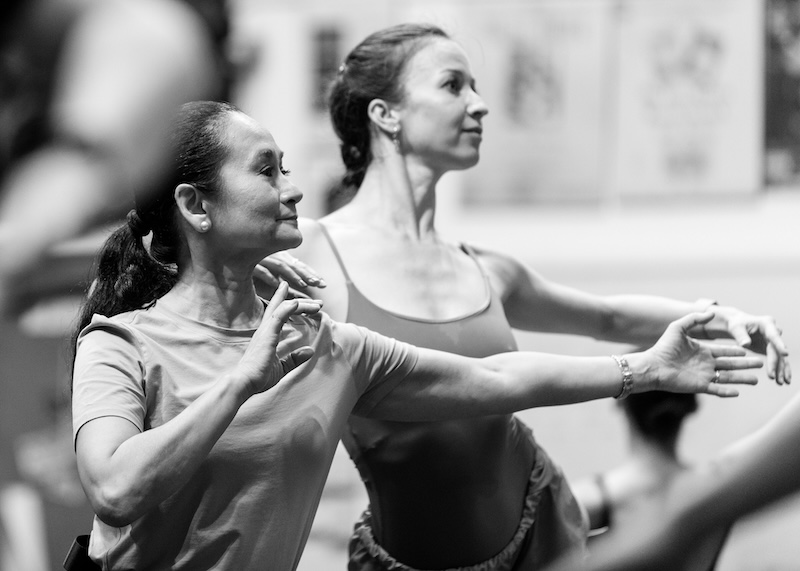
Lisa Macuja Elizalde and Shakirova
Rehearsal photos By Mark Sumaylo
AT Ballet Manila’s press conference last summer, artistic director and CEO Lisa Macuja Elizalde teased the guest artist in the company’s 30th season finale. When the image of Kimin Kim appeared, the reaction in the room was muted. Few realized they were looking at one of ballet’s brightest stars, the Korean-born dancer who became the only Asian to reach the rank of principal at Russia’s Mariinsky Ballet.
That unfamiliarity is likely to end when Kim takes the stage in Ballet Manila’s Don Quixote at Aliw Theater from Aug. 22 to 24, 2025. His performance as Basilio, the swaggering town barber, promises the kind of bravura dancing that has made him an international sensation: soaring jumps, whiplash turns, and textbook precision, all delivered with a buoyancy that makes the impossible seem effortless. No less striking is the sly comic timing he brings to the role, an ability that anchors his virtuosity in character.
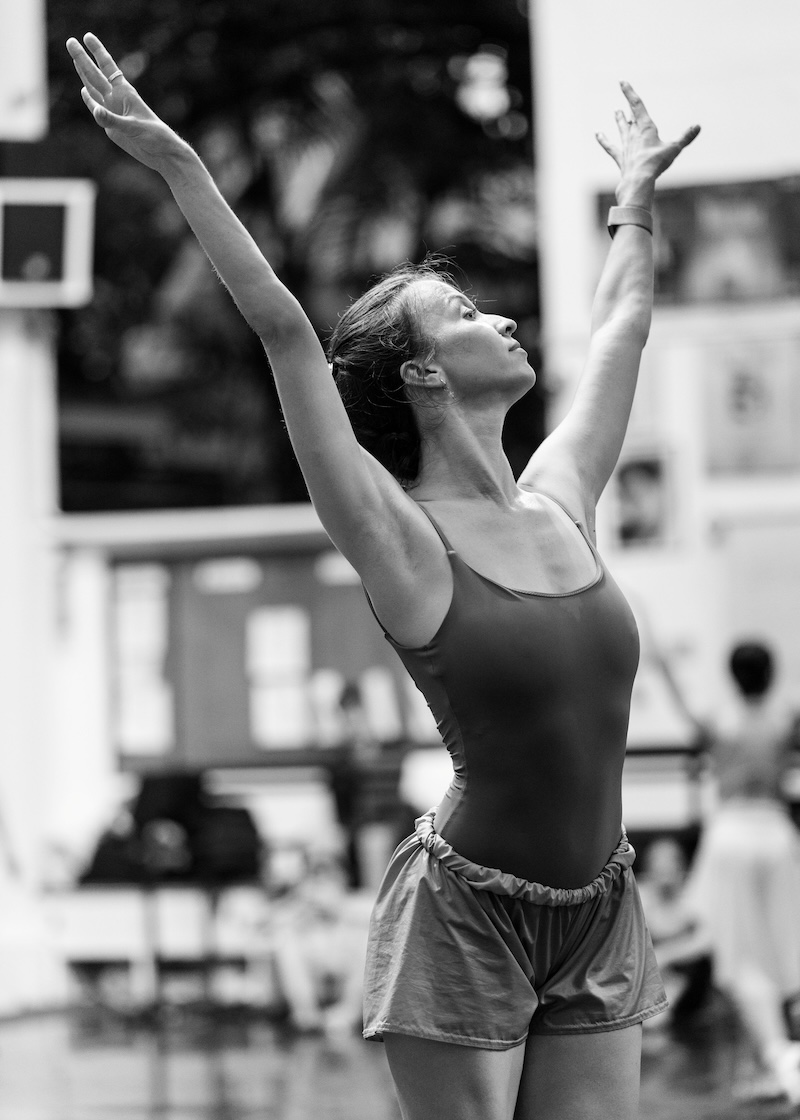
Renata Shakirova
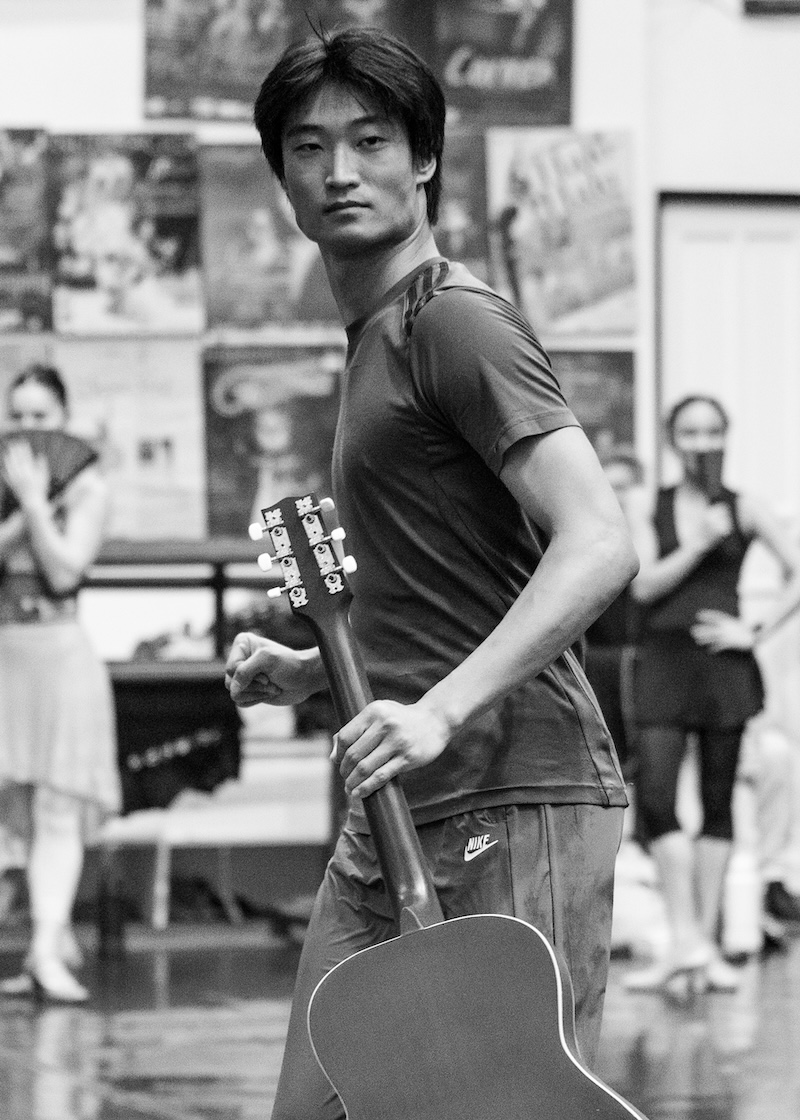
Basilio (Kim) uses a guitar to portray his bohemian spirit.
Dancing opposite him is Renata Shakirova, a fellow principal of the Mariinsky, cast as Kitri, Basilio’s spirited love interest. Shakirova has built her reputation on speed, power, and fearlessness. Yet she balances that attack with the refinement of her Vaganova schooling, shaping bold steps with elegance. Her quickness and musicality give her dancing a playful edge, making her Kitri not only technically dazzling but also alive.
The love story of Kitri and Basilio, the fiery pair at the center of Don Quixote, is only loosely drawn from Cervantes. In part II of the novel, a young woman named Quiteria is in love with the poor Basilio, though her father demands she marry the wealthy Camacho. Basilio fakes his own suicide, and the lovers win in the end.
Marius Petipa, French-born choreographer and chief ballet master of the Imperial Ballet St. Petersburg (precedent of Mariinksy), first spun this subplot into a full-length ballet in 1869 for the Bolshoi Theater. He renamed Quiteria Kitri, and made her and Basilio the central figures. Don Quixote himself became less a hero than a wandering dreamer who pushed the action forward but rarely took the lead.
Two years later, Petipa created a more lavish five-act version for the Mariinsky. In 1900, Russian dancer-choreographer Alexander Gorsky staged his version for the Bolshoi and later the Mariinsky, giving it livelier ensemble scenes, more natural movement, and theatrical detail. That approach gave the ballet the vibrancy audiences now know, with Kitri and Basilio’s love story and their competitive display of technical fireworks emerging as the heart of the work.
For Lisa Macuja Elizalde, who trained at the Vaganova Academy in St. Petersburg under Tatiana Udalenkova—the same teacher who later guided Shakirova—Don Quixote holds a special place in her heart. Addressing the press in the recent launch, she described it a “clapper ballet,” packed with soaring jumps, fouettés (whiplash turns), Spanish dances, and virtuoso tricks that draw spontaneous applause, and the “King of Ballets” because it gathers everything that defines classical bravura: comedy, character, and the famous grand pas de deux. When she danced Kitri in the Philippines in the mid-’80s, her plucky attack, sparkling footwork, and sly humor gave Filipino audiences a heroine both free-spirited and relatable. For many younger dancers who saw her, Kitri was no longer just a Russian-trained archetype, but a role they could aspire to themselves.
As the first foreigner invited to perform with the Mariinsky Ballet, Elizalde returned home bringing the rigor of one of the world’s most exacting traditions. Kim underscored that a strong classical repertoire is the backbone of any company, keeping dancers balanced and capable of growth. Without it, young artists cannot thrive. He praised Elizalde’s commitment to staging cornerstone works such as Swan Lake, Don Quixote, and Giselle, all drawn from the Mariinsky canon.
Elizalde noted that Ballet Manila’s dedication not only hones its dancers, but also cultivates audiences, ensuring that the company—and Philippine ballet itself—continue to advance.
As the first foreigner invited to perform with the Mariinsky Ballet, Elizalde returned home bringing the rigor of one of the world’s most exacting traditions
That Mariinsky discipline became the blueprint for Kim long before he set foot in St. Petersburg. Surviving the company’s stage demanded more than talent; it required a full education in technique, musicality, and stage presence. He began in Seoul, where Vladimir Kim and his wife, Margarita Kulik, both Mariinsky veterans steeped in the Vaganova tradition, became his anchors at the Korean National University of the Arts, instilling the very precision, clarity, and bravura that would later define his artistry. Vladimir Kim, a former soloist turned repetiteur, drilled into him the grammar of classicism—clean lines, musical sensitivity, precise placement. Kulik, once a blazing Mariinsky principal, urged the opposite: daring, bravura, and stage magnetism. The couple forged a dancer whose discipline and audacity would one day make him a Mariinsky superstar—a title Kim himself tends to dismiss as mere decoration.
Still, the leap from Korea to St. Petersburg was no small passage. The city’s winters alone tested him: months of snow and subzero winds, daylight shrunk to a few hours, a climate that punishes the body of even the strongest dancer. For Kim, whose instrument is his body, the cold seeped into daily class and rehearsal, making every plié and jump a battle against stiffness. But it also toughened him, tempering the steel that would see him through the Mariinsky’s unrelenting repertory schedule.
Language was another crucible. English, with its Latin alphabet, had already been a manageable hurdle. Russian was another story: cyrillic script, six grammatical cases, verbs that change form with speed. For a Korean speaker, it required starting from scratch. Yet fluency was non-negotiable—not just for rehearsals, but for absorbing the Mariinsky’s culture, its stories, its unspoken codes. Mastering Russian became part of the same daily discipline as barre and variation, another layer in the training that would eventually make Kim one of the Mariinsky’s most bankable stars, with his performances among the company’s top-selling tickets.
From 2012, Kim rose as a soloist with the Mariinsky Ballet, earning his place in a company where any newcomer with promise could easily be seen as a threat. He absorbed the pressures in silence, keeping his focus on work rather than rivalry. By 2015, he was named a principal dancer, his ascent reinforced by victories in major international competitions, including first prize at Varna, the fabled “Olympics of ballet.” His virtuosity dazzled audiences with the kind of pyrotechnics that seemed to defy human limits. Yet he insisted that technique was never an end in itself. For him, the jumps, turns, and feats of strength were tools to reveal meaning, emotion, and above all, music, translating shades of gloom, passion, or rage already written into the score. That belief, grounded in his training under Vladimir Kim and Margarita Kulik, whom he considered his second parents, shaped his artistry into something far beyond acrobatics.
Korean-born Kim’s virtuosity dazzled audiences with the kind of pyrotechnics that seemed to defy human limits. Yet he insisted that technique was never an end in itself
Renata Shakirova followed the traditional path into the Mariinsky. She trained at the Vaganova Academy under Tatiana Alexandrova Udalenkova, who drilled into her the essentials: balance, strength, and the ability to execute every step with both right and left sides equally. This rigorous base, Udalenkova believed, was the foundation upon which all complexity in ballet is built. Shakirova carried that discipline into her student years, when she was invited to take company classes at the Mariinsky. There, then–artistic director Yuri Fateev recognized her potential and cast her in soloist roles that few students ever touch: Amour (Cupid) in Don Quixote and one of the Odalisques in Le Corsaire. Soon after, she was entrusted with Rubies from George Balanchine’s Jewels, which was among the most technically demanding ballets in the repertory. She prepared in just a month with Kim, then himself an emerging star. For Shakirova, the transition from Academy to stage was swift and unforgiving, requiring her to dance not as a student but as a full professional from the start.
Shakirova’s professional debut as a company member came in 2015, when she was entrusted with Kitri in Don Quixote, a high-voltage role that seemed tailor-made for her. From childhood, her temperament leaned toward characters of energy and boldness, and under Udalenkova’s training she gravitated instinctively toward roles that demanded fearlessness and unflagging vitality. She dazzled in that first outing, but the exertion left her injured and in need of rehab that taught her the value of pacing and recovery.
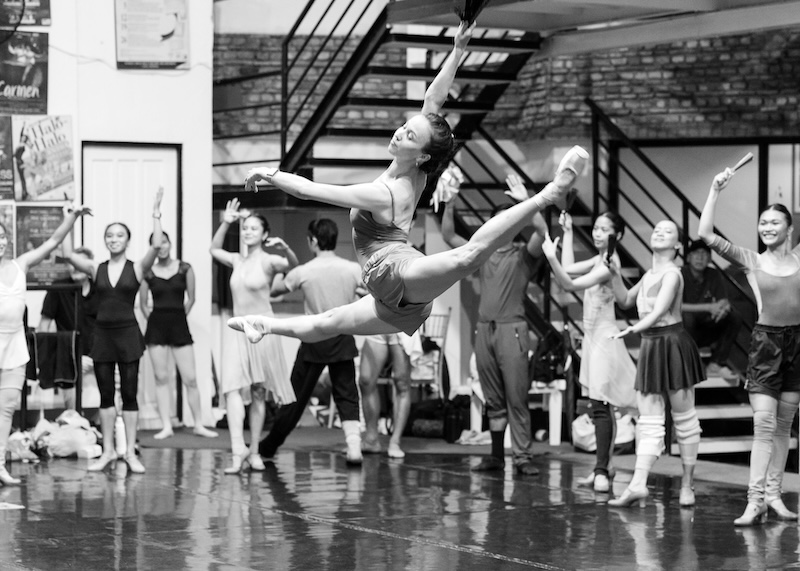
Renata Shakirova as Kitri bursting onto the town square full of energy
A decade later, she approaches Kitri with balance and depth. The role still showcases her virtuosity that audiences expect, but now it is also shaded with humor, sincerity, and tenderness. For Shakirova, Kitri’s appeal lies in her love of life and determination to shape her happiness, qualities that mirror her spirit.
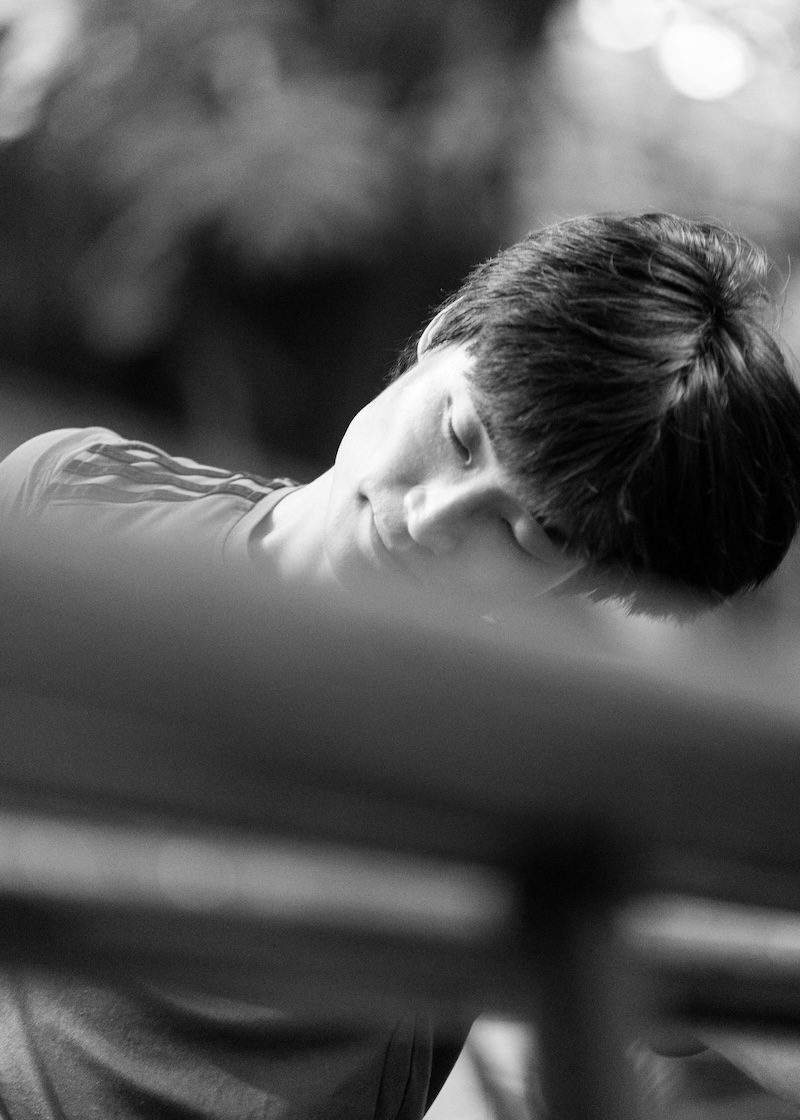
Kimin Kim
Her long partnership with Kimin Kim deepens this portrayal. When they first danced together a decade ago, she was still deferential, complicit in following his lead. Now, she is more assertive, relishing the push and pull of shared spontaneity on stage. Their chemistry thrives on this unpredictability: partnering, for them, is like a game—playful, daring, and alive in the moment.
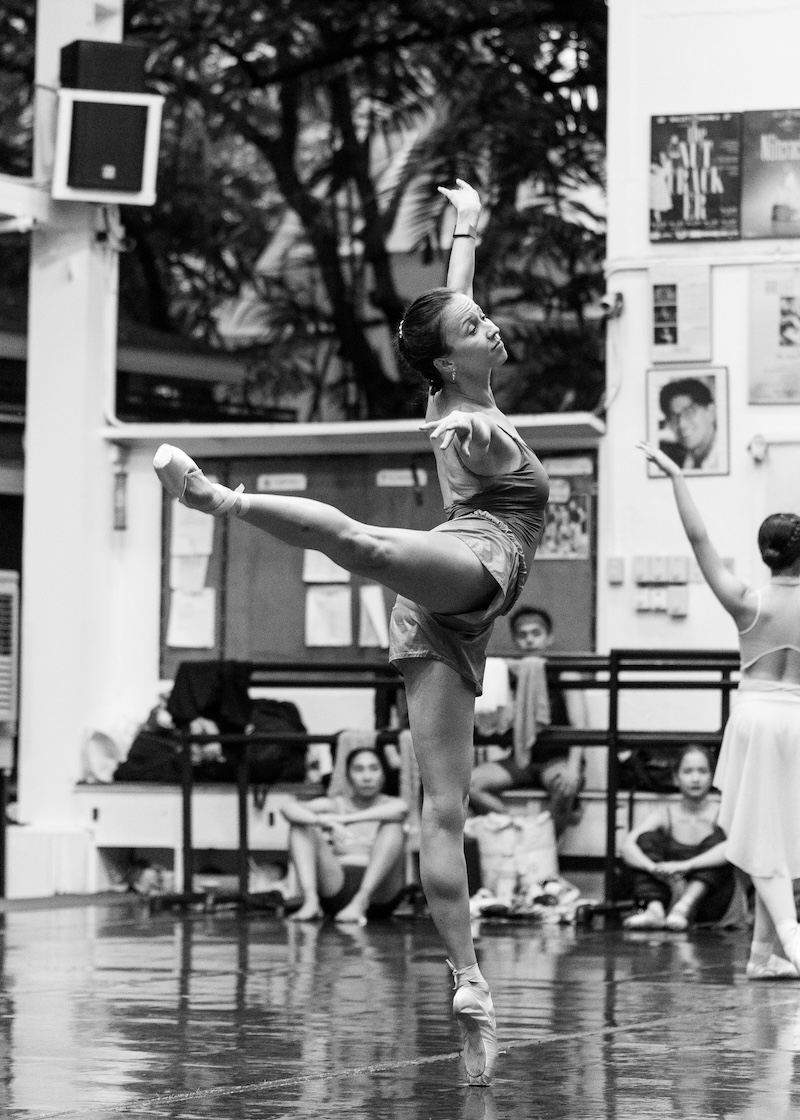
Renata Shakirova in a full expression of the arabesque
It is this mature interpretation of Kitri, enriched by her evolving artistry and her dynamic rapport with Kim, that she now brings to Manila for BM’s Don Quixote.
Throughout the interview with The Diarist.ph, Shakirova dissolved into giggles, Elizalde often joining her, while Kim delighted in teasing both women—and occasionally, this writer. At the Conrad Hotel press conference, the guest artists politely chose salad and salmon. When told he might be too busy for a long interview, Kim quipped, “I could give you three hours.” Elizalde quickly cut in: Rehearsals with Ballet Manila dancers awaited after lunch.
Humor, Kim insisted, is not optional in ballet—it’s survival. “All my life I’ve always had humor, because being a principal dancer at the Mariinsky is not easy,” he said. “If you don’t look at everything with humor, it is actually dangerous. The performances, the rehearsals, the daily class, the maintenance of your body—it’s very difficult.”
Shakirova likened it to being an athlete in permanent training. “Athletes prepare for one competition,” she explained. “Performing artists must always be ready for every different performance.”
Unlike Western companies that perform one ballet for several nights in a row, the Mariinsky follows a repertory rotation system, staging a different production almost every evening. Audiences get variety, but dancers must jump from Swan Lake one night to Don Quixote the next, with rehearsals for yet another ballet during the day. Compared to the run system in Europe, the US, and Asia, where dancers can pace themselves within a single role for weeks, the Russian model is far more taxing—it demands constant adaptability, accelerates fatigue, and increases the risk of injury, even as it produces some of the world’s most versatile performers.
The conversation turned to rumors that Kim and Shakirova were romantically linked, especially after a recent holiday in Boracay. Both laughed. “Renata is such a beautiful person—all men want to dance with her, to be with her,” Kim said with a grin. “And I am such a beautiful man as well. So our partnership is like that: We are beautiful together. In the theater, we are very good friends, we work very well together. And that is all I will say.”
Shakirova, chuckling, added simply: “The same thing.”


