
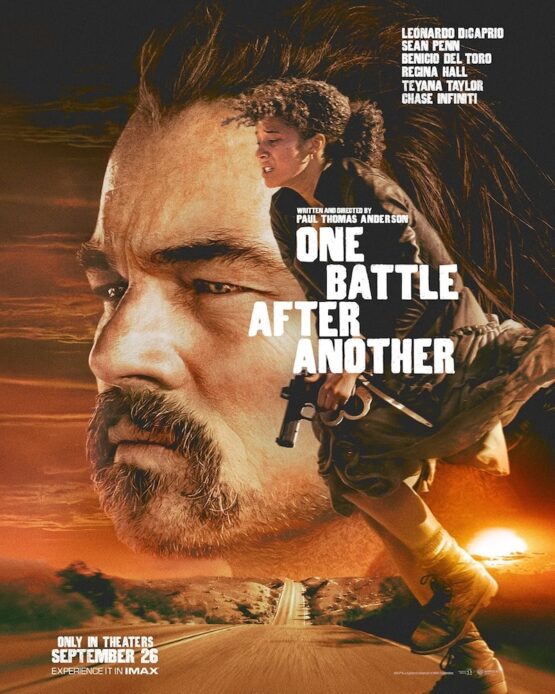
As much as winning the Academy Award for Best Picture is undoubtedly an impressive achievement, it also seems to place the winner in the thankless position of having to prove its worth for that golden statue. Admittedly, it’s a little amusing to think about how much importance we place on the Oscars when they really are (in the words of South Korean filmmaker Bong Joon Ho) a “very local” awards ceremony, voted on by over 10,000 film practitioners mostly hailing from the West.
So we should be mindful not to reduce discussions of a film’s merits into questions of competition—“Did One Battle After Another deserve to win Best Picture?” That seems to be an entirely different discussion that ultimately has more to do with the Academy of Motion Pictures Arts and Sciences’ tastes at a given moment in time. Still, the Oscar does serve as an invitation to revisit the work, whether or not it adheres to the idea of what an Oscar-winning movie “should” be.
And for this writer, at least, One Battle After Another—a sprawling black comedy-thriller about a former revolutionary and his daughter running from the military officer who forced them into hiding 16 years prior—is a stunning showcase of filmmaking craft. Paul Thomas Anderson’s latest presents a thrillingly unique deconstruction of genre films of this scale, told through unexpected choices in performance, and meticulous plotting that suggests a much richer world in its peripheries than in what we actually see.
Even as Anderson is recognized as a major contemporary American auteur, the director’s works have always been vastly different from one another. Following his coming-of-age dramedy Licorice Pizza in 2021 and the psychological romance Phantom Thread in 2017, One Battle fully leans into the absurdity of both its comedy and its thriller elements. It’s a miracle that the movie works, as Anderson infuses moment after moment with humor and intensity in the same breath. He doesn’t set these tones in contrast to each other (which would imply opposition), but lets them be equal expressions of a highly disorienting situation.
Anderson’s direction of action has a thoughtfulness to it that keeps it from becoming a Hollywood combat fantasy. As soon as our protagonists are informed of soldiers closing in on their off-grid California community, the panic of shifting into survival mode becomes a messy affair, with subsequent chase sequences through residential areas and nondescript landscapes feeling particularly naturalistic. Michael Bauman’s cinematography opens up the frame to an almost paranoid degree, while the grain of his VistaVision cameras make the film look like something shot in the ’70s—appropriate for a story about the past coming to collect.
But where the movie finds its signature is in Andy Jurgensen’s editing and Jonny Greenwood’s score, transforming what could have been a straightforward narrative into a restless succession of events often made to feel like one extended montage after another. Years of revolutionary activity are visualized as an abrupt blaze of glory, while tense scenes are stretched on and on, denying any easy relief. And still the film finds space to be funny, timing its comedy to emphasize just how ridiculous it is that people’s fortunes can change so quickly. And through it all, Greenwood’s spare instrumentation and disjointed melodies string things together with nervous, twitching energy.
Matching this odd, manic tone is a refreshingly funny Leonardo DiCaprio, who never tries to force his character, ex-bomber Pat Calhoun, into a heavy-handed redemption arc. He can barely manage as a competent revolutionary or as a model father, but his bumbling about (while stuck in a comically homely plaid robe) still lets him reveal a sincere and vulnerable side one can’t help but root for. Chase Infiniti—as Pat’s spirited daughter, Willa—puts on a reluctant brave face that only grows bolder, as she finds a real sense of identity and purpose even within these traumatizing circumstances. Benicio del Toro’s jovial, disarmingly Zen “Sensei” Sergio portrays heroism of a quieter, more community-oriented kind, while Teyana Taylor’s reckless Perfidia Beverly Hills deftly captures the confused, scared soul hiding beneath a passionate and violent exterior.
A refreshingly funny Leonardo DiCaprio bumbles about, but never tries to force his character, ex-bomber Pat Calhoun, into a heavy-handed redemption arc
And yet, among so many strong performances, the actor who still draws the most undivided attention here is Sean Penn. In his Oscar-winning performance as the obsessive Colonel Lockjaw, he appears to alter every bit of his physical, vocal, and psychological makeup to inhabit a character capable of being terrifying, pathetic, and hilarious all at once. From his deliberately off-putting walk to his gruff, overly poised manner of speech, Penn is able to serve as both genuinely intimidating villain and finely-tuned caricature of a grotesque military man seeking validation from white supremacists. (It’s worth pointing out here that One Battle also won the inaugural Oscar for Best Casting, awarded to casting director Cassandra Kulukundis.)
Anderson wrangles these characters into a script that loosely adapts Thomas Pynchon’s novel Vineland (his second Pynchon adaptation after 2014’s Inherent Vice). Between its humorous moments and propulsive set pieces, we get a peek into how these people’s worldviews have been shaped after promises of change have failed and individual desire has become the easiest god to worship.
These themes are more than enough to carry One Battle’s momentum from scene to scene; in the moment, you can feel the full weight of the stakes these characters are facing. With that said, after the film comes to an end, its world rings strangely empty. Anderson obviously stays committed to the limited time frame and points of view that these people have, but even the movie’s symbolic passing-of-the-baton to the next generation of politically conscious citizens avoids specificity. What do these characters decide to believe in now? After over two and a half hours of seeing some forms or resistance succeed and others backfire, what does the older generation actually wish to impart about justice beyond vague statements about continuing the fight?
Some argue that the film has no obligation to be a political manifesto, or that it’s enough that it functions as an analogue to several real-world issues today. But as One Battle’s comedy satirizes both the radical left and the fascistic right, it doesn’t give itself enough space to unpack the politics of violent resistance, the predatory appeal of white supremacist grifters, or other potent themes.
Despite this, it’s undeniable that the story does still work, even if only as a meticulously assembled series of events. It’s not just that the movie’s plot is relentless—it’s that, through the chaos, Anderson is able to reveal traces of order and morality still surviving in their own modest ways. When our heroes are saved by seemingly lucky breaks, it becomes clear that these are a result of secondary characters going through their own unseen journeys to build functioning support networks or gaining the courage to make a change. Hope persists, somehow—perhaps nothing else could be more absurd than that.
‘One Battle After Another’ is streaming on HBO Max.


