


With Metrobank’s Anvil trophies: Chito Sobrepeña, Mary Ty, George SK Ty, Arthur Ty, and Fabian Dee
(The story below was first published on July 30, 2025, right after Chito Sobrepena announced his retirement.
When Aniceto “Chito” Sobrepeña passed away Jan. 13, 2026 at age 72, Philippine society went into mourning that proved easily greater than that for a long-time government official, corporate executive and business personality. Eulogy after eulogy, mourners remembered and honored a life that went beyond work and business—to being a life that sought to make a difference in society, a life devoted to making the life of the ordinary Filipino a bit better. Truly, a man for others, the Atenean that he was.
As long-time president of the Metrobank Foundation—an institution that through the decades became the country’s benchmark for corporate responsibility—Chito spearheaded the recognition of and support for the hardworking sectors of society—the teachers, artists, journalists, the policemen and military, among others. In short, there was hardly any sector of Philippine society that he had not touched. On a personal capacity, he and wife Anna pioneered the spiritual work among married couples—to assure that marriage as an institution is anchored on religious faith.
So, when news of his sudden death, after the diagnosis of cancer of the pancreas, came, there was, in a literal sense, hardly a dry eye at the funeral service. In his homily, Fr. Tito Caluag, an old friend of Chito and Anna, noted that Chito died at 3 pm that Sunday, the hour of the Divine Mercy, and right before the feast of the Baptism of Jesus.
He described how Chito’s life was one of “service, prayer and mission….There was no dichotomy between his prayer life and work.”
Then in a most touching way, Father Caluag repeated a line from the Bible marking the Baptism of Jesus: “This is my Son in Whom I am pleased. Listen to Him.” Father Caluag added, “And we listened.”
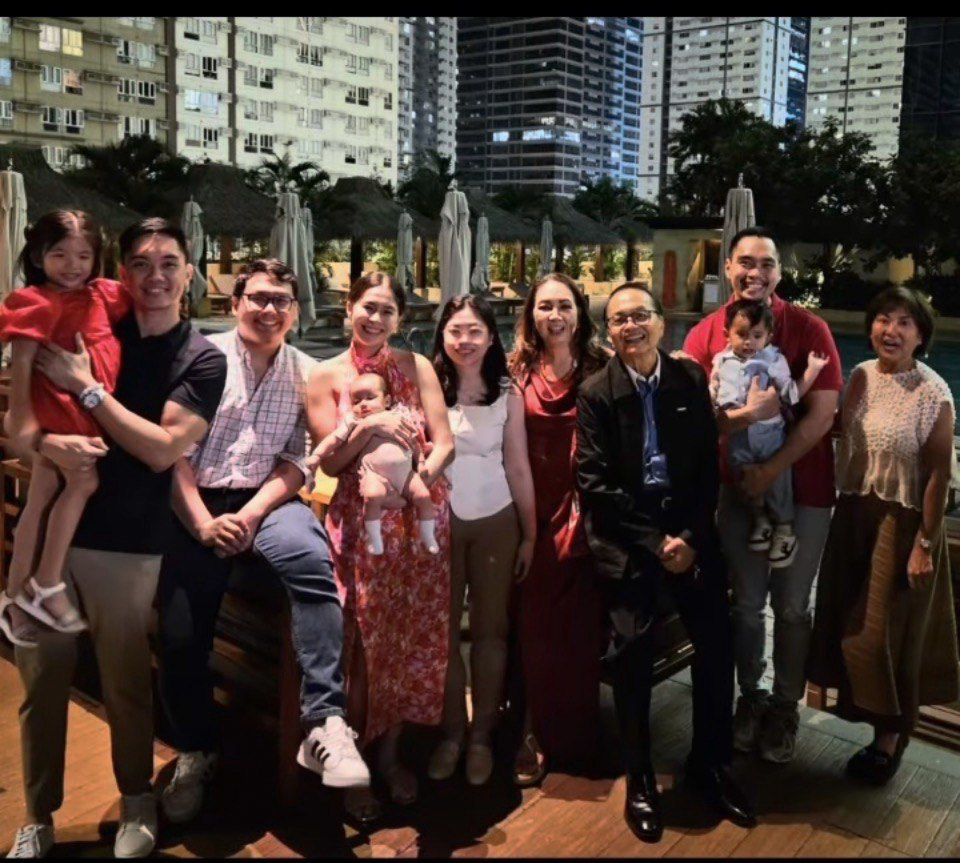
Chito and Anna Sobrepena with their family last Christmas
Last Christmas, how uncanny that Chito sent a message to friends to greet them and to give an update about his life since his recent retirement. How very Chito. He wrote:
“As 2025 draws to a close, we look back on the past year in much the same way as when it first began, that is, with deep gratitude and renewed hope. 2025 marked the year of my transitioning from the presidency of the Metrobank Foundation. Yet life has been anything but quiet. I remain fully engaged in my continuing responsibilities within Metrobank, Metrobank Foundation, GT Foundation, Manila Doctors Hospital, Manila Tytana Colleges and Toyota Motors Philippines School of Technology, lending support where needed and contributing to initiatives that move our institutions forward. I am grateful to continue doing work that brings much satisfaction.
“While the work continues to fill my days, Anna and I have also found ourselves more deeply involved in the life of our nation. We joined countless fellow Filipinos in peaceful protest rallies calling for integrity and accountability in public service. Standing up against corruption has reminded us that citizenship is a lifelong responsibility, one that demands both courage and hope. We remain committed to fight for the country we want to leave to our children, our grandchildren and the generations after them.
“One of our most meaningful endeavors has been helping Christian married couples strengthen their relationships. We nurture marriages through the Intimacy Weekend program which my wife and I designed and facilitate together. It has been more than 20 years since we began conducting these workshops aimed at strengthening communications between couples and many of the participants have shared how it has helped deepen their relationships.
“Our children—Gabriel Paolo, Rafael Agustin, and Michaela Corazon—continue to thrive in their respective professions and ventures. Watching them grow into responsible, compassionate, and accomplished adults remains one of our greatest blessings. We count ourselves much blessed that each of them has married fine persons. Genevieve, Kaye and Joash are like our own children and very much part of our family. We are also grandparents to Galilee age 5, Luke Rafael age 1 ½ and Rafaela Isabel, 4 months. They have brought so much joy into our lives that we had never imagined.
“As we celebrate the birth of Christ, we look to Him with hope. In the face of corruption issues, a challenged economy, and a continuing need of our countrymen heightened by natural disasters, we continue to believe that goodness prevails when people choose to help, extend compassion, are generous and pursue what is right, true, and just….”
We repost here TheDiarist.ph story written upon his retirement. It deserves to be read again and again.)
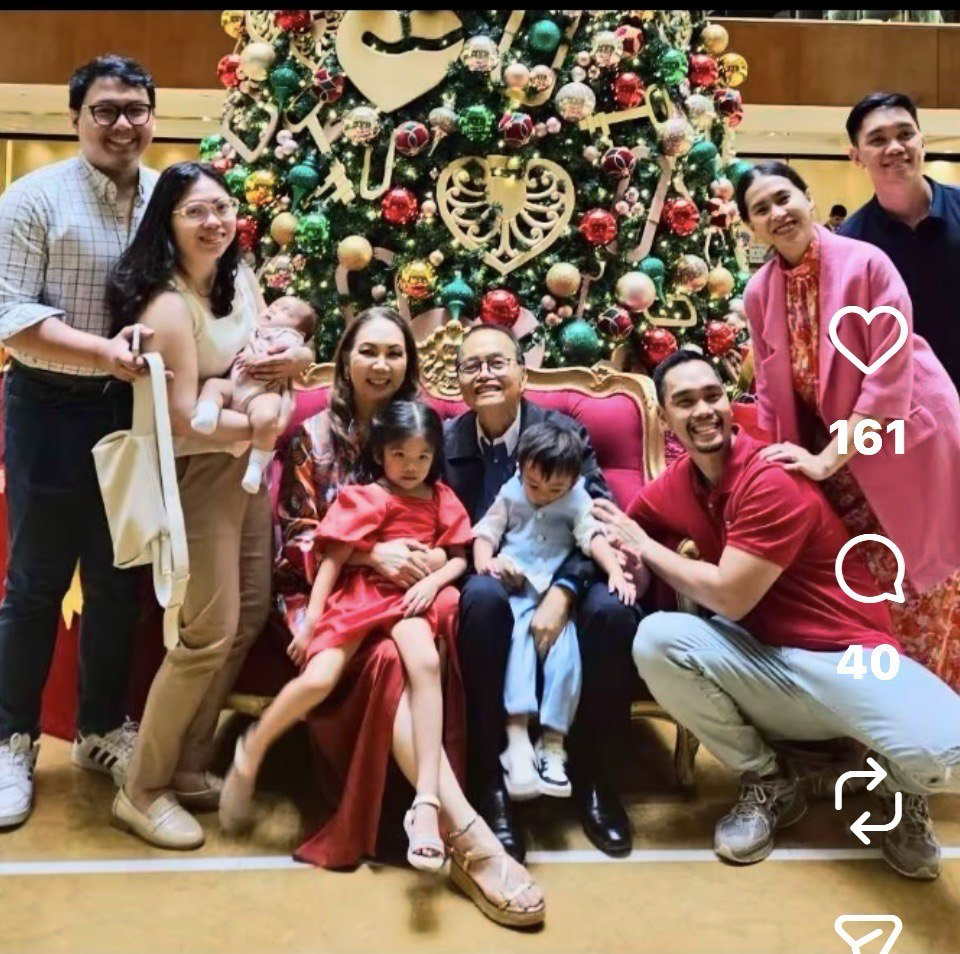
Chito and Anna Sobrepena with family, Christmas 2025
No one is indispensable—that’s said over and over, be it in a corporate organization, community, or one’s personal life. Yet why do we get this notion that it doesn’t apply to one good man, Aniceto Sobrepeña, known familiarly to friends and colleagues as Chito?
When he retired this month, after close to 30 years as president of the Metrobank Foundation, Inc. (MBFI), one of the most dynamic institutions in the country—and arguably a significant driver of social development—it was obvious from the rain of tributes that institutions and people alike can’t seem to let go of him, that this seasoned fighter and do-er is—no other better word—indispensable.
With 22 years of continuous government service, followed by nearly 30 years of corporate service, Chito has single-mindedly pursued a simple, life-long mission: to make the lives of others better. He’s a man for others—he happens to be an Ateneo graduate. Yet his calling has been anything but that cliché. Under his watch, MBFI has made a difference in the lives of teachers, soldiers and the police, artists (many of today’s leading artists and designers were products of the MBFI awards), and even media.

For the Pasig River Rehabilitation project, at the installation of two island reactors at Estero de Paco: Alfred V. Ty, Gina Lopez, and Chito Sobrepeña at the Paco Market
He worked to mine the resources of a conglomerate to uplift the lives of others, when, given the heft of his academic and corporate credentials, he could have just been content being a corporate player.
Born to an affluent family, this cum laude graduate of Ateneo (AB Political Science, 1973) who, at 36, became the youngest Cabinet Secretary in the Cory Aquino administration, used his career credentials to try to make a difference in society. Not a mere careerist nor technocrat, he made his life into one unending mission beyond career success and fortune.
Perhaps this is why, as could be gleaned from the tributes, Chito Sobrepeña is pretty hard to clone. That brain and fortune come with a strong heart. That exemplary educational attainment comes with strong values.

At the Metrobank Foundation Recyclables Wellness Camp held at the Manila Tytana Colleges, 2008
In these challenging times, he is one of the few good men.
“What I have done throughout my career has been a response to a life much blessed,” Chito told TheDiarist.ph a few days before his retirement. “Idealism started me on the path of development work, but it wouldn’t have been enough. We burn out when all our good intentions and capabilities cannot bring about the change we hope to effect in the lives of our countrymen.”
Chito himself described to us the personal journey that led him to where he is now, at the helm of one of the biggest institutions in the country.
“I grew up in San Jose City, Nueva Ecija, exposed to the hardships and challenges of the farmers. While our family treated our workers as extended family, there was so much that needed fixing in the system. I became a student activist in my college years at Ateneo, inspired by the dictum of ‘A Man for Others.’”

At the launch of the Doña V. Tytana Community Center in GK Escopa, Quezon City: Atty. Pilar Nenuca Almira, Theresita O. Turla,
Chito Sobrepena, Anjanette T. Dy Buncio, Zandra M. Ty, and Elvira O. Chan
It is noteworthy how early in adulthood, right after college, he chose to work among the poor.
“In 1972, when Martial Law was declared, some of my fellow students went underground to fight the system. When presented the challenge to bring about improvement of lives by working within the system, I accepted and joined the National Economic and Development Authority (NEDA). I volunteered for the poorest region and found much satisfaction in the interaction and exposure that widened my understanding of those living on the fringes of our society. Their realities help me craft the policies and recommendations for the improvement of their situations.”
It is ironic how the more dire the situation he had seen, the stronger his idealism became. Cynicism and pragmatism didn’t take over this young man. In this alone, Chito’s journey was exceptional from the get-go.
“I was energized by the hope of contributing to the upliftment of their station. The process of change can be slow, and even when I was being recognized with promotions, rising to become the youngest bureau-level director in the national government at 28, it felt hollow.”

Bags of Blessings (BoB) Manila at Mehan Garden/Universidad de Manila, near City Hall: Mary Ty, George SK Ty, a beneficiary and her child, and Chito Sobrepeña
Something makes all the difference in the success trajectory of this professional: faith.
“Thankfully, a re-introduction to the God of my early religion classes brought me into a relationship with God that was personal and life-changing. There was a paradigm shift from pursuing my agenda to following His lead. Recognizing Him as the source of all good, following Him, was the most logical path to take. I also began to see that He had been alongside me, even when God was just an abstraction and an idea in my mind.”
A recognition of a power stronger than his set him out in the right direction. “I realized how privileged I was to be doing what was meaningful and important to me. My government work continued in Malacanang, where I managed President Cory Aquino’s social fund as head of the Presidential Management Staff. I was also concurrently the Cabinet Secretary in the Office of the President.”
His career was becoming a lesson on how to keep the faith.
“Besides the demands of my positions, it was also a very challenging time for the Aquino administration, with seven coup d’etat attempts and a volatile economy. My wife, Anna, had asked then why I still continued to work in government when it meant being overworked, underpaid, and maligned. I told her that the psychic income of seeing the gladness of residents in far-flung barangays, where we had an artesian well installed, was more significant to me than a larger paycheck.”
After 22 years of government service, it became obvious to Chito that climbing up to the topmost of the corporate ladder, with a fat paycheck, would not be his end goal.
“That I have been able to continue doing development work in the private sector is also a gift that I am very much grateful for. I was offered to work in different companies, but it was MBFI that I was drawn to. Working with visionary leader and philanthropist, Metrobank Group chairman Dr. George S. K. Ty, enabled me to continue the development work close to my heart.
“It has never been just a job for me. The Foundation realized my hopes to contribute for the greater good.”
Apparently, this man has chosen well. His journey shows how he’s made the right decisions—not only by himself or his company, but also by his country.
At the onset, he had the distinction of attaining the highest rank in the Career Executive Service Officers (CESO) corps, at the start of his 22-year government service.
Then he embarked on a second career in the private sector. In 1995, he became the first executive director of the Metrobank Foundation. In May 2006, after concurrently serving as executive vice president from 2003 to 2005, he was elected president of MBFI, the corporate social responsibility arm of the Metrobank Group and one of the largest corporate philanthropic foundations, in terms of operating budget, in the Philippines.
From 1995 to the present, he steered MBFI into pioneering milestones in corporate social responsibility and social development. MBFI has become one of the most progressive and dynamic corporate philanthropic organizations in the country. It has earned acclaim for its well-thought-out and executed programs—Metrobank Foundation Outstanding Filipinos (teachers, police, soldiers), Metrobank Art & Design Excellence (MADE), Metrobank-MTAP-DepEd Math Challenge (MMC), Metrobank Scholarship Program, Grants and Social Development Partnerships, National Teachers Month, and Helping Hands Calamity response programs, among others.
In this way did the Foundation touch the lives of ordinary people and the marginalized on the fringes of society.
Under his stewardship that spans close to 30 years, MBFI has received more than 50 local and international awards in corporate citizenship, public relations and business communications, including the Sesquicentennial “Gawad Rizal” (lone institutional awardee) from the National Historical Commission of the Philippines (NHCP) in 2012; the Signum Ministerii Medal (Model of Outstanding Leadership in Corporate Sustainability and Responsibility) from De La Salle University in 2013; and the Agora Award for Excellence in Advocacy Marketing (the first recipient in this category) from the Philippine Marketing Association (PMA) in 2001.
On July 16, 2025, he stepped down after close to 30 years as president of the Metrobank Foundation, and after 16 years as executive director of GT Foundation, Inc., the family foundation of the late Metrobank founder, Dr. George S.K. Ty.
The many tributes became the opportunity to look back on his youth. After graduating, he joined NEDA in 1974, after finishing his Certificate in Development Economics from the University of the Philippines Diliman as a NEDA scholar. In 1977, he earned his Master of Arts in Development Economics as a USAID scholar at the Williams College in Massachusetts, USA.

At the MBFI anniversary outreach/tree planting at Toyota Motor Philippines, January 7, 2011: Elvira O. Chan, Nicanor L. Torres Jr., Chito Sobrepena, Dr. David Go, and Ronald Gaspar with officers and staff of MBFI
Being a registered environmental planner, he was elevated in 2017 to the Philippine Institute of Environmental Planners (PIEP) College of Fellows. In the spirit of volunteerism and community service, he held leadership roles in such organizations as the Philippine Business for Education (PBed), the UP Program in Development Economics Alumni Association (UP-PDEAA), PinoyME (Microenterprise) Foundation, Philippine Economic Society (PES), and the University of the Philippines Foundation (UPF).
Post-retirement, he will continue to serve as vice chairman of Manila Doctors Hospital (Manila Medical Services, Inc.), MBFI’s healthcare arm; chairman of Manila Tytana Colleges (formerly Manila Doctors College) and trustee of Toyota Motor Philippines School of Technology, Inc., Metrobank Foundation, Inc. and GT Foundation, Inc. He remains consultant of Metrobank.
Apart from these, he values his membership in Ang Ligaya ng Panginoon (Joy of the Lord) Community, a Catholic Christian covenant community based in Metro Manila since 1982.
Given the above commitments of her husband, his wife, Anna Isabel Crisostomo Sobrepena, an award-winning writer and editor herself, doubts if she and their three children and two grandchildren will get to see more of him even now that he is officially retired. He continues to have a packed schedule. In our chat, she said, “I thought we were going to wake up late, watch a movie, eat out, travel and chill with Galilee and Luke (the grandchildren). Joke’s on me…But seriously, he has so much to give. It would be a disservice to keep him from pursuing his development work.”
Replying to questions from TheDiarist.ph, Chito Sobrepeña puts it in his own words:
Can you really slow down?
After nearly five decades of full-time work in both public service and the corporate philanthropic sector, “slowing down” is a relative concept. I may have stepped down from major leadership roles, but I continue to serve in advisory and trustee capacities.
I’ve always believed that when one is called to serve, that calling doesn’t retire. It just evolves.
Slowing down, for me, means creating more space for reflection, mentoring, and deepening the spiritual dimensions of leadership and service. Purpose does not retire—it simply refocuses.
Why did you choose the path of foundation work in a corporate setting, instead of just corporate work?
After my years in government, particularly in development planning, I was drawn to the opportunity to continue contributing to national development in a different setting. Foundation work allowed me to stay true to my passion for nation-building—this time through education, public service recognition, and social investments.
The corporate setting gave me the platform and resources to institutionalize programs that could address long-term societal needs, guided by sound strategy and strong values.
Over the years, I realized that foundations, especially those embedded in corporations, could be powerful channels for sustained social impact.
Foundation work gave me the opportunity to shape initiatives that uphold human dignity, provide hope for the future, and inspire the youth, while still harnessing the structure and resources of a corporate organization.
What self-fulfillment did you derive from this chosen path?
There is profound fulfillment in knowing that our work at the Foundation has created ripple effects in countless lives—uplifting teachers, inspiring public servants, nurturing artists, helping youth finish their education, and responding to communities in crisis.
The satisfaction comes not from accolades, but from the quiet assurance that we have been instruments of positive change. For me, that’s a priceless reward.
There’s immense joy in witnessing how well-executed programs can transform lives. Honoring unsung heroes like teachers, police officers, and soldiers through the Metrobank Foundation Outstanding Filipinos, or equipping students through scholarships and math competitions, has been exceedingly fulfilling.
This path has given me the rare privilege of blending strategic leadership with genuine service to others.
Can you cite a few most notable moments in your work?
I was able to persuade Metrobank chairman Arthur Ty to deliver a major speaking engagement at the LCF CSR Expo in 2004. He has always preferred to keep a low profile, but after finally convincing him that it was time for him to speak in public on behalf of MBFI, he eloquently delivered our points of view on how the business sector could refocus programs towards the youth sector.
During the pandemic, we rechanneled our unprogrammed funds towards providing urgent food assistance that included a systematic community pantry initiative, distribution of personal protection equipment (PPE), and construction of molecular laboratories, among others. The agility of our program execution was deemed exemplary.
All our accomplishments in community service and humanitarian assistance were put front and center when the Senate passed a resolution in 2019 honoring our Group chairman George S. K. Ty posthumously as a businessman and philanthropist. His financial resources and commitment to nation-building enabled the Foundation to uplift the lives of our fellowmen across sectors.
Corporate foundations are mission fields and not just workplaces
Will you encourage the younger generation to take this career path? Why?
Through the years that I have served in the Metrobank Foundation, I have told young people that there is no more meaningful way to use their talents and skills than to pursue a career that uplifts others.
One can work in a foundation and still be successful. A finance graduate can manage grants and scholarships. A communications major can tell the stories of award-winning teachers, dedicated police officers, and brave soldiers to inspire others. A business graduate can help design sustainable programs for a bank, a telecommunications company, or a real estate conglomerate. Those in the creative industry, the techies and strategists, can build platforms that change lives.

Sobrepeña at the Gulayamanan Harvest Festival by East West Seed Foundation
Corporate foundations are mission fields and not just workplaces. I continue to tell the young people who do internships with us to “look for purpose” and “look beyond paychecks.”
I exhort our college scholars to get themselves employed in companies, like foundations, that will allow them to apply strategic thinking and innovation, while advancing causes greater than themselves. The rewards are intangible but enduring: purpose, impact and the joy or serving others.
Relationships are the real capital
Any other insights you’d like to share?
I would like to share these:
A. Relationships are the real capital.
Projects come and go, but genuine relationships with stakeholders—government officials, community leaders and civic groups—create goodwill, and the networks that make long-term impact possible.
B. Make space for young leaders
Mentor the next generation. Allow them to be part of decision-making, learn from missteps, and claim their voice. Great leaders don’t just finish strong; they raise those who will continue the race.
C. Live with gratitude; lead with faith
No title or accomplishment can match the satisfaction of following the path of God. Pray over decisions and give thanks for every door opened or closed. Detours and delays are part of the journey. It will only make sense when we trust Him and maybe realize it only from hindsight.
________________________________
Now that Chito Sobrepeña is retired, perhaps he should hit the ground running (ironic) and do a nationwide lecture tour to share his experience and life with the youth—on leadership, corporate responsibility, nation-building and giving back to society.
Perhaps this is one way we can save the Filipino youth from a wasteland where their minds are shaped by troll farms, their hearts corrupted by dynasty politicians, and their future hijacked by corrupt institutions.
Chito Sobrepeña and a few good men present an option to the millennials and GenZ who want to migrate out of frustration and for lack of choices in the Philippines.


