

‘Maria Makiling’ will be staged on July 5 at 3 and 7:30 pm and July 6, 3 pm at the Samsung Performing Arts Theatre, Circuit Makati.
A spirit of myth and warning rises in Maria Makiling, a lyrical new ballet choreographed by Ronilo Jaynario that channels the power of the legendary mountain goddess.
Presented by Philippine Ballet Theatre, the 75-minute work blends folklore, ritual, classical ballet, and contemporary movement into a portrait of a diwata who protects, provides, and punishes.
Set in the 19th century in the agricultural town of Los Baños, the ballet opens in pastoral serenity. Villagers harvest rice, offer their crops at the foot of the mountain, and dance in gratitude. They live in harmony with the land, watched over by the mysterious Maria Makiling.
“In the legend,” Jaynario explains, “when someone is sick or in need, they go to the mountain. Maria Makiling gives them ginger—and that ginger turns into gold. She’s always providing.”
This generosity finds poignant expression onstage: a villager collapses from illness and is revived by a remedy—the ginger gift from the goddess. The moment is both magical and deeply human, evoking the everyday mysticism that permeates rural life.
As in his other folklore ballets, Jaynario interweaves ballet with folk dances. A stylized Maglalatik, a traditional dance from Laguna, becomes a showcase of rhythm and martial grace. Dancers, clad in coconut-shell armor strapped to their chests, backs, and limbs, strike the shells in syncopated choreography once tied to mock battle. Here, it pulses with ritualistic energy, punctuated by aerial turns, pirouettes, straddle jumps, and bravura.
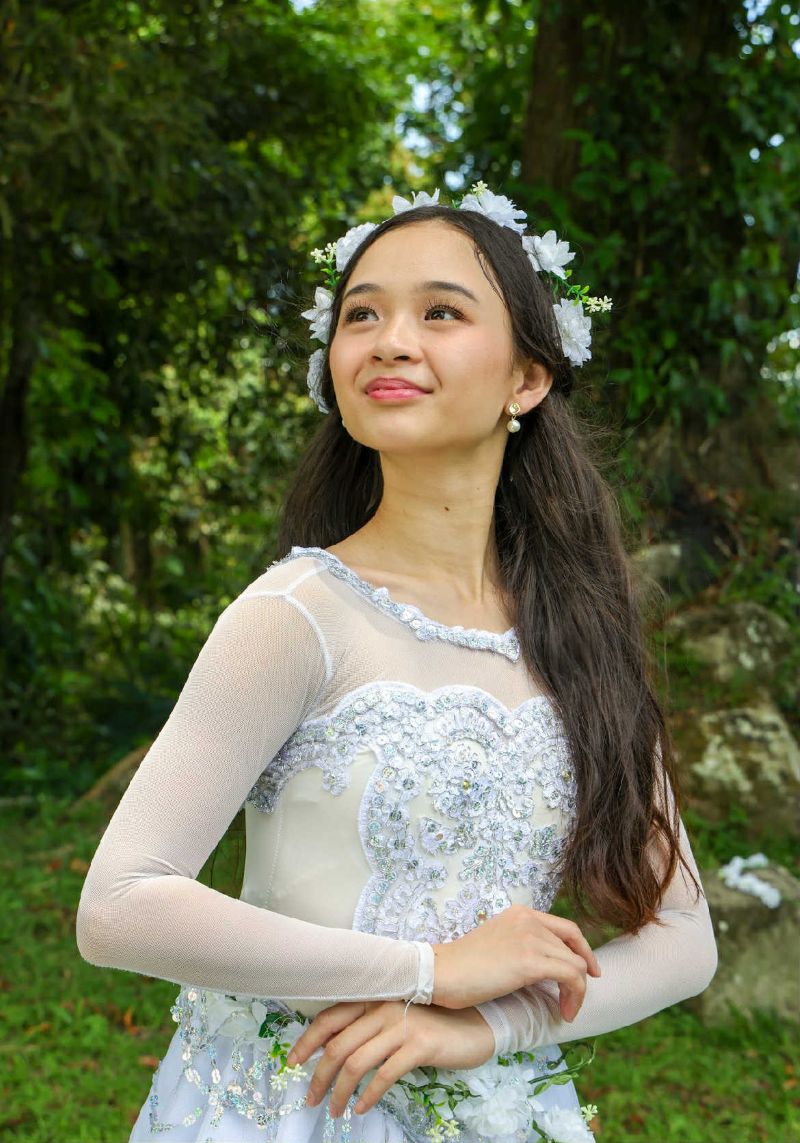
Gabbie Jaynario alternates as Maria Makiling.
At the heart of the story is a pas de quatre. Three suitors vie for the goddess’s affection: a Guardia Civil officer (Dominador Delmo), a mestizo ilustrado (Ace Polias), and Juan, a humble farmer portrayed alternately by Justine Orande and Matthew Davo. Maria Makiling is danced by Jessa Tangalin and Gabbie Jaynario.
One highlight, says Jaynario, is Delmo’s solo as the officer, “with his castanets and haughty Spanish air.”
Maria Makiling is drawn to Juan for his humility, and he then becomes the object of jealousy. The rival suitors, their pride wounded, conspire to eliminate him. But their cruelty extends further—they desecrate the mountain she protects. In a moment that draws on real-life environmental infractions, they litter the forest with cigarette butts and trash. The recklessness ignites a blaze, echoing the all-too-familiar consequences of careless tourism in Los Baños.
When several Guardias Civiles arrive to investigate the fire, the culprits point at Juan. Framed for arson, he is arrested and executed. Maria Makiling, grief-stricken and betrayed, retreats into the mountain. Her presence vanishes, her silence final.
She sleeps, the legend says—and is never seen again.
The ballet ends not in triumph, but in haunting reflection. The legend, passed through generations, becomes a parable about the fragility of trust, the cost of betrayal, and the harm inflicted by neglecting the land.
The legend, passed through generations, becomes a parable about the fragility of trust, the cost of betrayal, and the harm inflicted by neglecting the land
Jaynario grounded his choreography on research, drawing on José Rizal’s references to the diwata in his works, visiting local museums in Los Baños, and consulting with historian and University of the Philippines Los Baños Vice Chancellor Roberto Cereno. When he told Cereno about the idea of shrouding the mountain in white for the video as Maria Makiling descends, the latter was struck by its symbolism and coincidence.
“The older women here talk about the mountain being covered in white,” Cereno told him. “It means the clouds have gathered. That’s how they know if it will rain, or if they can go out and celebrate.” After their production meeting, Jaynario declared, “We’re right on track.”
For the choreographer, the story is deeply personal. He spent four formative years as a student at the Philippine High School for the Arts, located at the base of Mount Makiling. The school’s dance studio stood in the shadow of the slopes.
“I heard so many stories,” he recalls. “Some said she appeared when you were doing something wrong. Then, suddenly, she’d vanish.” Hikers who damaged the forest were said to get lost, wandering in circles without finding a path down. “It was as if she was punishing them.”
One moment has stayed with him. On his final night in school, graduating students lit candles along the pathways by their cottages in a farewell ritual. As they chatted, some noticed a white figure moving among the trees.
“Those who weren’t paying attention didn’t see anything,” he said. “But others felt her. It was as if she was really there.”
He remembers a moment of panic. “She seemed to jump down from the hill where our cottages stood. We screamed. The candles were still burning. I thought, ‘Maria might be angry!’ I grabbed an umbrella to put them out.”
The presence felt like a warning. “She protects the mountain,” he says. “And she doesn’t like fire.”
On campus, that belief is more than superstition. Behind the dance studio stands a rock long associated with the spirit of the mountain. Since his freshman year, Jaynario recalls, upperclassmen taught newcomers to leave offerings—candles, whispered prayers. Over time, it became a ritual.
“There’s even a part of Mount Makiling that couldn’t be leveled to expand the studio,” he notes. “The ground rises in a way that looks like a nose—part of a woman’s face. It was left untouched.”
The myths remain alive, shaped by reverence and fear. “When someone cries out for help,” Jaynario says, “animals come down—lizards, even birds. They know if you’re good or not. They protect you, or they don’t.”
In Maria Makiling, Philippine Ballet Theatre asks urgent questions: What happens when the natural world is taken for granted? Can reverence for myth shield us from the consequences of greed?
The ballet positions Maria Makiling not merely as a legendary figure, but as a symbol of conscience—a reminder of the delicate balance between humanity and the environment that sustains it.
Maria Makiling marks the third folklore-inspired ballet collaboration between composer Paulo Zarate and Jaynario. The multi-hyphenate Zarate is a musical director, film composer, songwriter, and music consultant, whose work has earned nominations and awards from institutions like Awit and the Stevie Awards. His studio services major networks, record labels, and ad agencies.
The composer’s intent was for the music to narrate the story on its own, allowing audiences to follow the arc without relying on a plot synopsis. Each scene flows with musical logic, beginning with full orchestration infused with indigenous sounds and culminating in a rich, layered finale.
Evoking the late Spanish colonial period, the score features classical guitars to evoke the era. Since the ballet draws from myth, Zarate also wove in whimsical, “Disney-esque” fantasy elements. The animation of flowers in scenes featuring the mountain goddess reminded him of Fantasia, where Mickey Mouse conducts music that springs to life—a clear influence on his musical storytelling.
In the scene where two rivals conspire against Juan, tense string passages build a sense of impending betrayal. The ilustrado and Guardia Civil officer perform to guitar accompaniment, while Juan the farmer is delineated with light, playful rondalla instruments. Maria Makiling’s themes lean toward New Age tones, layered with ethereal choral textures.
“Some motifs are repetitive but playful,” Zarate explains, “so the audience can remember them long after the curtain falls.”
‘Maria Makiling’ will be staged on July 5 at 3 and 7:30 pm and July 6, 3 pm at the Samsung Performing Arts Theatre, Circuit Makati.


