
The Philippines has spent generations looking outward for design cues. The times call for designers to look around them instead.
That is the thinking behind “Designing for the Pluriverse,” the theme of the Design Center of the Philippines’ (DCP) 10th International Design Conference. The idea draws from Colombian anthropologist Arturo Escobar, whose 2018 book, Designs for the Pluriverse, calls for design that recognizes different ways of living, knowing, and relating to the world rather than assuming one model can fit everyone.
Rhea Matute, DCP executive director, said the idea starts with the country itself. The Philippines has more than 7,000 islands, hundreds of communities, and traditions that vary from one region to another. The pluriverse theme asks designers to recognize those differences instead of smoothing them out into a single idea of what Filipino design should be.
The conference grew out of the DCP’s work on “archipelagic thinking” and its mapping of the country’s design sector, where designers have called for greater regional representation and more attention to local craft traditions and stories. The conversation also extends to ASEAN, whose diversity offers a useful parallel, particularly Indonesia.
Indonesian designer Tita Larasati was invited partly for that reason. Her work in Bandung, West Java, and with the United Nations Educational, Scientific, and Cultural Organization (UNESCO) Creative Cities Network, has brought communities, government, and creative practitioners into the same conversation. In Indonesia, those networks have also helped local initiatives gain a larger role in the country’s development.
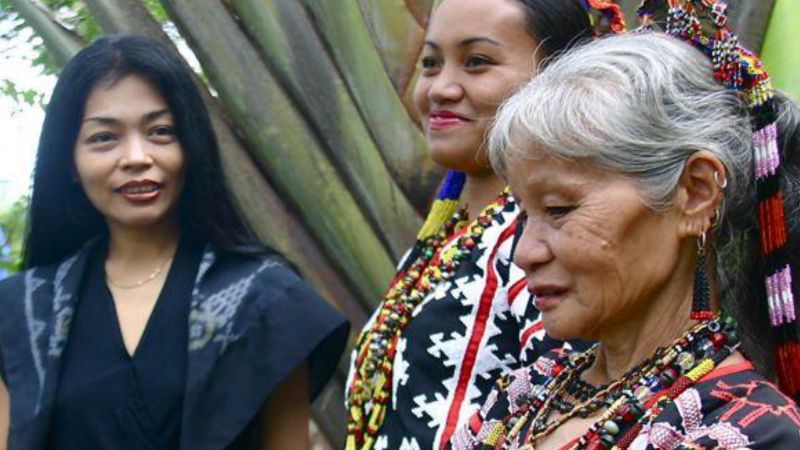
Grace Nono, better known as a musician, has spent decades researching indigenous knowledge and living traditions, and has become an ethnologist and cultural heritage advocate. Matute invited her as a keynote speaker for the depth of Nono’s scholarship and her knowledge of indigenous communities.
The DCP is now looking at the possibility of developing a Philippine Indigenous Design Charter, bringing designers, schools, and indigenous representatives into the process.
The same diversity could have commercial value. Matute said consumers no longer necessarily want one dominant look. Smaller quantities and a wider range of styles can serve people with different tastes and cultural references.
Young Filipinos are also looking more closely at where they come from, including those raised abroad who are becoming curious about their histories. For designers, that opens a field of references that has barely been exhausted.
In 1989, Grace Nono went into the mountains of Mindanao and heard something her elite education had never prepared her for. She encountered a Manobo baylan (ritual specialist) named Laco, then heard a mother named Baunsoy sing an oral chant in a nearby village. Nono returned to the lowlands inspired, confused, and angry. Why had voices like these been absent from everything she had been taught?
That question has shaped more than three decades of her work, from the School of Living Traditions, where indigenous elders pass knowledge to younger generations, to Kaalamang Ninuno, an online traditional arts series. At the International Design Conference, Nono described these efforts as part of a “pluriverse,” in which different ways of knowing and living can exist without being forced into a single system
In school, she studied the visual arts, music, literature, philosophy, religion, and the history of Western civilization. Yet for all that breadth, the education she received, shaped by a neocolonial system, taught her to value rational thought while leaving little room for knowledge rooted in the body, emotion, place, and experience.
The encounter with ritual specialists changed the way Grace Nono understood learning. Instead of treating indigenous knowledge as material to collect and study, she began learning directly from its holders
The encounter with ritual specialists changed the way she understood learning. Instead of treating indigenous knowledge as material to collect and study, Nono began learning directly from its holders. That came with relationships and responsibilities. She had to undergo rituals, present her intentions to councils of elders, explain what she would do with what she learned, and observe the conditions set by the communities sharing it.
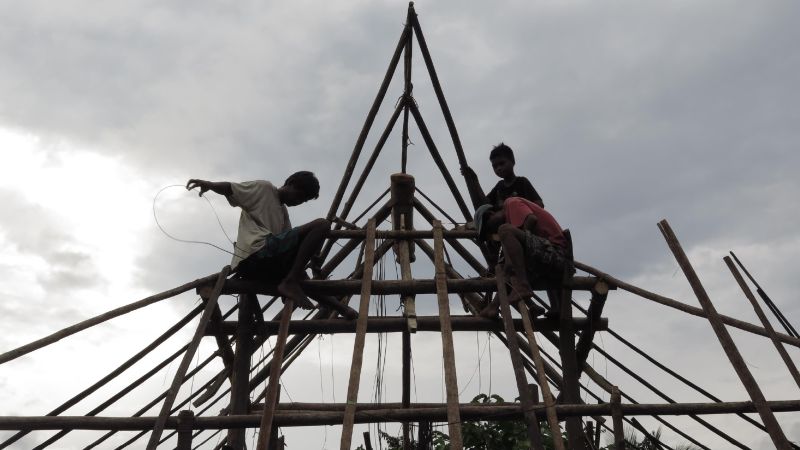
Traditional house-building is one of the subjects taught at the School of Living Traditions.
This became the basis for work she has pursued for more than 30 years, including the School of Living Traditions (SLT). It puts indigenous elders and young people together so that knowledge can pass from one generation to the next while the knowledge is still alive. The lessons include oral history, language, tribal governance, customary law, ancestral-domain conservation, rituals, food, traditional medicine, weaving, beadwork, embroidery, chants, instrument-making, dance, and traditional house-building. Also being preserved are practices that are not part of conventional education, such as as suyam embroidery and old arts.
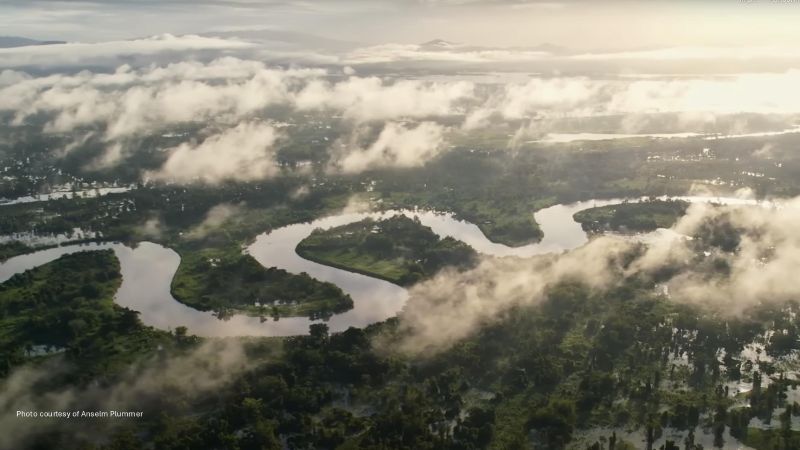
Preserving ancestral land in Agusan del Norte (Photo courtesy of Anselm Plummer)
Nono’s work puts the pluriverse into practice by keeping indigenous knowledge with the people and communities who carry it. The world does not have to operate according to one system of knowledge, one definition of intelligence, or one model of progress. Indigenous communities do not have to squeeze their knowledge into Western academic categories before it can be considered valid.
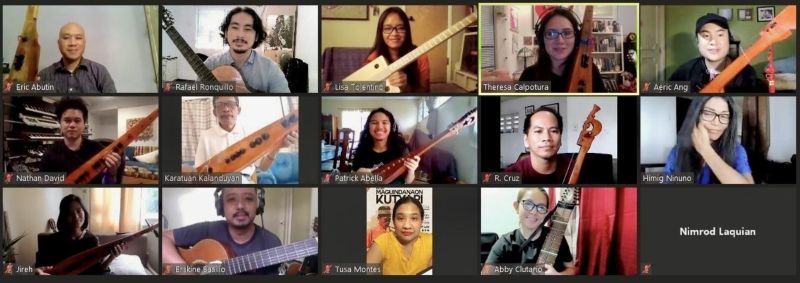
Online webinar on traditional arts
Technology, too, can be used to widen rather than narrow that world. Nono’s Kaalamang Ninuno traditional arts webinar series uses platforms such as Zoom to connect indigenous master teachers with students in different parts of the world. The students include curious learners, overseas Filipino workers, and people with advanced academic degrees, including Ph.D holders.
The technology may be contemporary, but Nono does not want the knowledge turned into another form of online content, available to anyone simply because it can be put on a screen. The teachers set the terms for what can be taught and how it can be learned.
She cites master teacher Agamayo Butokan, who has specific rules for students learning how to play traditional instruments. The student has to follow the conditions set by the teacher rather than treating the lesson as a transaction.
That approach runs against the speed and appetite of the internet, where knowledge can be separated from its source and passed around without context. For Nono, the people who carry traditional knowledge cannot be separated from the knowledge itself. Neither can the places, histories, and relationships that produced such knowledge.
Thus, the webinar series puts two things that are often treated as opposites in the same frame. A centuries-old tradition can be taught through Zoom. A master teacher living remotely in the Philippines can teach someone on the other side of the globe. Modern technology does not have to erase the uniqueness of a culture; it can help people find it.
Nono’s idea of the pluriverse is about making room for different ways of knowing and living, including those that Western education has historically dismissed. The SLT gives indigenous communities a place to transmit that knowledge to the next generation. Kaalamang Ninuno allows the same knowledge to cross borders without stripping it of the relationships and rules that give it meaning.
The lesson followed Nono back to her family’s land. She had taken the familiar route out of her birthplace, then the city, and eventually overseas. At some point she began asking where all that movement had taken her. Her parents had lived and died on the family property, where they are also buried. She returned to Agusan del Norte determined to keep the land from being swallowed by development.
She arrived with a plan for an eco-agri and heritage park. Working with local and indigenous associates, she held permission rituals, cleared grass for organic vegetable gardens, dug drainage canals and fish ponds, and planted native trees.
Then scientists studying the property showed her that the land was peatland, formed from soil, water, and layers of ancient plant material. Centuries of deforestation and urbanization had already degraded it. The trees she had planted were dying because they did not belong in that soil, while the canals and fish ponds were draining the water the peat needed to survive.
Her work became one of restoration. She began planting trees appropriate to the peatland, collecting rainwater and using solar energy, while working with the community to protect the wetlands.
In all, the three projects take the idea of designing for the pluriverse as designing for all directions—from passing indigenous knowledge to younger generations and connecting master teachers with students worldwide, to restoring a damaged ecosystem.
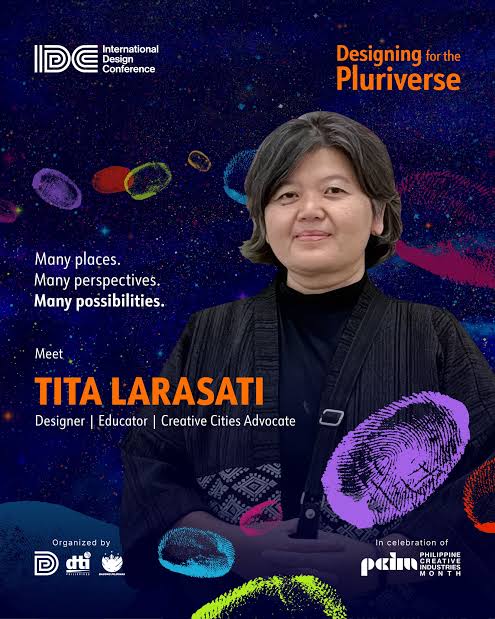
Tita Larasati
Dwinita “Tita” Larasati began as an industrial designer, studying at the Bandung Institute of Technology (ITB) in West Java, Indonesia before pursuing a master’s in design research at Design Academy Eindhoven and a doctorate at Delft University of Technology in the Netherlands. Her work had focused on sustainability. After about 10 years abroad, she returned to Bandung in 2007 and went back to teaching and research at ITB. Later, her work evolved into community development, creative cities, and policy, from designing products and being an academic talking about creative economies.
In 2008, she helped found the Bandung Creative City Forum, bringing together creative communities in a city that was trying to work out how design could address everyday urban problems. In 2015, she was among those who started the Indonesia Creative Cities Network, which has since grown from about 20 cities to more than 260 cities and regencies. She is also the resource person for Bandung in the UNESCO Creative Cities Network, which recognized the city as a City of Design.
In 2008, Tita Larasati helped found the Bandung Creative City Forum, bringing together creative communities in a city that was trying to work out how design could address everyday urban problems
Bandung is a case study worth examining in the Philippines, another archipelago where geography, economic inequality, and uneven access to services complicate development.
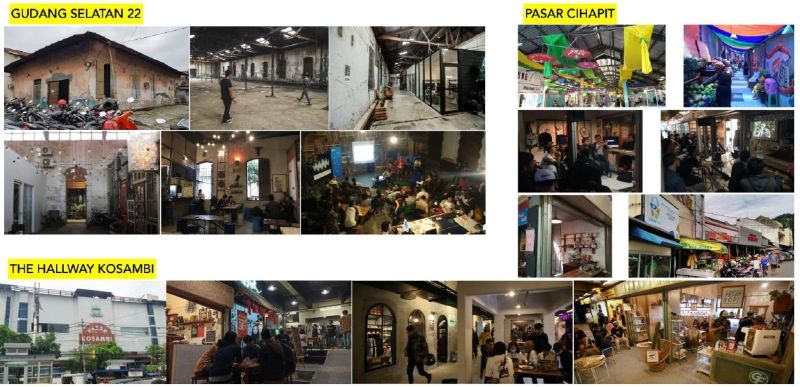
Sites in Indonesia’s Living Museum network
Indonesia’s vast geography has meant long distances between communities and sharp differences in access to healthcare and education. Many communities have also depended on extracting minerals and developing plantations for their livelihoods. Larasati sees a shift among younger Indonesians toward an economy based more on ideas, creativity, and human skills.
Bandung’s citizens began tackling problems without waiting for government to tell them what to do. They treated the city as a laboratory, developing quick prototypes that could be changed or discarded. Public art projects appeared in the city, a river was turned into a cinema, and bike-sharing was tested.
Bandung treats design as a way of solving urban problems, not simply making objects. Prototypes let communities test ideas quickly and adjust them as needed, while creativity can narrow the gap between citizens and government, policy, and people. “Designers also create systems, and also later, the system could be more established if there’s a policy that backs it up,” Larasati said.
That approach brought young creative communities from across Indonesia together in Bandung in 2015 and led to the Indonesia Creative Cities Network.
Bandung then began holding annual design-thinking workshops where government officials, designers, artists, and citizens worked together without the usual hierarchy. Ideas generated in those sessions could be tested, adjusted, and eventually turned into policy
That process helped build the conditions for Bandung’s recognition as a UNESCO City of Design.
A network has since grown from the Bandung experience which also changed the scale of the work. The Indonesia Creative Cities Network began with about 20 cities in 2015, and now brings together more than 260 cities and regencies. Smaller cities that might struggle to get the national government’s attention individually can approach it as part of a larger network, while communities can exchange ideas instead of starting from scratch.
For the Philippines, where creative activity is heavily concentrated in Metro Manila and a few other urban centers, the model offers another possibility. A city does not have to wait for a national program before experimenting. Smaller cities do not have to develop their creative economies in isolation.
Larasati’s approach also reflects the realities of Southeast Asia. Much of the region’s economy depends on young workers, small businesses, informal enterprises, and labor-intensive industries, so design solutions have to work with the resources people actually have.
That has led to experiments with materials that would otherwise be thrown away, including vegan leather made from local waste and alternative fibers for construction. In Bandung, digital equity is built by hand, pairing affordable tech with neighborhood workshops that teach local artisans and marginalized residents how to run digital storefronts and share their stories. That same community-first spirit drives a new wave of travel. Instead of traditional sightseeing that leaves places worn down, regenerative tourism invites visitors into living villages and cultural networks. Travelers do not just consume; they learn indigenous crafts, support micro-economies built on upcycled materials, and leave the landscape healthier than they found it.
Design has also been used for disaster preparedness. Urban forests and disaster-preparedness parks give communities spaces where people can learn about environmental risks and practice responding to them, while storytelling and interactive installations make the subject less abstract.
The underlying idea is broader than product design. Larasati sees design as a way to bring government, communities, artists, and designers into the same conversation, with each contributing knowledge. She noted that during the pandemic, designers were forced to rethink priorities. “Design would offer how the world can be better, more scenarios. But there are some issues, like climate, food, energy, and so on. These are the future challenges,” said Larasati.
What Indonesia offers the Philippines is a way of getting things done. Bandung’s creative communities did not wait for government to solve urban problems or for ideal conditions to emerge. They organized, tested ideas, brought people to the same table, and built networks that gave local initiatives a larger reach. Larasati’s point is that design can provide the tools, but the will to use them has to come from the people who live with the problem.
Design Week Philippines presents ‘Sama All’ on October 10, 2026, Saturday, at Likhang Filipino Exhibition Halls, Pasay City.


