
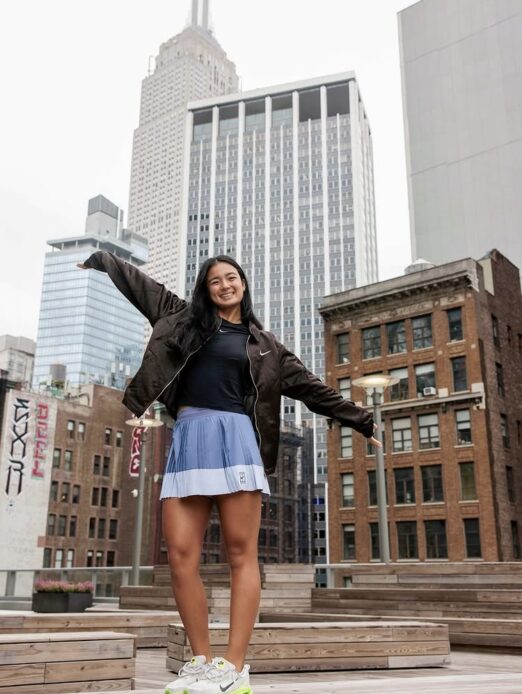
Dear Alex:
You are phenomenal. It’s clear you’ll only continue to go on from here, further and farther to bigger and greater triumphs over the next decade and beyond. The losses or setbacks along the way only strengthen your already formidable mettle, which is of a quality both unexpected and amazing.
View this post on Instagram
When you spoke after winning the US Open Girls Singles in 2022, in your mother tongue no less, you took us on your journey, so cognizant of your privilege, honor, and responsibility, as the very first tennis professional from the Philippines to reach this glory. No doubt, you’re a harbinger for real change, as tennis becomes less a pastime for the elite, and more tennis athletes are developed and supported.
Naturally, you’ve amassed fans galore, for we Filipinos are always keen to support our own. As the most digitally engaged people in Asia spending the most time online, we will never stop cheering you on. Win or lose, fan-personing is a cultural trait.
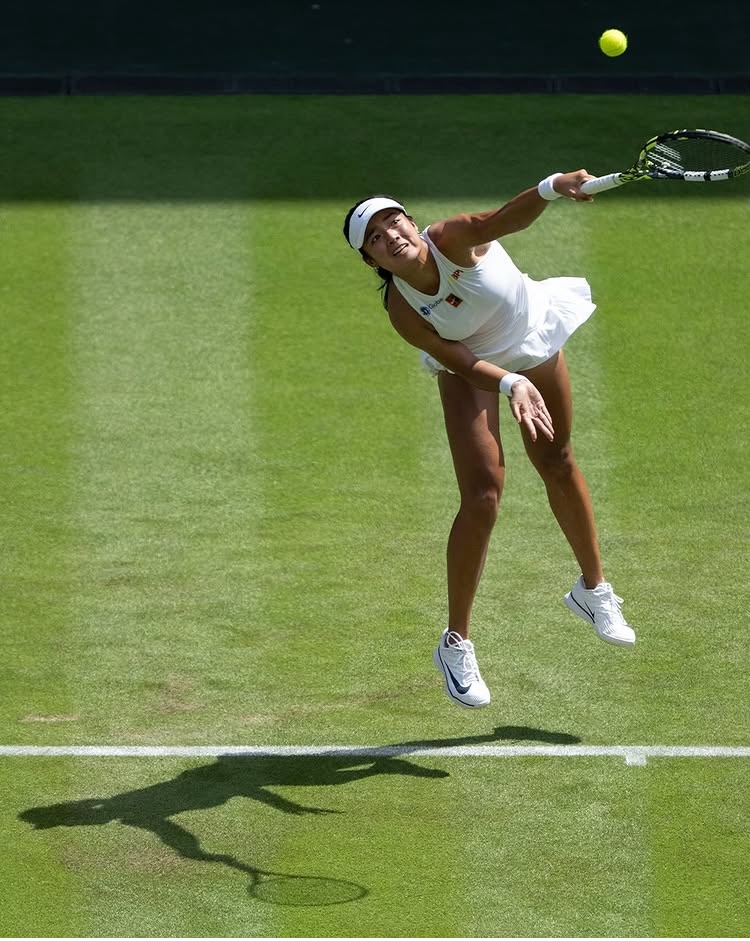
Playing in Wimbledon’s Centre Court last July
You played a wonderful grass season, in which you went from being ranked above 100 to being ranked 56, due finishing as a finalist at the Lexus Eastbourne Open. Not just the first Filipina, you’re the first person from Southeast Asia to have won a set at Wimbledon, and against the defending champion no less! This after a stellar run at the Miami Open, when you broke into the top 100, finishing off not one but three such top WTA players as Jelena Ostapenko, Madison Keys, and champ Iga Swiatek (currently number 4), before breaking into the semi-final and giving Jessica Pegula, who is now number 3, a run for her money, causing her to write on the camera after your 6(3)-7, 7-5, 3-6 battle: “I’m tired!” The Miami run catapulted you into the grand draw at the French Open at Roland Garros a month ago, again, a first for a Filipino and for a Southeast Asian, man or woman.
As the hardcourt season has begun, and we approach the US Open, I keep thinking of what I’d love to tell you. Ridiculous, because who am I really? Just a 50-something club league “tita” player who picked up a racket only in her early 40s. Even as I cringe at my own thick-skinned daring, I persist in writing down things you likely know already, only with the very best hopes and intentions for the brilliant career you have ahead of you.
Your physical game. When I saw you play the qualifying rounds of the Singapore Open in January, I was close enough to yell as you won your match against the Japanese Sara Saito in three sets. I also saw you lose to Swiss Simona Waltert in two the next day. Perhaps that’s when I started worrying, particularly seeing you extend your leg to stretch it out, not once but several times in Singapore. At the Miami Open, when you had to take a couple of medical timeouts, that worry grew. When you hit your hip with your fist in the heat of play, I pray it’s only a fidgety habit, and not a niggling ache of something more.
Injuries are part and parcel of tennis. But while you are young, training and lifestyle interventions can build your strength, bolstering your core, hips, back, and legs. I pray you never neglect this aspect of your game. There’s genetics, to be sure, but the body can change. Have a look at Serena Willams in 1995, and at then again at the height of her career. Train, train, train, not just on the court, but in the gym. As Rafa Nadal reportedly said to you himself, “You have the heart. Now you have to build the legs.”
As Rafa Nadal reportedly said to you himself, ‘You have the heart. Now you have to build the legs’
Your height already puts you at an advantage, which is not to say size is a factor that impedes tennis. Jasmine Paolini is a huge player in a small package at 5’4. But you are more than tall enough at 5’9, the same height as Iga Swiatek, Coco Gauff, and Serena Williams. You are blessed in your left-handedness, and you do so much in your foundation to build a truly dominant game.
Which is not to say that your current game is dismissible. Your baseline play is formidable. Your consistency is extraordinary; you play high percentage tennis and make few unforced errors on the whole. Your skill as a counter-puncher is breathtaking as you bide your time, wait for your chances, and seize your opportunities. Your defense is impeccable.
Your offense? Well, what player doesn’t have at least one facet in their game that can’t do with improvement? According to Tracy Austin, Mirra Andreeva has “improved her forehand” in the short time she’s been playing.
You said it yourself: Your serve is “a work in progress.” Good to hear, because awareness is the first step. We are optimistic for its blossoming and transformation into a fearsome weapon. You are far from the only WTA player who stands to benefit from a serve revamp. Reportedly, Aryna Sabalenka is the WTA player with the most improved serve, and clearly she worked on increasing power and consistency. Pundits have gone on and on about Iga Swiatek’s inadequate serve, and at Roland Garros, her second serve was evidently vulnerable. But at Wimbledon, Andy Murray noted the Swiatek serve is “coming along,” as was evident in her run up and eventual win.
While playing high percentage tennis is effective, it’s the unpredictable choices that are lethal. The timely risks pay off, and mixing things up creates opportunities. It renders you unreadable. Serve and volley. Come into the net. Change direction. Pass, drop, and lob. Champion Steffi Graff, one of the GOATS and a powerful baseline player, said she was always being told to serve and volley. Had she done it earlier, she might have beaten Serena Williams’ slam record or Margaret Court’s, who knows?
In your first Wimbledon match, Barbora Krejcikova had a higher percentage of attacking points: 35 percent to your 16 percent, and 43 winners to your 24 in that Wimbledon match. She came into the net to take 8 of her 13 net points. Inside you lives a wily, unpredictable wicked woman. Release her, killer instincts and all. Let her play. L
Your mental game. It’s amazing that you’re able to switch on the necessary amnesia that allows you to let go of errors and start over, playing one point at a time. You have an unerring sense for the play while in motion, enabling you to stay in the game even when you are down more than a break. The way you maintain composure and reset in such tight situations is truly awesome to behold.
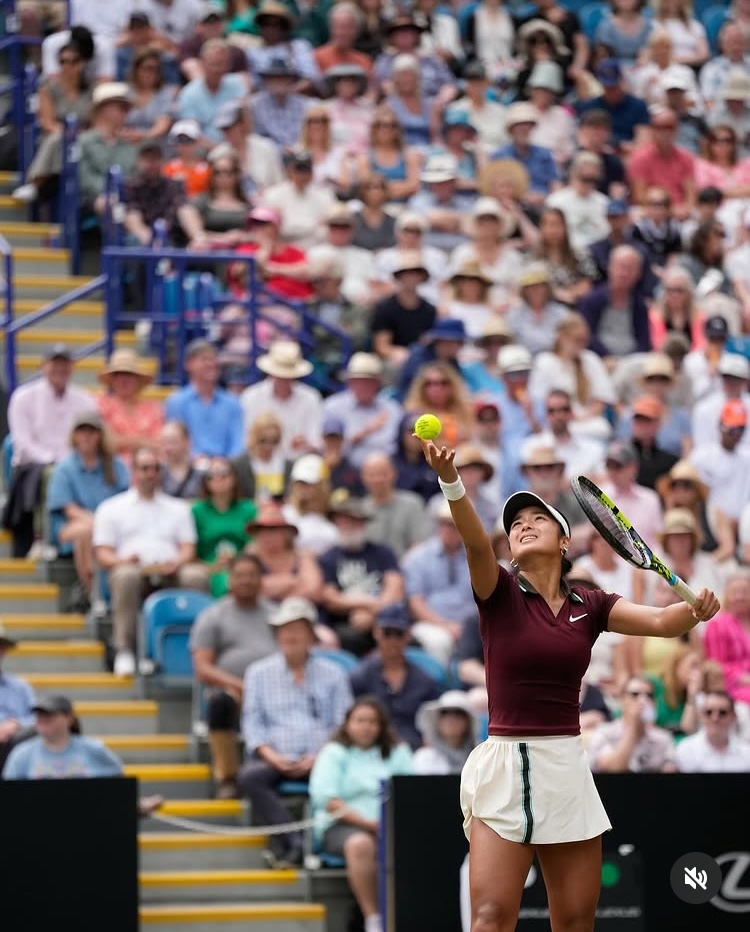
Playing at the Eastbourne competition in the United Kingdom
It’s understandable that in higher-pressure moments, nerves can wreck you. Managing this better will come in time; that’s just tennis. That glorious semi-final you played at the Lexus Eastbourne Open against Varvara Gracheva (7-5, 2-6, 6-3), pulling it together in the end, deftly proves it.
After that match, you broke down in involuntary, infectious tears. “It was such a tough match,” you said. “I didn’t know what to do.” And yet you did know. You pulled yourself out of that second set hole, quelled the uncertainty, and rose above it.
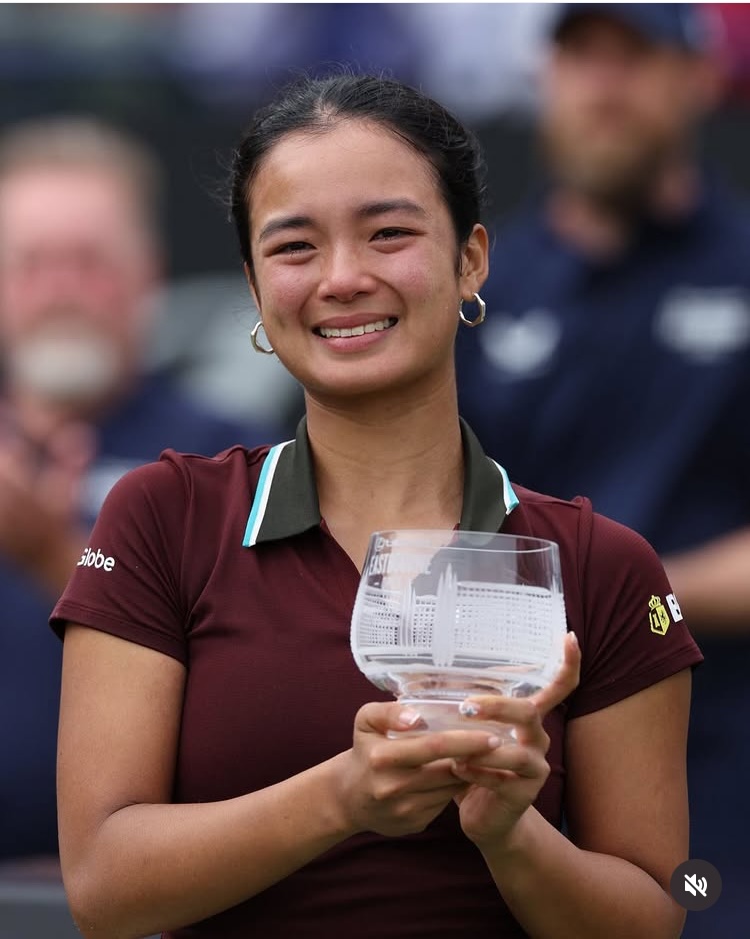
Holding her Women’s Tennis Association (WTA) trophy at Eastbourne
You’ve said work at the academy was so tough, matches are comparatively easy. Now you’re learning that matches are tougher, precisely because the stakes tower so high. More than a handful of nerves may have well gotten the better of you in that Eastbourne final against Maya Joint, which just slipped out of your grasp. You lost it (6-4,1-6, 6-7(10)), unable to convert four match points in that third set tie-break.
Protect your head and heart spaces. You’re polite and accommodating. These are generally traits of our culture, and while it solidifies your already strong appeal and has you winning over the crowd, it’s possible to take it too far.
A measure of niceness is more than sufficient, for so long as it requires no effort or energy on your part. There will be instances when a poker face may serve you better. Always lean into a course of action that requires the least mind and emotional space, especially while you’re on the court. The body obeys the mind and the heart, for the most part. Protect both, and consider the following:
Don’t read any of your press, which includes all media, digital and print (including, and perhaps especially, pieces like this!), during the season, and always skip the comments.
At best, it’s a distraction. At worse, it could go to your head. Naysayers come crawling out of the woodwork, as do trolls, especially in the comments. Safeguard your head and heart space.
Decline all but the required press engagements or interviews.
There is publicity and public relations, of course. But there is power in keeping low-key and under the radar. Being nowhere to be found is an advantage, and will help you on court. Don’t give away parts of yourself for easy pickings, just because it’s asked for or expected.
They will say, “Are you tired?” “What are you eating?” “How do you feel.” And while it may be no big deal usually, there will be times when it might irk you. Protect yourself from it all with a polite refusal.
While you’re young, it is good to learn the word “no” followed by “thank you.” Again, do you, but if it takes effort or doesn’t feel right, say no.
While you’re young, it is good to learn the word ‘no,’ followed by ‘thank you.’ Again, do you, but if it takes effort or doesn’t feel right, say no
Eliminate your presence on social media, at the very least during the tournaments.
Be intentional in all your actions, including and especially online. It’s understandable that you want to de-stress. If you must, limit it to a private account reserved for those near and dear to you. Have someone else manage your public profile.
Finally, we know you will never forget where you’re from… it’s one of the things we loved about you instantly. But, but, but…while you are on court, put the Philippines and the Filipinos out of your head.
This might be the hardest thing of all. Of course, you love your country. You’ve demonstrated a keen awareness of the epic role you play. You’ve recognized how you’re making history “not just for yourself but for your country.”
But you do not need the weight of the Philippines, its 115 million, and the broad diaspora we form across the globe when you are on the court. It is much too heavy a burden for anyone. There’s more than enough pressure without it.
Just play, Alex.
Play because you love it, and would have loved it, regardless of where you were born, where you live, or where you happen to be from. That’s why you picked up a racquet when you were four years old, and never looked back. That’s why you left to study abroad when you were not even a teenager. You love tennis. It’s your destiny.
On your IG account, you said, “…when you’re living your dream, it doesn’t feel real.”
Well, it is real, dear Alex. Playing in the slams—the Australian Open, Roland Garros, Wimbledon, and sooner than you think, the US Open, the site of your first major triumph as junior champion in 2022—may have been a dream once. Wake up, because now, it’s your reality.
As Roger Federer said, “It’s hard work to make it look easy.” You’ve always known that, and the knowledge helped you get here. You will work even harder to achieve more. You have a beautiful career ahead of you and bigger dreams to make real. The Philippines and Filipinos all over the world will be with you every step of the way, no matter what.
You can go as far as you have it in yourself to go. And Alex, that’s ALL. THE. WAY.
All my best wishes, most especially in this coming US Open,
“Tita” Noelle
P.S. One more thing: I hope the hair spray you use between games is non-toxic. Traditional hair sprays are full of carcinogens. I hope you’ve found yourself a non-toxic, chemical-free alternative!


