


The community of the Transfiguration Abbey in Bukidnon led by Fr. Abbot Savio Ma. Siccuan, OSB, Superior of the Transfiguration Abbey wearing an abaca chasuble woven in Kalibo, Aklan

Rose chasuble of handwoven abaca from Kalibo, Aklan, with embroidery by the ‘bordadoras’ of Lumban, Laguna
Thirty-three years ago, one afternoon, I sat down for merienda with designer Gang Gomez at Café Adriatico. Our table right by the window from where we could watch the world go by, when Malate was still the chic epicenter of café society, he agreed to talk, on the record, about his plan to leave fashion design to enter the monastery. It was the talk of the town. This was in 1990.
I remember I was almost tearing up as we parted because I said I would not see him again—not as often, at least—and that I would miss him.
Well, many years later, as the monk Dom Martin Gomez, Gang, it turned out, would still be present in my life. He’d give me updates about what he was doing in the monastery, so that one time, I chided this erstwhile-publicity-shy couturier—”You seemed to keep me updated now more than before, and I thought I’d miss you!”
Dom Martin didn’t really drop out from the lives of family and friends. He was there to visit me, in the hospital, at the bedside of my mother as she lay in coma, and he prayed over her. Such moments of kindness and faith, I will not forget. I also still remember how even at the peak of his fashion design career and even with its cutthroat competition, Dom Martin would tell me that religion was a priority he couldn’t take lightly.
Today, Dom Martin Gomez, OSB, has been with the Benedictine order, with the Transfiguration Abbey in Malaybalay, Bukidnon—for 32 years. He took a medical leave about two years ago, but has been back in the monastery since then.
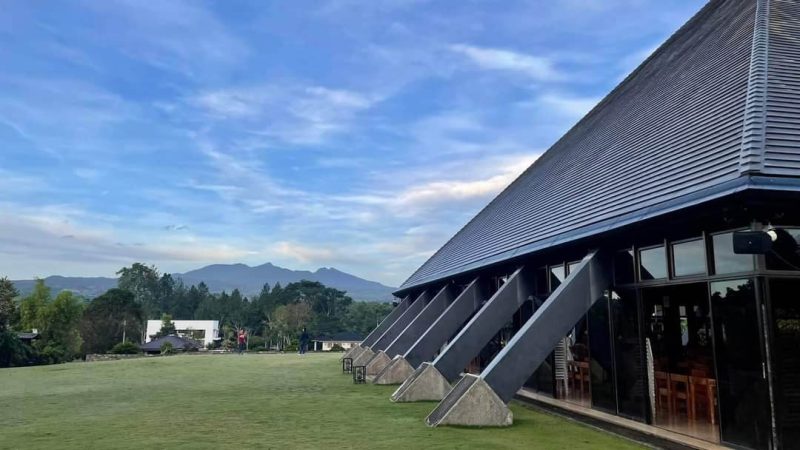
The chapel of the Transfiguration Abbey designed by National Artist Leandro Locsin and in the background, the Museum of Liturgical Vestments, backdropped by the scenic mountains of Bukidnon
Dom Martin has given me anchor in both the temporal or my career, and the spiritual. Temporal—even in his monastic life, as early as 1996, he has been a strong advocate of inculturation of the liturgical vestments, and has devoted two years and a half going around the weaving centers and gathering handloom woven fabrics, from Abra to Ilocos to Mindanao, to meet up with tribal weavers and crafts folk, and the NGOs. He also consulted experts in indigenous materials, such as Jeannie Goulbourn, Barge Ramos, Noli Hans, Margie Macasaet and the Katutubong Pilipino, and the people behind Habi, the group for the preservation of indigenous weaves. This advocacy went beyond aesthetics and design, into the preservation and promotion of indigenous weaves and crafts, and the integration and inculturation of native traditions in the liturgy. He was granted permission by his superiors to research on the indigenous materials for vestments. “I began to ponder why our materials were imported and costly and not suited to our climate.”
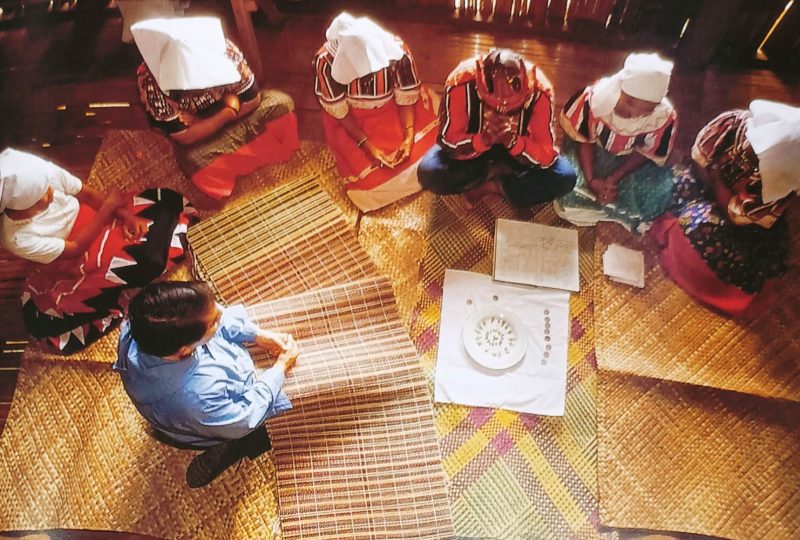
Welcome ritual of the Talaandig in Lantapan
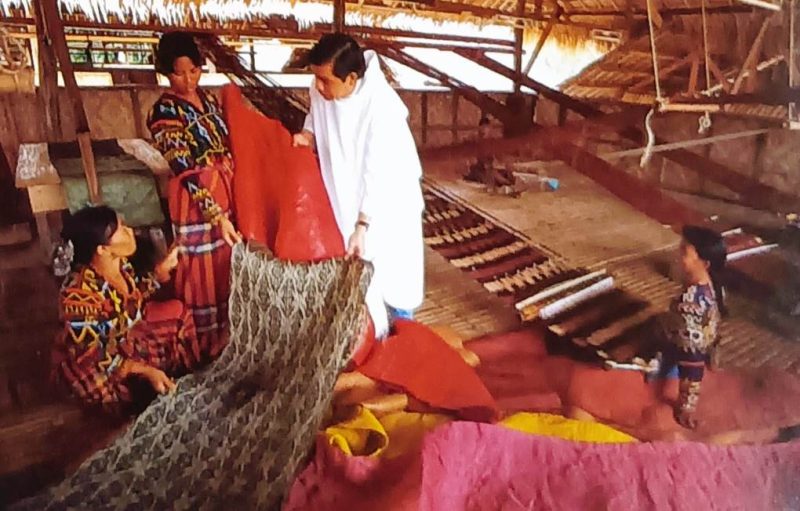
Dom Martin Gomez scrutinizing t’nalak handwoven with T’boli weavers in a T’boli village
‘Inculturation encourages the people to bring their culture into the liturgy of the Church’
He now explains the context of his advocacy: “Inculturation is a movement in the Church right after Vatican II, which stresses the fact that the Church should respect the culture of the people where it finds itself. It encourages the people to bring their culture into the liturgy of the Church. But to do this requires a deep understanding and respect of the culture of the people. For example, in the inculturation of the liturgical vestments, one cannot use an indigenous textile associated with mourning, to make a vestment for a happy celebration.”


Inculturation: Liturgical vestments made of indigenous handloom woven fabrics from various parts of the Philippines featuring embroidery by local crafts folk
In 1998, he mounted an exhibit of liturgical vestments—a collaboration for “inculturation of sacred vestments” made from handloom woven fabrics. In 2017, the exhibit was shown at Ayala Museum. The collection is now in the Museum of Liturgical Vestments in the Monastery of the Transfiguration in Bukidnon,
‘What I have given up some years back, have been given back to me’
When he left fashion design in 1990 or 1991 (he had a period of discernment), people couldn’t believe that he was giving up a thriving career of 20 years, but now, looking back reminds me that God certainly has His ways. Dom Martin tells me, “I am happy and grateful that whatever talent I have as a designer I am now able to use for the glory of God. It is like, what I have given up some years back, have been given back to me. My 20 years in the fashion world were really a preparation for what I’m doing now, only on a higher level.”
This advocacy is rooted, he stresses, in the Benedictine rule of balance, harmony with nature, simplicity. He explains, “This situates my work in the Benedictine artistic tradition….of harnessing whatever is available in the vicinity… . the nobility of labor….”
Dom Martin, even as Gang Gomez the designer, has always had a way of pulling us—his colleagues and friends—back to earth, from the stratosphere of our frenetic lives. He says, “In this time of social media, faith still should remain at the center of our living. When we are always in touch with God, and remember that we were created in the image and likeness of God, we can be assured that we are on the right track.
“Every day I pray that God would increase my faith. There should always be room for growth in the spiritual life. Tomorrow, we will always be a better version of who we are today!
“To truly believe that God loves us and is yearning for all of us to come back to Him every day, is indeed a blessing!”
I’ve always found his story inspiring, and more so in Lent. Every time I glance at the image of Bambino di Aracoeli, which he gave me when he entered the monastery, I think of him. How timely it was that the other week Dom Martin shared his journey of faith with the community of Expanding Circles, via Zoom.

Dom Martin Gomez with an image of the Bambino di Aracoeli
He prefaced his sharing with the reminder that “God could never be outdone in generosity.”
Dom Martin de Jesus Hizon Gomez was born to a prominent Pampango clan, to Domingo and Eloisa (Paras-Hizon) Gomez. At 18, he was a cum laude graduate of AB Philosophy at San Beda, who also wanted to dabble in fashion design. Instead, however, he worked for a masteral degree at UST, also in Philosophy, and taught Moral Philosophy also at UST. At 20, he was granted his wish to study fashion design in New York at Mayer School of Fashion Design, later at Slim’s, and in those years he learned the rudiments of the profession, from sketching to sewing. He represented Mayer in a design competition, which he’d win—he became the first Asian to win the New York Design Foundation Award; this was in 1970.
After winning the award, he went on a retreat in upstate New York, which he now recalls as a “beautiful experience”—after a train ride that gave one a passing view of the ugly graffiti walls, he came upon the late autumn scenery of golden leaves. It started to snow and he got off on the landscape covered with clean white snow. He saw in this as a sign—after the cluttered scenery came a beautiful quiet moment. He was drawn to the experience of the retreat, which to his parents was the warning sign to bring him back to Manila lest they lost him to a religious life. In Manila, he became an assistant to Christian Espiritu, the designer of the ternos of the then First Lady Imelda Marcos. The two-and-a-half-year stint with Christian brought him to the well-heeled fashion clientele, but it also left him drained. He quit and took a long respite from the industry. Then in 1974, he opened his own atelier in Malate, near Remedios Circle.
From 1974 to 1989, the designer Gang Gomez had a thriving career dressing the Who’s Who of society—he was the favorite of doyennes Imelda Cojuangco and Fe Panlilio—and held sway over his peers. He helped found the Filipino Designers Group with good friends Joe Salazar, Rusty Lopez, Auggie Cordero, Inno Sotto, Cesar Gaupo, Lulu Tan-Gan. But more important to him, with Ben Farrales, he was active in and then led the Congregacion Santissimo Nombre del Niño Jesus, which propagated the devotion to the Child Jesus.

Dom Martin Gomez (second from right) with designer colleagues, from left, Mike de la Rosa, Lulu Tan-Gan, Steve de Leon, Loretto, Barge Ramos, Mark Higgins, Oskar Peralta
Eventually, in his late 30s, he looked inward again and talked to his spiritual director—“Why my Lord is calling me to the religious life.” He was asked by his spiritual counsel and family to have some time for discernment, that it could just be a form of “midlife crisis.”
Finally, shortly after 1990, he joined the Transfiguration Abbey in Bukidnon. “It was a new decade, a new life,” he says.
‘God has plans for us. It is our duty to try to search and find out….’
The irony of life is that his monastic life also gave him a venue to exploit his talent and expertise as a designer. “Never underestimate the grace of God,” he says. “What I gave up (in fashion) was given back to me…. I was allowed to design for the Church, to design for the greatest and most important celebration, the Holy Eucharist.”
He adds, “God has plans for us. It is our duty to try to search and find out….to learn to listen…the moments of silence….so we’re in touch with the Lord.”
Life is a constant, deep communication with the Lord. That has been the life of worship, faith and hope of Dom Martin.
I am running here my profile of then designer Gang Gomez, from my book i’m afraid of heights (or why i can’t social-climb’ published in 2012.
1990
Leading fashion designer Gang Gomez is entering the monastery.
This news surprises even a blasé Manila. For the past two weeks, fashion and high society have been a-hum with talk that Gang, one of the country’s most influential and sought-after designers, is abandoning fame and fortune to be a priest. Correction—to be a monk.
Gang Gomez’s world, indeed the world-at-large, is shocked. I’m not.
In more than a decade I’ve known him, Gang has struck me as different from his peers. Different, not weird.
He’s a regular hardworking, ambitious guy who’s not above the press release-syndrome that’s imperative in the highly competitive fashion industry. Yet somehow, he’s led me to suspect that his priorities are different from those of his colleagues.
I’ve often chided him that given his leadership skills, he should now take his rightful turn to be president of the elite Filipino Designers Group. But he’d just laugh at the suggestion, saying he had other commitments, primary of which was the Congregacion Santissimo Nombre del Niño Jesus, the group devoted to propagating the devotion to Child Jesus.
Ten years ago, my first close encounter with Gang was not in fashion, but about “Bambino” –which is how he calls his life-size Sto. Niño. The stories about Bambino regaled me so much. We drove at six one morning all the way to Malolos to watch the Sto. Niño procession that included Bambino. This was long before the Sto. Niño procession became the vogue.
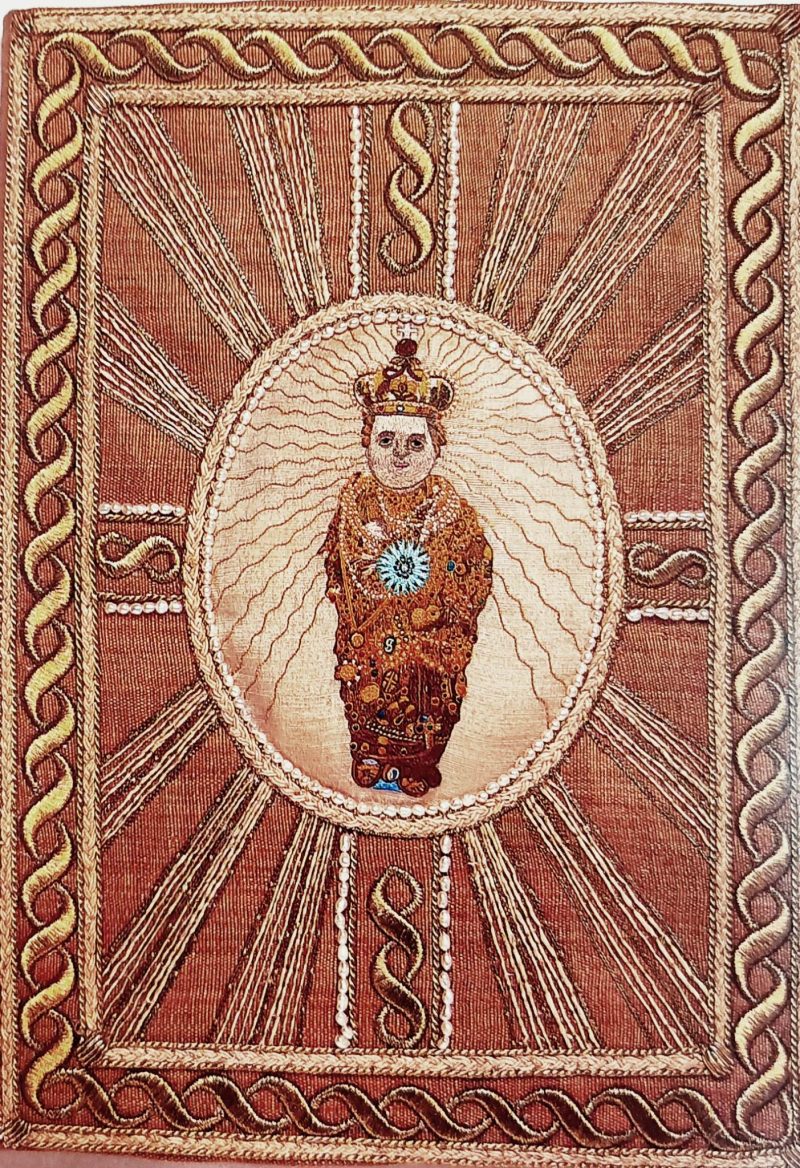
Gospel book cover of the image of Bambino bears the weaving traditions of Luzon, Visayas, Mindanao. The abaca fabric was woven by the Blaan, the center medallion is pina woven in Kalibo, Aklan, the portrait of the Bambino is embroidered needle painting made by the women of Sta. Barbara, Iloilo. The braid around the medallion and the sun rays are made of the fiber used in weaving by the Ifugao.
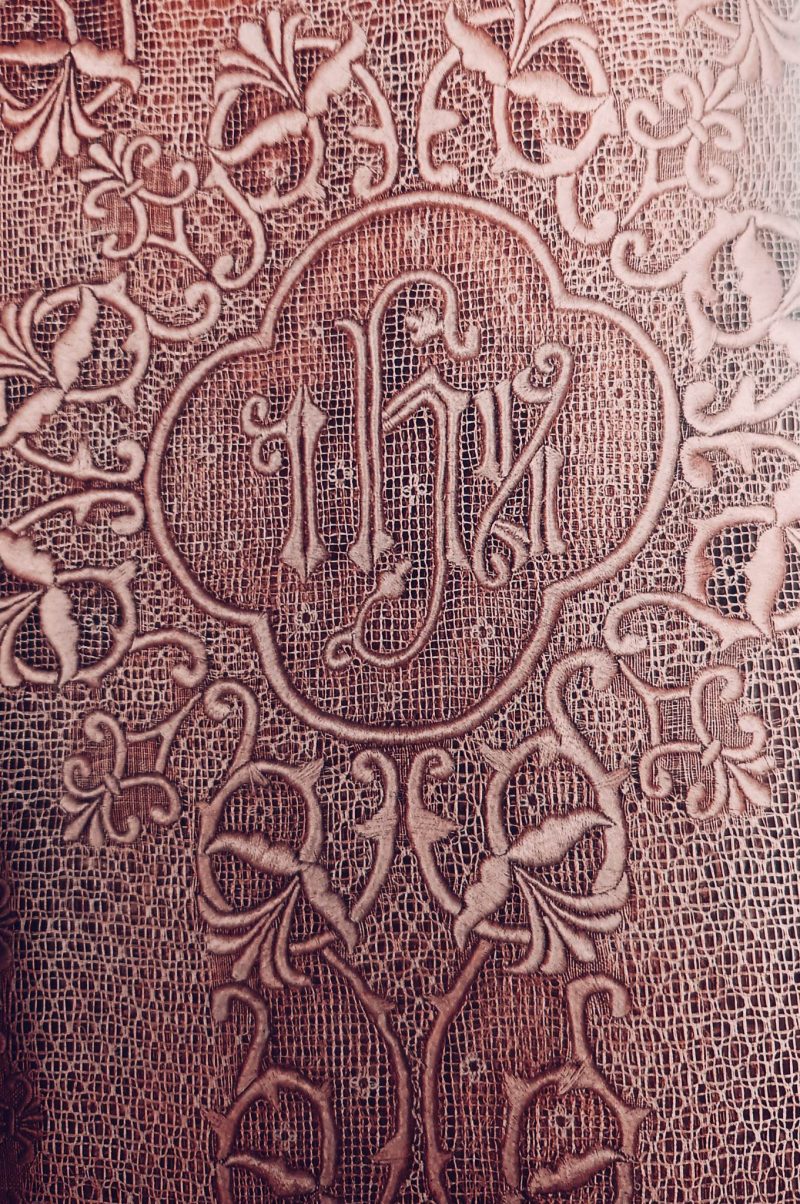
Detail of medallion in handwoven abaca in a chasuble
That early morning procession was quaint and folksy but solemn, not carnival-ish. I enjoyed covering it not so much for its interesting images as for how it showed me Gang up close. I had never seen Gang so assiduous—and happy—preparing for the procession, like he was putting together a collection. From then on, Bambino became our common friend—mine and Gang’s.
Gang and I have shared “Bambino stories” through the years, the latest of which happened two years ago, when Gang, his family and Bambino were held up one evening on the highway bound for San Fernando, Pampanga, Gang’s hometown. A group of men brandishing armalites and calling themselves “NPA” hijacked their van, took them on a terrifying ride, then dumped them on a deserted road and sped away with Bambino’s crown. Gang and his sister had to trek several kilometers to San Fernando, lugging the toddler-size Bambino and a pail of flowers meant for the procession set for the next day.

Dom Martin Gomez with his sister Erlie and brother Erie
The stories come with prayers. Gang saw to that. He gave me, like he must have his other friends, the Bambino stampita. I could recite its prayers every night and improvise on them.
While other designers give clothes as Christmas gifts, Gang gives stampitas, Sto. Niño statues or flowers. But those are externals. Piety is never difficult. Good character is.
Gang, as I said, is different. At lunch, never count on him for entertainment—he’s no good source of gossip. Even in his intrigue-ridden fashion milieu, Gang has yet to sharpen his tongue. He’s thrived in the industry without having to be bitchy.
He’s laidback, conservative in both his behavior and fashion line. His clothes are noted more for their intricate workmanship (the embroidery on his wedding gown makes people gasp in admiration) than flamboyance and trendiness.
Somehow he seems to have a calming effect on his peers. Talking about even as mundane a topic as fabric or embroidery, he’s given to introspection about life. After all, he has undergraduate and graduate degrees in Philosophy—AB Philosophy (cum laude) from San Beda and M.A also in Philosophy at UST.
So, last Monday, I rang up Gang to ask if the rumor was true. Totoo ang tsismis
Now, looking back, I should have known there was indeed something more to this chronic introspection and shifting priorities.
So, last Monday, I rang up Gang to ask if the rumor was true. Totoo ang tsismis.
There’s a muffled chuckle on the other end of the line—“Yes, I’m joining the Benedictine monastery.”
We talk about it—like doing a run-through of the decade just passed— then comes the hard part. I’ll write about it, I say.
“No, I really don’t know if you should. I don’t know how to handle this (publicity) right.” The apprehension in his voice sounds real. “Baka sabihin, papasok na lang ako, nag pa-publicity pa.”
We talk about the monastery in Bukidnon instead. That Monday, he had just come from a month’s stay in Bukidnon, during which he learned that he had been accepted to the postulancy.
“I’m very happy. This is my third homecoming to the Benedictines; the first was in grade school at San Beda, then in college, at San Beda, then now. I feel like I’m finally coming home.”
That moment, I realize fashion has indeed lost its Gang Gomez, and I will not see Gang in a long, long time.
But for today, Tuesday, we’re together at merienda at Café Adriatico. We’re chattering away again, but this time, it’s all on the record. He’s given in.
Gang has turned 41. “Forty one, Yes we’re getting old,” he laughs.
The decision to join the contemplative life was not sudden. When he turned 40 last year, he sat back, he says, “to see where life’s going.” But then, Gang always sits down to see where life’s going, so we thought his turning 4-0 was no big deal.
“I’m not one of those professionals who forget about spiritual life and then one day wake up. It’s not a jolt with me. I’ve been thinking, thinking all this time.”
Gang says that in his case, one can’t speak of a dilemma between the material and spiritual worlds. “Tug of war? It’s a very quiet one, if you can call it that. In the middle of the night, I’d wake up and feel there was something I had to attend to. It came to a point when I’d be thinking of it (joining the religious order) the whole day in my shop and couldn’t concentrate on the clothes.
“I feel it’s an obligation I have to attend to now.”
Gang has been seriously considering the monastic life for a year now. Last year, he wrote various religious orders to inquire about their programs. Then last February he zeroed in on the Monastery of the Transfiguration of the Order of Saint Benedict, in Bukidnon.

Museum of Liturgical Vestments in the Transfiguration Monastery in Bukidnon
“I just inquired, I didn’t apply. But, in their letter, they said the age limit was 35. I was clearly overaged.”
That didn’t discourage him. He wanted the religious life. In the three-day retreats the Congregacion would hold regularly, Gang would experience what he calls a “high”.
Early this year, he wrote the Order to ask if he could stay as guest in the Bukidnon monastery. (Guest and observers are allowed.) It was set for May.
Four days before his departure for Bukidnon in May, he received a letter from the Order reiterating the age limit; in effect, it was a rejection of his apparent intention to apply.
“But I had made up my mind. I wanted to go, if not as applicant, then as guest.”
So for two weeks last May he lived at the Monastery of Transfiguration in Bukidnon. It is a 42-ha. property developed early in the ‘80s by the highly-regarded Benedictine monk, Abbot Eduardo Africa. Its 20 ha. planted to corn, coffee and vegetables, the property is where the religious order lives a contemplative life as envisioned by Saint Benedict, and does manual labor.
‘But there was a deal. The director told me to go back to my career’
In his two weeks there, Gang wasn’t a mere observer or guest—he worked on the farm and prayed with the monks. “Before I left the Monastery, I begged the vocation director to let me come back and meet Father Abbot. (Africa was then in the US on a medical treatment.) I told him I need a lot of charity from you,’ He agreed.
“But there was a deal. The director told me to go back to my career.”
During his stay in Bukidnon, Gang had to close his shop. “I knew that was the great test, because May is the peak month of weddings. I wanted to see if I could give that up.”
Indeed one of the country’s most sought-after designers gave up something. Manila’s biggest wedding of the year, set for July—the Xander Tantoco-Mons Romulo nuptial—was offered to him first. He turned it down—a decision that left him sad because the groom’s mother Justa is his good friend.
The vocation director told him, “Enough of these so-called sacrifices. Lead a normal life. Go back to your friends and write me a month later.”
But, as early as then, Gang already knew he’d be closing shop. Before leaving Bukidnon, he told the guest master he’d surely be back by July. That June, Gang stopped accepting orders from clients.
On July 7, the rejected applicant was back in Bukidnon. He was dead set to live there for the time allowed – a month.
“I was busy.” Gang describes his Bukidnon stay and waves away my startled look.
“At 3:30 a.m. we wake up.”
“But,” I interrupt, “that’s just about the time we’re coming home from Café Adriatico?” He ignores my reminder of contemporary life.
“At 3:40, we say our prayer. This is one of the most beautiful feelings. While the world is asleep you’re awake to praise the Lord. As you walk to the chapel, you pass by the plants, feel the fresh air, see the fireflies. Everything is quiet. The communication line to God is never clearer. We meditate.
“Then at 5 a.m. the Lauds, then the Mass. At 6:25, the third party they call the terce. You beseech the Holy Spirit to guide you during the day. At 6:40 a.m., breakfast.”
“At 7 to 7:30, we have time to change to working clothes. Then we work on the farm. That time there were 10,000 coffee trees to prune, of course not in a week naman. At 11, we climb back to the monastery to change and shower for the next prayer.
“At 11:24 comes the sext.” He spells it for me, just to be sure. “Sext is the noon prayers. Then lunch. At 1 p.m. siesta. From 2:30 to 5 pm, you can do the lighter work, finish pending chores. I spent my time observing. Dom Benito, the old monk who’s the tailor. He was sewing a new habit for a new monk. The machine was so old, walang motor.”
“Then at 5 p.m. the vespers, Before 6, we have dinner. After dinner is the recreation, the social hour when you can chat. Before 7 is the compline, the evening prayer.”
He gasps. “This is the most solemn and touching for me. Sing the psalms, most of them composed by Father Maramba (the renowned Benedictine musician). It’s a direct hit. It gets you here.” He points to his heart. “You pray and entrust everything to the Lord. Then from 7:45 p.m. to 7 a.m. is the great silence.”
Listening to Gang describe his experience in the monastery, I know he has found his world. I don’t tell him but I’m convinced he’s—very—happy.
“All that time,” he recalls, “I was gathering the courage to ask the Abbot if I could be accepted. I was afraid to be turned down again. But when I was finally granted an interview with Father Abbot, I told him my feeling—I feel I’ve just come home here. Then he told me and I couldn’t believe it—I’m very happy to tell you we’re accepting you. I was so happy I cried.”
That was in the first week of August. By August 8, Gang was back in Manila to break the good news to his incredulous friends.
Gang will be back as postulant in the monastery in January. He has given himself until September to wind up his fashion commitments. November and December, he’ll spend with his parents in Pampanga. “I want to devote time to them before I leave.
Gang comes from a well-to-do family, the second in a brood of four.
His postulancy will take a year, then he’ll spend two years in the novitiate and another three studying theology in Cagayan. It’ll take six years before Gang can finally be a part of the Monastery of the Transfiguration.
Why the decision?
“That’s the hardest question.” He pauses. “I was never attracted to diocesan priesthood. I want a very simple life and that is the contemplative life.
‘…. You’re applauded after the show. It’s all for the self, then comes a point when you ask, is this really making me happy?’
“In our (fashion) world, kailangan istariray ka. You’re applauded after the show. It’s all for the self, then comes a point when you ask, is this really making me happy?
“Last year at the FDG (Filipino Designers Group) show, everything was a success – the reviews, everything. Then I asked myself, can I imagine myself old and still doing this?
“When I was a kid, all I wanted was to be successful designer. Now I am that. But there must be something other than the material. My mother would always say, ‘You never keep your clippings (articles on him) in an album. Now, as I look back, I realize perhaps I never did because, in the end, those things will never really be important to me.”
This was not the first time Gang was drawn to religious life. When he was barely 25, after studying fashion at the Mayers School in New York, he spent a weekend in upstate New York in a monastery to see what it was like.
“But I was too young then. It wouldn’t have lasted.”
Isn’t it hard to give up everything?
“Years ago, my driver broke my antique verina. I was so mad. At night, I was still upset and sat up wondering. It’s only a verina. The Lord gives us bits and pieces every day but we don’t have time for the little blessings.
“And then again, I realize you can be so dedicated to your work, you become a slave to it. The monastery is the only place in the world where one can take a step backward, to simple things, and in that step, you give way to God.”
Gang is excited as he wraps up his work. He can hardly wait for January.
“Now I have a good family, a good career,” he says. But he wants something else.
We fall silent. It’s time for me to go back to the office. I forget to tell him something—we’ll miss you, Gang.


