
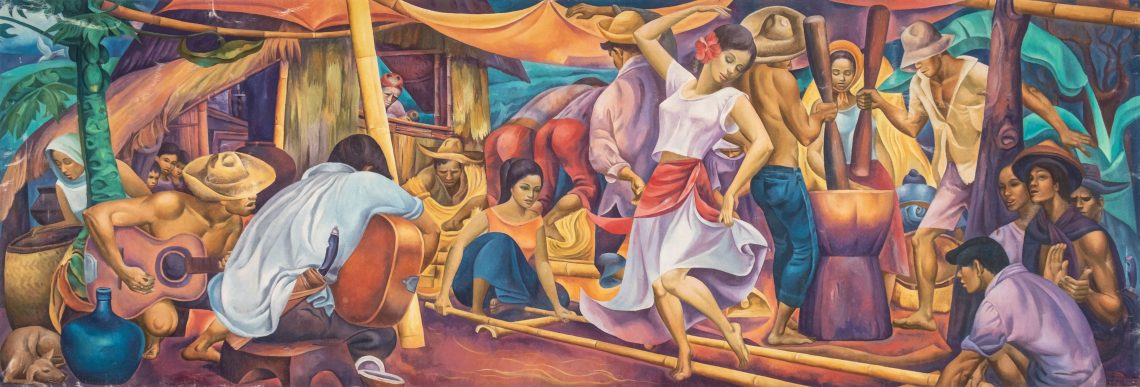
(Carlos “Botong” Francisco’s “Tinikling No. 2” ca.1964 from the collection of Estefania Aldaba Lim, is among the highlights of Leon Gallery’s Kingly Treasures Auction 2024 set for Nov. 30, 2024 at Leon Gallery. It will include lots for the benefit of the International School Manila Filipino Scholars Program.)
There are far too many ‘firsts’ begun by Estafania “Fanny” Aldaba Lim, a woman who was no stranger to challenges from a very early age. Born into the conservative Aldaba family of Malolos, Bulacan, (her father was Provincial Treasurer), she nevertheless defied convention and expectations and appealed to her family to allow her to study in Manila. There, she became an over-achiever, graduating with degrees in Liberal Arts, then in Education, before World War II at the Philippine Women’s University.
It was, however, only after she discovered Psychology and earned a Master’s Degree in it at the University of the Philippines, that she discovered her true calling and life’s work.
Fanny would follow her dream to the United States, where she would reach the first of many achievements, at the University of Michigan as the Philippines’ first female PHD in clinical psychology.
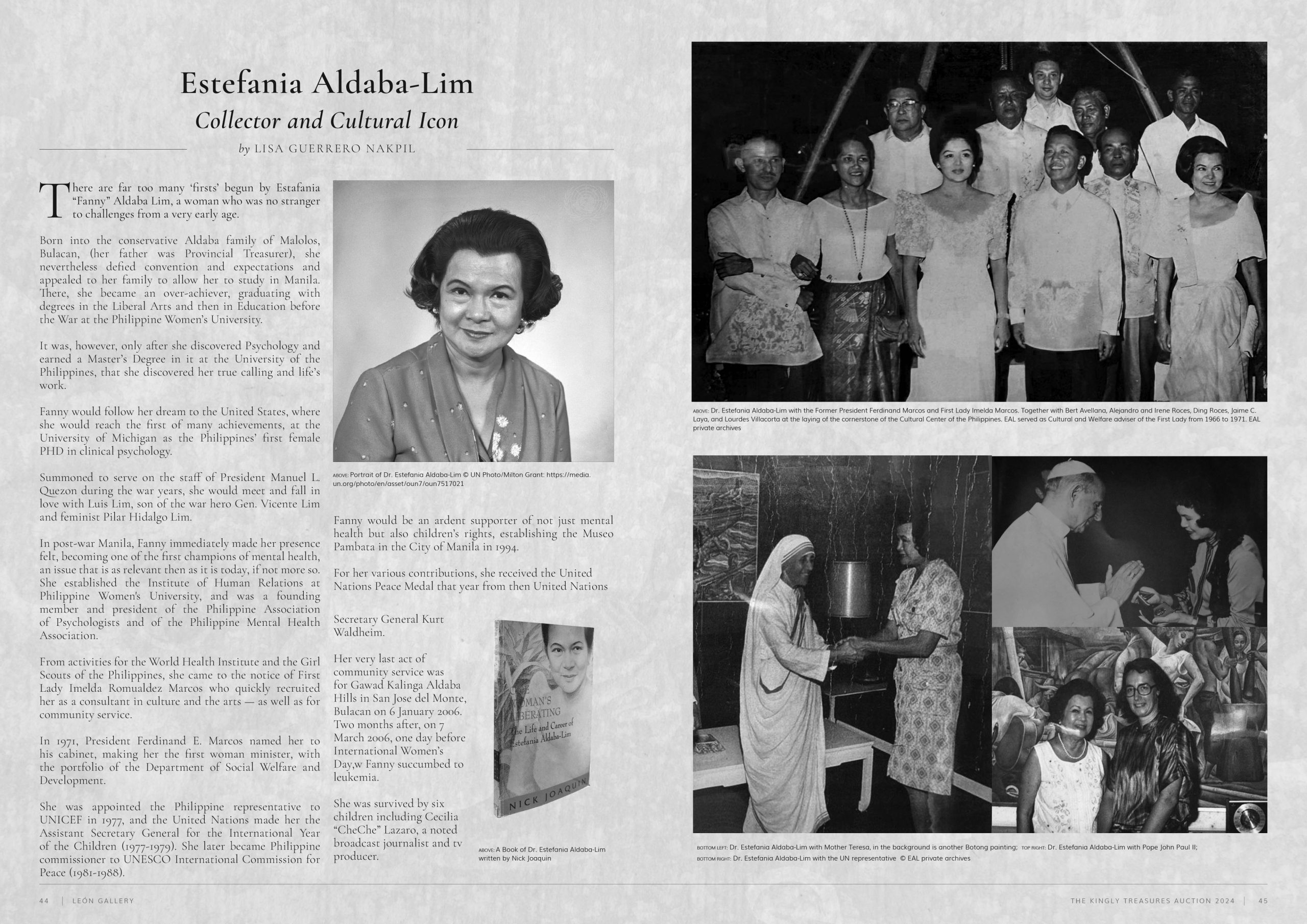
A page in the catalogue of ‘Kingly Treasures Auction 2024’
Summoned to serve in the staff of President Manuel L. Quezon during the war years, she would meet and fall in love with Luis Lim, son of the war hero Gen. Vicente Lim and feminist Pilar Hidalgo Lim.
In post-war Manila, Fanny immediately made her presence felt, becoming one of the first champions of mental health, an issue that was as relevant then as it is today, if not more so. She established the Institute of Human Relations at Philippine Women’s University, and was a founding member and president of the Philippine Association of Psychologists and of the Philippine Mental Health Association.

Estefania Aldaba Lim (seated, right) with her family
From activities for the World Health Institute and the Girl Scouts of the Philippines, she came to the notice of First Lady Imelda Romualdez Marcos who quickly recruited her as a consultant in culture and the arts—as well as for community service.
In 1971, President Ferdinand E. Marcos named her to his cabinet, making her the first woman minister, with the portfolio of the Department of Social Welfare and Development.
She was appointed the Philippine representative to UNICEF in 1977, and the United Nations made her the Assistant Secretary General for the International Year of the Children (1977-1979). She later became Philippine commissioner to UNESCO International Commission for Peace (1981-1988).
Fanny would be an ardent supporter of not just mental health but also children’s rights, establishing the Museo Pambata in the City of Manila in 1994.
For her various contributions, she received the United Nations Peace Medal that year from then United Nations Secretary General Kurt Waldheim.
Her very last act of community service was for Gawad Kalinga Aldaba Hills in San Jose del Monte, Bulacan, on 6 January 2006. Two months after, on 7 March 2006, one day before International Women’s Day, Fanny succumbed to leukemia.
She was survived by six children, including Cecilia “CheChe” Lazaro, a noted broadcast journalist and TV producer.
Remembering Tita Fanny and the world of Botong Francisco
by GASPAR A. VIBAL
After Botong’s untimely death in 1969, there were very few Botongs left in private hands, mostly with personal friends or benefactors of the muralist. Due to his preference for large-scale work, most were done for institutions. From the 1970s, Susano “Jun” Gonzales became the go-to specialist in restoring these larger-scale paintings. Gonzales began as a fine artist, but decided to specialize in painting restoration after his studies in Europe. During his prime, he was considered the go-to expert in saving artworks in precarious state. His leading advocate was Dr. Eleuterio “Teyet” Pascual, himself a chemist and a promoter of conservation studies. From his studies of Botong’s underpaintings, canvases, and sketches, Jun became intimately connected with the master’s work.
On the field surveys of privately owned works by the art restorer Gonzales, only a few were found, mainly in the residences of prominent or influential women. There was the enormous and impressive mural of President Ferdinand Marcos Sr., which First Lady Imelda Marcos specially commissioned for the family’s ancestral home. There was a very rare sgraffito mural in Sen. Helen Benitez’s residence. The political activist and feminist Charito Planas proudly had three (!) privately commissioned murals (The Code of Kalantiao, The Legend of Maria Makiling, and the lovely prototype of Pista sa Bayan, which Gonzales had assured me as being the sole work of the master). Charito had acquired them through her sister, the more famous Carmen, affectionately called Mameng, the onetime adversary of Manuel Quezon and a city councilor of Manila, whose art teacher was none other than Botong himself. Then, there were important paintings given by the National Artist himselfr and/or purchased by Dr. Solita Camara Besa, an internationally recognized biochemist who had befriended the muralist.
Of the prominent women who had collected Botong, there was the equally famous Estefania Aldaba-Lim, whom my mother worshipped. She was not only glamorous but also noteworthy for her mile-long accomplishments. Even before she distinguished herself as the first female Cabinet secretary, she had already become renowned for being the first Filipina PhD in clinical psychology, a recognized researcher and authority on children’s mental health, and an advocate for women and children in the public sphere.
Encouraged by her numerous fans, supporters, and friends, she eventually left the Philippine government. She was called to the international stage as an assistant secretary-general of the United Nations and co-convener of the International Year of the Child in 1979. She became known for her practical, no-nonsense approach to addressing children’s welfare on a global scale. Instead of wasting money on highly politicized and expensive international conferences, she advocated establishing national commissions in each country to address child poverty, lack of education, and malnutrition. For her worldwide advocacies, she was given the United Nations’ Peace Medal. In later years, she could have just sat on her laurels, but instead she focused her last efforts on establishing the Museo Pambata with her daughter, Nina Lim-Yuson. Elegantly coiffed and equally sociable, she had a straightforward demeanor, simply introducing herself as Fanny, while downplaying her enormous contributions to the country and the world.
Mr. Gaspar “Gus” A. Vibal is the publisher of the all-important, authoritative reference monograph on Carlos “Botong” V. Francisco titled ‘The Life and Art of Botong Francisco’ (2010)
Botong: The poet of Angono
by LISA GUERRERO NAKPIL
Manila in the Fifties was, quite simply, another time and another place. Glittering, glamorous, Manila was part Vegas, part L.A. Confidential, peopled by hardy entrepreneurs, some say, even buccaneers, who had walked through the flames of World War II and triumphed.

Carlos ‘Botong’ Francisco
The country was bursting with optimism as well as a steadfast Filipino pride. The future was there for the taking. Men were making matches made in heaven with Miss Universe, couturiers like Ramon Valera and Salvacion “Slim” Lim were confecting visions fit for the Paris runways, and a revolving door of celebrities from Tyrone Power, Gregory Peck (think Roman Holiday!), Orson Welles, to William Randolph Hearst and the Duke and Duchess of Windsor populated the Manila society pages, while the local business aristocracy would routinely make it to Time Magazine. Sleek skyscrapers, housing nightclubs, theaters, as well as bustling multinational offices, jostled side by side to fill the skyline.

Estefania Aldaba Lim (center) with her children, including Cheche Lazaro (to her left) and Nina Lim-Yuson (front)
On this stage walked titans—who, for that time and place filled with the extraordinary—were not so different from everyone else. Carlos “Botong” V. Francisco began his career as an illustrator for empires that sold millions of copies a day. He also designed movie sets and costumes for the elaborate epics directed by Manuel Conde (our very own equivalent to Daryl Zanuck). Botong shot to fame for his murals—the most famous landing him a two-page spread in 1953 in Newsweek for the Philippine Pavilion at the New York World’s Fair. He was moving from triumph to triumph, and had become the country’s very own Diego Rivera. He was painting up a storm, creating masterpieces for City Hall, the Philippine General Hospital, as well as dozens of exuberant commissions for the spanking-new Manila cityscape.
Dubbed the “Poet of Angono,” for the sleepy, lakeside fishing town which soon attracted a bevy of other artistic leading lights, including Manansala, Botong soon became most famous for his creation of a Filipino iconography—landscapes inhabited on one hand, by a pantheon of heroes from Bonifacio and Rizal— to their everyman equivalents in rice fields, mountain terraces. as well as lowland rituals. His works were all painstaking researched. Botong kept a scrapbook where he detailed the lore and legends of Angono; and according to his last apprentice, Salvador “Badong” Juban, he also studiously collected artifacts from the various Filipino tribes and never began a work without first immersing himself in research.
Botong was the chief architect of the vision of the proud Malay, unsubjugated by any colonial power.
The tapestry of Filipino life
by LISA GUERRERO NAKPIL
Botong Francisco was the master of rendering men and their lives larger than either of them, of elevating the commonplace to the spectacular, and in the process, of creating myths and legends.
And he did this with the boldest of concepts — by focusing on the minutiae, the beloved, precise but often overlooked details that make the lives of the Filipino everyman, uniquely and particularly his own.
In Tinikling No. 2, he records the end of the harvest as a twofaced Janus : On one hand, filled with the jubilation of dance and song but also another cycle of hardwork and discipline.
The original owner of this work, the wonder-woman Estafania Aldaba Lim, is recorded by Nick Joaquin to have fallen in love with ballet when she watched a cinematic version of Swan Lake in a Malolos moviehouse as a girl. It’s not surprising that this work that has the Filipino ‘tinikling’ (that must be danced with both grace and skill while hopping between two bamboo poles) would capture her attention. The lead character sways to the sound of an imaginary tune a flower in her hair. It is a theme that Botong would return to, time and again. (‘Tinkling No. 1’, otherwise known as ‘Harvest Festival’ now a lost work, was last seen in the collection of Malacañan Palace, and is dated 1962.)
Like that first Tinikling, the harvest ends with the grinding of the grain: two men put their backs to an unseen stone in the background. To the right, are a pair of men and a woman, pounding the rice. with long pestles in a shared mortar called ‘lusong’. Two women on either side of the work wield bilaos (circular flat baskets) to separate the chaff from the lifegiving grain. Another man seems to be gathering sheaves.
Surrounding this beehive of activity is the community of Angono brethren: a man strumming a guitar, three others gape entranced, drinking in the flow of life. There are three boys as well as the town elder or shaman or apothecary ‘hilot’ who peers out of a window. (Botong typically portrayed this wizened figure in his paintings, and one suspects this character was a kind of alter-ego for the artist.) There are other figures that enrich this tapestry, peering here and there from the nooks and crannies of the work, another distinctive Botong conceit. The papaya and banana trees endemic to every small town in the Philippines book-end the piece, as do a glass jeroboam and a sleeping dog, a sheathed balisong and a gnarled tree trunk.
Interestingly, Botong has included a vignette of what appears to be an artist’s home that we can glimpse through an open window: a candlestick on a dresser, and two paintings. it is, with this singular act of inviting the viewer into his home, Botong has allowed us to enter into his world, through the Kaleidescope of Filipino Life.
All the above articles reprinted from the Leon Gallery catalogue, The Kingly Treasures Auction 2024


