
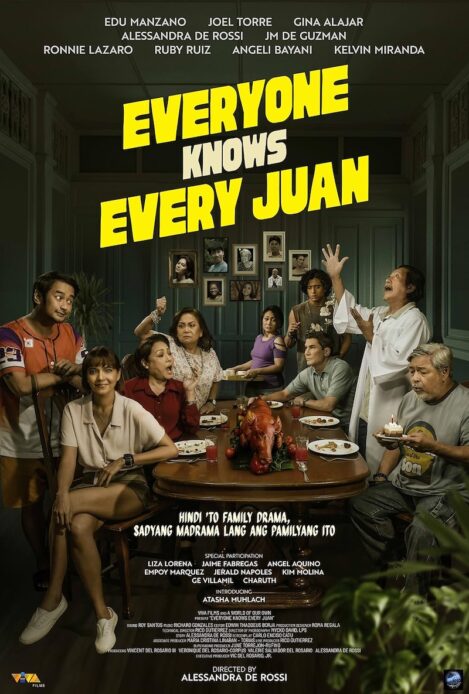
Alessandra De Rossi has done it again. She’s directed another movie she stars in, an admirable accomplishment and a rare feat for a Filipina actress.
The movie’s called Everyone Knows Every Juan (Netflix). A satire on sibling relationships and sibling rivalry, it’s about three brothers and three sisters, all of a certain age. Somewhat estranged from each other, they reunite for the first death anniversary of their mother. Venue of the reunion is the old house they grew up in. Now occupied by the youngest sister (De Rossi) and her boyfriend (JM de Guzman), the home is in a provincial town.
The sister played by Da Rossi appears to be the most level-headed. The older siblings comprise a motley group. Eldest brother is a celebrity plastic surgeon (Edu Manzano). He’s undergone more procedures for himself than most of his patients. The two other brothers, played by Ronnie Lazaro and Joel Torre, are struggling. Lazaro is a construction worker but has church pastor aspirations. Joel Torre is a failed musician drowning his sorrows in pale pilsen. Their sister played by Gina Alajar is running for town councilor, but a sex video starring herself and her brother-in-law could ruin her chances. Ruby Ruiz is a financially strapped single mother. She abandoned her family to live with another woman.
During the reunion, it’s learned that the late matriarch had left an unofficial will written on a piece of paper. To their shock, she has bequeathed the house to the young gardener, played by Kelvin Miranda. Unresolved issues and resentment among the siblings also start coming out in the open, adding to the turmoil. Skeletons are revealed, personal predicaments professed. It turns out they need each other more than they care to admit.
Alessandra De Rossi’s track record as filmmaker is the envy of movie directors who dream of the Netflix glory she basks in. She’s a capable storyteller. Innovative filmmaking techniques such as the continuous take format are used, though a second take was needed to film the evening scenes. The lighting is uneven, but De Rossi deserves credit for trying something new and challenging.
Yet instead of enhancing the story, the continuous take process attracts attention to itself, especially since the camera moves around the old house with such lightning speed. Whatever impact the story might have had is further diluted. Style triumphs over substance because nothing the director does can erase the fact that Everyone Knows Every Juan is weak satire. It’s cute at best, but seldom funny, and contrives to make a social statement.
Several movies about bickering siblings have been made. Soxie Topacio’s Ded Na si Lolo is the gold standard. It’s not a masterpiece, but it remains focused on the subject, and it’s hilariously entertaining. Coincidentally, it also starred Gina Alajar as the level-headed sister.
Alajar has her work cut out for her as she tries to breathe life into the Looney Tunes character she plays in Everyone Knows Every Juan. Like her co-stars, she plays it broadly and overcompensates. They mug, and it’s obvious they’re in on the joke; nothing feels spontaneous. Ruby Ruiz is supposed to be funny when she delivers the expletives with a vigor matched only by battling motorbike riders on a road rage incident. Even the extras are too theatrical and are obvious products of the legitimate stage.
The cast plays it broadly and overcompensates. They mug, and it’s obvious they’re in on the joke; nothing feels spontaneous
By contrast, De Rossi underplays to the point that she seems to have been drugged or hypnotized. Yes, she’s supposed to be the serene one, but making use of a simple prop such as a cigarette or mirror could add layers to the woman she plays and more zest to the deadpan, zombie-like persona. Actors are tasked to persuade viewers to believe in the person they’re playing, and to earn empathy.
Unfortunately, De Rossi’s film doesn’t give the cast a chance to win us over. The family in the movie is simply vile. It doesn’t help that the script lacks the clever dialogue, sarcasm, and dry and subtle humor that could deliver laughs through nuanced acting. Of the cast, Ed Manzano comes off best. He doesn’t strive too hard to be funny. He merely lets an outrageous situation play itself out.
Many of our filmmakers and playwrights go overboard when it comes to satires. They throw in every social issue there is. In this movie, however, the mother’s surprise will is the main point of contention. This gets lost in the crowd because so much happens in the movie. Yet even that point is pointless. The piece of paper wasn’t notarized. Why they didn’t burn it and pretend it never existed, we’ll never know.
The movie’s narrator is also drowned out in the mayhem. The late mother, voiced by Liza Lorena, narrates the story. She opens the movie and welcomes us to her home, but what she says is hardly intriguing. It just isn’t enough to make us curious. At one point we forget there’s a narrator. It’s a lost opportunity. Being the mother, she could have provided a witty and more detailed description of her children, and made a few catty comments about them.
The best thing about the movie is it doesn’t need a cast of young flavors of the month for box office appeal. It’s a showcase for older, seasoned thespians, not stars for every season. The film definitely needed their expertise, and they did try their best. Surprisingly, younger cast members like Kelvin Miranda wisely avoid an image-making star turn. How could he, when most of his scenes are shared with the bombastic Joel Torre, who often plays to the very last row—or in my case, to the birds in the trees outside my window?
Everyone Knows Every Juan might play better on a theater stage. A change in the title would be in order, though. Choose something that doesn’t sound like a slogan for a budget airline. Then again, we’d be missing the lovely house they used for filming. It’s located in Mexico, Pampanga, and I can see myself living in it—unless the neighbors are of the all-day, all-night videoke party variety.


