

This Saturday, September 14, Salcedo Auctions The Well-Appointed Life offers collectors an exceptional opportunity to acquire rare pieces of Philippine indigenous heritage.
At the forefront of this extraordinary collection is an extremely rare 19th-century hagabi, the oldest surviving ceremonial Ifugao prestige bench to ever come to auction in the country, which stands as a powerful symbol of the region’s cultural and communal practices. Alongside this significant artifact, the auction will also feature an array of indigenous treasures, including the Kulaman limestone burial jars, intricately carved bulul, and ritual items that offer profound insights into the artistry and traditions of various Philippine communities.
The hagabi is more than just a bench; it is a revered artifact deeply embedded in the social fabric of Ifugao culture. Traditionally crafted from a massive narra tree chosen by the community, the hagabi is created in a communal effort, marked by elaborate ceremonies. After being carved in the forest, the bench is transported to the village amid feasts and rituals, symbolizing kinship and the prosperity of the family that commissioned its making, having attained kadangyan (literally, “wealthy”) status. The hagabi featured in this auction, with its naturally weathered surface and thoughtful repairs, reflects its long history of use and the significance it held in Ifugao society.
The late playwright Floy Quintos, one of the country’s leading specialists in indigenous art, having curated numerous exhibitions, most notably at the Musée de Quai Branly in Paris, recognized the importance of this hagabi early in his career; he had in fact brokered the sale of this very same prestige bench to the current owner in the 1980s, making it a treasured find for the most seasoned collectors.
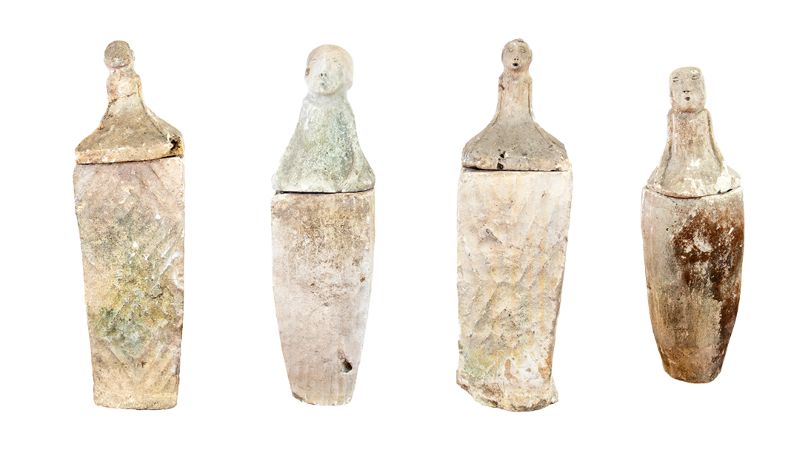
‘Kulaman,’ early Manobo secondary burial jars from the 8th to 9th centuries, each estimated at P80,000 to P100,000
The sale also highlights other extraordinary artifacts that together weave a rich tapestry of the Philippines’ cultural heritage. Among these are the Kulaman limestone burial jars, remarkable relics carved by the Dulangan Manobo people of Southern Mindanao between the 6th and 11th centuries. These jars, used for secondary burials, are distinguished by their intricate lids adorned with anthropomorphic figures and geometric patterns. As the only known movable limestone ossuaries in a region otherwise dominated by clay burial jars, they represent a unique aspect of ancient Southeast Asian culture.
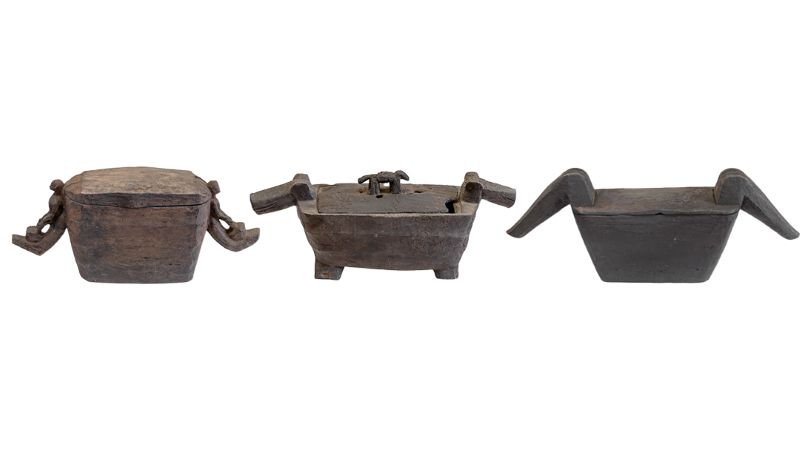
(From left) A very unusual ‘punamhan’ with anthropomorphic handles (9 1/2 x 24 x 7 1/2 in), estimated at P200,000–P240,000; a ‘punamhan’ with zoomorphic heads and a lid featuring a dog or pig decoration (9 x 23 1/2 x 7 1/2 in), estimated at P100,000–P120,000; and a ‘punamhan’ with zoomorphic heads encrusted with blood patina (9 3/4 x 27 x 5 3/4 in), estimated at P60,000–P70,000
Complementing the hagabi and burial jars are the punamhan, wooden ritual boxes used by the Ifugao for storing objects related to rice field rituals. These boxes, often coated with a distinctive blood patina from sacrificial ceremonies, reflect the spiritual practices tied to agriculture in Ifugao culture. Each box, carved with care and consecrated through ritual, played a crucial role in the community’s harvest celebrations.
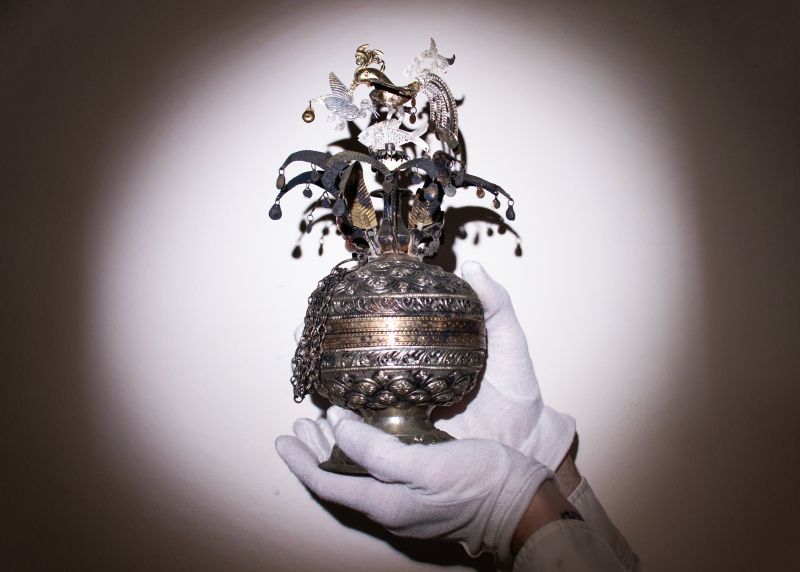
An embossed silver and gold tobacco holder (11 x 4 3/4 x 4 3/4 in), estimated at P180,000–P240,000
The auction also features an exquisite embossed silver and gold betel leaves container, a symbol of hospitality that holds ingredients for betel chewing—a practice with roots tracing back over 2,000 years. This container embodies the elegance and ceremonial importance of betel chewing in Southeast Asia, where it was a widespread social custom.
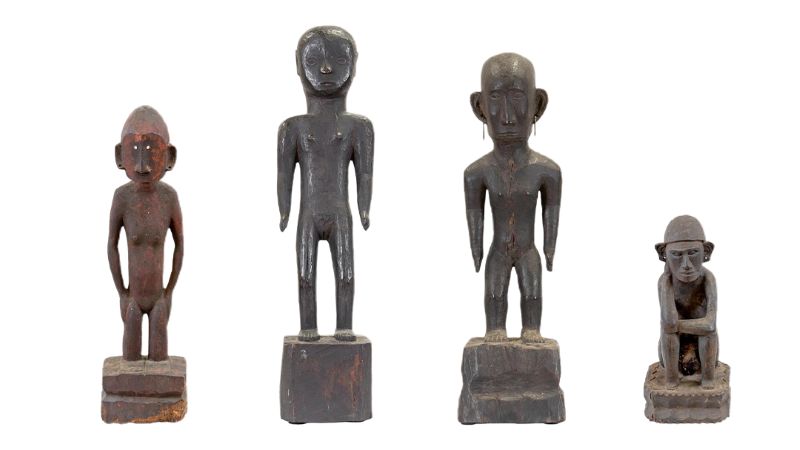
(From left) An important standing male ‘bulul’ with scarifications (19 1/4 x 5 x 4 in), estimated at P300,000–P400,000; a finely carved standing infant-like ‘bulul’ (25 1/2 x 6 1/4 x 6 in), estimated at P240,000–P300,000; a Tagiling-style standing figure,(23 x 6 x 5 in), estimated at P240,000–P300,000; and a seated Tagiling ‘bulul ‘with tattoo (13 1/4 x 5 1/2 x 5 in), estimated at P220,000–P260,000
Four significant bulul, or wooden ancestral figures, further enrich the auction’s offerings. Each bulul, with its unique characteristics and historical importance, serves as a guardian of rice granaries and a protector against evil spirits in Ifugao tradition. From the naturalistic standing infant-like bulul to the intricately tattooed seated Tagiling bulul, these figures showcase the artistry and spiritual beliefs of the Ifugao people. The scarcity of authentic bulul today enhances their value as collectible items, each piece telling a story of devotion, craftsmanship, and cultural continuity.
These remarkable artifacts, representing centuries of Philippine tribal and ethnographic history and culture, will be available at Salcedo Auctions’ “The Well-Appointed Life,” presented in partnership with exclusive bank partner Metrobank, with the support of Kahi Estates by Damosa Land. The live and online auction is on Saturday, September 14, starting at 2 pm. The online catalogue is available at salcedoauctions.com, and the preview is ongoing until Friday, September 13, at NEX Tower, 6786 Ayala Avenue, Makati City, from 9 am to 6 pm daily (closed on Monday).
For inquiries, email info@salcedoauctions.com or call tel. no. (+63917) 107-5581, (+63917) 591-2191, or (+63 917) 825-7449. Follow @salcedoauctions on Instagram and Facebook for the latest updates.


