
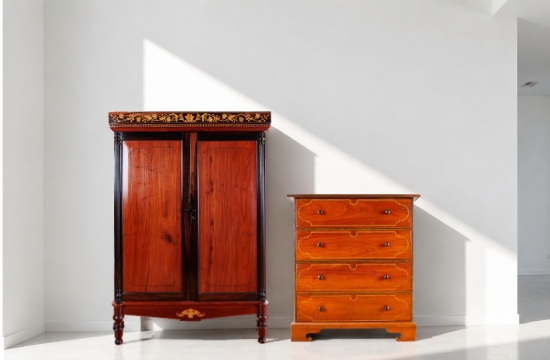
‘Under the Tree: The Wish List’ goes live and online on Saturday, 28 November, 2 p.m. at Salcedo Auctions, NEX Tower, 6786 Ayala Avenue Makati City.
Filipino colonial-era homes have been a repository of artistry, where faith and domestic life find expression in the skilled hands of generations of carvers, furniture makers, and artisans. At Salcedo Auctions’ Under the Tree: The Wish List, on Nov. 28, 2026, a fine selection of antique furniture and ecclesiastical objects gives a glimpse of this rich material heritage.
Spanning periods, regions, and traditions, these pieces reveal how Filipino craftsmen—with migrant artisans—drew from European influences to create a distinctly Filipino craftsmanship.
Among the most intriguing expressions of this ingenuity is the country’s santero tradition, exemplified by a late 18th-century image of an unidentified female saint from Bicol hewn from a single block of molave to reveal the combination of European religious iconography with regional, folk-naive sensibility. This reinforces the mystery of her identity, shifting the iconographical interpretation away from the standard meditative stance.
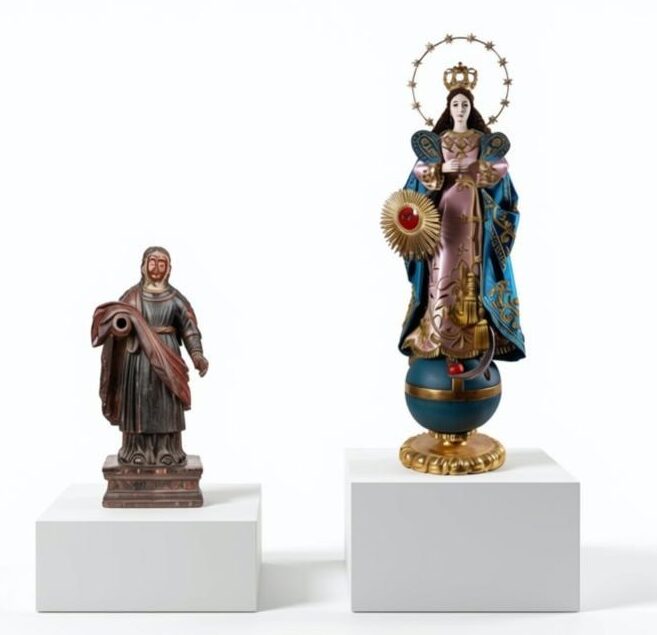
A late 18th century ‘de tallado’ image of an unidentified female saint from Bicol; An early 19th century life-sized ‘de vestir’ ivory head and hands image of La Inmaculada Concepcion.\
There is also an extraordinary assembly of six classical archangels from 1940s Manila, exemplifying the theatricality of Filipino religious art, each figure distinguished by its own attributes and mounted on individually inscribed bases.
Just as arresting is a life-sized de vestir image of La Inmaculada Concepcion, uniting early 19th-century ivory head and hands with intricate contemporary vestments and gilt silver accoutrements. The historic ivory components are complemented by the textile and metal artistry of Dr. Raffy Lopez, one of the country’s foremost ecclesiastical artists. Inspired by the queenly vestments of Nuestra Señora de los Remedios de Malate, the elaborate satin robes, embroidered in gold thread and finished with braided tassels, demonstrate how the tradition of sacred image-making continues to evolve through the hands of contemporary santero practitioners.
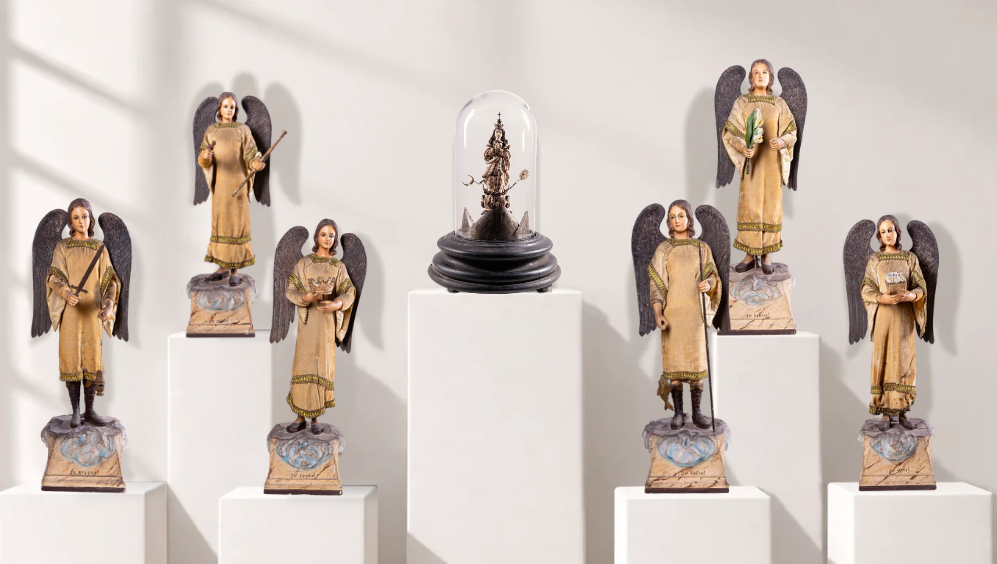
Rare assembly of six classical angels from 1940s Manila and solid ivory image of Immaculate Concepcion with gold and silver accoutrements enshrined in a ‘virina’
The furniture selection echoes country’s regional identities. A rare set of eight early 20th-century Art Nouveau-style dining chairs from Manila features anahaw leaf carvings and dramatic cabriole legs, marrying decorative European styles with local botanical references.
From Laguna comes a late 19th-century Chippendale Revival chest of drawers, its narra facade framed by delicate Moroccan arch in kamagong and lanite, and grounded by the characteristic bracket feet of provincial cabinetmaking.
Manila’s cosmopolitan character is further expressed in a second-quarter 19th-century aparador from Binondo. Its rich narra panels, framed in dark kamagong, are embellished with an elaborate crown, resulting in a sophisticated blend of Eastern auspicious symbolism and Western neoclassical ornament.
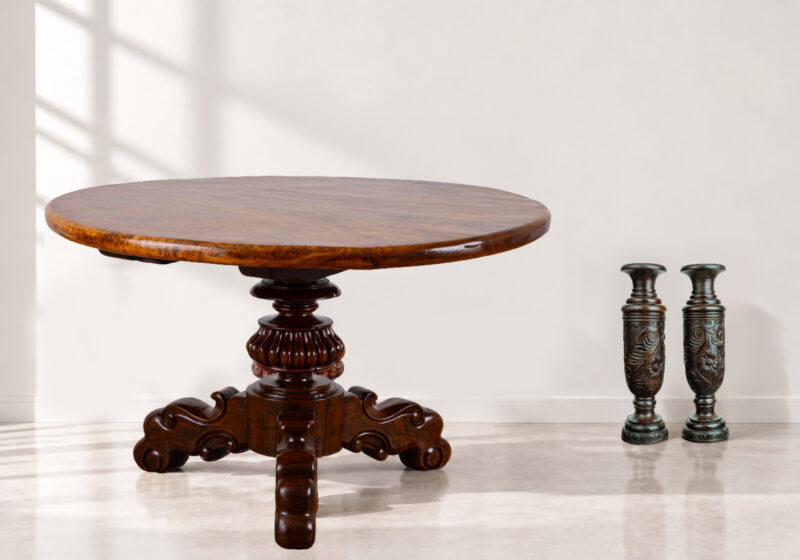
A robust Renaissance Revival center table with one-piece top and an expressive provincial pedestal base; A rare matching pair of baluster-form floor vases featuring relief-carved swirling acanthus fronds, wildflowers, and scalloped motifs
Bohol’s furniture-making tradition asserts itself through a late 19th-century Renaissance Revival center table in molave. Its massive turned pedestal and scrolled legs embody the expressive proportions and confident carving associated with Boholano workshops.
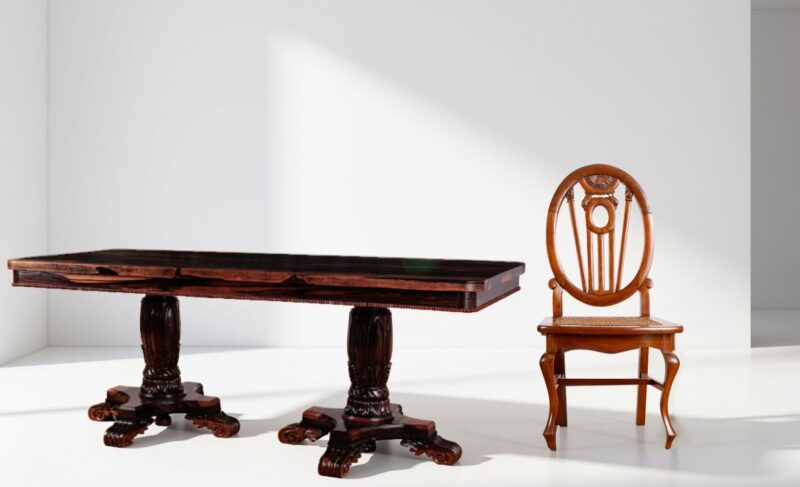
A ca. 1920s-1930s late Regency style kamagong wood dining table attributed to the Iwahig Prison and Penal Farm; An early 20th century set of eight Art Nouveau style dining chairs
From Palawan comes an exceptionally rare Regency-style kamagong dining table, attributed to the Iwahig Prison and Penal Farm. Its monumental, single-plank top reveals dramatic ribbons of different wood types, a testament to the natural character of the Philippines’ most prized hardwoods. A matching pair of relief-carved baluster-form floor vases, also in kamagong and attributed to Iwahig, further demonstrates the versatility of this timber.
Together, these objects tell a story that extends beyond the influence of Spanish colonial design. They reveal a culture of craftsmanship that adapted, reinterpreted, and ultimately indigenized foreign forms through local materials, regional aesthetics, and generations of practiced hands.
‘Under the Tree: The Wish List’ takes place live and online on Saturday, 28 November, 2PM at Salcedo Auctions, NEX Tower, 6786 Ayala Avenue Makati City. The online-only ‘Under the Tree: The Holiday Sale’ starts at 10AM. For inquiries, email info@salcedoauctions.com or phone +63917 1075581 | +63917 1126854 | +63917 8946550. Follow @salcedoauctions on IG and FB


