

‘Bangaw’ begins its run at the FEU Center of the Arts blackbox theater on March 5. Performances are every weekend until April 25. Reserve tickets at https://forms.gle/7THWddzz5UTSsaHn9.
Staged by the Far Eastern University (FEU) Theater Guild, Bangaw is a musical adaptation of William Golding’s novel Lord of the Flies. Set in the distant future, it is about a plane-load of schoolboys marooned on a deserted island. The boys are in their preteens to early teens. They’re presumed to be British, and were being evacuated from their war-torn country when their plane went down. As none of the crew survives, the young passengers are left to fend for themselves.
In Lord of the Flies, Golding presented a new treatise to the adage, “When boys are good, they’re very good. When they’re bad, they’re awful.” His version should go like this: “When boys left alone on an island are bad, they’re savage. When they remain good, they’re killed.” This is exactly what happens in the book.
With such a dark premise, it was hard to imagine the story being told as a musical. But librettist Gold Villar-Lim made a few changes in adapting the story for the stage. She didn’t set out to do another Oliver!. She switched it to the Philippine setting, with the children trapped on an island somewhere in the Sulu Sea. She added schoolgirls to the equation.
Lim makes the story ripe for music. There are many pop cultural references, though sometimes they feel forced. But they do add a contemporary vibe and help make the songs fit in. Many of the compositions by Vince Lim carry an ethnic tribal sound. Rap is also predominantly used, and for once my ancient self enjoyed this type of “music.” It offers an opportunity for the youngsters to express themselves with attitude. Confrontations become more compelling as they engage in a “war of rap.”
The music also adds texture to the characters. Insecurities and phobias are further underscored, motives more clearly defined. I guess the schoolgirls were added to accentuate the hierarchy, or the lack of it, on this island. Also, a pivotal character, named Piggy in the book, is made out to be gay in Bangaw. Some may accuse this production of shoving diversity down our throats, but this change does add tension and definition to the proceedings.
After the play, I sought out the librettist to tell her that, with the presence of girls and a gay boy, the story opens itself to the sexual awakening of some of the youngsters. She acknowledged this, and said she thought hard about exploring their carnal and romantic desires. But she eventually excluded it. It would have made the play too cluttered, she explained.
As far as I know, there have been three film adaptations of Lord of the Flies. A black-and-white film was produced in 1963. A visually stunning remake was released in the 1990s. Both were watchable and fairly faithful to the book. They also carried some of the book’s flaws. The other version was a local film released in the 1970s, entitled Alkitrang Dugo. I never did get to see it.
I was around 11 when I read Lord of Flies. Its premise fascinated me. Children toiling on an island without adult supervision seemed appealing. With no one around to make us finish the veggies and enforce bedtimes, this was island living at its finest.
The book, however, doesn’t touch on the uncertainty a child feels when he’s abruptly deprived of the security only a parent could give. I know that feeling. It happened to me on my first day in kindergarten at St. Theresa’s College Manila. For the first time in my five long years on this earth, I felt abandoned. I was trapped in prison-like surroundings and taunted by despotic spinster teachers. Many of us literally peed in our pants. This sense of abandonment was missing in the book and the two movies.
The book, however, doesn’t touch on the uncertainty a child feels when he’s abruptly deprived of the security only a parent could give
Homesickness is more pronounced in Bangaw. Likewise, the difference between the good boys and the bad is vividly outlined, yet somewhat stereotyped Lead character Raf (played by Sam Siasoyco) is said to be a student in an expensive school. Many of his lines are in English. Bad boy Jack (Aldin Covarrubias) is crass and a bully. His crossing over to the dark side is a predictable outcome. He was already a savage; the island didn’t turn him into one.
Bangaw benefits from the brilliant staging by artistic director Dudz Terana. The huge ensemble cast figures in a major fight scene. The stage is too small, but Terana makes the battle happen within the limited space. Inventive lighting makes the audience believe a bloody rumble is ongoing right before them—even if the action isn’t seen clearly. The effect is both disturbing and spectacular.
The stage is covered with sand to give us a semblance of the beach experience. Dance movements, as a result, are severely limited. I was thinking of what sort of dance can be performed on this surface. All I could think of was the fire dancing in Alona Beach in Panglao. Surrounding the stage are thin bamboo posts which prove to be useful in terms of blocking and transitioning to the next scene.
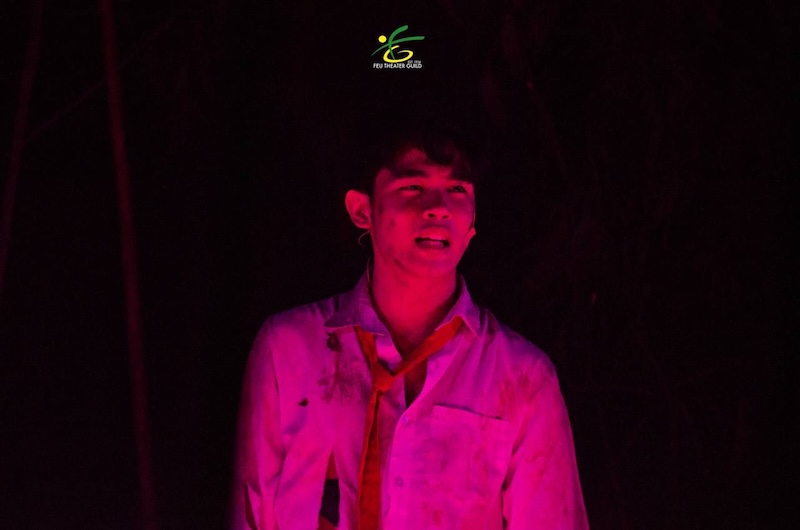
Sam Siasoyco as Raf, who tries to create order among his fellow castaways
Terana selected an impressive group of actors to play the castaways. They can act, sing, and rap. They can also break your heart. Playing the lead is FEU B.A. Comm student Sam Siasoyco. He plays Raf, the boy who means well for everyone on the island. Unlike in the book, the grief that follows the fight in Bangaw is profound. It’s all up to Siasoyco to make the tragic finale work. He delivers with a heartrending performance.
So poignant is the ending, Terana did away with a curtain call. Applause would ruin the bittersweet ending, he said. Thus, the audience is ushered out feeling forlorn—for the actors. They deserve our cheers and bravos. I’ve seen some of the cast in past productions of the FEU Theater Guild, and they’re getting better and better.

Jhaerelle Villabos as Tabeks, so named after the fact that he’s overweight and gay
I also love the type of source material Terana goes for. Previous adaptations include the works of Gabriel Garcia Marquez and Roald Dahl—high-brow fare, as opposed to the jukebox musicals based on old, mediocre movies.
‘Bangaw’ begins its run at the FEU Center of the Arts blackbox theater on March 5. Performances are every weekend until April 25. Reserve tickets at https://forms.gle/7THWddzz5UTSsaHn9. For updates and inquiries, check the FEU Theater Guild Facebook page or Instagram (@feutheaterguildofficial).


