
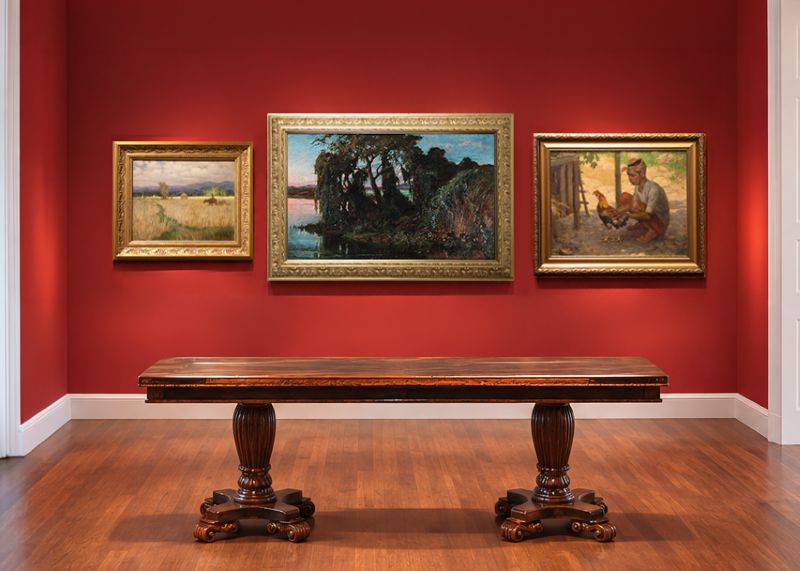
In one sweeping view, collectors and art lovers can trace the evolution of Philippine art from the early 1900s to the present at Salcedo Auctions’ year-end marquee sale, Under the Tree: The Wish List. Spanning more than a century of artistic expression, works offer more than just a chronological order to reflect the changing currents of the country’s art landscape and provide glimpses into the lives of artists amid the social and political climate of the times.
Paintings from 1912 to the 1930s capture a period of calm as the country emerges from centuries of colonial rule, exemplified by Fernando Amorsolo’s Field Scene (Bataan) from 1928, and Sabungero from 1936.
It was also a time of transition, as Filipino artists increasingly embraced new influences. This is poignantly expressed in an untitled riverscape by Fabian dela Rosa, dated 1914, which captures a scene by the water—quite possibly the banks of the Pasig from the Sta. Ana district of Manila. Where Amorsolo’s works evoke a relaxed atmosphere, dela Rosa’s painting conjures the dramatic nostalgia of day yielding to night, heightened by a darkening foliage set against a fading pink blush.
In the context of its time, Dela Rosa’s riverscape lends itself to a metaphorical allusion to suggest a cycle of passage and succession.
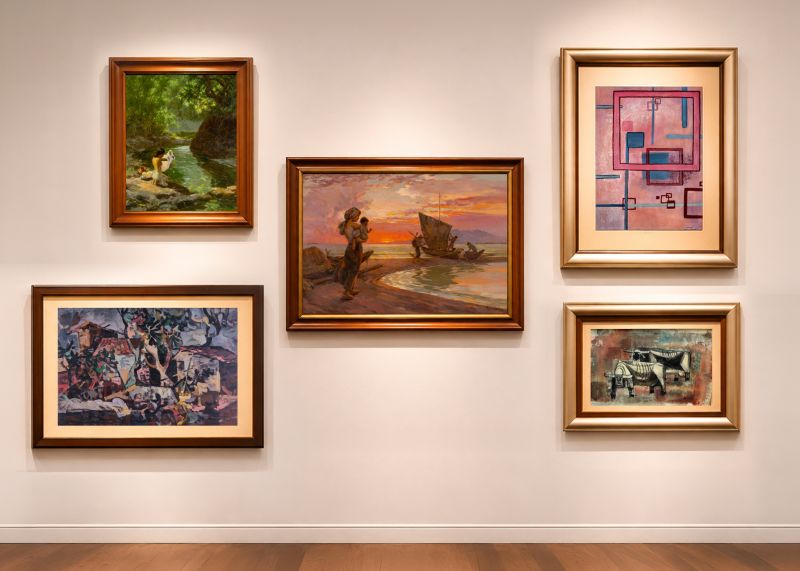
Clockwise from top left: Fernando Amorsolo’s two works, ‘Washing by the Stream’ (1951) and ‘Departure of the Fishermen’ (1958); Nena Saguil’s 1954 work ‘Untitled’; Ang Kiukok’s ‘Carabaos’ (1957); and Romeo Tabuena, ‘Landscape with Houses’ (1956)
Works from the years immediately before and after the war are understandably scarce. But the selection from the 1950s marks the Philippine landscape’s First Golden Age, revealing the disruptions that would enrich, as well as divide, the art scene. From the auction catalogue, paintings by post-war modernists (among them Nena Saguil’s untitled abstraction, and Ang Kiukok’s Carabaos), alongside those by the Neo-Realists (like Romeo Tabuena, Victor Oteyza, Ramon Estella), stand side by side with Fernando Amorsolo’s bucolic idealism.
Developments in the 1960s picked up the pace with the emergence of the new radicals, such as Roberto Chabet, David Medalla, Danilo Dalena, and Lee Aguinaldo, whose works reflect the rigorous experimentation that defined the decade.
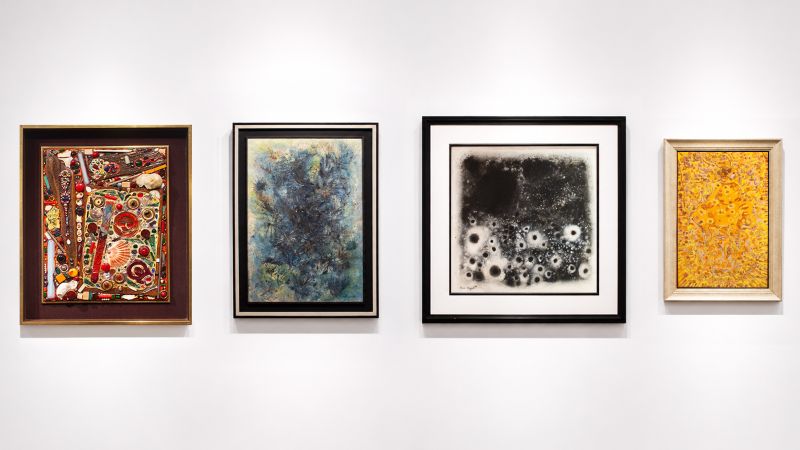
Alfonso Ossorio’s ‘Fat & Thin’ (1962); Lee Aguinaldo’s ‘Blue Explosion’ (1963); Nena Saguil’s untitled canvas (1964); Danilo Dalena’s ‘La Virgen de Antipolo’ (1969)
The post-war modernists, meanwhile, continued with the momentum that started a decade prior, with epic murals and paintings in public spaces—most notably the Cultural Center of the Philippines and the slew of hotels built during the period—bringing art to a broader audience.
Amid the political and cultural upheavals of the 1970s, many galleries opened, contributing to the growth of Philippine art. Two entries in this sale mark a closure and new beginnings: H. R. Ocampo’s untitled abstract from his Visual Melody period, and Galo Ocampo’s Echo, created a year after his first solo exhibition and the start of a prolific chapter which saw the artist exploring diverse themes.
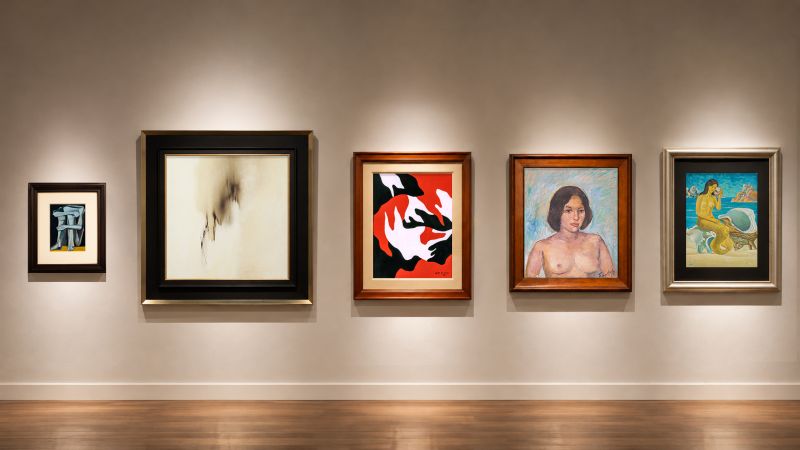
Ang Kiukok’s ‘Seated Figure’ from 1976; Fernando Zobel’s ‘Noviembre IV’ (1978); H.R. Ocampo’s untitled abstract (1978); Victorio Edades’ ‘Untitled (The Model)’ from 1976; and Galo Ocampo’s ‘Echo’ (1974)
For Ang Kiukok, the decade became a defining period in which he articulated the anxieties of 1970s Manila, evident in Seated Figure. In contrast, Fernando Zobel’s acclaimed Serie Blanca work Noviembre IV, brought to life in the same era, is a contemplative reduction of color and form.
The 1980s signaled the beginning of another important phase with the emergence of new contemporary voices and the rise of Social Realism. But it would be the modernists, such as Victorio Edades, Federico Aguilar Alcuaz, Galo Ocampo, Zobel, and Kiukok, who would dominate the scene, reaching their artistic peaks within the period.
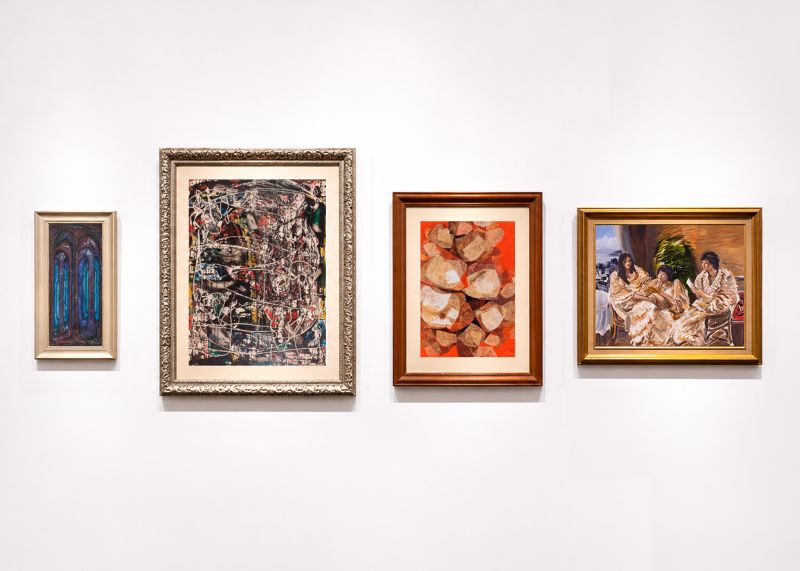
Ramon Estella’s ‘Passages’ (1985); Alfonso Ossorio’s ‘Abstract’ from 1983; Jose Joya’s ‘Dragon Year’ (1988); Federico Alcuaz’s ‘Tres Marias’ (1985)
By the 1990s, Philippine art had become an increasingly diverse landscape, with artists exploring new themes, materials, and approaches, while established masters continued to refine and extend their practice. The period also signaled a changing of the guard, as a new generation of artists emerged, increasingly attuned to shifting cultural conversations and the boundless possibilities of contemporary expression.
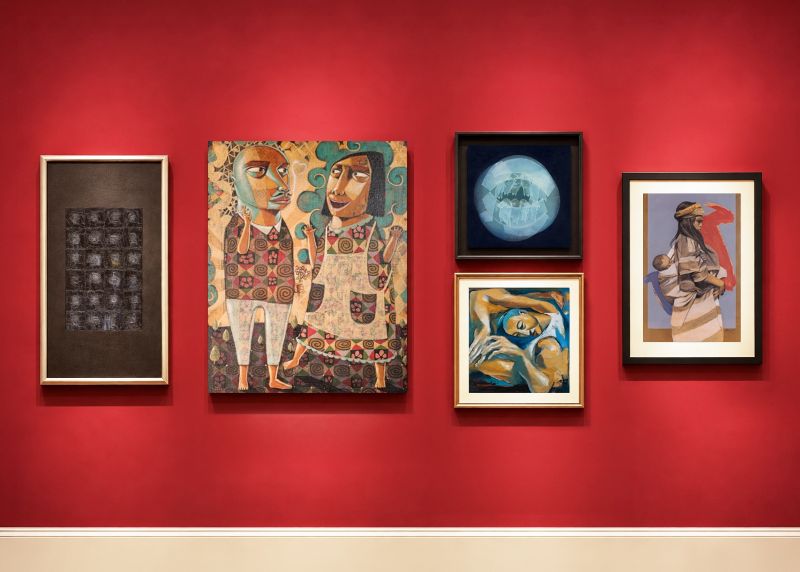
Lao Lianben’s ‘Voices’ (1998); Rodel Tapaya’s ‘Nang Magtapat ng Pag-ibig si Tebang Siga kay Pitang Tsimosa’ (2007); Romulo Olazo’s ‘Diaphanous #897’ (2012); Emmanuel Garibay’s untitled work from 2004; BenCab’s ‘Ibaloi Mother and Child’ (2007)
From the turn of the millennium to the present, Philippine art has experienced an unprecedented period of growth and expansion. More galleries opened, while international exhibitions and cross-cultural exchanges widened the horizons of Filipino artists who gained greater visibility in the global stage.
It was in the last decade or so that this new generation made remarkable inroads into local and international auctions, like those featured in the room list—Ronald Ventura, Mark Justiniani, and Jigger Cruz. Their achievements reflect not only the dynamism of the Philippine art scene, but also the diversity, ambition, and creative vitality of art being made today.
Across more than a century of artistic evolution, each generation has expanded the vocabulary of Philippine art, with works that capture the spirit of their times while continuing to resonate with generations to come. This collective body of work is a testament to the Filipino artist’s most enduring gift to a nation: the gift of a life in art.
View the ‘Under the Tree: The Holiday Sale’ morning auction catalogue (sale starts at 10 am) and the ‘Under the Tree: The Wish List’ afternoon auction catalogue (sale starts at 2 pm). For inquiries, email info@salcedoauctions.com or SMS/phone (+63917)107-5581 / (+63917)112-6854.


