
Gener Caringal
Before the first leap, there is a look. Oryang, portrayed by Jessa Tangalin, sits on the floor watching her husband, Andres Bonifacio (Matthew Davo), lead men in white uniforms. She is the emotional center of Andres KKK, Philippine Ballet Theatre’s (PBT) History Month production. Here, choreographer Gener Caringal channels patriotism through expressive movement over spectacle: the body tilt, the turn, the downward spiral to the floor and the soaring leaps set to Bayan Ko, surge across the floor with revolutionary fervor.
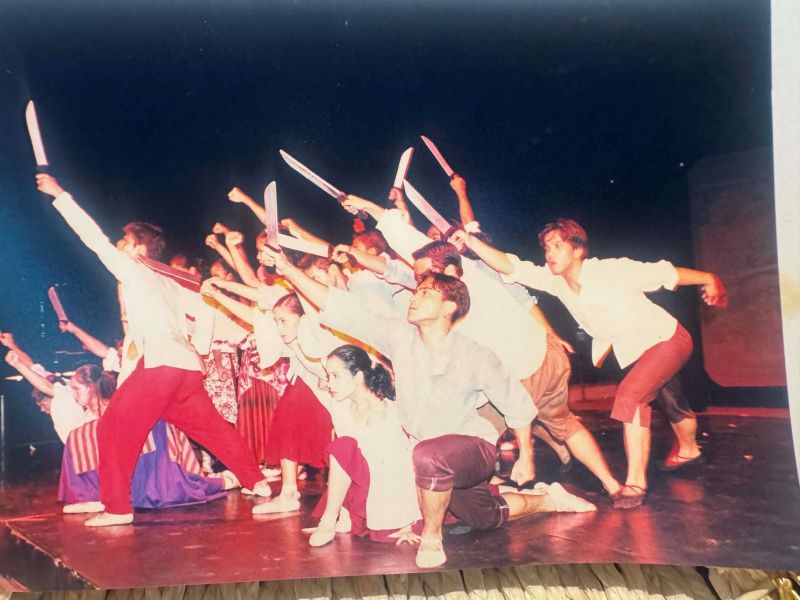
Premiered in 1996 at the Cultural Center of the Philippines (CCP) for the revolution’s centennial, the dance draws inspiration from Bonifacio’s patriotic poem, Pag-ibig sa Tinubuang Lupa (Love for the Native Land). Its opening image echoes Guillermo Tolentino’s Bonifacio Monument. The hero stands defiant, armed with a bolo, flanked by revolutionaries in struggle. The narrative follows the deep bond between Bonifacio and Gregoria “Oryang” de Jesus, the capture of the Katipuneros by Emilio Aguinaldo’s Magdalo faction in Indang, Cavite, Bonifacio’s execution in Maragondon, and Oryang’s overwhelming grief.
In rehearsals, Caringal is exacting about musicality, phrasing, and narrative intent, pushing his dancers to fully inhabit Jesse Lucas’ score and Lilia Quindoza Santiago’s libretto. Full physical and emotional commitment is non-negotiable—a hallmark of Caringal, PBT’s former artistic director who now leads the University of the East (UE) Silanganan Dance Troupe. UE’s male dancers supplement PBT’s corps ensemble; what they may lack in classical ballet polish, they cover with a raw dynamism that makes any rough edges disappear.
Ahead of the August 22–23 run at the Proscenium Theater, PBT alumni who previously danced the roles of Andres and Oryang still recall the production as a career high point. Caringal freed them from ballet’s obsession with polite technical perfection and looking pretty, encouraging them instead to explore the inner lives of their characters, use deep breath to bridge technique with emotion, and make the movement distinctly their own. Stripped of superficial pyrotechnics, the choreography serves pure storytelling—exposing the political crab mentality that has long held the country back, set against Oryang’s devotion and the sacrifice of Filipinos laying down their lives for freedom.
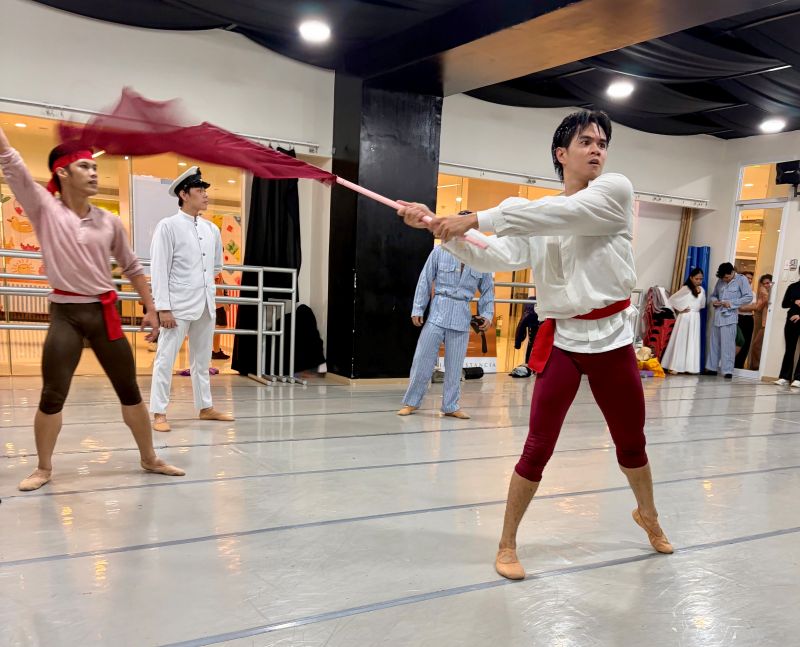
Matthew Davo as Andres
“Given the corruption today, we see Filipinos fighting each other purely for personal gain,” says Davo. “They serve for power, not love of nation. I hope our leaders can learn from the past.”
The roles of Andres and Oryang were originally created on Melvin Martinez and Maritoni Tordesillas. Losing weight for the gala, Martinez brought grounded modern dance savvy and formidable partnering skills. Caringal found a distinct collaborator in Tordesillas.
“She not only had strong technique, but she was a very good actress,” he recalls. “Once I gave her instructions, she’d say, ‘Let me let it sink into my system.’ By the next rehearsal, I was amazed—the intentions were so clear in her movement. Her entire body was expressive.”
Caringal insisted that his leads match their physical intensity to the recorded spoken word, demanding that the dancers move with the precise dynamics and emotional weight of Jonee Gamboa’s narration. That narrative power translated seamlessly abroad. When PBT toured the US and performed Andres KKK at the McKenna Theatre, San Francisco Mayor Willie Brown declared November 2, 1996, as “Philippine Ballet Theatre Day.”
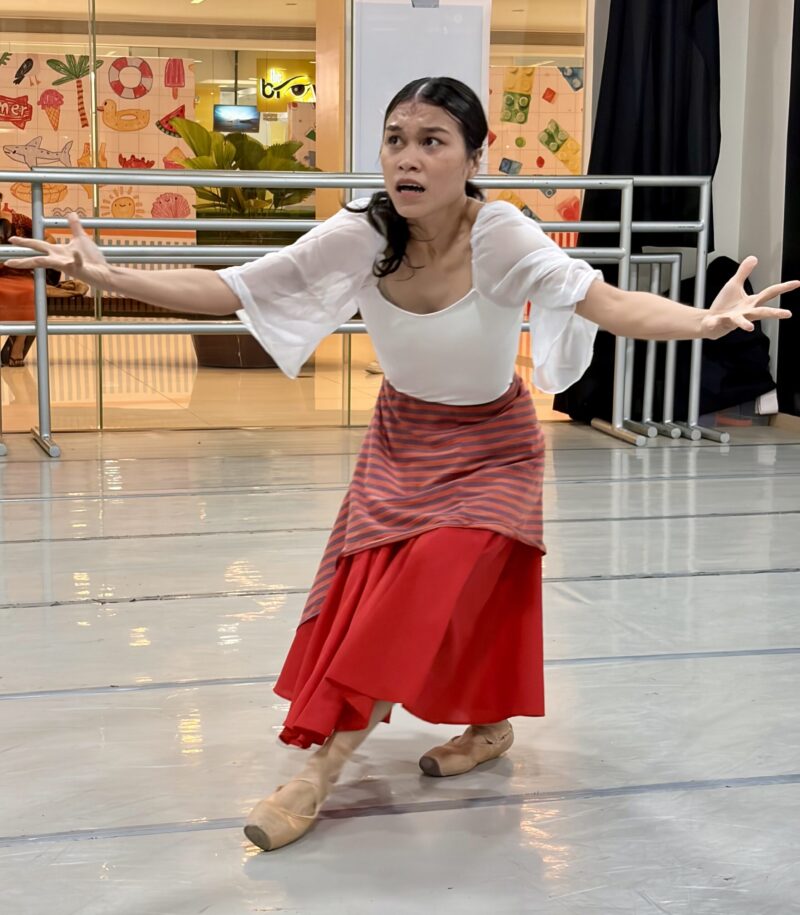
Jessa Tangalin as Oryang
Caringal notes that Tangalin and Dominador Delmo, the alternate Andres, have both captured the earthiness of the contemporary style, even while the women dance on pointe. Davo, on the other hand, is a natural performer whose movement can be a bit too airy, requiring firmer guidance.
Meanwhile, he is struck by Sophie Tiangco’s dedication as the alternate Oryang. She travels out of her way to UE, where Caringal is based, for extra rehearsals. Caringal recalls her as once being merely “an exhibition dancer”—someone focused strictly on executing steps rather than moving with purpose. “She would just perform and perform,” he says. “But her expression was totally blank.” Today, he is pleased with her transformation. “Now she’s acting.”
For Davo, working with Caringal remains a privilege. “Whenever he gives corrections, you need to take everything to heart,” he says. “You have to understand the story so you can deliver it effectively.”
This intensely theatrical approach was forged over decades on stage and behind the scenes. Caringal began dancing at 16 under Corazon Generoso-Iñigo in the University of the East (UE) Dance Troupe, taking the helm in 1974 after she left for the University of the Philippines (UP) Filipiniana Dance Group. Around the same time, cultural leader Nick Lizaso was directing plays and began inviting dancers, including Caringal, to act in theatrical productions at UE.
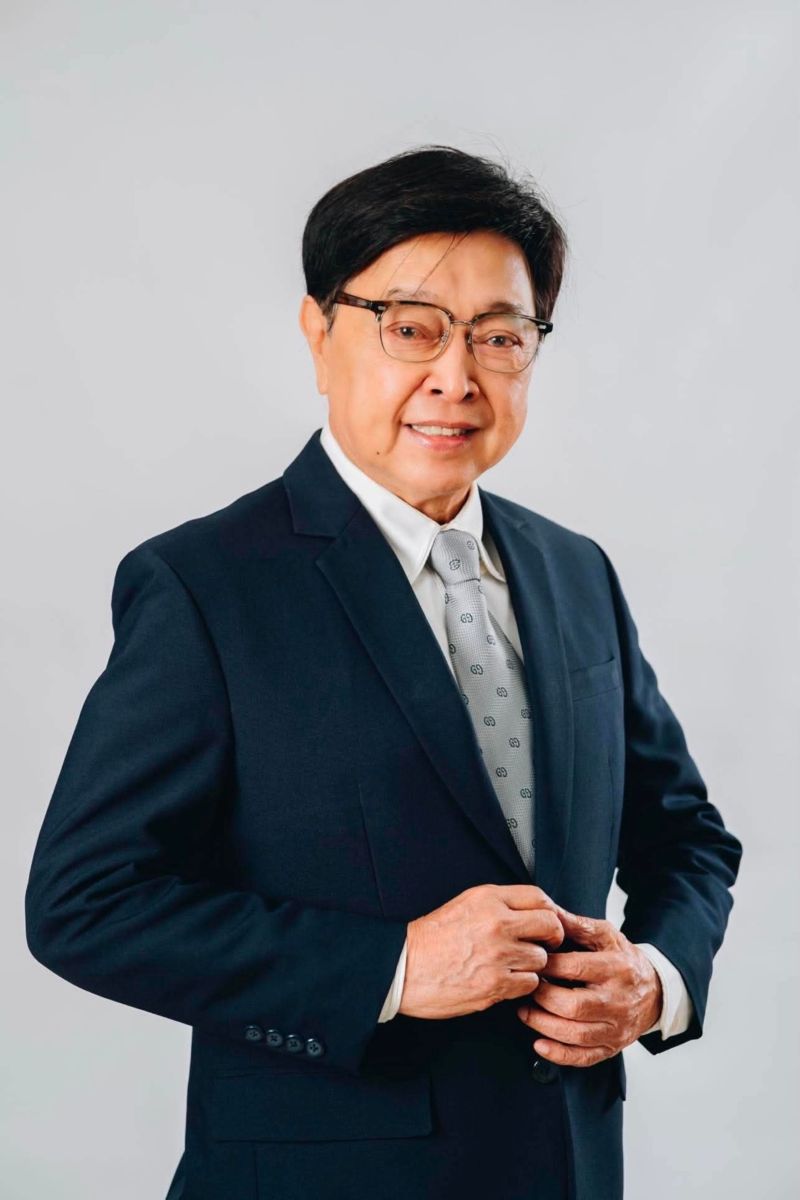
Now 79, Caringal began dancing at 16 under Corazon Generoso-Iñigo in the UE Dance Troupe, taking the helm in 1974
Caringal likewise performed in outside productions. His big leap into ballet came unexpectedly when choreographer Julie Borromeo held auditions for a dream sequence in Flower Drum Song. Recognizing Caringal’s charisma and raw potential despite his lack of ballet training, she watched him gamely tackle the exercises at the barre and cast him on the spot.
When choreographer Alice Reyes returned from her studies in the US to introduce modern dance to the Philippines through campus lecture-demos, she spotted Caringal at UE as one of three danseurs with exceptional promise. In 1969, he went on to become a founding member of the Alice Reyes Dance Company, which evolved into Ballet Philippines.
During summer workshops organized by the future National Artist for Dance, dancers would routinely line up to participate in Caringal’s choreographic experiments. That creative freedom birthed Ang Sultan (1973), which became one of Ballet Philippines’ most enduring works from the Reyes era. It started as a simple improvisation exercise blending Muslim motifs with modern dance. Eventually, it became a story about a Muslim princess, the slave she loves, and an angry Sultan set to Western music.
When Ang Sultan was added to the company’s touring repertoire, Caringal edited a divertissement instead, composed by Lucrecia Kasilag. Though initially displeased with the edits, the future National Artist for Music was so impressed by his choreography that she composed a new score. Complete with gongs and kulintang, it was tailored specifically to his narrative.
In 1986, Caringal co-founded Philippine Ballet Theatre (PBT), later serving as chairman of its artistic council and as artistic director for 18 years. There, he created Vinta, the company’s signature neoclassical ballet inspired by the colorful vintas of Zamboanga, along with celebrated works such as Prism, Pinoy Komiks, and the Maranao epic Darangen ni Bantugen.
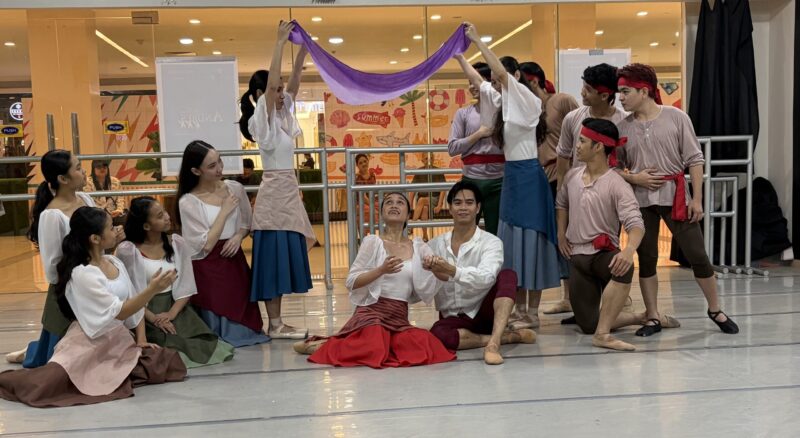
Wedding scene of Andres and Oryang and the Katipuneros
Yet Andres KKK stands out as one of his most widely performed and deeply felt creations. Caringal recalls staging the ballet in an informal settlement area in Marikina. The audience initially whistled and hooted as the ballerinas’ skirts twirled, revealing their legs. But as the drama unfolded, the crowd fell into a hushed silence. Years later, in the early 2000s, PBT even brought elements of the production to a float for the Independence Day Parade in Quezon City.
Throughout his career, Caringal has moved between institutions. He directed the UE Silanganan Dance Troupe from 1974 to 1987, crafting works rooted in Filipino heritage by weaving together modern dance, folk motifs, and ballet. After helming various other dance companies, he returned to UE to choreograph for the opening of the University Athletic Association of the Philippines (UAAP) in 1998. Then the university created the position of director for cultural affairs for him, allowing Caringal to revitalize its entire performing arts cluster—from the dance troupe and theater group to the choir and jazz band.
This lifelong dedication to cultural storytelling has earned him Manila’s highest artistic distinctions, including the Patnubay ng Sining at Kalinangan sa Sayaw (1997), the Gawad Gatpuno (2008), and the prestigious Diwa ng Lahi (2018), which consolidated his prodigious repertoire of Filipino-themed works. But the crown jewel of his honors arrived with the 2024 CCP Gawad Award Para sa Sining, which acknowledged the breadth of his legacy choreographies for PBT and BP.
Still, for Caringal, the ultimate accolade isn’t carved in metal or wood. His greatest reward comes often when scrolling through social media and reading posts from former dancers reflecting on his work ethic, and how Andres KKK helped them discover their unique identity on stage.
At 79, Caringal shows no signs of slowing down. Just last January, the UE president extended his contract for another three years. This was a nod to the simple fact that the university couldn’t find a replacement of his caliber. His calendar remains full with new choreographies to compose, school tours to run, and plans to revive Labaw Donggon, the Visayan epic he created while leading the Philippine delegation to the 5th Asian Festival of Performing Arts in Singapore in 1985. That production not only earned critical acclaim, but also opened doors for him to choreograph for the Singapore Dance Theatre and bring Filipino dancers to international festivals.
While many of his peers have retreated to retirement, Caringal is still on his feet in the studio, physically demonstrating movements for his dancers.
“Work is very healthy for me,” he says. “And I’m really enjoying it.”


