
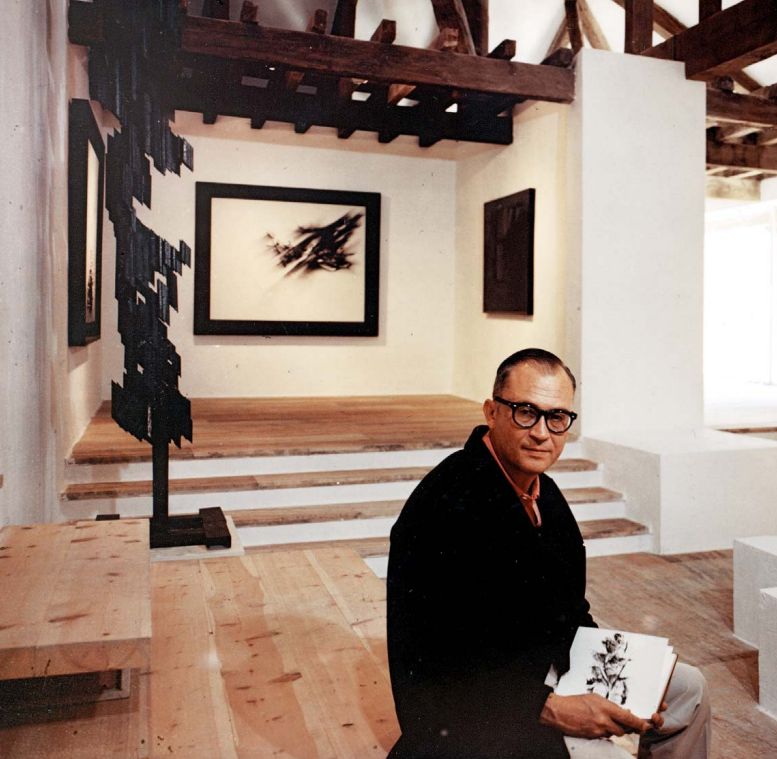
Fernando Zóbel in the large gallery of the Museum of Spanish Abstract Art, 1966 (Photo reproduced in ‘Fernando Zóbel: Catalogue Raisonné of Paintings)
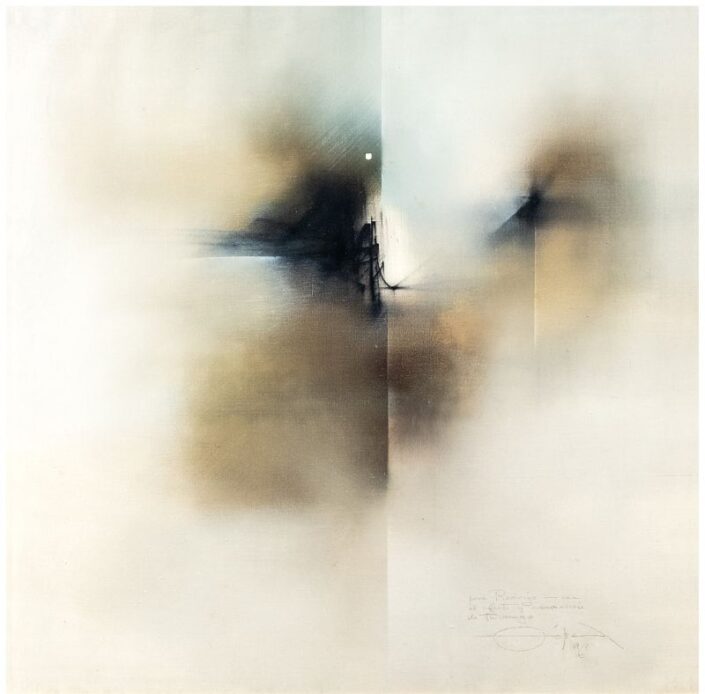
Fernando Zóbel’s Septiembre, a las siete de la tarde, en Tres Juncos is a major highlight of Leon Gallery’s the Asian Cultural Council (ACC) Auction 2025 this Saturday, February 22. This year’s ACC auction marks a decade of fruitful collaboration between Léon Gallery and the ACC Foundation Philippines, in their mission of granting talented Filipino artists the opportunity to broaden their artistic horizons overseas.
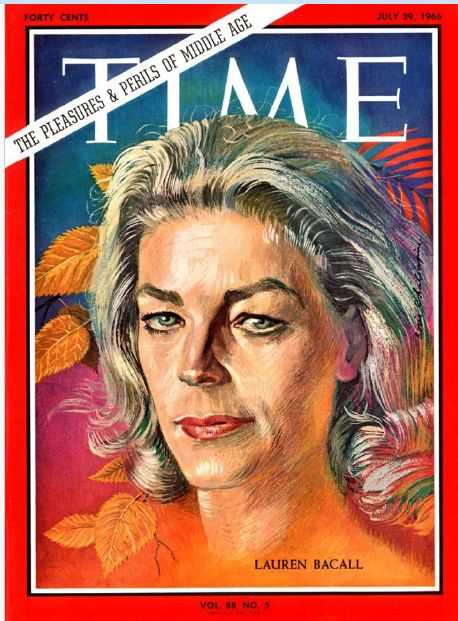
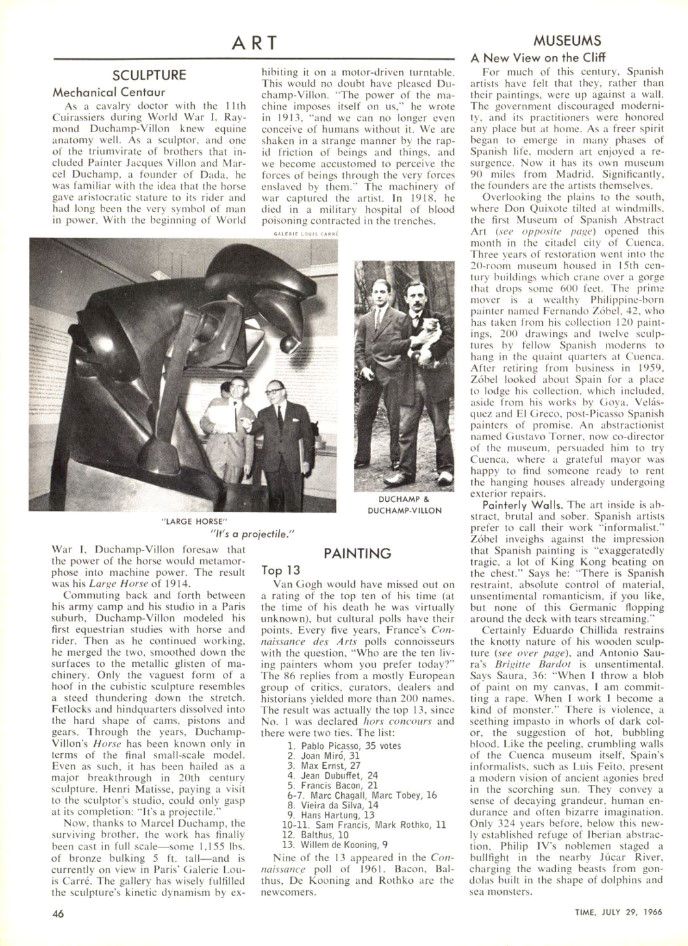
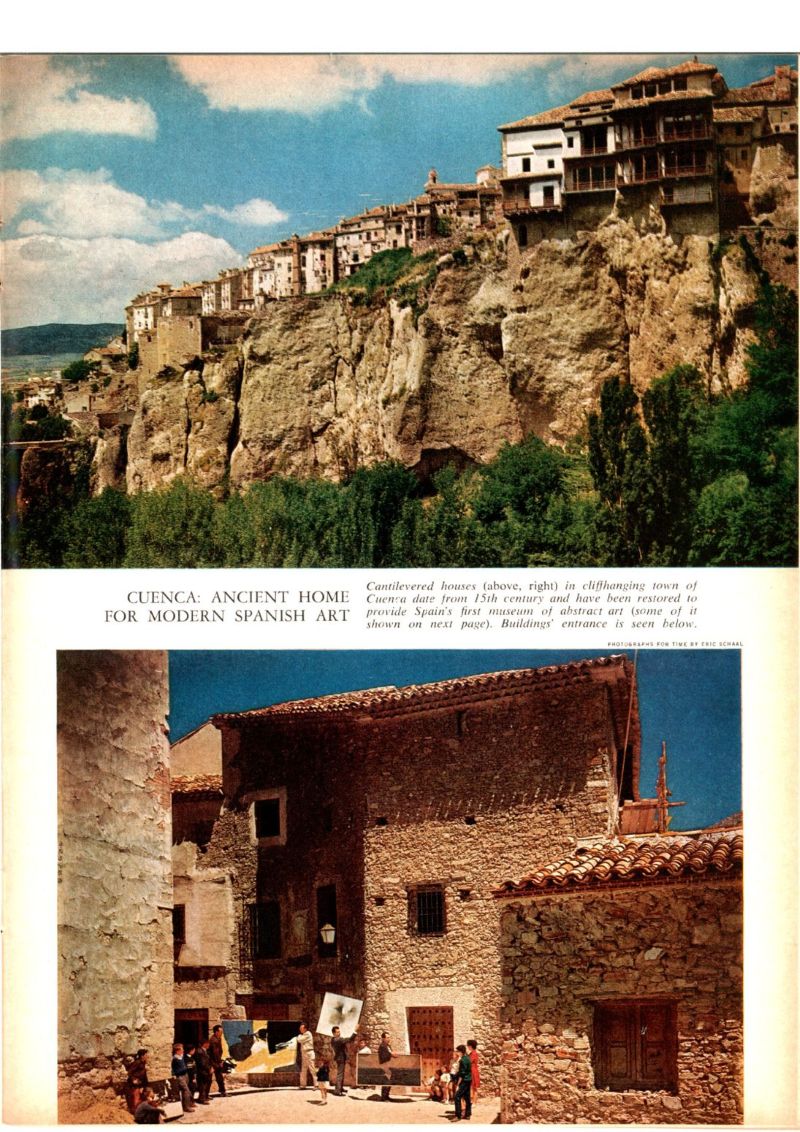
The TIME Magazine article featuring Zobel’s masterpiece and the museum
Undoubtedly one of the most significant photographs of Fernando Zóbel taken during his years as a painter and collector was the image taken by Eric Schaal for Time magazine (July 29, 1966).
It shows, at its center, an assistant of the artist holding the magnificent A las siete de la tarde, en Tres Juncos (At 7 pm in Tres Juncos) that is an important highlight of this auction.
Shortly after the Museo de Arte Abstracto Español, which Zobel established in Cuenca, Spain, opened to the public on June 30 of the same year, 1966, his works and the museum were featured in the international American magazine, and became the catalysts that turned the museum into a global touchstone for any art lover.
Undoubtedly, A las siete de la tarde, en Tres Juncos is one of the most important modern paintings of the second half of the 1960s—so much so that Zóbel himself chose this painting to represent his work in international media, both as an artist and as a collector.
Although painted in May 1966, the painting refers, through its title, to the month of September, and more specifically to a time—7 in the evening. This should lead us to reflect on Zóbel’s slow and methodical work as a meticulous researcher of the effects of light at different times of the year, and his impeccable study of nature in his sketchbooks, which he would later revisit to create paintings based on his observations of natural phenomena.
This interest and admiration were drawn not only from the Renaissance (where artists like Leonardo da Vinci studied the effect of water or clouds), but also from Impressionist painters, who, with tools such as the portable easel, went outdoors to paint nature in situ. Zóbel ventured out on the fields with his sketchbooks, to document and study the landscape, the effects of light and water, and other details unnoticed by mere passers-by.
From these small observed details or effects, Zóbel created an extraordinarily complex structure. A vertical axis runs through the canvas from top to bottom, dividing it into two clearly marked halves. In this painting, the right side is further divided at the top (perhaps due to a reflection or sunlight effect). At the center, calligraphy (if it can be called that), clearly derived from his black series, is surrounded by different shades of brown—the brown of the Castilian landscape at the end of summer and the beginning of autumn, but also the earthy brown of Degas, to which Zóbel had referred to on occasion, which structures the space around these two vertical axes.
Finally, a tiny white square anchors the scene and creates a clear spatial ambiguity. This recurring feature in Zóbel’s 1960s works (although we know of paintings with this same solution from the 1950s, such as in Composición en rojo y negro, 1955, or Saeta 27-Báltica, 1957, among many others that present this square or rectangle as the defining element of the piece), has unmistakable importance.
One cannot fail to notice Zóbel’s use of a technique inspired by the Impressionists
One cannot fail to notice Zóbel’s use of a technique inspired by the Impressionists, with their fixation on the scene through such a point; Saeta 27-Báltica undeniably recalls this method, even in its use of blue and red, likened to the famous Impression, soleil levant (1872) by Claude Monet, often considered the origin of the Impressionist movement, and by extension, modern art.
Indeed, this rigorous white square in the painting holds the piece in place, sustains it, and, through its ambiguous resource, presents a perfectly composed work.
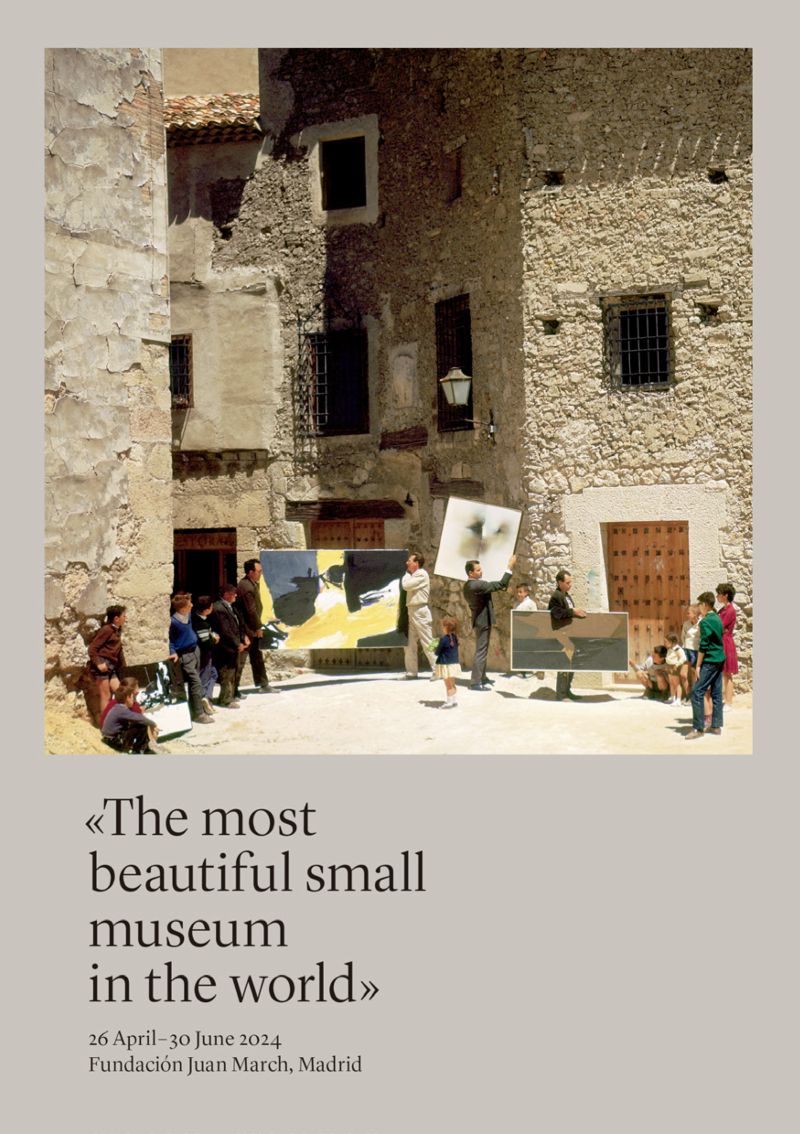
Cover for the catalog of Fundacion Juan March’s 2024 exhibition of the Museum of Spanish Abstract Art’s collection
The title, in addition to placing the painting in time (and hour), locates us in the village of Tres Juncos, around 60 miles from Cuenca, the city which Zóbel transformed, with the opening of his museum, into the capital of contemporary art in Spain. As mentioned, Zóbel presents a familiar space in a familiar time, and so it can be said that the painting is a form of figuration, based on a specific moment and place.
The painting is dedicated to Rodrigo, none other than Rodrigo Lozano, mayor of Cuenca from 1961 to 1966, and the driving force behind the museum’s opening. He was the one who gave permission for Zóbel’s museum to be built among the Casas Colgadas (“Hanging Houses,” referring to the traditional houses built on the edge of cliffs, famously suspended over the Huecar River). Thanks to him, we have this unique location.
Zóbel, in deep gratitude to Rodrigo Lozano, gifted him a painting that was especially significant to the artist, acknowledging Lozano’s fundamental role in his dedication, “with affection and admiration.”
The Asian Cultural Council Auction is happening on February 22, 2025, at 2 pm, at Eurovilla 1, Rufino corner Legazpi Streets, Legazpi Village, Makati City. Preview week is from February 15 to 21, 2024, from 9 a.m. to 7 pm. For further inquiries, email info@leon-gallery.com or call tel. no. 8856-2781. To browse the catalog, visit www.leon-gallery.com.
Follow León Gallery on their social media pages for updates: Facebook – www.facebook.com/leongallerymakati and Instagram @leongallerymakati.


