


Curator Carlos Quijon Jr. presents an image of the bust of Hermano Puli in Lucban, Quezon, during a workshop-lecture in Udine, Italy. (Photo by Alya Honasan)
From April 20 to November 24, 2024, the 60th International Art Exhibition organized by La Biennale de Venezia was held, entitled Stranieri Ovunque–Foreigners Everywhere. The Philippine participation in this massive event, the Philippine Pavilion at the Artiglierie of the Arsenale, one of the major exhibition venues, was a multi-media installation put together by the brilliant duo of curator Carlos Quijon Jr. and artist Mark Salvatus.
It featured sculpture—specifically, intriguing resin rocks embedded with actual instruments used by small-town bands—video, light, and sound, an ingenious tribute to history and modernity, tradition and evolution, and many complex layers of national identity. Rooted in Salvatus’ own history as a son of Lucban, Quezon, the pavilion was titled Sa kabila ng tabing lamang sa panahong ito /Waiting just behind the curtain of this age—a direct quote from a fascinating historical figure and another son of Lucban, Apolinario de la Cruz, a.k.a. Hermano (Brother) Puli. How this seemingly “minor” revolutionary of Philippine history ended up making an appearance on the global art stage, alongside a wealth of artistic expressions, is interesting in itself.
Apolinario de la Cruz (July 22, 1815–November 4, 1841) was a Filipino religious leader, who led the Cofradía de San José, established in 1832 simply because the Catholic Church in the Philippines then wouldn’t allow indios like Puli to join the priesthood and serve. Puli ended up establishing the cofradia, a religious order for Filipinos that ballooned to some 5,000 members from the Quezon, Batangas, and Laguna areas. Naturally, this alarmed the Spanish government, who had to send two waves of troops before the cofradía was overpowered, and Pule was captured and killed—most dramatically, with his body quartered and distributed to the different provinces, and his head displayed on a stake in view of his family, as a warning to anybody who got similar ideas. Yes, there was discrimination even against those who wanted to practise the same faith.

Video at the Pavilon shows the view of Mount Banahaw from the window of artist Mark Salvatus’ home when he was growing up (COURTESY OF MARK SALVATUS)
Puli had actually begun showing his religious inclinations by working and serving at the San Juan de Dios Hospital. Later, when the brotherhood had to relocate to escape prying eyes, they chose Mount Banahaw as their home base, lending even more credence to the image of the mountain as a sacred, even paranormal, place. While Puli and company were devotees of Christian virtues, regularly holding Masses, there was also room for pre-colonial beliefs, like the use of anting-anting in their practice. When accused of heresy, Puli tried to explain that the cofradia was never against the Catholic faith—an appeal which, of course, fell on deaf ears, and eventually led to the group’s massacre. As some consolation, after investigating the event, the Spanish Courts laid the blame on the Governor-General, ruling that Puli and the cofradía had no political motives—but had still committed an offense against the Catholic Church.

The bust in the actual site in Lucban, Quezon (Photo by JF Juacalla, from EverythingQuezon Facebook page)
Today, a marker stands in Lucban, Quezon, under a bust of Puli, put up by the National Historical Commission, paying tribute to him and the cofradia as “tagapagtanggol ng kalayaan sa pananampalataya at ng karapatang panlipunan” (defender of the freedom of worship and of social rights).
The pavilion title came from Puli’s final pep talk for his men, before their imminent death, still revealing an optimism and idealism that would carry them forward. In his curator’s notes, Quijon writes, “Puli declared that the ‘abrupt events’ that were about to transpire ‘can be anticipated by the faithful through certain signs.’ Puli advised them to always discern the ‘meaning of the times’ and that ‘Victory is just behind the curtain of this age’…It alludes to a liminality which, in Puli’s turn of phrase, anticipates an anti-colonial or even post-colonial condition. The mystical is placed in the affective horizon of advent and anticipation, a space wherein something is yet to take place, a promise is yet to be fulfilled.”
Puli is very interesting, Quijon says, precisely because his is an often overlooked minor narrative. For one thing, this was not a simple cut-and-dried case of anti-colonialism, the curator notes. Also, Puli was no Jose Rizal; he didn’t actually want a revolution. “His was an assimilative gesture: ‘Please recognize us, we can be ourselves, and we can do a vernacular Catholicism.’ But he is still filtered through colonial history. So how do you jump from this notion to a larger community, which is the Philippines, something larger than him?”
The essence of his titular statement, Quijon says, is futurity. “Puli is important because his ‘revolution’ ultimately failed. So, the phrase comes from this final moment in this clash. He said, ‘Definitely I see that we will fail, but victory is just behind the curtain of this age. So, we should keep and hold on to that, so that the idealism stays.’”
Thus, the mountain where Puli and the cofradia sought refuge became the anchor for the exhibit: as an icon, guardian, and looming presence from artist Salvatus’ growing-up years; as a revered home for local artisans and musicians who climbed it for inspiration and spiritual renewal; and even as a place of considerable environmental integrity: Salvatus reveals how illegal logging remains somewhat minimized at the foothills of Banahaw, because people remain wary of its protective spirits.
In the text for Confradia/Komunidad: The World Embraced by Hermano Puli, a permanent exhibit put up in 2017 at the Villa Escudero Museum in Tiaong, Quezon, kept in the National Archives of the Philippines, and used as a reference for material on the Philippine Pavilion in Venice, Puli is further described as a denizen of the mountain who lived closely with nature: “The dates of Hermano Puli’s birth are still being disputed…What cannot be denied is that Puli was born in Lucban, a town in the lap of Mount Banahaw. It is likely that he was baptized in the front of the very same retablo on exhibit.
“The forests would have still been intact then. Streams, waterfalls, and springs would have been everywhere. These along with certain caves are still considered sacred today….
“When anyone wanted to escape the clutches of the powers-that-be, they often headed for the mountains. Even Puli took refuge on the slopes of Banahaw. Here he set up his camp away from his enemies. On the mountain, no one was around to pass judgment. Only the animals and birds could act as one’s guide. There is silence, creating space to think. One’s vision could cover great distances…”
In the end, this reluctant rebel and eco-warrior, like many heroes, had an influence that extended beyond his short lifetime. The work of Salvatus and Quijon helped tell the story of a mountain and its place in a people’s fight for freedom in their small part of the world.
“Instead of grinding Puli’s memory underfoot, the Spaniards, by what they did, made his story shine brighter,” concludes the exhibition text. “By cutting up his body and scattering the parts to different towns in the lap of Banahaw, they emphasized that Puli did not belong to only one place.
“Puli’s heroism belonged to a whole nation.”
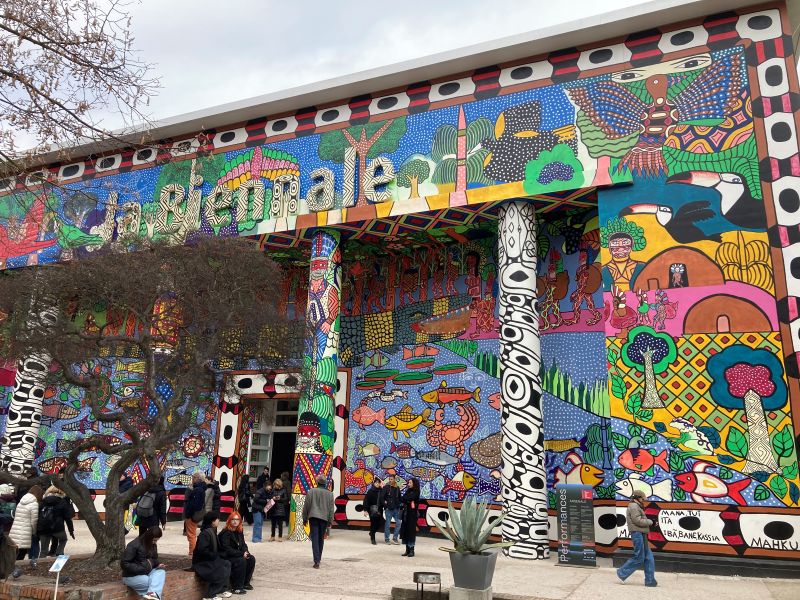
The entrance to La Biennale 2024 (Photo by Alya B. Honasan)
The Philippine participation at the Venice Biennale is a collaborative undertaking of the National Commission for Culture and the Arts, the Department of Foreign Affairs, and the Office of Sen. Loren Legarda.


