
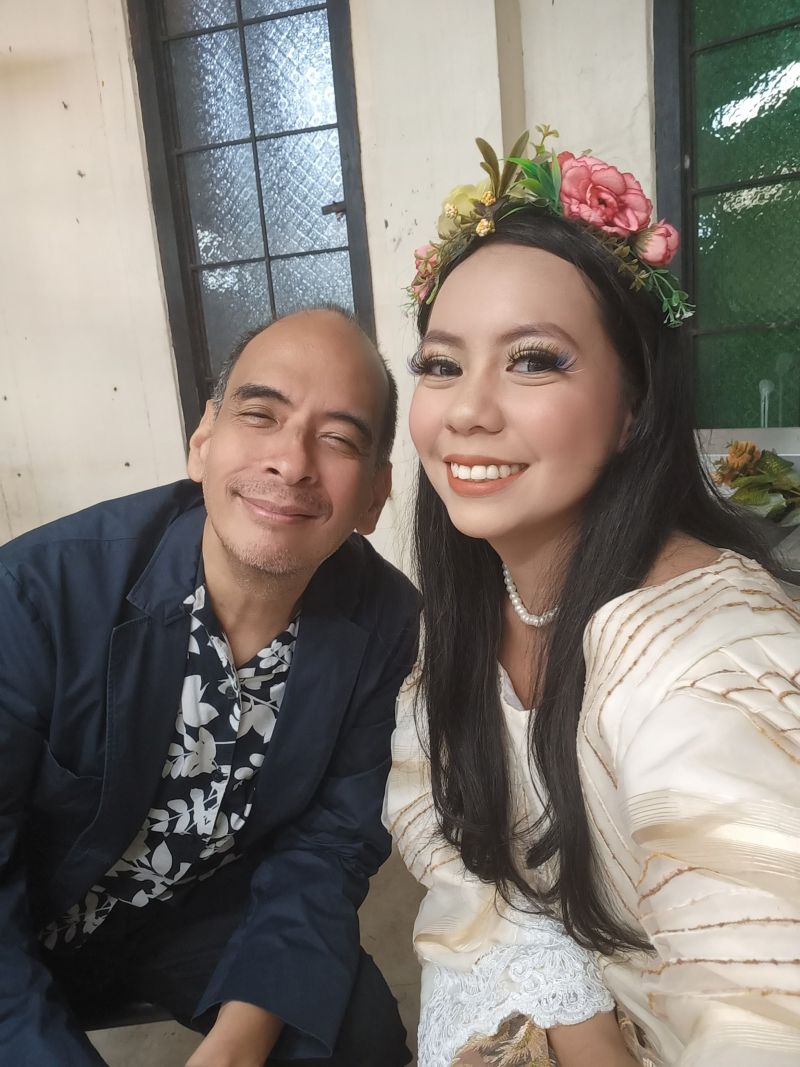
Coke Bolipata with soprano Angeli Benipayo who sang one of the roles in the Handel opera,Serse, the first opera mounted in the fishing village of San Antonio, Zambales.
Saturday night, June 28, at Manila Pianos, Coke Bolipata mounted a modest recital—his first in 10 years—and felt gratified. “I was honestly surprised—and deeply moved—to see a full house that evening. These days, you don’t take that for granted. I wasn’t sure how a piece like Spiegel im Spiegel would be received—it’s so spare, so introspective. But something extraordinary happened: a silence fell over the room, deep and reverent. You could feel the audience breathing with us. Some were moved to tears. The bravis that came after weren’t just applause—they felt like a shared release, a collective thank-you.”
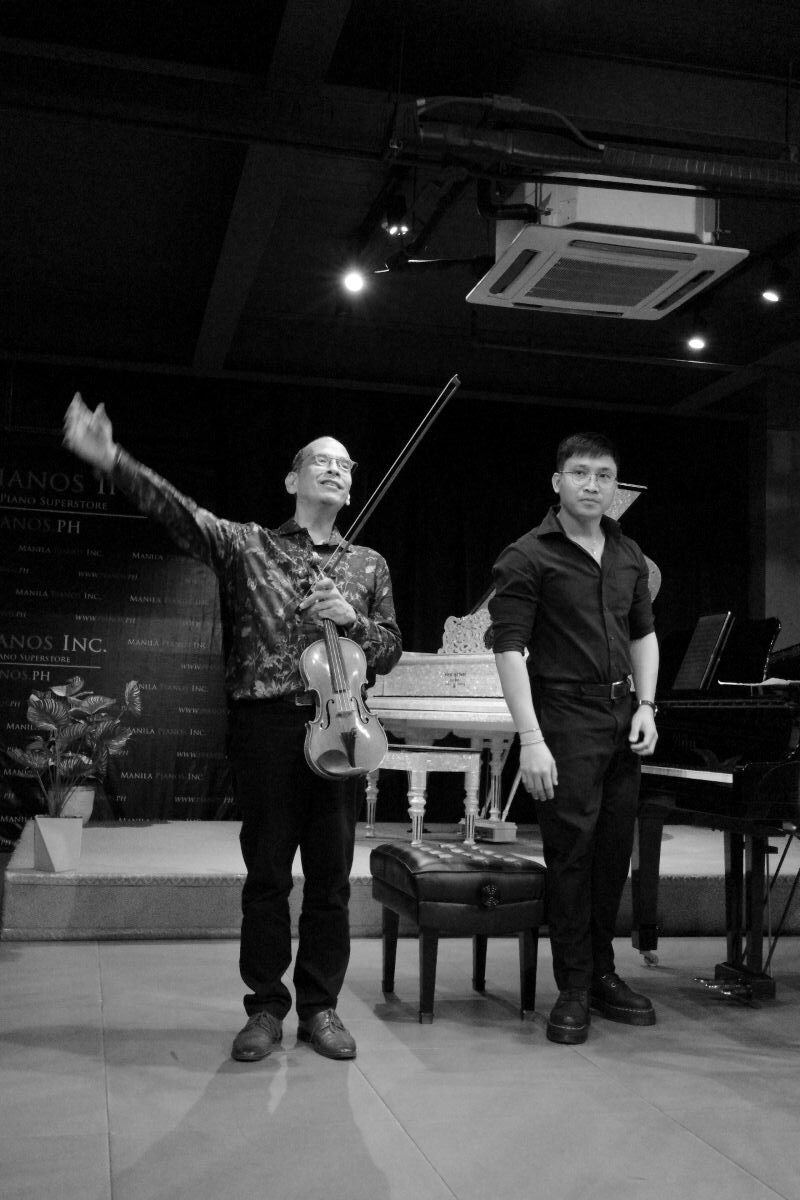
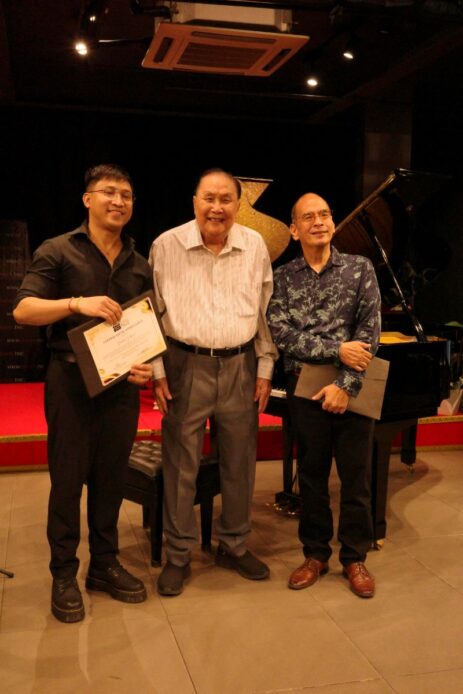
Coke Bolipata with pianist Zandro Zulueta at Manila Pianos: ‘I look back to mentors like Oscar Yatco and Stella Brimo…. But that absence is both a loss and a kind of freedom’
Coke likes to think his collaborating artist, Zandro Zulueta, belongs to a new generation of performers—one for whom much of the country’s musical past may remain unknown or only vaguely felt. “It’s one of the conditions of modern times: legacies fade quickly, and the artists who shaped entire eras are often forgotten. I look back to mentors like Oscar Yatco and Stella Brimo, and I sigh—remembering how their mere presence could command a room. There was a gravity to them that’s hard to explain, and harder still to pass on. But that absence is both a loss and a kind of freedom. It allows younger musicians like Zandro to face the challenges of artistry on their own terms. The lessons are still there—discipline, sensitivity, depth—but the medium and the pace have changed. I must say Zandro met those challenges with grace and agility. I first had the chance to work with him in a series of concerts in Davao two years ago, and immediately appreciated the lightness with which we played together. There’s an ease to his musicianship, a generosity in the way he listens and responds. It’s been a joy to share the stage with him—and to watch him chart his own path, quietly and with conviction.”
At this stage of his musical journey, Coke’s performing life has changed. “It’s no longer about proving anything, or chasing perfection. It’s about finding joy—in the music, in the moment, in the faces of those who are listening. I’ve learned not to let the pressure to impress drown out the message I want to convey. That night reminded me that connection, not brilliance, is what matters. And I’m profoundly grateful—to still be relevant, to still be doing what I love, and to still have something to say.”
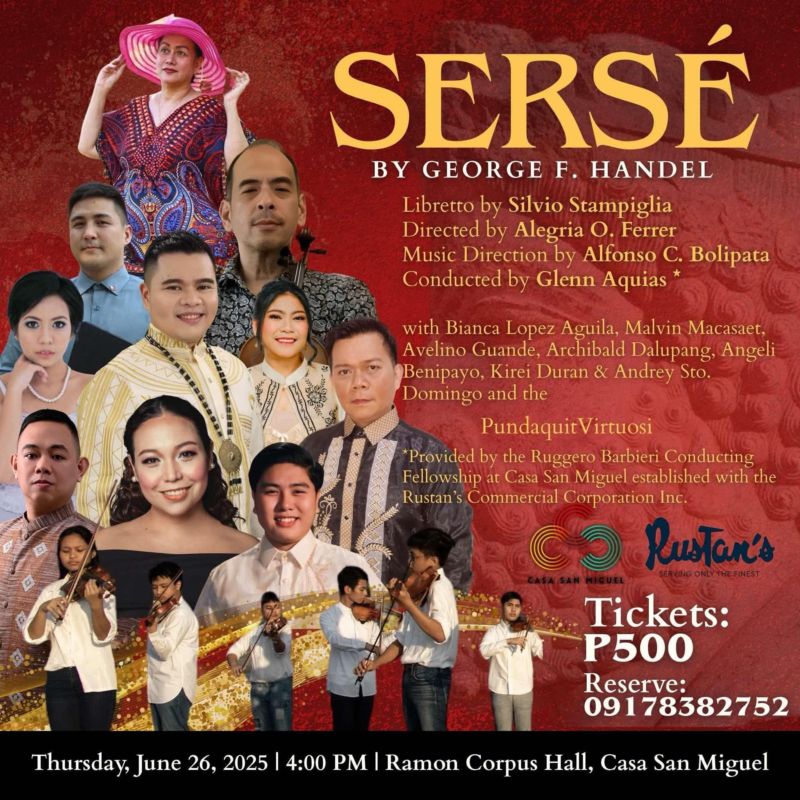
Pundaquit poster of the Handel opera in San Antonio, Zambales.
Two days before his Manila Pianos concert, he was overseeing the staging of Handel’s opera Sersè, again in Pundaquit, Zambales.
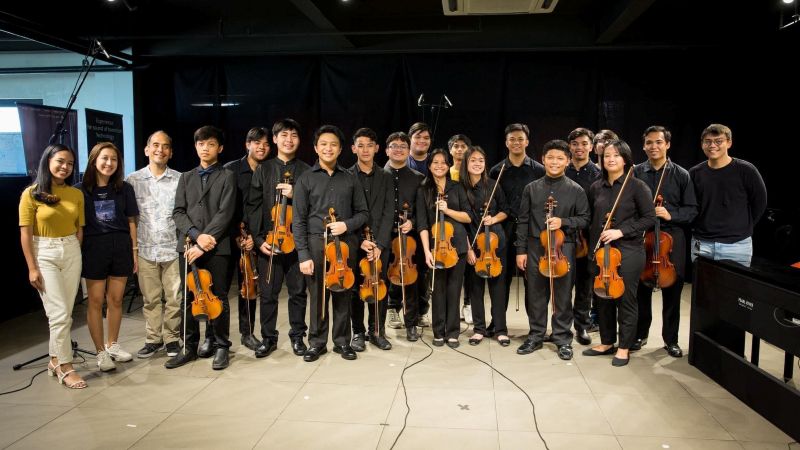
Coke Bolipata (third from left) with members of his Pundaquit Virtuosi
One is curious if there is an audience for opera in that small town by the sea. Directed by Alegria Ferrer, the Handel opera was brought to life with the live music of the festival ensemble called the Pundaquit Virtuosi.
Angeli Benipayo, one of the featured singers in the Handel opera, shared her first opera outing in this fishing village. “The audience really enjoyed the opera. They were able to follow the story because of the subtitles. We actually interacted with the audience, and we could see they had a good time with Handel.”
Coke shares the good news. “Yes, we do have an audience for opera in that small town, and they are more than ready for more. Handel’s Serse was, simply put, an afternoon to remember. The performance unfolded like a rare jewel—intimate, fearless, and deeply moving. With minimal set design, the spotlight was firmly on the singers. And they delivered—each voice rang out with clarity, passion, and power, proving that excellence doesn’t require spectacle. The in-the-round staging made every note feel personal, every emotion close enough to touch.”
On staging Handel’s ‘Sersè’ in Pundaquit: ‘Yes, we do have an audience for opera in that small town, and they are more than ready for more’
What struck the violinist most was the response. “There was a full house on its feet, clapping, cheering, asking for more. This wasn’t just polite applause. This was recognition. Hunger. Joy. It’s a quiet tragedy that many of our finest singers—who should be center stage—are too often relegated to the chorus of international productions, even here at home. Sersè was a gentle but firm rebuke to that. It reminded us of what’s possible when local talent is given space to soar. Zambales is ready. The soil is fertile, and the seeds have been planted. Sersè is just the beginning. We’ve seen the first bloom of what I believe will grow into a vibrant, enduring garden of artistry rooted right here, by the sea.”
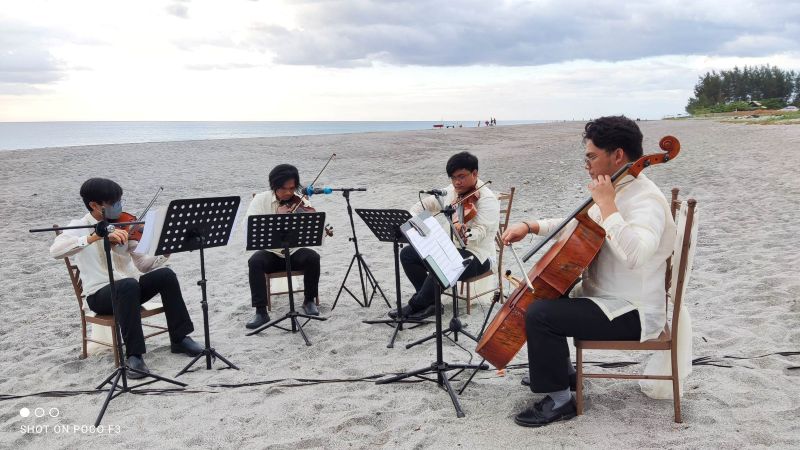
The Pundaquit String Quartet by the sea of San Antonio, Zambales
His Pundaquit Festival of the Arts in San Antonio, Zambales, is 32 years old, and has given birth to several music-related advocacies that include honing young talents and interacting with public schools not just in Zambales, but in Metro Manila.
For the record, the Pundaquit Virtuosi represents eight generations of musicians and artists. Casa San Miguel has been training for the last 26 years, under its community arts program called Cuerdas Cuadros.
Initially designed in 1994 by Coke Bolipata as a community development program for children after the devastation wrought by the Mt. Pinatubo eruption, the program has expanded its reach to include gifted students from other parts of the country, including Manila, Pampanga, Baguio, Pangasinan, Samar, and Davao.
Its pioneering members have garnered awards from the National Music Competitions tor Young Artists (NAMCYA), slots in the Asian Youth Orchestra, grants from Asian Cultural Council and the Japan Foundation, as well as scholarships to secondary and tertiary level institutions including the University of Santo Tomas Conservatory of Music, the St. Scholastica College of Music, the Colleges of Music and Fine Arts of the University of the Philippines and the Philippine Women’s University, the Sta. Isabel College of Music, and the Philippine High School for the Arts.
Coke’s effort was highlighted by a European tour of the Pundaquit Virtuosi in 15 cities in eight countries 2019. Looking back, he observes: “Classical music in the Philippines has always operated within fragile infrastructure, if not an outright lack of it. What exists often runs on missing parts: few institutions, limited funding, inconsistent mentorship, and little in the way of a long-term ecosystem for artists. Any career in this field, then, feels constrained from the very start—defined more by obstacles than by possibility. I was lucky, in a sense. I had the rare privilege of being mentored by Maestro Oscar Yatco and nurtured within the Philippine Philharmonic Orchestra. That period led to a series of performances and recordings of major works for violin and orchestra, from Bach to Berg. These were formative years, grounding me in the canon, while also affirming that such a path was possible, even here.”
Founding the Pundaquit Festival and giving birth to its advocacies altered his musical vision. “It saved me from the rigid linearity of a conventional performance career and opened lateral directions—paths that allowed me to explore other urges: teaching, curating, organizing, creating space for others. The violin never left my hands, but the role it played expanded. It became not only a tool for solo expression, but also for community building, for storytelling, for asking deeper questions about art, identity, and place.”
Looking back over the past 32 years, the music highlights he remembers aren’t only the performances on grand stages or the collaborations with orchestras. “There are also those quiet recitals in village chapels, the spontaneous ensemble rehearsals in the schoolyard, the sound of a student playing their first clean phrase. They are moments where music—and now, words—have found a way to live and even flourish, despite the odds, on our own terms.”
For him, his life as teacher and festival organizer has been a continual weaving of art, purpose, and community. “Teaching, for me, has never been just about instruction—it’s about nurturing imagination, discipline, and voice. Whether guiding a young violinist through their first notes or mentoring an artist in shaping their narrative, the work is always grounded in awakening a sense of agency and wonder. Festival work began as a natural extension of this, initially focused on staging concerts and creating spaces for performance. But over time, it evolved into something far deeper: a platform for education, critical reflection, and cultural reclamation.”
Festival work has evolved from staging performances to creating ‘a platform for education, critical reflection, and cultural reclamation’
The growth of the school has been a vital part of this journey. What began as a modest program in San Antonio has since expanded, with satellite sites now in Tondo and Batangas. “Our core community has grown to over 200 young learners each year, many of whom return annually, forming a living, evolving family. And with the launch of our teacher training program, we’ve experienced a massive leap—scaling up to reach over 2,000 students through public school partnerships, equipping teachers to integrate arts and cultural literacy into their classrooms.
“Teaching and organizing have become inseparable for me—both are acts of care and construction. They are about building something that lasts beyond a single performance or lesson: a sense of continuity, of cultural rootedness, of possibility. And ultimately, about creating spaces where art is not a luxury, but a way of life. Now, the fulfillment I get is different. It’s not just in the applause after a concert, but in watching a young student discover the violin for the first time, or seeing a community begin to recognize the value of its own traditions. It’s in crafting a space where art isn’t separate from daily life, but woven into it—where creativity becomes a way of reclaiming identity and imagining a future.”
He admits the context of music-making is now different. “Much of what we do now is tied to specific events or institutional needs—more sporadic, less anchored. I sometimes hesitate to even call it ‘performing’ in the old sense. It feels more like we’re all gigging—stepping in for a moment, then stepping back out. The sustained arc of an artistic life feels harder to trace. But performance has also evolved into something else: a part of a broader conversation. Audience development is now a crucial part of the work. It’s through public engagement that the art form grows—charting new waters, breaking boundaries, and staying responsive to the times. And yet, we’re also up against a rapidly shifting landscape: evolving genres, digital fluency, changing cultural appetites.
“Classical music, in this context, can feel like it’s swimming upstream, especially in a country where infrastructure remains fragile and fragmented. Still, through teaching, I’m repeatedly humbled by the raw, radiant talent that surfaces despite the odds. There is an astonishing urgency and clarity in the young people I work with. Often untrained but deeply instinctive, they bring a kind of raw truth that reminds me why this work matters.”


