
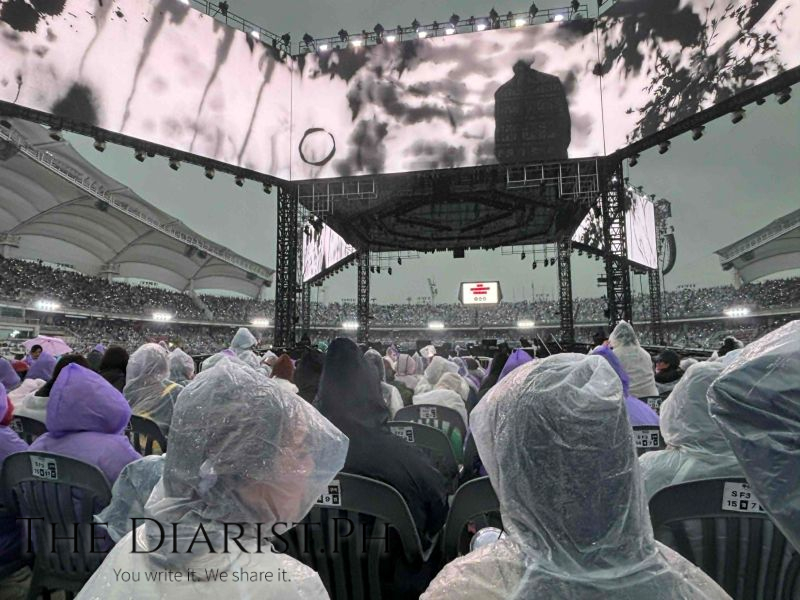
That moment of April 9, 2026—3:30 pm, to be exact—was one time I became truly grateful to be in my senior years. Thank God, I move (okay, look) like a senior, not like a GenZ marathoner. And that was how I came face to face with Mr. Lee, who must be today’s most famous bodyguard in the world, at least on social media.
Mr. Lee has been the bodyguard of BTS for over 11 years now—you see him in reels walking ahead of the boys, alongside them, or a few steps behind them, his eyes a razor-sharp scanner of the crowd, his hands usually extended like one physical bar between the boys and the fans trying to press in.
View this post on Instagram
Or sometimes, reels and fan feeds capture him in chill moments with the boys. One of the most shared posts shows him with Jin: Jin greeted and hugged a visibly touched Mr. Lee after the eldest BTS walked out of the camp gate during his discharge from military service. Mr. Lee headed the BTS security detail stationed at the gate waiting for Jin to hop into the van.
@bangtan_fanlife Even their bodyguard is happy he is back 💜💜💜 #jin #jinisback #wwh #kimseokjin #theastronaut #btsjin ♬ Never Let Go – Jung Kook
Given how fans stan him, it’s not surprising that Mr. Lee, endearingly called the “8th member” of BTS, is known to people worldwide and has grown a fandom of his own, some of whom call themselves “LEEgions.”
April 9 was the comeback day of BTS, the BTS World Tour Arirang concert, after four years the seven boys spent in South Korea’s mandatory military service. To a global fandom known as ARMY, the day was not only special but also most significant—the DDay. To say merely that ARMY had been looking forward to it does not quite capture that massive, aggregate scream, like a global creature waiting to exhale. I had prepared (logistically, digitally, psychologically) for this day—one on my bucket list (my first live BTS concert)—but I wasn’t exactly waiting to exhale; I was more like out of breath that afternoon of April 9.
In Goyang, Seoul, we arrived way before lunch at Goyang Stadium, and settled down to a quick BBQ lunch in a restaurant in the vicinity way before the 3 pm soundcheck. We were in full gear for rain—more than 90 percent probability, according to forecast. “I don’t even remember being this anxious before my general anesthesia, CS (caesarean procedure, eons ago),” I told my lunchmates in a self-mocking tone, Theresians many years my junior whom another Theresian, our chief ARMY enabler Nikko Dizon, introduced to me. Olive Santos, the hip mom of one of them, was telling me to stop putting on, taking off, then putting on again my rain gear in panic mode. Calm down, she said, as I tried to choose between my vintage Comme des Garçon long raincoat (an old freebie) or the transparent raincoat given the ARMY in the venue.
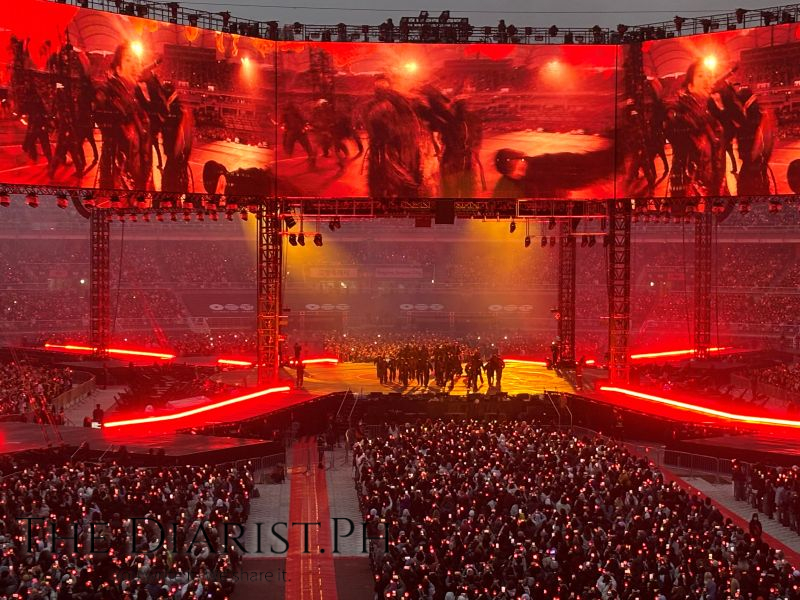
Panoramic view of Goyang Stadium, BTS Arirang World Tour, at sundown on April 11, 2026, under clearer skies.
Relax? BTS World Tour Arirang would be my first K-pop concert, no, my first open-arena concert—count out Madonna, Michael Jackson, Katy Perry and such concerts, all in Manila, not in an uncertain foreign land. To me, this was unknown territory, charted on sheer blind faith in Nikko. For my sons who could be reading this—know that I didn’t even make it to that historic (and controversial) Beatles concert in Manila in the mid-‘60s, unlike my grade school classmates (one of them from a prominent family that had free access), because I didn’t want to skip class—in grade school! (Yes, nerds are made, not born.)
This was my first K-pop concert, no, my first open-arena concert—count out Madonna, Michael Jackson, Katy Perry
Tita Olive, supposedly more senior than I, could walk fast, I’d soon find out, quite fast so that she left me behind in the rush to the floor (open air) for the soundcheck. She was in half-dash to the floor section since the soundcheck was about to start. I was trying to catch up about a meter behind her when the staff pulled the wheeled rail barricade right in front of me, just as I was about to step in. My one foot almost in, she said, “Closed!” “Closed?!” I said out loud.
I couldn’t believe it, then right that second, I saw, popping up to my right, a black-suited man who asked the staff to pull back the rail barricade and motioned me to walk right in, giving me a nod to say that it was okay to proceed. I did right away, saying “thank you” to him, telling myself that I didn’t know BTS security must all look like Mr. Lee—until I realized, it was Mr. Lee!
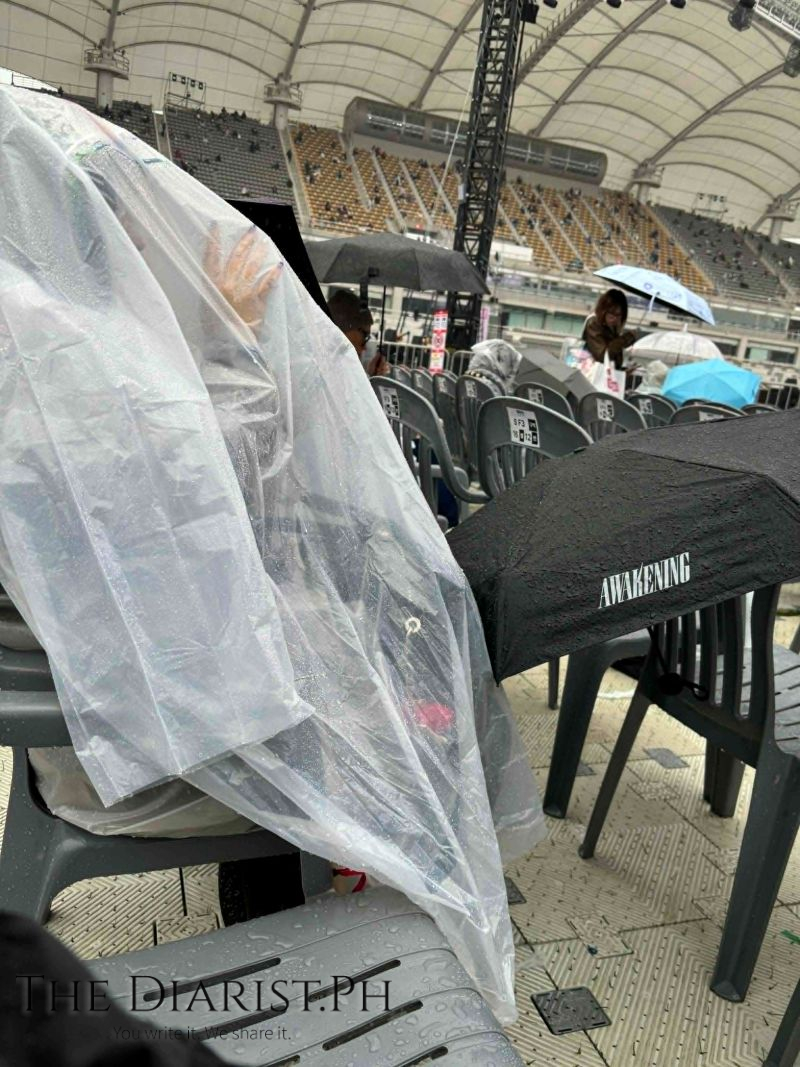
ARMY in full shroud, working her phone, waiting for concert to start in Goyang April 9
I didn’t have time to throw a lingering gaze back, because no sooner had I reached my row than BTS were already onstage starting Swim before a screaming ARMY, now all up on their feet. So it was indeed Mr. Lee preparing to clear the path for the side entrance of the boys. It was Mr. Lee, who let me and two others beside me step in, even as perhaps right that moment BTS waited far deep on the side ready for their triumphant entrance to the stage amid the growing euphoria of an audience gathered in the slight downpour. The gentleman bodyguard must have noticed how this “tita ARMY” was trying to make a valiant dash for the rail, was almost at the rail—but could only waddle in those chunky boots (trainers were not for this cold and rain).
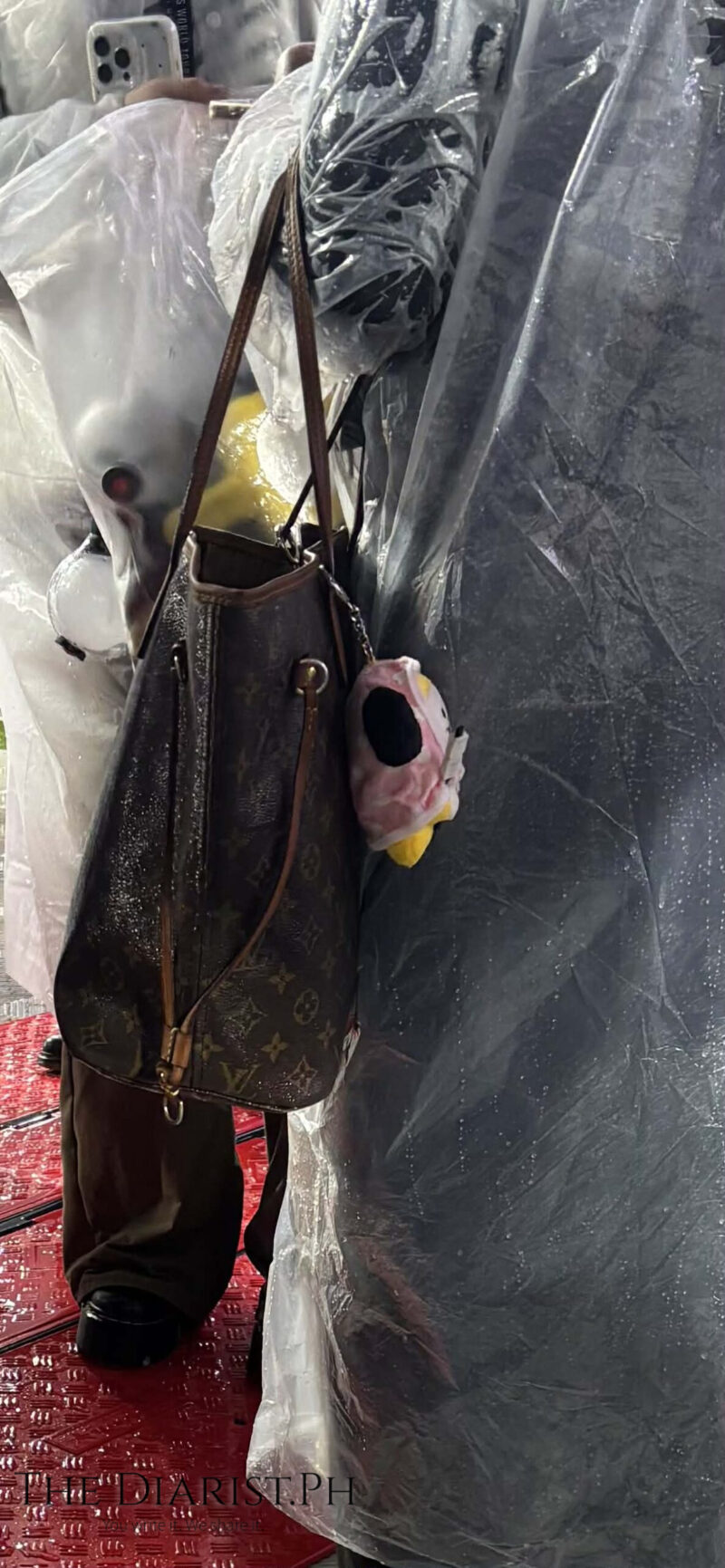
Bag soaked in the rain
The “señora ARMY,” our TheDiarist.ph reviewer Tats Manahan would chide me later.
I could have missed the soundcheck if not for him. No surprise, little gestures of kindness by Mr. Lee towards ARMY have been going viral. It would only be on the second concert day, April 11, when I had a bird’s eye view from the second floor, that I saw how, way before the start of the 7 pm, concert, Mr. Lee and the security retinue were indeed clearing the side exit right where I came face-to-face with Mr. Lee two days ago; that would be the BTS’ entrance route. Unlike in other concerts where BTS were borne right up on a platform in the middle of the stage, in this comeback concert, BTS entered from the side. From my second-floor perch, I also saw how the security would wave right in the latecomers to run to their seats—I, therefore, was no exception, just standard procedure.
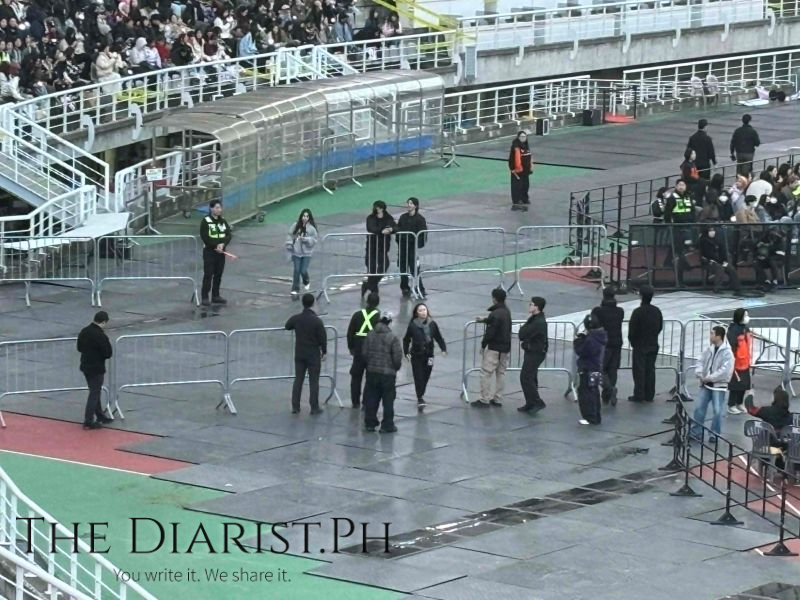
Side entrance, where BTS would emerge, manned by the security team
But still I like to think that mine has been a unique experience of the considerate gesture of the famous bodyguard towards a “tita” trying to catch her breath.
It was already 3:45 in the afternoon when BTS began the soundcheck with Swim, in their jackets and hoodies because the drizzle was getting heavier. Normal, Hooligan—by-now popular tracks from their newly launched Arirang album—followed, the boys and their fandom remaining oblivious to the downpour that came with clockwork precision.
ARMY and BTS stayed together in the incessant downpour for almost four hours!
After four years, the much-awaited reunion of BTS and ARMY happened in the rain. This made the significant occasion even more special, the historical even more personal and unforgettable—ARMY and BTS stayed together in the incessant downpour for almost four hours (including the soundcheck)! From the mid-afternoon soundcheck to the evening concert that began at 7 pm and ran for over two hours, Goyang Stadium was a sea of transparent raincoats lit with the rhythmic wave of ARMY lightsticks.
After the soundcheck, where mostly Jin and V, among the seven, worked our side of the floor, I didn’t bother to leave my seat and just decided to wait for the 7 pm concert, like many in the audience did. (To pass the hours, believe it, I prayed my daily rosary on my seat—but without making an imposition on the divine to stop the rain.)
It was during the wait that I felt the strong bond—warm and cordial—among ARMYs. I got the customary tokens from my seatmates, Chinese ARMYs from Shanghai, BTS keepsakes and jellies. In turn I dug into my bag for whatever I could hand out, Snickers and Mentos (uh, not really the ARMY type of hand-outs, and I didn’t want to part with my Skyflakes). Part of ARMY bonding in concert is sharing goodies and BTS tokens—they always come prepared (second day, I got a BTS paper fan and clip).
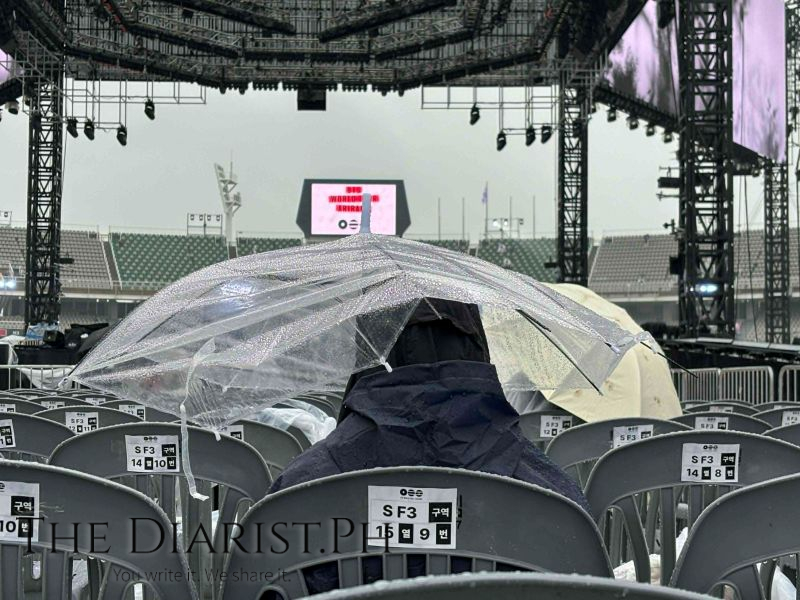
ARMY determined to stay put and wait for the concert after soundcheck
At Goyang Stadium that afternoon, ARMY was one tight huddle in the rain. ARMYs could be fierce and feisty online, but on the ground, they were warm, cozy, fraternal. The bond among supposed strangers is instant among ARMYs in a BTS concert, “You can leave your stuff and they don’t get lost,” Nikko told me, preparing me for the ARMY experience. I witnessed it right that moment—since the hoodies of the two ARMYs were blocking the view of my Chinese seatmates, the latter tapped the hoodie-wearers on their shoulders and volunteered to fold the hoods themselves, in the process even fixing their hair. I was so amused watching these two pairs of ARMY strangers—seated in front, the other behind—doing a quick hair fix to allow a better view for everyone.
(I must include this amusing vignette: On the second day of the concert in Goyang, at Subway restaurant near the stadium, we sat amused at the table with a Chinese ARMY, who spent the pre-concert hours putting on makeup on her co-ARMYs, her entire makeup paraphernalia, from brushes to sponges, laid out on our table. On-the-spot makeovers in preparation for their posts, reels, and livestream. How to be GenZ!)
The heavens may have turned nasty that night in April, but ARMYs knew how to count their blessing— RM, Jin, Suga, j-hope, V, Jimin and JK reunited onstage at last.
As the clock ticked closer to 7, ARMYs rose as one from their seats and broke into cheers and chants that grew louder and louder until fireworks heralded the entrance of the boys, flag-waving dancers ushering them in. Right at that moment at Goyang Stadium, the BTS World Tour Arirang signaled the official start of the 2026-2027 tour that would take them across the globe, in 85 performances, 23 countries, 34 cities. The non-stop rain made sure that this kick-off would be like no other in recent concert history.
View this post on Instagram
The first number, Hooligan, fired up the crowd, the stage spewing out columns of fire, followed by another hyper-energy song, Aliens. As early as these first tracks from Arirang, the audience discovered that immersive 360-degree-stage experience. The boys didn’t stay put on centerstage but instead worked the wings on all sides, performing the closest they could get to fans, free-style dancing, singing, engaging the audience, then bringing back Run BTS, all this as they got heavily drenched in the rain. Curiously, the downpour became even heavier the moment they did their signature greeting, all seven standing in one line on centerstage to take a bow before the audience and to speak, their voices mixing with the steady patter of rain. Here were the seven, their makeup washed away by the downpour dripping on their faces, their hair soggy, all together facing ARMY and the world again. Not even the stormy weather could dampen those radiant boyish smiles.
Was I glad I wore water-repellent, from raincoat to bomber jacket underneath. All zipped up to my neck, I didn’t get wet or even fill the chill, even late into the night.
BTS Arirang in Goyang featured the new tracks one after the other—They don’t know ‘bout us, Like Animals, Swim, Merry Go Round, Normal—interspersed with the hits that have bound ARMY and BTS through the good and bad years: Fake Love, Not Today, Mic Drop, and of course, in the encore, Butter and Dynamite. In Swim, funny V was literally trying to swim in the puddles accumulating in the rain. The boys were all over the place in Fake Love, water splashing on their heels, leaving you amazed at how they kept raising their performance level on the water-logged stage.
It was ingenious how they meshed FYA with the all-time showstopper Fire. But while they didn’t do the full Fire choreo, 2.0 took its place as the drop-jaw moment, to show what is, as j-hope put it, “the BTS today”—a synchronicity of movements so intricate, minutely subtle, and highly nuanced that it raised pop music choreo to a new level of technique and skill, sophistication and innovation. Indeed, when it comes to music, choreo, performance, BTS have only BTS to beat. The group has evolved way beyond the K-pop genre, and Arirang is the evolution.
@iamyournnay We don’t stop rideeeee 🔥 @BTS #BTS_WORLDTOUR_ARIRANG_GOYANG ♬ เสียงต้นฉบับ – iamyournnay
Jon Caramanica wrote in New York Times: “Throughout the 2010s, BTS set the high-water mark for K-pop’s worldwide spread with a hyperkinetic blend of sturdy hip-hop, lithe soul and punchy pop…. Its success was musical, but also symbolic, an announcement of South Korea’s primacy on the global pop stage.”
In Goyang, like in their succeeding concerts, Idol served like a battlecry to rally the troops, and how. Behind the BTS flag unfurling in the downpour, the boys ran around the stadium, except RM who, recuperating from an injury, was carried on a chair, as ARMY ramped up the Idol chant. What an explosion of adrenaline. Then it all mellowed down in the encore with Come Over, Please (my favorite), and the signature finale, Into the Sun.
My goosebumps moment? A lot on that cold spring night, or two cold spring nights
My goosebumps moment? A lot on that cold spring night, or two cold spring nights (we watched again on April 11, when the ticket site yielded remaining tickets for not-the-best seats in the house). From the second floor’s panoramic overview, I felt so overwhelmed in Body to Body, as the melodious chanting of Arirang by the crowd gave way to the electrifying pounding of drums. The effect was both kinetic and haunting. One felt incredulous and impressed that one country’s folk song would be learned and sung by global communities. (A week later, Arirang would also reverberate at Tokyo Stadium—a seeming irony given the history between Japan and Korea.) Lawyer Val Gonzales, a fellow Theresian, almost chastised us later—“Don’t you remember the Arirang we were told to memorize and sing in class, with other national songs of other countries? How can you forget?” (Never underestimate the memory of an ARMY who paid attention in class.)
It was heartwarming how BTS, before filing out on the side wing, stopped and stood in line at the exit, hands linked, took their collective bow to end the night, a humble gesture of gratitude before the stadium and the global audience that kept its word—that it would wait for their return.
View this post on Instagram
The world watching the livestream couldn’t see the vast and diverse demographics of the fandom. That night we did—from kids and GenZs (refuting the notion that BTS fandom has gotten old, ouch!) all the way to the Boomers; we spotted one or two in wheelchairs. (Yes, to ARMY titas out there, a BTS concert is age-friendly, so no need to fear.) The BTS fandom cuts across generations and demographics. That should be obvious by now.
How did we ourselves land in the fandom? It’s a long story from Inquirer newsroom to Goyang
How did we ourselves land in the fandom? It’s a long story from the Inquirer newsroom to Goyang, from print journalism to the digital platform.
Long story short, it was BTS who gave us the idea—in a manner of speaking (for we never met the boys)—to go digital and launch the website, TheDiarist.ph, on Dec. 4, 2020 (yes, Jin’s birthday), as a platform for writers and essayists. It was not for ambulance-chasing spot news reporters and certainly not for preening influencers (we don’t have the flat abs for that).
At that time our colleagues Alya Honasan, Nikko Dizon (both ex-Inquirer), and Lou Gonzales (the digital native among us, who graduated from digital publishing at NYU) just wanted to write our pandemic experiences, starting with how BTS and K-drama had become our world’s escape from the pandemic. It didn’t hurt that my son, Luis Carlo, was the most visual among us, who encouraged his mom’s BTS binge-watching and had a network of GenZ videographers. Our veteran PR friend, Annie Ringor, was the chief enabler because she was into BTS herself.
Aside from being the most gifted and assiduous music makers of their generation— just watch their dance practice videos to see that incredible precision, and listen to their lyrics that plumb the psyche of today’s youth—BTS ushered me into the digital era. They serve like a digital teacher in a manner no techie could. (Like, to learn how to do Weverse and queue online for tickets for days!—you have to try it at least once in your lifetime, like swimming, or go through it, like a root canal.)
BTS ushered me into the digital era. They serve like a digital teacher in a manner no techie could
As early as 2015 or even earlier, as Inquirer Lifestyle editor, I was noting my staff’s obsession with K-pop (one would skip work just to attend K-pop dance lessons) and K-drama. Nikko would fly abroad just to watch BTS perform. Another editor was into the pre-BTS generation of K-pop (Beast/Highlight), and considered it sacrilege to move from Highlight to BTS.
This newsroom milieu got me listening to BTS and watching all their videos, including the summer travel episode shot in Coron, their rookie days (American Hustle Life, BTS Rookie King—start your binge with these early unfiltered videos), their Bon Voyage series where they are giddy, adventurous boys let loose in their first-time destinations (i.e. losing a passport, missing luggage). I sat up, stayed glued, and laughed real hard. These antics and foibles cracked me up—and, because they could very well be like my sons, they could give any mom like me a vicarious high-blood. Relate.
For many, they have become the “happy pill.” Tita Olive discovered BTS as she was trying to cope with the grief of losing her husband. I remember a dear friend, one of Manila’s known socialites, who went through her chemotherapy watching BTS videos. A stan of RM, who she believed was the quintessential leader, she would hurdle an MRI by asking the hospital staff to play BTS.
That was when I began to realize how perhaps, by force of circumstances (scant access to mainstream media), and unbeknown to them, these seven boys—artists/goofballs, what a rare combination— could be leading the world to a new form of engagement: the digital space of raw, no-filter videos. They were neither performing nor mounting acts, but were simply turning on the cameras in their day-to-day life. In those early years, hardly did people predict that BTS would usher in the norm of authenticity and candor in social media—and win you over with their various quirks and unique personas.
True enough, in their wake came the buzz words “authenticity,” “rawness”—which in time every influencer started to use. In fact, these became today’s marketing playbook. (In 2020, my farewell story in Inquirer, right before retirement, was how BTS “capture the Zeitgeist of the era—by being so raw and honest,” how they became this era’s success story by blending digital technology with their music and old-fashioned family values.)
In 2020, I became more curious after Harvard Business School published a case study titled Big Hit Entertainment and Blockbuster Band BTS: K-pop Goes Global. I even answered a survey run by an informal group of Ivy League graduate students in the US about BTS. By then, the business and academic institutions were already seeking empirical data on the K-pop industry and its fandom, most specifically the BTS phenomenon.
Also, I caught author Paulo Coelho’s tweet (pre-X era): “To all those who are always criticizing @BTS_twt, the most important band in the world: Please watch a few videos: I am sure you gonna change your mind.”
During the pandemic, BTS became a 24/7 digital diet—their cameras, turned on for streaming whenever they felt like it, creating an engagement with fans (even non-fans) the extent of which modern history had not seen. They banked not only on fame or celebrityhood, but also on their sheer presence in your home or in your personal space.
After this, celebrityhood would never be the same again—BTS spun off their accessibility and relatability into a personal addiction/obsession of a fandom. And it was a fandom that was thinking and analyzing, feeling and empathizing, protecting and even owning, as Jimmy Fallon said, “seven of the biggest stars on the planet.”
‘If my sons could be as tight as they are, that’s a blessing,’ said an ARMY mom
These seven have spent half a lifetime living together, developing a brotherly bond that past and present pop celebrities would perhaps find hard to match. “If my sons could be as tight as they are, that’s a blessing,” said an ARMY mom who has seen the BTS grow from boys to men, seen how the eldest Jin would drive the youngest JK to school, how V and Jimin bickered over “dumplings,” the members beaming like proud elders during JK’s graduation—ARMY memory bank. Even in today’s videos, Jin, who loves to cook, insists that you throw a noodle at the wall, and if it sticks, then it’s cooked. They talk to each other so fast it puts subtitling to the test. Their chemistry onstage—no scriptwriter could write a better one. Offstage, through the years, BTS made BTS (behind-the-scenes) addictive content, which other pop celebrities could follow as template.
Their story or narrative is now the lore of contemporary pop, passed on from a young generation to an even younger generation.
Engagement? About the group’s chemistry, Jin is quoted in a docu how he only has “to catch their eye” to communicate. Curiously enough, that “communication” has extended to their fanbase. BTS-ARMY engagement is worth a study, as even luxury brand marketers know.
An example of such engagement: In the Arirang concerts, RM has been telling fans to “look at us” instead of your phones, to share and enjoy the moment. Watching in Goyang, I was nudged by my ARMY seatmate—with a stare— to do just that: relish the moment.
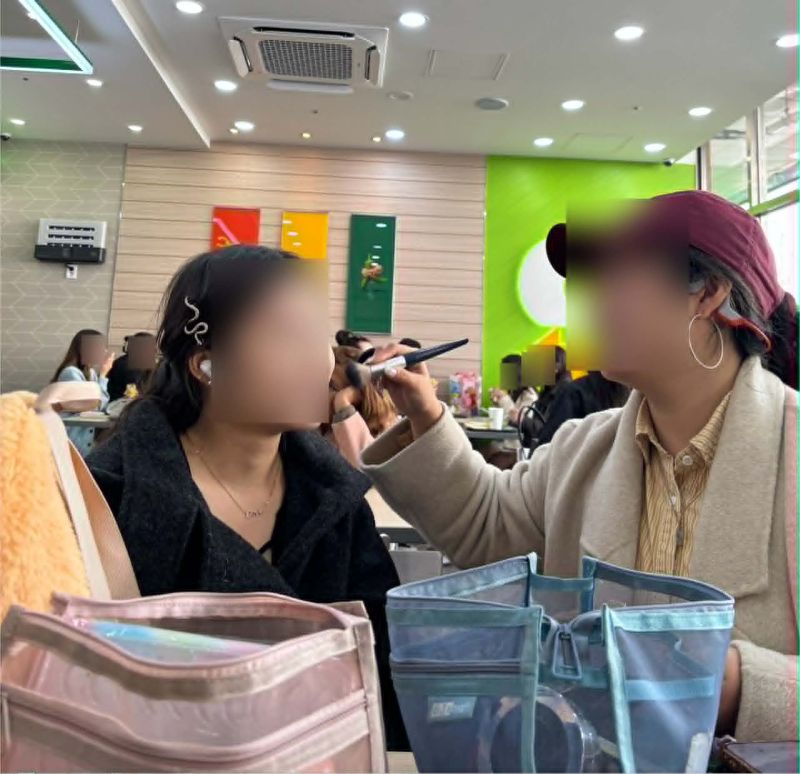
ARMY doing makeover for their posts
It’s downright amazing how BTS can stir up not only a fanbase, but also an economy. New York Times wrote: “After a four-year hiatus, the powerhouse K-pop septet BTS has returned with a new album, Arirang, a raucous test of its creative mettle amid rapidly changing genre norms; a temperature check on the strength of Hybe, the conglomerate that has nurtured it for more than a decade; and an intended beacon of Korean soft power globally.
“Got all that? Upon this fragile 14-song base, whole economies teeter.”
We get it, BTS have helped define an era. But for us, those hours in Goyang were simple—like enjoying the rainbow even as it rained.
Read more:


