
All photos by Alya B. Honasan
Go to my native land, go, foreign flowers,
Sown by the traveler on his way,
And there, beneath its azure sky,
Where all my afflictions lie,
There from the weary pilgrim say
What faith is his in that land of ours!…
…And tell there of the day he stood
Near to a ruin’d castle gray
By Neckar’s banks, or shady wood,
And pluck’d you beside the way.
-from ‘To the Flowers of Heidelberg’ by Jose P. Rizal
THE young ophthalmology student was only 24 years old and far from home in Heidelberg, Germany, and he sometimes assuaged his feelings of homesickness and solitude by taking long walks on the banks of the Neckar River. It was a path that was known as part of The Philosopher’s Way (Philosophen Weg), as many known thinkers would trek the scenic, isolated trail to clear their minds and enjoy the view of the picturesque city and its “ruin’d castle gray,” in reference to local landmark Heidelberg Castle. He had arrived in winter, February of 1886, and by that spring, on April 22, 1886, he had written the poem, To the Flowers of Heidelberg, asking the flowers to carry his message of love and peace to his much-missed native land.
That young student was Jose P. Rizal, national hero of the Philippines. He was in Heidelberg to specialize in ophthalmology under renowned teacher Dr. Otto Becker at Heidelberg’s University Eye Hospital, where he got to use the ophthalmoscope that had just been invented in 1851. Rizal had a driving reason to be there: He wanted to treat his mother’s cataract problem that was threatening her vision.

The busts of Pastor Karl Ullmer and Ferdinand Blumentritt at Jose Rizal Park
It was on one such walk that Rizal reportedly would meet a pastor named Karl Ullmer, and he ended up transferring to Ullmer’s vicarage in Wilhelmsfeld, a municipality in the hills of Odenwald, some 30 km from Heidelberg.
“In Wilhelmsfeld he found low-cost accommodation, more contact with understanding people, recognition, and the peace and quiet that he needed for his studies and his literary work,” reads a brochure published by the Knights of Rizal, Chapter Wilhelmsfeld-Heidelberg, in May 2023. “Rizal felt very comfortable in Wilhelmsfeld, celebrated his 25th birthday with the parish family, and never forgot his homeland. In the guest room he had pinned a large map of the Philippines to the wall.”
This was also where he would finish the last chapters of his incendiary first novel, Noli Me Tangere, before sending it off for publication. He had left Wilhelmsfeld by the time the novel had been printed in Berlin in 1887, shipped to the Philippines, and was soon sowing the seeds of revolution.

The author by the vicarage on Jose Rizal Strasse in Wilhelmsfeld, where Rizal finished the ‘Noli Me Tangere’
Last October 12-21, I was in Frankfurt, Germany, for the Frankfurt Book Fair (Frankfurt Buchmesse or FBM), where, for the first time ever, the Philippines was the Guest of Honor, occupying pride of place in a 2,000-sqm special pavilion, and presenting a packed schedule of talks, discussions, and performances. It was estimated that over 400 writers, illustrators, and publishers showed up, with some 100 Filipino publishing houses represented.
The event was almost a decade in the making, a collaboration of the National Book Development Board (NBDB), the National Commission for Culture and the Arts (NCCA), the Department of Foreign Affairs (DFA), and the Office of Senator Loren Legarda, with Legarda serving as the project’s moving force and primary proponent.

The three-storey apartment at Ludwigsplatz 12 where Rizal finished his poem; note the plaque on the upper left side
The gorgeous Pavilion (“No flowers and not too much color,” Guest of Honor curator Patrick Flores had insisted), designed by Stanley Ruiz, was divided into four zones, one of them exclusively dedicated to works on and by Rizal. Thus, the rockstar intellectual’s intimate relationship with this European nation came very much into focus.
One zone at the Philippine pavilion was dedicated to Rizal. Thus, the rockstar intellectual’s intimate relationship with this European nation came very much into focus
On a gloomy Friday, I took the train from Frankfurt to Heidelberg, less than an hour away, followed by a winding Uber car ride up a pine-lined road to Wilhelmsfeld, which was as quiet as you could imagine a small town to be, although with more modern-looking homes; I spotted only one grocery store, near the post office. I was dropped right in front of the Ullmer vicarage on Jose Rizal Strasse 15, now immaculate but empty. Senator Legarda had reported earlier this year that the house, because of its historic value to Filipinos, may come into Philippine ownership, although that remains unconfirmed.
An earlier photograph of the vicarage had indicated the room where Rizal stayed, with an upper floor left-side window; just imagining our extraordinary hero staring out that window as he wove together the lines of the Noli was moving. In fact, the theme of the Philippines at the FBM was “The imagination peoples the air,” a line lifted from the Noli, where Sisa was at the point of despair, but somehow still hoping that she would find her sons and all would be well. Was Rizal still being optimistic as he wrote this? Compared to El Filibusterismo, his darker second novel, it would seem so.

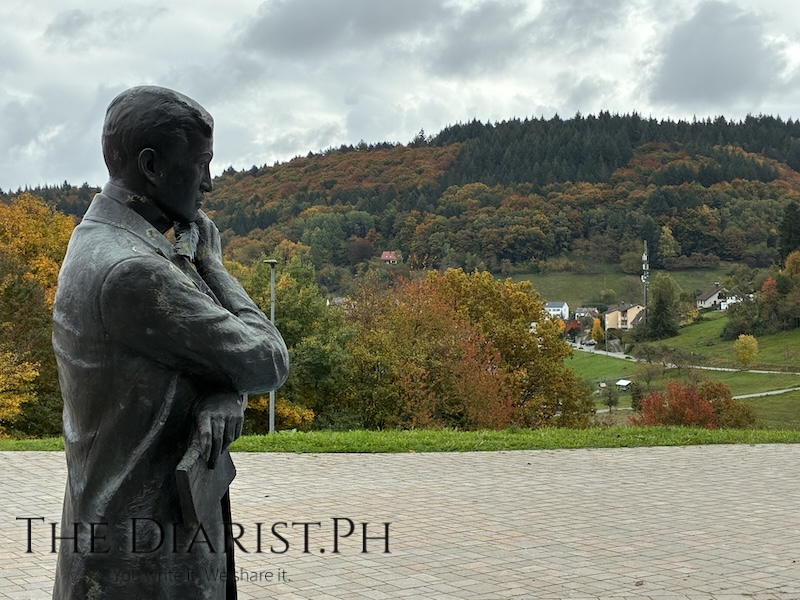
Detail of the bronze statue by Anastacio Caedo
From the vicarage, it was a 15-minute walk to Jose Rizal Park, an expansive open-air area where yes, our boy stands with quill and notebook in his hands, again pondering many things in that great mind of his. Flowers have been lain at his feet by the General Consulate of the Philippines, and the Philippine flag hangs behind him, beside that of Germany. In the summer, the pool he stands beside is filled with water, I was told, but now, he has for a backdrop the colorful autumn leaves of the trees in the distance.
I asked directions from a German lady trimming a hedge; she spoke no English, but knew exactly where Jose Rizal Park was, and pointed me in that direction with a smile.
I asked directions from a German lady trimming a hedge; she spoke no English, but knew exactly where Jose Rizal Park was, and pointed me in that direction with a smile
What’s interesting is that the bronze statue, donated by the Philippine-German Association in 1978 and created by sculptor Anastacio Caedo, is not alone; he has some company in the busts of important people in Rizal’s life and career, including Pastor Ullmer, the Austrian teacher who was Rizal’s close friend and pen-pal Ferdinand Blumentritt, and mentors Dr. Otto Becker and pathologist and friend Dr. Rudolf Virchow—esteemed company, indeed.
Later, upon the suggestion of historian Ambeth Ocampo, I visited the Jesuit Church in Heidelberg—Rizal went to the Ateneo—and saw the three-story building at Ludwigsplatz 12 nearby, where Rizal first stayed in Heidelberg and actually finished his poem. A plaque has been placed on the building, which now houses a bookstore on the ground floor.

The view of the Neckar River from Rizal Ufer in Heidelberg
Most exciting for me, however, was catching a bus back from Wilhelmsfeld to the center of Heidelberg, and an Uber to Rizal Ufer, or Rizal Park. My Uber driver thought I was heading to the hospital across the street, until I asked to be dropped at a bus stop with the sign “Rizal Ufer” nearby, which I followed down to the riverbank. Today, Rizal Ufer is a narrow bike and walking path, with a few benches, that runs parallel to Mannheimer Strasse, but with lots of plants and trees and a view of the Neckar River, accompanied by the soothing sound of rushing water. Birdwatchers would have a field day watching many of the creatures perched on logs or flying overhead.

The marker along the path at Rizal Ufer in Heidelberg, along the banks of the Neckar River, probably part of The Philosopher’s Way
I wasn’t sure if it would still be there, but I was ecstatic to find it: a rock with a worn plaque dedicated to Rizal, who no doubt often wandered this path lost in thought. The inscription opens with the first line of To the Flowers of Heidelberg, followed by these words, translated from German: “Dr. Jose Rizal, 1861-1896, poet and national hero of the Philippines, studied ophthalmology in Heidelberg in 1886. In this poem, the poet describes his great love for his homeland on the banks of the Neckar. The most important spiritual leader of the colonial Philippine freedom movement was convicted as a revolutionary in Manila and executed on Dec. 30, 1896.”
I sat for a few minutes on a bench on that path, with very few people walking or biking past on that early weekday afternoon. I thought about how our national hero also sought solace in nature when burdened with thoughts of the turmoil back home. I appreciated how the German people acknowledged him, and as a “spiritual leader” no less, as Rizal may not have held a gun to incite revolt, but wielded a pen like the most lethal and timeless of weapons that it is.
That I was there on a secluded path that Jose Rizal walked almost 140 years ago, on the occasion of a global event celebrating the power of the written word, was truly a moment to be cherished.


