
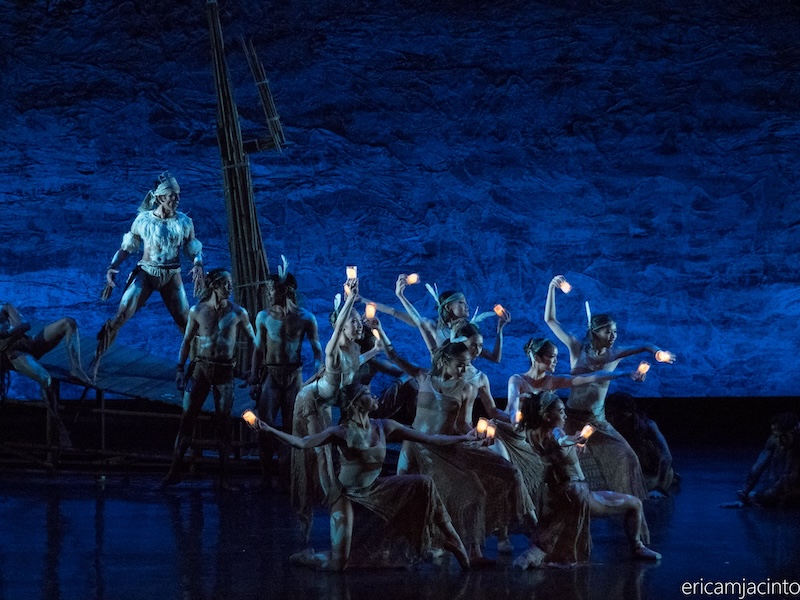
In the studio, dancers of Tales of the Manuvu move as if they’re forming the shape of the world itself. They stretch and bend with balletic sweep and grounded strength, arms reaching skyward, torsos curling toward the floor, evoking the creation of humans, earth, and sky.
Even in rehearsal, the pulse of the music is palpable. Drums and gongs suggest thunder, while electric guitars and melodic vocals hint at the rock-infused score that will drive the full production. The rhythm seems built into the dancers’ bodies, each step and leap carrying the myth forward.

Alice Reyes, National Artist for Dance (Photo by Jojo Mamangun)
Nearly five decades after National Artist for Dance Alice Reyes first brought this fusion of Manuvu myth and contemporary movement to the stage, the restaging feels alive and immediate, rooted in the stories recorded by anthropologist E. Arsenio Manuel such as the making of man and woman, the fragile rope of life, and the separation of heaven and earth.
Performed by Alice Reyes Dance Philippines (ARDP), Tales of the Manuvu centers on the conflict between two gods—Manama, the supreme deity, and Ogassi, the rival deity.
Despite the grand status, Manama’s realm is barren, marked only by a lone katungaw-tungaw, a sparse, hardy tree that survives in harsh conditions and symbolizes resilience and minimalism. In contrast, Ogassi’s kingdom is lush with fruits, vegetables, and life, reflecting abundance and temptation. Manama, good but lazy, issues commands while often falling asleep. One day, he instructs the bumblebees, diwatas, and anitos to steal Ogassi’s fruits by distracting Busaw, Ogassi’s protector. This sparks the battle between the forces of good and evil.
In the Manuvu creation myth, Manama creates the First Man, who is at first content in the new world. But Ogassi intrudes, and because abaca fibers were mixed into the clay from which humans were formed, life becomes fragile and finite. Manuel explained that the inclusion of abaca accounts for human mortality. Abaca, a fiber used for rope, becomes a powerful symbol of life itself, something that can fray or break.
In the dance, this idea is made visible when the cord is cut onstage, a gesture that underscores the fragility of life. Ogassi also plants loneliness in the First Man. In response, Manama creates the First Woman to be his companion. With her, humanity is completed, restoring balance and affirming that life is meant to be lived in relationship.
However, Ogassi sows dissatisfaction in the First Woman, prompting Manama to intervene. In the song Uod na Kakapa, Manama introduces knowledge and sex to humanity, aiming to reclaim the trust of his creations. Over time, however, the world grows harsher and goodwill diminishes. Manama retreats, raising the sky to separate himself from the earth. Ogassi is left to roam unchecked and wreak havoc on humankind. He unleashes Makarallig, a destructive plant that spreads terror and ruin, portrayed onstage as a towering puppet that threatens to consume the world.
Confronted with fear and abandonment, humans learn they must fend for themselves. They unite, overcome Makarallig, and discover their own strength and ability to shape their destiny.
Reyes says the lesson is that we must depend on ourselves and act together as a community. This message of resilience, cooperation, and self-reliance drives the story to its conclusion, leaving audiences with a sense of shared responsibility and hope.
The choreographer was inspired by the research of anthropologist Manuel, who documented the oral traditions of the Manuvu tribe. She went further into the material and read up on the mythology. Unlike the many versions of Adam and Eve she had encountered, this was the first time she had seen the stories that form the foundation of Manuvu belief.
She loved the idea that human life is ephemeral because the rope of life was cut, and that heaven and earth were separated when Manama found the world too noisy and raised the heavens. “It is remembering the past and considering what you are doing with the future,” she said. “I found that very charming.”
This vision is reflected in the signature songs, Noong Unang Panahon, which evokes the distant beginnings of the world, and Ang Puso ng Tao, which reflects on the human heart and creation itself. Reyes says the music and stories captured her imagination.
“The myths charmed me, and made me want to bring them to life. I am an urban girl and a literature major from Maryknoll College, exposed to Western plays like Our Town and Romeo and Juliet, and the Manuvu tales were wonderfully innocent,” she says.
In 1977, Reyes collaborated with a creative team that read like a roster of Philippine arts royalty. The libretto was written by Bienvenido Lumbera, National Artist for Literature; the music was composed by Dero Pedero, with additional music by Afterbirth; costumes were by Ernest Santiago; lights by Salvador Bernal, National Artist for Theater; and lighting design by Monino Duque. Over the decades, the work has evolved.
In 1977, Reyes collaborated with a creative team that read like a roster of Philippine arts royalty, including National Artists Bienvenido Lumbera and Salvador Bernal
The 2026 restaging was by ARDP ballet master Lester Reguindin. It features musical arrangements by Mike Guevarra, production design by Loy Arcenas, lighting by Barbara Tan Tiongco, and collaboration with Jai Sabas of the University of the Philippines (UP) Concert Chorus and a live band.
Reyes took artistic liberties to create a jazz-ballet version of Tales of the Manuvu, blending lyrical and rock-opera styles, voice and music, indigenous mythic tones, theatrical storytelling, and inventive use of props. In the original production, the First Man and the First Woman emerged from a giant cauldron, their body parts tossed in like ingredients.
In the 2026 staging, they come out of a guyabano fruit, a change driven by the theater’s architecture. The Rockwell Proscenium Theater has no wings, so the giant cauldron could not be hidden offstage, and the guyabano serves as a visually striking, compact alternative that works within the space.
The style retains the jazz-ballet flavor of the 1970s. Reyes wanted a contemporary interpretation of a tribal mythology, not a folk reenactment, using ethnic references as inspiration. Baby boomers will feel nostalgia in movements such as swinging and slapping the hips from side to side, a contemporary leap with one leg extended to the side while the other folds around it; Reyes’ signature side tilt; and Martha Graham-inspired profiles. She also developed a unique gesture for the piece: elbows bent in front of the body with the palms facing the dancer, moving up and down in a staccato pattern that evokes urgency.
“I do not want anything that comes anywhere close to K-pop or hip-hop,” Reyes says. “That is so done now. That is one of the reasons I like to stage older pieces. I mentor dancers and choreographers, but I want them to see the range of movements from the ’70s and ’80s so they understand the history and vocabulary of Philippine dance.”
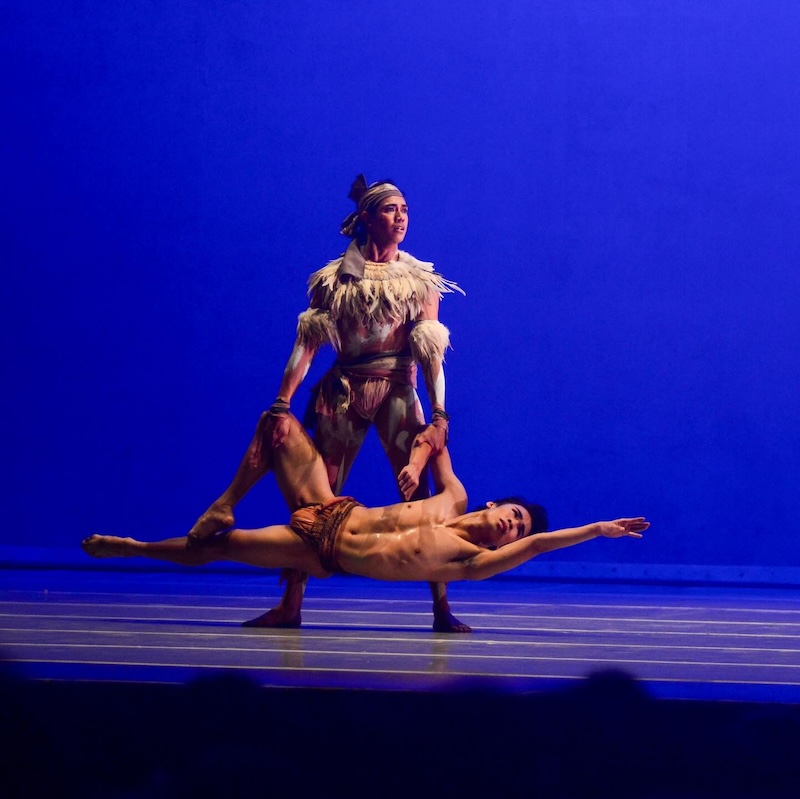
John Ababon as Manama and Renzen Arboleda as First Man in Alice Reyes’ restaging of the ballet (Photo by I.R. Arenas)
She adds, “I’m basically a very lyrical choreographer, and I wanted to keep it light. Yet, there is always a lot of floor work and athletic arm balances to counter the lyricism.” The dancers move with a different energy than earlier generations, carrying the weight and earthiness of modern dance. This new generation at ARDP is more fluid and balletic, bringing a different kind of elegance to movements that still retain the power and ritualistic quality of the myths.
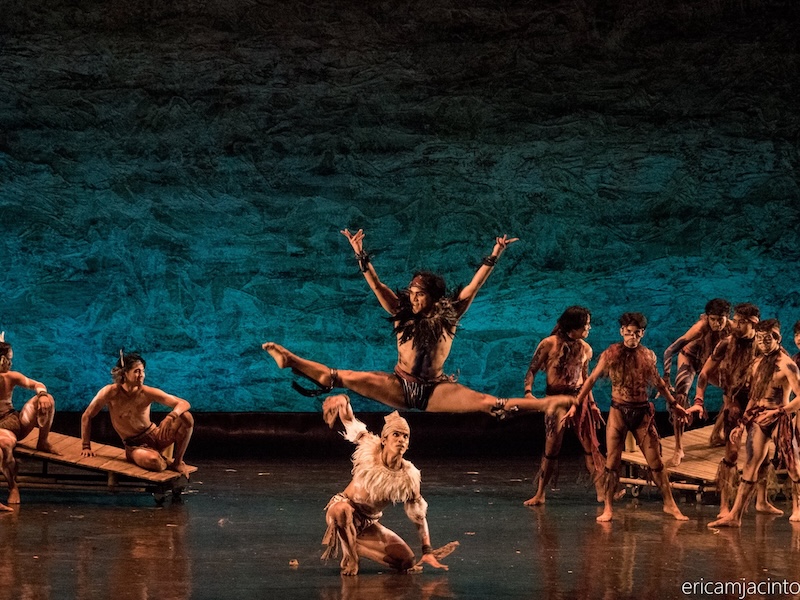
Ejay Arisola as Ogassi (Photo by Erica Jacinto)
Reyes is also flexible with her choreography, adjusting solos to complement the strengths and individual styles of the soloists rather than imposing her choreography originally set for another dancer. Manama, the protagonist, is alternated by seasoned danseur John Ababon, who brings an authoritative presence, and by emerging talent Renzen Arboleda, whose dancing is bold and dynamic. Ogassi, the antagonist, is alternated by Ejay Arisola, naturally gifted with precise and expressive movement, and Erl Sorilla, whose style is sharp and energetic, with sudden bursts of speed that convey cunning and mischief. The contrasts between the gods’ movement qualities such as controlled versus chaotic, measured versus unpredictable, bring the conflict to life on stage.
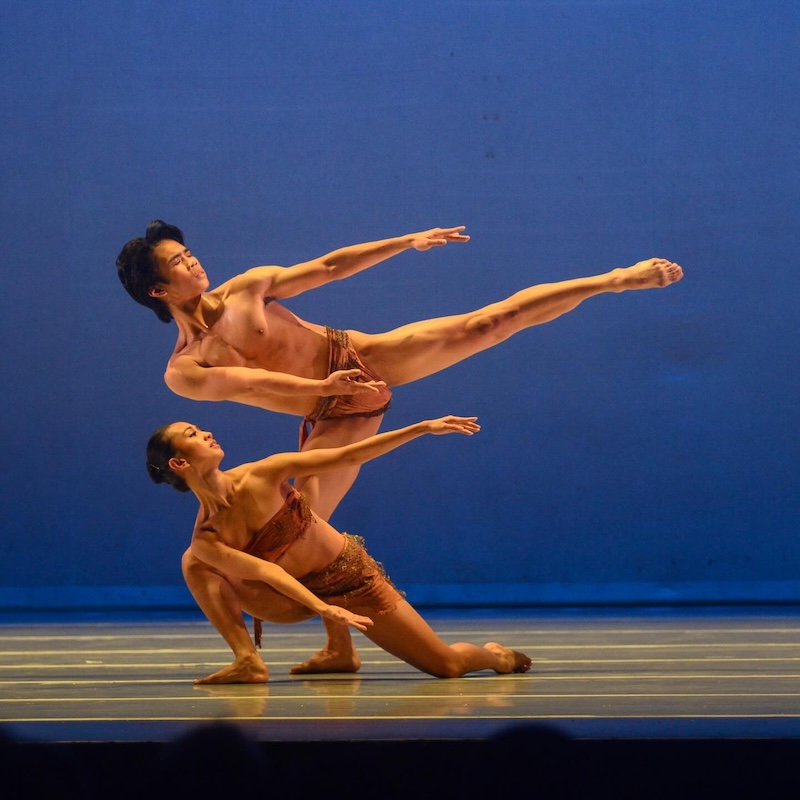
Krislynne Buri as First Woman and Renzen Arboleda as First Man in the latest restaging (Photo by I.R. Arenas)
For the music, the electric piano pounds, brass and sax blast, tribal percussion rattles, and the electric guitar tears through the air. The music drives the myths, the movements, and the audience, leaving them awed.
‘Tales of the Manuvi will run at the University Theater at UP Diliman on February 27-28 and at the Proscenium Theater at Rockwell on March 28-29.


