
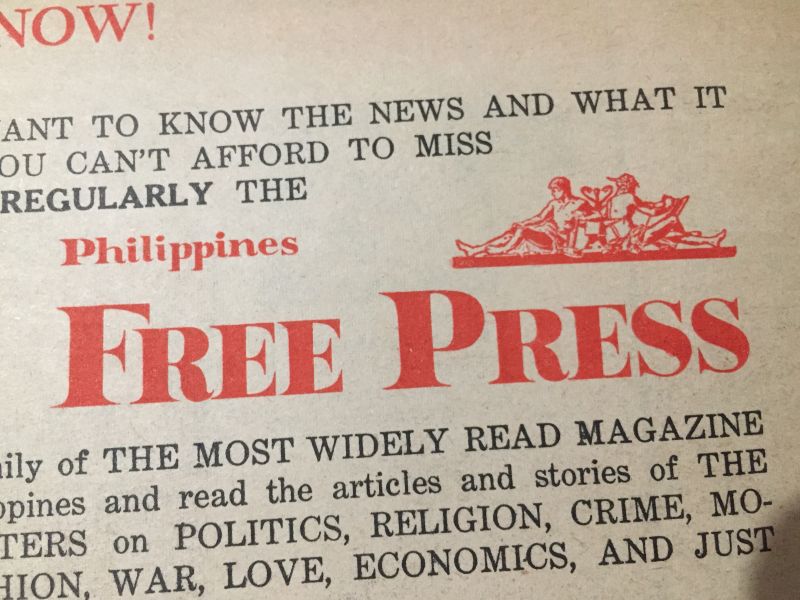
While in the process of moving out of what I called home for a decade, I unearthed cardboard boxes under my bed containing my personal collection of the Philippines Free Press magazine. I kept them for a few articles I’d written, some issues for the literary section that had helped shape what Philippine literature is today, and many for the fearless, well-written political essays and hard-hitting editorial cartoons.
On July 25, 2011, Monday, the 110-year-old newsweekly magazine, once called “the Bible of Filipinos” when print was king, released its final issue.
Since Facebook was only seven years old back then, the magazine’s closure was quiet—no major announcements, not even in the mainstream media. Copies just disappeared from newsstands.
I was witness to the publication’s last eight months, and although it closed 15 years ago, there’s still a pang of regret on why I didn’t focus that much on its archives.
I was not a regular employee, but just a caretaker of its features. The Free Press was once like a favorite, older neighbor I used to get drunk with every Thursday night.
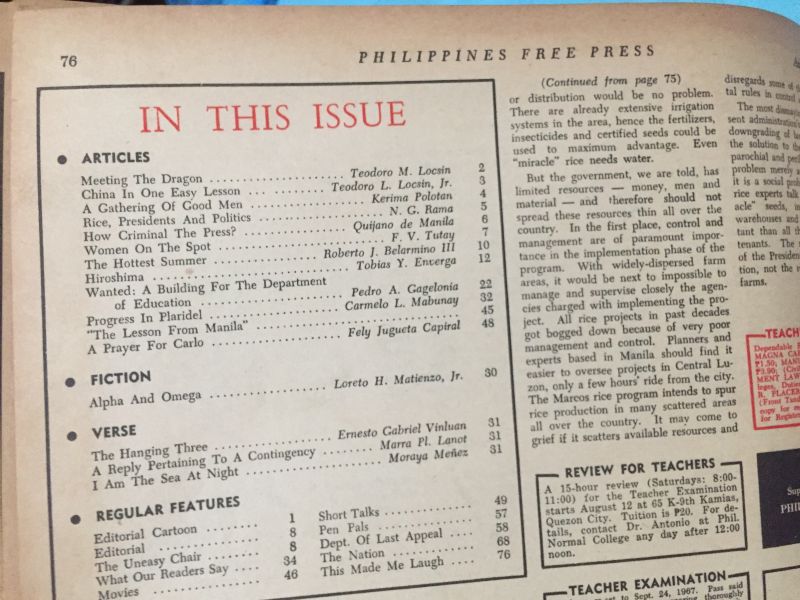
A star-studded table of contents: Long-form articles by Teodoro Locsin Sr., Teddy Boy Locsin, Greg Brillantes, and Nick Joaquin as Quijano de Manila, among others, made any issue of the old ‘Free Press’ a collector’s item.
After finishing college in the mid-1990s, I was employed in TODAY newspaper, owned and managed by Teodoro “Teddy Boy” Locsin Jr., our current Ambassador to the United Kingdom. TODAY was the sister publication of the Free Press magazine, which was still under Sir Teddy Boy’s father, the great editor-writer and patriot Teodoro Montelibano Locsin Sr., or TML.
The youngest brother, Ramon, nicknamed Monchito, was originally based in New York, working for the Philippine consulate but, if memory serves, in the last few years of the magazine, he also helped in the marketing department.
It was the late 1990s. I never saw TML in person because we were told he was semi-retired and would just oversee the magazine from home. Henry was manning the business department in a separate building in Makati City.
I saw Teddy Boy more often because he taped some portions of Assignment, the award-winning weekly investigative-documentary show he was hosting for ABS CBN News Channel (ANC), in the advertising department of TODAY before lunch.
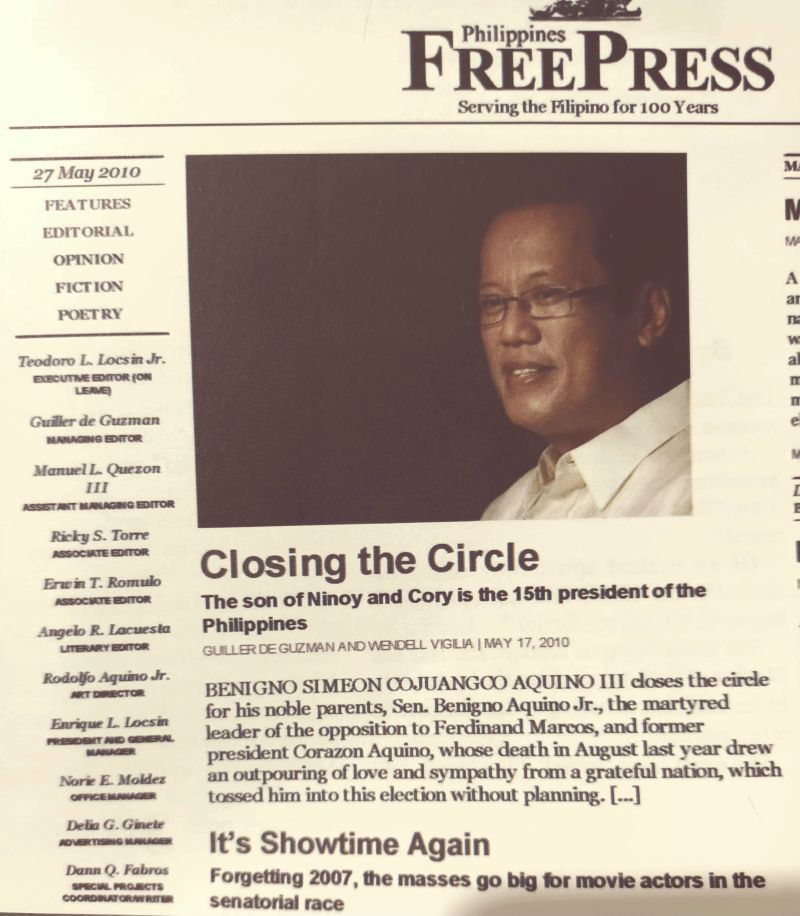
The editorial box in 2010 with the names of Ricky Torre, Erwin Romulo, Manolo Quezon, Guiller de Guzman
Free Press, being a news weekly, would close its pages every Thursday, and during those crucial hours until midnight, we would visit its editorial office and have a few drinks with two of its senior political writers, Ricky Torre and James Saspa, also contributing editors and writers for TODAY’s advertising supplements section.
Call it our version of the Thursday group. It included Lourd de Veyra, staff writer for TODAY’s lifestyle and entertainment sections under veteran editor, the late Abe Florendo. There was Brian Afuang, TODAY’s graphic artist and later editor for its motoring section, and Benjie Lontoc, TODAY’s editorial cartoonist. We were regularly joined by film and music writer Bert Sulat, who was a contributor to Abe’s section.
TODAY occupied the first and third floors of Macrima, a three-story building owned by the Jaka Group of Companies, along Edsa in Guadalupe, Makati City. The Free Press used to hold office in the Makati Tuscany Building at 6751 Ayala Avenue, but later transferred to a three-story townhouse unit at the back of Macrima.
Thursday sessions would start after the final pages of TODAY were put to bed. By 10 pm, while the stories of the two were being proofread, laid out, and getting final corrections, Ricky and James would join us. It was Lourd who would go to the Free Press library and bring out a volume or two from the archives, which dated back to the late 1930s up to the early 1970s.
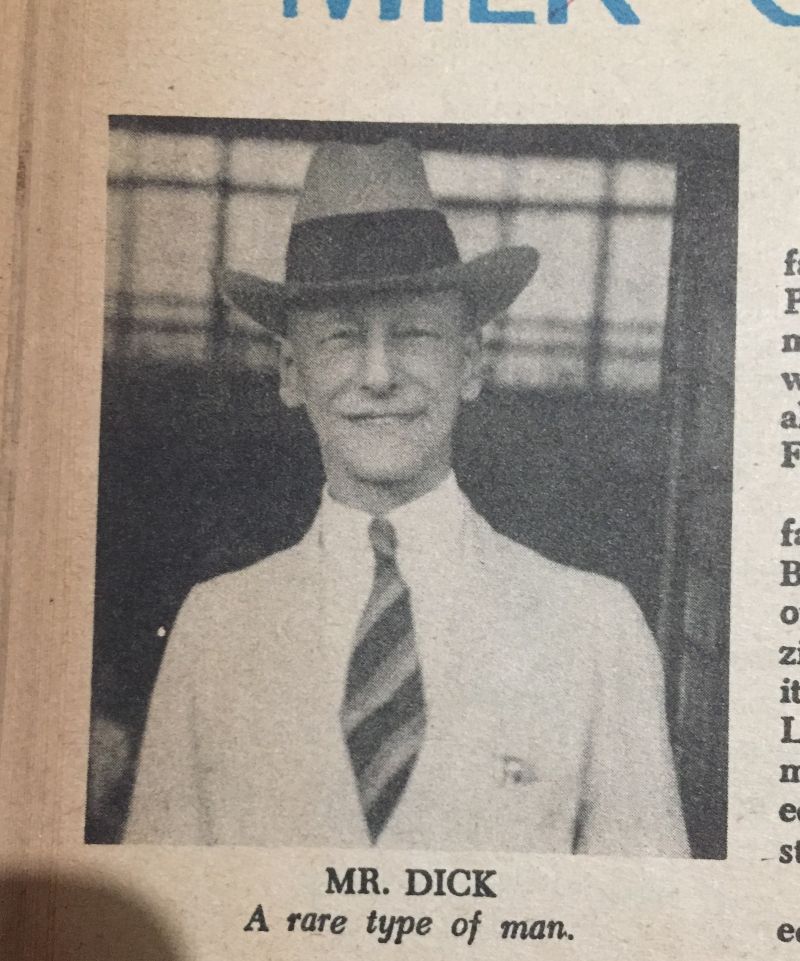
Robert McCulloch Dick was a Scotsman who founded and ran the magazine for more than half a century, before and after World War II.
They were a treasure trove of the finest works of Teodoro Sr., Teddy Boy, Nick Joaquin, Jose “Pete” Lacaba, Wilfrido “Ding” Nolledo, Gregorio Brillantes, Carlos P. Romulo, Leon O. Ty, Frederic S. Marquardt, Felimon Tutay, Edward R. Kiunisala, Estrella Alfon, and owner-publisher Robert McCulloch Dick, a Scotland-born expat journalist.
Each issue was like a time capsule, bringing us back to the era when Escolta was the center of fashion, business, and trade, when the hallowed halls of Senate and Congress were dominated by firebrands like Claro M. Recto, Benigno “Ninoy” Aquino Jr., Jose W. “Pepe” Diokno, Lorenzo Tañada, Francisco “Soc” Rodrigo, Ferdinand Marcos Sr., Gil Puyat, practically the names of public schools and streets nowadays.
Each issue was like a time capsule, bringing us back to when Escolta was the center of business, and the halls of Senate and Congress were dominated by firebrands
From the late 1940s, there were the sports features and reportage by Arsenio H. Lacson, a regular contributor to the Free Press before he became Mayor of Manila.
There were also the early writings of the future lawyer-diplomat Leon Ma. Guerrero Jr., our country’s first Ambassador Extraordinary and Plenipotentiary to the Court of St. James, from 1954 to 1962.
Nicknamed Leoni, he was often referred to as “The Golden Boy of the Philippines Free Press.” At the time when McCulloch Dick was still running the magazine, Leoni served as staff writer and eventually, associate editor from 1935 to 1940.
From the book LMG, The Leon Maria Guerrero Anthology, edited and published by his son, advertising executive David Guerrero of BBDO, Leoni recalled while in college at the Ateneo de Manila University in the late 1930s that it was his salary from the Free Press that helped him finance his studies.
We quote from LMG: “When I started working, I made writing my form of livelihood—quite early, in fact, even before I graduated from the AB course. That’s when I joined the Free Press, based mostly on my belief at the time that to make money is to write; that the reason for writing is to make money…When most newspaperman were making about 60 to 100 pesos a month, I was making P600! Every time another publisher would try to hire me, my boss, McCulloch Dick, would raise my salary by a hundred pesos.”
The late veteran classical music, arts, and culture writer Pablo Tariman (1948-2025) would always post on social media about how he got his first paycheck from the Free Press in 1969. “The Free Press would pay you in advance once your story got approved for publication. ‘Di mo pa nakikita in print, bayad ka na,” he’d tell me later on.
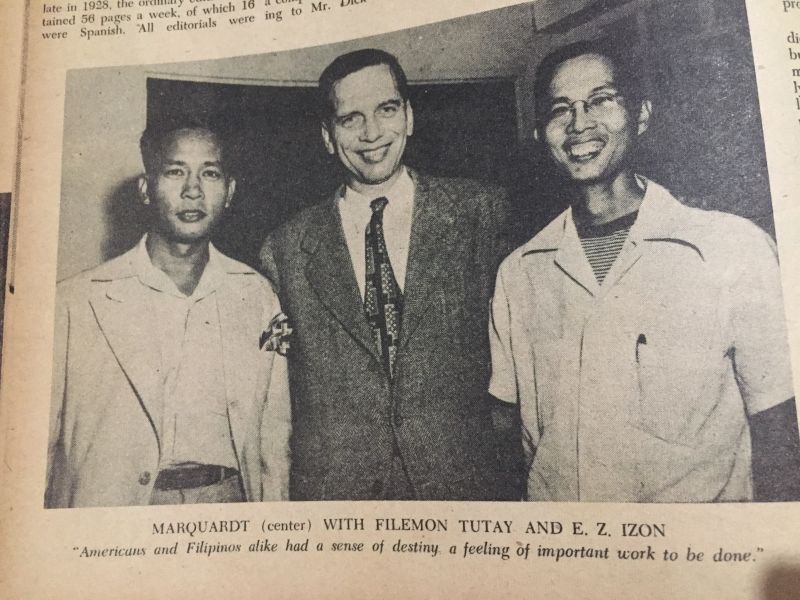
Frederic S. Marquardt (center) with staff writer Leon O. Ty (left) and cartoonist-illustrator EZ Izon in the 1960s
The magazine was described in those decades when our country was still a colony of the United States by Frederic S. Marquardt, an American born in Manila who served as Free Press associate editor before World War sII: “The Free Press was known, in many quarters, as the ‘Bible of the Filipinos’ because of its persistent support of Filipino causes during the ‘days of Empire.’ Not many Americans read it.”
For exposing the abuses against Filipinos, the colonizers hated the Free Press. At some point, McCulloch Dick faced libel cases and was once ordered to be deported.
The newsroom was still housed on the third floor of the original Free Press building on Avenida Rizal, near Azcarraga. Marquardt wrote that his bosses, McCulloch Dick, a Scotsman, and the magazine’s business manager F. Theo Rogers, an American, were “that oddly matched but splendidly attuned pair putting out the most influential publication in the Philippines.”
When the Free Press celebrated its 50th anniversary in 1958, McCulloch Dick was co-recipient of the first Ramon Magsaysay Award for Journalism, Literature, and Creative Communication Arts, together with another fearless journalist, the Indonesian Mochtar Lubis.
McCulloch Dick was honored for playing “a pioneering role in establishing and maintaining the tradition of press freedom in the Philippines…despite repeated attempts to curtail publication.”
In the 1950s to 1960s, there were the editorial cartoons of resident artist Esmeraldo Z. Izon, otherwise known as EZ Izon, portraying corrupt politicians as crocodiles, vultures, and pigs. I remember reading one editorial article calling congressmen “representa-thieves,” and EZ Izon’s accompanying illustration had the plenary session full of crocodiles. Izon’s interpretation of our government officials and contractors continue to be spot on.
I remember reading one editorial article by EZ Izon calling congressmen ‘representa-thieves’
His most popular cartoon, I think, is the hauntingly sad image of Jose Rizal, holding a torch as he descends into a dungeon leading to what looks like an old garrison turned prison cell. A woman in a tattered dress is chained to the wall, her feet chained to iron balls, and written on her baro (native blouse) is the word “Filipinas.” The chains on her hands and ankles have the words, “Graft, Corruption, Lawlessness, and Superstition” written on them. Rizal asks the woman, “Still here?”
It came out in July 1961 to commemorate the 100th birth anniversary of our national hero, and still keeps on coming back, this time on our social media news feeds.
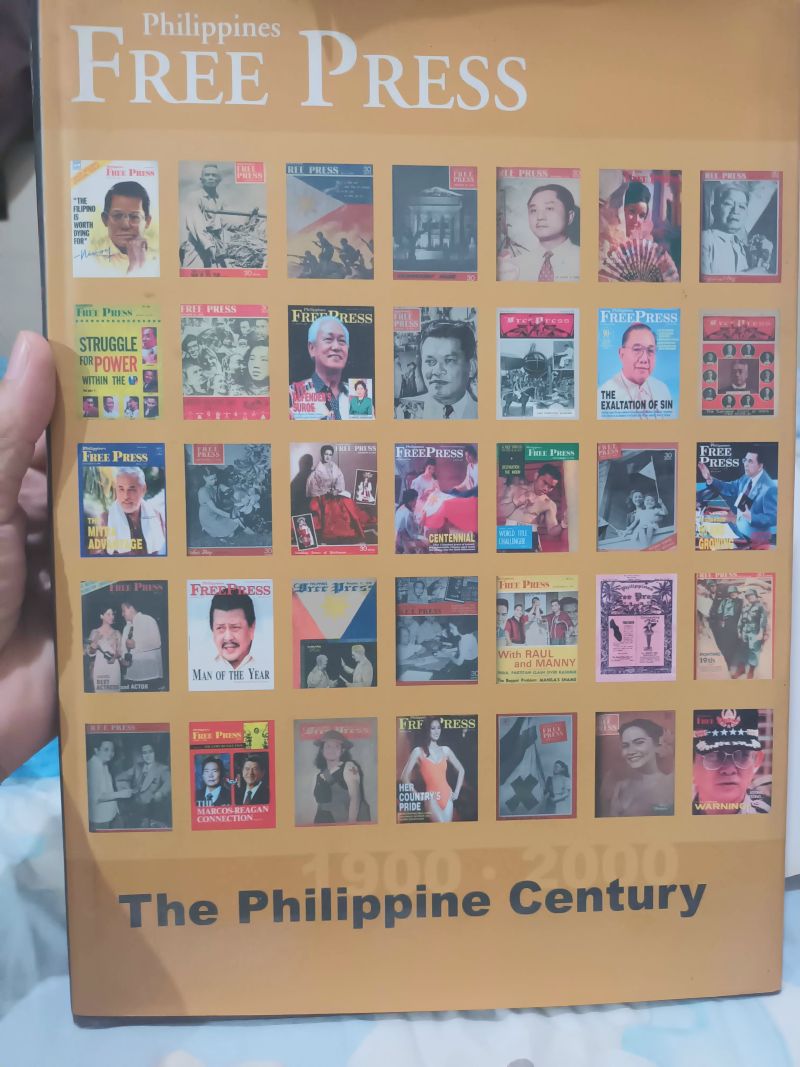
The coffeetable book ‘Philippines Free Press, 1900-2000: The Philippine Century’ gathered some of the best articles from the founding of the magazine, documenting highlights in Philippine history. It was edited by Teddy Boy Locsin.
Izon (1911-1997) was the longest serving editorial cartoonist and illustrator of the magazine, starting in the 1930s up to his twilight years in the 1990s. In 1993, the Free Press published a collection of his editorial cartoons in the coffeetable book Cartoon History of the Republic. Like TML’s books, it’s been out of print.
And then of course, there were the feature stories and reportage that were treasures for history buffs and writers.
In a story by TML about Emilio Aguinaldo, he was able to ask the aging politician about his involvement in the murder of Andres Bonifacio and his strained relationship with Apolinario Mabini. The article, Interview with the General, came out in an issue from June 1949.
We quote: “Aguinaldo, at 80, is a spry old gentleman who seems to run as he walks. He holds himself straight; he talks with animation and authority; he is no sad echo from the past but still very much the man who had headed the army of the revolution against Spain.
What about Bonifacio?
“I do not like to talk about it.
But he should. People still hold him responsible for Bonifacio’s death.
“Bonifacio was executed after being found guilty by a court-martial of treason and sedition. I had nothing to do with it. He was a good man, but violent.…
What about Mabini?
“He was a good man, too. They were both good men. But it was he who, after a political defeat, spread the slander that I was responsible for Bonifacio’s death. They were both good men and we were friends. We were friends until politics destroyed our friendship….”
He shook his gray head.
“I do not like to speak of those things now. We must keep their names bright. We must have as many heroes as possible, for the glory of our country.”
The rest of the article was uploaded by Manuel Luis “Manolo” Quezon III, who once served as the magazine’s managing editor and editorial writer, on the Free Press blog he moderates, namely Philippines Free Press online.
Some of EZ Izon’s works can also be found on the site.
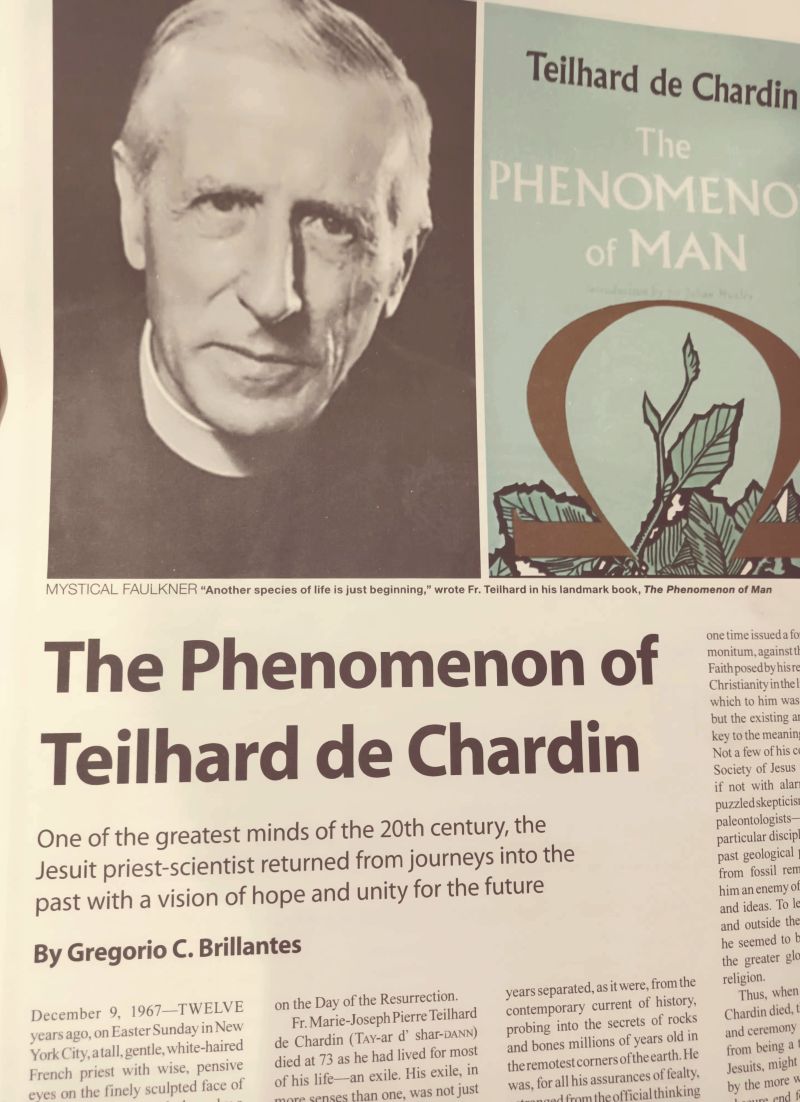
A reprint of National Artist for Literature Gregorio Brillantes’ story that came out in 1967, when he was executive editor of the ‘Free Press’
Decades ago, I remember one encounter with Gregorio Brillantes at a Dia Del Libro event of the Instituto Cervantes when they were still based in Casa Español de Manila on Kalaw Avenue in Ermita. Nick Joaquin has passed on already.
Upon learning I was writing for the Free Press and TODAY, Brillantes told me TML was among the underrated and underappreciated literary writers of the last century. I can’t remember the exact words, but he said something about how TML’s being a publisher and editor of the Free Press overshadowed his output as short story writer, novelist, and poet. He said that TML as a literary writer was on the same level “as our dear old friend Nick.”
In the 1960s, Brillantes was executive editor of the Free Press when TML was already its publisher and president. Joaquin and Izon were associate editors.
Brillantes, considered the Filipino master of the short story in English, was posthumously awarded National Artist for Literature on Sept. 1, 2026, exactly a year after he passed away on Sept. 26, 2025 at age 92.
At the TODAY library, I found copies of TML’s collection of short stories titled Trial and Error, collection of poems titled Fragments and Ruins, as well as his elegantly written historical novel on Jose Rizal, The Heroic Confession. All three are out of print.
True to the description “Bible of the Filipinos,” despite being a weekly, Free Press would have 200 pages or more per issue. I could imagine the pressure on Joaquin, TML, and the rest of the staff. These were issues particularly from the mid-1950s up to 1972, the year it was closed upon the declaration of martial law.
TML, together with fellow editor Napoleon Rama, publisher Joaquin “Chino” Roces of The Manila Times, and then Senators “Pepe” Diokno and Ninoy Aquino, and other freedom fighters were jailed.
At the time, both the editorial and business offices had moved to the new Free Press building on Pasong Tamo, on a 5,000-square-meter lot owned by TML. The building reportedly had one of the more modern, state-of-the art printing presses in Southeast Asia.
In 1973, the assets were bought by Marcos Sr.’s aide-de-camp, Gen. Hanz Menzi, from TML, with a ‘Marcos-cannot-be-denied’ warning
At the time, Joaquin and Brillantes had moved on to work for other publications. Joaquin may have published anthologies of his reportage from the Free Press later on, but there were more gems to be found in the archives.
Ricky would later point out Joaquin’s story on Ernest Hemingway. Titled Hemingway Was Here (Free Press, July, 1961), the article was Joaquin’s chronicle of Hemingway’s two stops in the Philippines in 1941 during the “eve of the Pacific War.”
The first was an overnight stopover at a dockyard in Cavite in February with his third wife, journalist Martha Gellhorn, and for one week in May of the same year, when he was billeted at the Manila Hotel.
At the time of their stay, he and Martha were war correspondents, covering the Pacific islands. Hemingway had also just married Martha in September 1940, and the couple’s “working tour” in Southeast Asia was part of their extended honeymoon.
Joaquin wrote how, as a literary writer, Hemingway was at the peak of success. Everywhere he went, he was treated like an international rock star, at the time when the term wasn’t used yet.
Joaquin wrote that it was in November 1940 that the movie rights for Hemingway’s novel For Whom The Bell Tolls was bought by Paramount Studios for $100,000. (With today’s purchasing power, that would amount to $2,392,714.29.)
The movie had Gary Cooper playing the main character Robert Jordan. Prior to that, the novel, as Joaquin wrote, “has already sold half a million copies,” and part of the deal with Paramount was a bonus to pay him 10 cents ($2.39 today) for every book sold.
Joaquin described their first visit: “When he came to the Philippines in 1941, he was not only a literary idol, he was a democratic hero, and his name was being invoked against all the precious dwellers in ivory towers.
“He flew in with Martha Gelhorn on the ‘California Clipper’ on February 21, at half-past one in the afternoon. They were on their way to Hong Kong, and would be leaving at eight the next morning.
“He looked, then, very much like the later Clark Gable: very thick and dark and brawny, with small twinkling eyes and abundant hair beginning to go gray on the sides. The voice didn’t seem to belong to so powerful-looking a man, being soft and low.
“Martha Gellhorn was a stocky girl with auburn hair and careless clothes; [Filipino journalist] Yay Panlilio noticed that her stockings were twisted.”
On their second, longer visit, Joaquin recounted a garden party at the Mandaluyong residence of American couple Janet and Herbert Walker that Hemingway attended. Quoting artist-writer Lyd Arguilla, he wrote how Hemingway sampled lechon and other native Filipino food, drinking heavily “all night long with the capacity of a tankard.”
He also met Lyd’s husband, the young writer Manuel Arguilla, whose short story How My Brother Leon Brought Home A Wife won grand prize in the 1940 Commonwealth Literary Contest. Joaquin wrote that Hemingway was so impressed by Manuel Arguilla that he arranged for a meeting with him the following day.
“Arguilla found Hemingway just finishing his work: it was late in the morning. Hemingway said Filipino writers, too, should do all their writing as early as possible in the morning, as he did: ‘In this climate, nobody should be up at noon!’”
At the time, Manila was in the middle of a heat wave and “the day before [Hemingway arrived], a great fire had devoured a hundred blocks of Tondo, between Moriones and the bay.” Hemingway would later donate a check for $250 (now worth $5,696.94) to the fire victims.
Nick Joaquin wrote of how Hemingway told Manuel Arguilla that Filipino writers should work in the morning: ‘In this climate, nobody should be up at noon!’
He told Manuel that, if “he really wanted to become a professional writer, he should devote at least eight hours a day to writing. Writing should be like going to the office; something you had to do, not something you did only when you felt like it. It didn’t matter that you had nothing to say; you should still write every day, eight hours every day just to keep in trim. Writers should keep in trim, like dancers or boxers. And when you gather the day’s random pages, said Hemingway, you’re surprised to find something there: there’s always something of you there.
“A professional writer, said Hemingway, was writing even when he was not actually writing. Everything he did, everything he went through, was a preparation for writing.”
Sadly, Manuel Arguilla died fighting the Japanese during World War II at age 33.
This advice on writing early in the morning after having a good night’s rest—despite a hangover, in Hemingway’s case—has been followed by generations of writers and creatives, like, as far as I know, National Artist Ricky Lee and auteur Lav Diaz.
There was also Joaquin’s story titled From Yeh, Yeh, Yeh to Go, Go, Go, about the controversial Beatles concert at the Rizal Memorial Football Stadium on July 4,1966. The day they were about to leave for their next concert in New Delhi, they were booed and beaten at the then Manila International Airport. Their flight was delayed for hours due to some papers—manager Brian Epstein’s and an assistant’s—that needed to be “stamped.” All the troubles were because they failed to appear and perform special numbers at Malacañang Palace upon the invitation of First Lady Imelda Marcos.
I’ve read this gem of music reportage, and Joaquin revealed that John Lennon, Paul McCartney, George Harrison, and Ringo Starr were willing to perform at the Palace. It was their manager, Brian Epstein, who “was being ornery.” He was the one who rejected the invitation many times.
Quoting the concert promoter, Ramon Ramos of Cavalcade Inc., Joaquin wrote that the Beatles “were provided with a program of their Manila schedule as soon as they arrived” on July 3, 1966, Sunday afternoon, and it included a call at the Palace the following morning.
Joaquin wrote that Ramos repeatedly reminded Epstein of the Malacañang appointment. Once was after the press conference at the Manila Yacht Club, before boarding the Elizalde boat Marima, where they had dinner of “consommé, fried chicken, and filet mignon with mashed potatoes, carrots, and sweet peas.” The yacht would take them to Manila Hotel with a short tour of Manila Bay. Ramos said before they parted ways that night, he again reminded the cranky manager, who reportedly was complaining about everything. Epstein “just rejected it.”
Josine Pardo de Tavera Loinaz, a young beauty queen who was among the few guests of the Elizaldes on the Marima, told Joaquin that “away from the madding crowd, the Beatles turned out to be charming chaps—very natural.” Despite Epstein’s attitude, she said the four musicians “were nice right to the very end.
“I had a nice long chat with George, the nicest of them all,” Loinaz was quoted as saying. She added that Harrison even told her, “We want to come back to visit when this craze dies down and we’re not famous anymore.”
Music historians regarded the Manila stop as more traumatic than historic, one of the reasons why The Beatles never toured again.
The two literary essays by Joaquin were reprinted some time in 2008 in separate issues, when Ricky was already editing the features section. And those were just some of Joaquin’s works that his admirers won’t find in his collection of reportage. If they were, they’re probably out-of-print anthologies. Up to now, thankfully, there are no online versions either.
TML passed away on Jan. 21, 2000 at 85. The Los Angeles Times cited his “exploits as a guerrilla who fought the Japanese during World War II and for his journalistic talent and leadership.”
The same year, TODAY and Free Press transferred to a bungalow with a spacious garden shaded by trees at 55 Paseo de Roxas in Makati City. I learned later it used to house an embassy.
For us, employees of TODAY, the new place was a relaxing office. At Macrima, we would always hear honking from all types of vehicles, especially from notorious “killer buses” that made EDSA their private parking lot.
The Paseo de Roxas office was so homey, if you came early in the morning, you’d see the kind-hearted and shy Mang Claudio, our resident utility man, sweeping dry leaves and all kinds of trash in the front yard.
One of the senior editors, Ruben Lampa Sr., while having coffee at the open-air receiving area outside, would tell us in jest: “You could invite friends or ‘yung nililigawan mo (whoever you’re courting) to have coffee here and tell her, this is your house and all the people coming in are visitors.”
Lampa was one of the longest serving editors of the Free Press. He started in the late 1980s and stayed until the magazine’s closure in 2011. He was also one of the copyeditors of TODAY.
He shared some memories from the newsrooms.
“We only used Macs. Even our personal computers at home were Macs. We were such Mac ‘loyalists,’ like Teddy Boy. But Mr. Locsin (TML) wrote on yellow pad. Veterans like Mike Dueñas and Ed Kiunisala used manual typewriters,” Lampa said.
“Never saw (TML) use one. He’d write his editorial in long hand. He would give the pages to me with instructions to ‘clean it up’ if necessary. (He was such a brilliant man with so much knowledge of literature, philosophy, history, politics that he’d sometimes get carried away with asides leading to information overload.) After his piece had been typeset and copyread, I’d give it back to him for his final approval.”
Josine Pardo de Tavera Loinaz told Joaquin that ‘away from the madding crowd, the Beatles turned out to be charming chaps—very natural’
TODAY occupied the entire first floor, and the Free Press editorial was housed in what looked like a stock room under it that was converted into an office. “Literally underground press na kami, pre,” Ricky used to describe it in jest.
When Teddy Boy was elected as first-time congressman for the First District of Makati, as required by the law, he needed to take a leave from the Free Press and TODAY. Without TML and Teddy Boy’s direct editorial guidance, the Free Press wasn’t the same anymore.
TODAY would have its last issue some time in 2005. As we joked about it, TODAY became part of our yesterday.
With its meager staff, Free Press forged on and from its Paseo de Roxas office, it transferred to Great Wall building at 167 Yakal Street, also in Makati City.
In 2008, the Free Press celebrated its centenary as a newsweekly and 10 years since our memorable Thursday nights. I returned as contributor for the magazine.
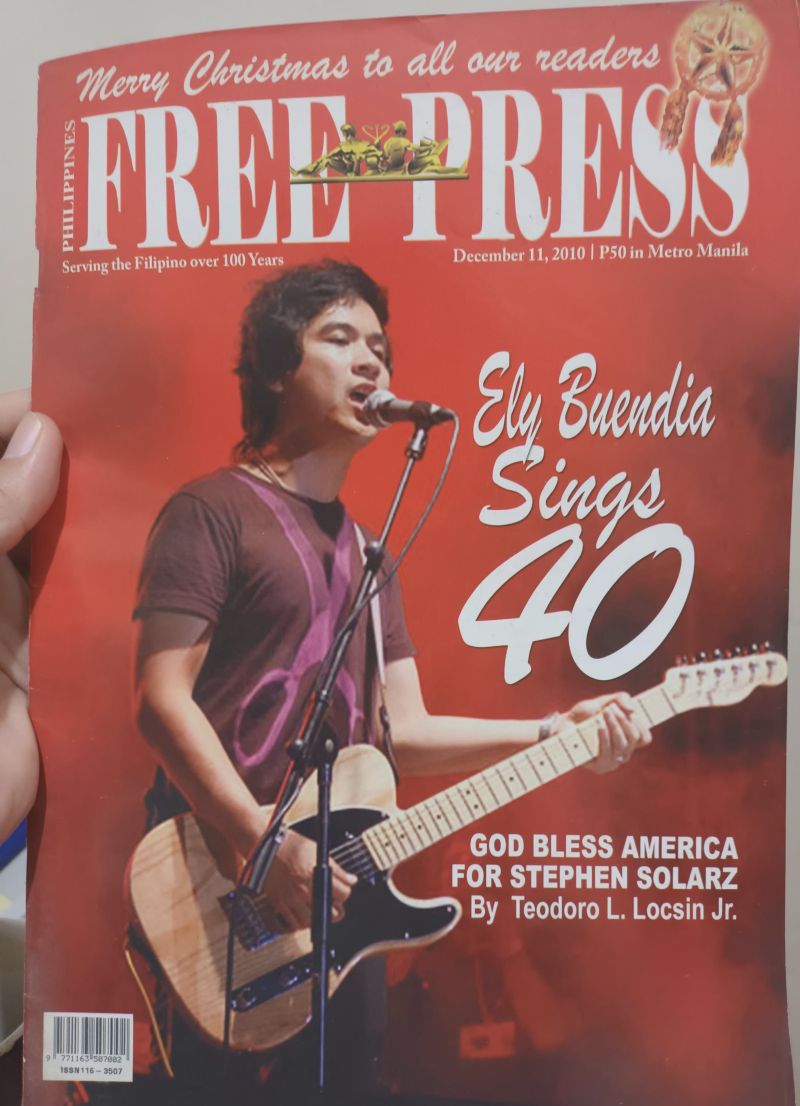
A copy of ‘Free Press,’ second week of December, 2010. The author wrote the Ely Buendia story using the pen name John Lloyd de Jesus.
I was employed as assistant lifestyle and entertainment editor for a newly-established business paper, so I wrote for the Free Press using the nom de guerre John Lloyd de Jesus.
Those years, there were almost no returned copies from suppliers nationwide. There were still newsstands where one could buy all kinds of dailies, tabloids, and magazines.
I left the newspaper job in the latter part of 2009. On some days, I missed the newsroom, so I still made frequent visits to the Free Press to drink with Ricky, same Thursday nights after the closing of pages.
If Sir Henry wasn’t around, we’d drink the night away in his office, consuming more than half of the barely-touched vodka he kept in a corner beside the round wooden conference table. I guess he never noticed why his bottle kept getting half full. But I can’t imagine Ricky and I being summoned to his office only to be scolded, “H–dot, how dare you two drink my vodka!” using Sir Henry’s favorite cussword.
In the latter part of 2010, when I found myself freelance writing again, I bombarded Ricky with story proposals. I was happy to be back more often at the Free Press office in Great Wall, and even more delighted to know the magazine has been earning well from advertising sales. Every page of an article was paired with an ad.
This was the situation on the day I took over the features section of the Free Press. I was there full-time for about eight months and two weeks. I was on board with Free Press in the latter part of 2010 and for a few months, Ricky, who had moved on to a new job, was still like a guide to me.
He would arrive during the closing of pages on Thursday night and edit whatever materials I produced for him. We’d split the monthly editing fee.
By January in 2011, I begged him to hand me the Free Press job full time because I had a young family then and there were more bills to pay.
The number of pages for the features section depended on the supplements for the week. Guiller de Guzman, then editor-in-chief, would give me a minimum of eight pages to fill up. I’d come up with stories, mostly reprinted features from the archives.
Henry would prefer using reprinted materials written by TML and Teddy Boy so there would be no cash outflow. A reprint of Nick Joaquin’s stories would need payment to his estate managed by his niece, Charo Joaquin-Villegas.
To save up, I used old issues of TODAY, whose archives, together with what was left of the Free Press volumes, were stored in a book rack in Henry’s office. For a couple of months, I also ran TML’s The Heroic Confession.
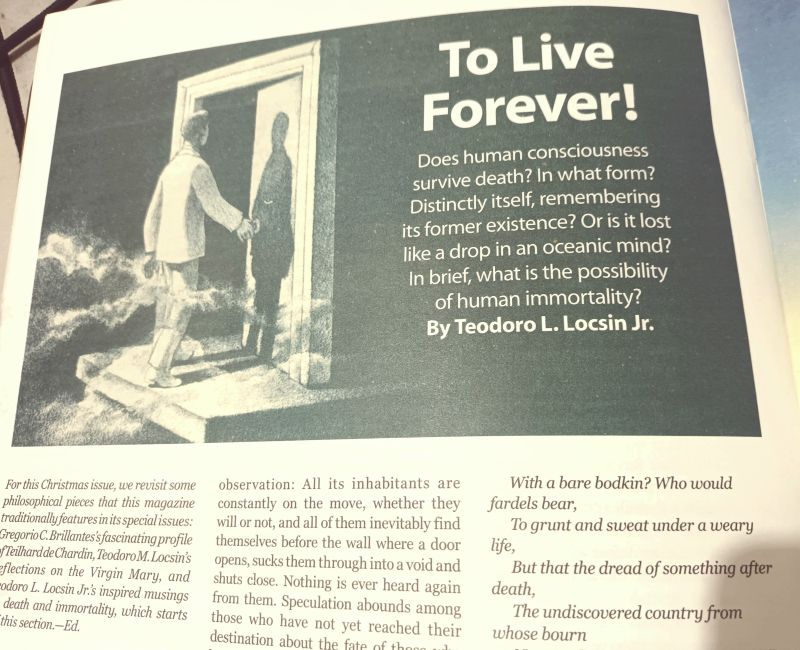
Teddy Boy Locsin’s philosophical piece originally published in August 1970 was reprinted for the Dec. 11, 2010 issue.
In the latter part of 2010, Teddy Boy had just finished his three terms in Congress. Having freed himself from public service, he had all the time to edit and write for the Free Press. The more exciting phase began.
Suddenly, come Monday mornings, a copy of the magazine from the previous week would land on Guiller’s tables with red “X” marks, paired with Sir Teddy Boy’s comments on how to improve and what not to publish anymore.
The worst comment on what Sir Teddy Boy viewed as badly-written articles would have the word “P—–ina” in bold red letters all over the pages. I should have asked Guiller for those issues and kept them framed for posterity’s sake.
With Teddy Boy back to writing editorials and some feature stories, plus his guidance on the overall quality of stories coming out, every issue was like a collector’s item again.
On the business side, from a reader’s point of view, there were regular ads. But since the elections had been over for almost a year, advertising supplements, the lifeblood of print media, seldom came.
Free Press’ closure came with the official announcement that its business license had been expired for some time. They were told the lawyers of the Free Press were working double time to remedy the problem. A week before it had its last issue, dated July 25, 2011, there was an announcement that the closure was just temporary. After more than 110 years, the folding up of what used to be the number one newsweekly magazine happened quietly.
At the time, I was contributing articles for the Lifestyle Arts & Books section of the Philippine Daily Inquirer and I proposed to its editor, Lito Zulueta, a story about the Free Press Annual Literary Awards that took place on July 12, 2011.
The Arts & Books section came out Mondays, and as it turned out, my piece on what would be the last Free Press Literary Awards was published the same week the final issue of the Free Press was seen on newsstands.
Despite the magazine’s closure 15 years ago, the Free Press Literary Awards still holds the distinction of giving the biggest amount for winners in the short story and poetry categories: P80,000 for the First Prize; P50,000 for the Second Prize; and P30,000 for the Third Prize.
For a time, I didn’t put my name in the editorial box since I was not a regular employee, but for the last issue, I told myself, why the heck not?
For a time, I didn’t put my name in the editorial box since I was not a regular employee, but for the last issue, I told myself, why the heck not?
The cover story for the final issue was about a first-time lawmaker from Lanao del Sur, who was in the news for allegedly mauling a security guard in Congress. I never got to keep a copy of that issue because it was nearly sold out.
One lovely Tuesday morning, I received an SMS from an unregistered number. It read: “Totel, prepare materials. We may be given signal to continue publishing. Waiting for word. Guiller.”
But months passed and no word came from Guiller, who I learned later was hired by the Philippine Daily Inquirer. He became part of the Central News Desk, overseeing Page One stories as the last-look editor.
Ricky eventually left his job and had short stints with other media companies before eventually joining Inquirer’s Central News Desk. He still works there, a trusted name when it comes to closing the pages of the news section. Guiller passed on during the pandemic years.
I’d like to think the gems of the Free Press remain in its archives.
Then again, I admit I haven’t read much from the 1930s to the 1960s. That honor belongs to Ricky and Manolo.
Sometime in 2016, one morning on the way home, I was dazed from night shift duty at Inquirer.net, where I had been employed for five years. While riding the LRT-1 from Vito Cruz Station to Roosevelt Avenue Station, the train stopped midway after passing Recto Station.
I was half awake while struggling to stand up and sluggishly held on to a grab handle. I looked outside and noticed something familiar. There were sculpted bas-relief figures on the topmost, central part of the wall of an old three-story building in front of me. It was one of those green-and-white painted Art Deco structures dating back to the American period.
It had two near-naked men, like figures of Hermès from Greek mythology. They were seated and not facing each other. One was writing in a big book, and the other was stretching his legs. Between them was the caduceus with two snakes, but without the winged image at the center.
I had goosebumps, but I was too sleepy, and it was morning rush hour. I knew I wouldn’t last another hour and might collapse, so getting off the train at the next station to see the actual building where the Free Press was originally housed and what has become of it was out of the question.
In later encounters, Ricky told me he passed by the old Free Press building once on his way to Malacañang. He recounted that aside from the usual ukay-ukay stalls on the first floor, there was a gay bar named “Wild Bols” on the second floor. Ricky specifically pointed out, “Pare, ‘yung spelling ng balls, B.O.L.S.” Beside it was an open-air gym.
I imagined macho dancers gyrating to Duran Duran’s Wild Boys, knowing that in that building, the likes of Joaquin, Brillantes, TML pounded on their typewriters the stories that would influence the nation’s top policy makers and the course of Philippine history.
The rest of the building, Ricky told me, was either padlocked rooms or decaying vacant spaces. He said heritage advocates could have been more astute in preserving the place and a historic marker should have been placed there. It housed the Free Press for more than half a century.
In 2019, I did find the time to revisit the area. To my dismay, the whole building was gone. It was just a vacant lot with the usual debris. I was told by a security guard it was torn down only a few weeks ago to give way to a new condominium building. I could have asked a piece of the Free Press sculpted logo, perhaps the figure of the caduceus or the near naked man stretching his legs. It felt like when people wanted a literal piece of history during the collapse of the Berlin wall.
Last time I checked, the Free Press building still stands on Pasong Tamo, housing a pharmaceutical company.
I remember reading one of Nick Joaquin’s articles in the archives that came out in the late 1960s. He said going to the Pasong Tamo building was just pure work. “You go there, file your stories, and leave.”
He added that the real Free Press, the one he knew, was in that building on Avenida, Rizal. I’d drink to that. Still, I regard the Free Press before martial law as the epitome of excellence in magazine publishing.


