
With its steady run for two decades, Art in the Park (AIP) returned to the open grounds of Jaime C. Velasquez Park in Salcedo Village, Makati last Sunday, March 15, for its 20th anniversary, once again gathering artists, collectors, and casual viewers in a shared space for art.
Lisa Ongpin-Periquet, co-founder of the fair, told TheDiarist.ph its back story:“Art is so much a part of my life and my family’s life. I would say my parents, they collected art. So I got very aware and I loved to draw when I was young. And my great grandfather—my father’s side—was a big art collector before the war. So there were still a lot of paintings in the family, and they were very much valued by my parents, aunts, and uncles.”
From a modest 12 booths in 2006, the fair gradually grew beyond its origin as part of the Salcedo Market. By 2014, she said, it had become a full-day Sunday event of its own. Ongpin-Periquet described this growth as organic, built with co-founder Trickie Lopa and their team. Its focus: to keep art accessible.
“It’s an incredible milestone,” Ms. Ongpin-Periquet said. “The staying power is there… We found that more and more people attend the event every year.” She added, “People are hungry for it.” Even during the pandemic in 2020, the fair adapted by going online for two years, even on its 15th anniversary. “People were still willing to buy,” she noted, especially when price points remained accessible—an approach the fair continues through its price cap, set at P70,000 this year.
AIP continues to emphasize the value of encountering art face-to-face, keeping the experience within one’s reach, remaining an accessible entry point to the local art scene.
This year’s fair drew a large crowd, with free viewing of over 55 booths across the open grounds. The anniversary celebration also introduced a limited-edition Art in the Park 20th Anniversary book about its history, alongside the Art in the Park at 20 Portfolio Box, featuring two sets of signed prints by 40 acclaimed artists.
It felt alive. To a first-time visitor like me, there were no better words to describe my experience.
AIP had a wide range of works, from visual art and pottery to furniture, sculptures, and even literary pieces, each carrying distinct concepts and styles. The diversity reflected a generation that continues its push toward being more expressive, inventive, and original in how it creates.
“It’s very democratic. We want to get as many types of artists and artworks,” Ms. Ongpin-Periquet said, explaining how they often work with art groups.
This year, the fair featured collectives, schools, and galleries from within and beyond Metro Manila. “Each booth has so many artists on display. That’s the spirit of Art in the Park. It’s very democratic. It’s wide. It gives everybody a chance.”
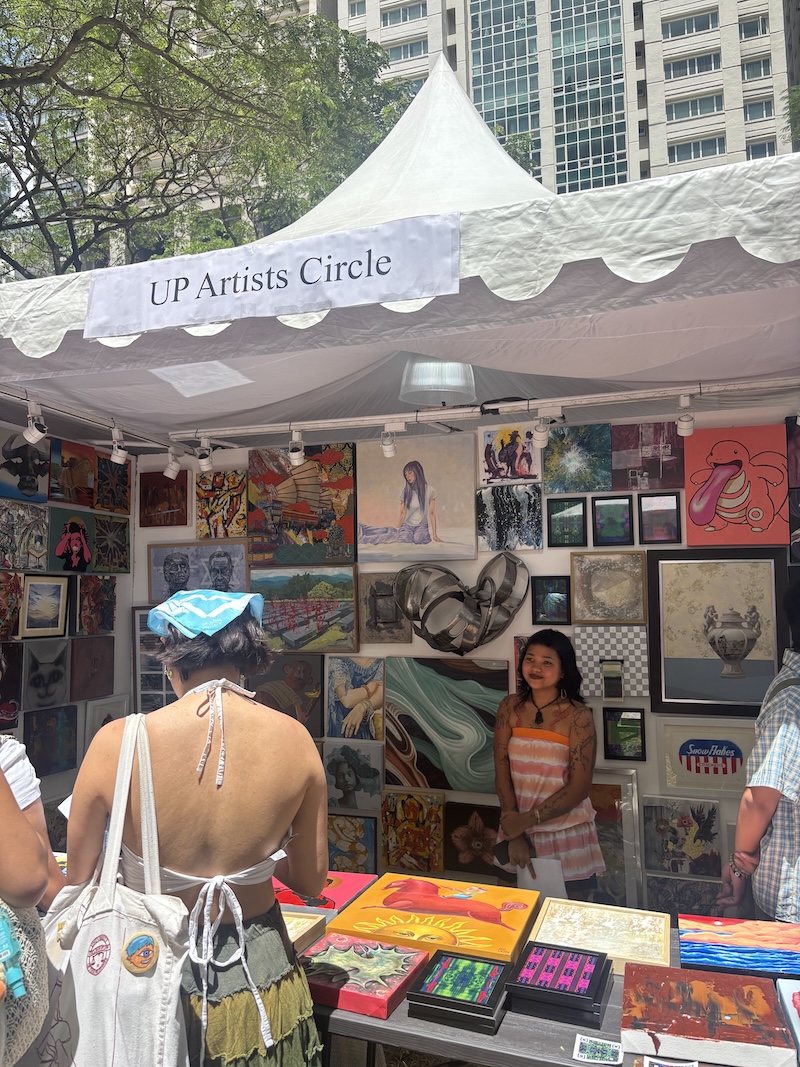
UP Artists’ Circle’s booth. Photo by Trixia Policarpio
It was a welcome sight to see UP Artists’ Circle (UP AC) among the collectives. The group, an art fraternity and sorority based at the University of the Philippines, has been around for 15 years, bringing together students, alumni, and educators in a shared practice of making and exhibiting art.
Speaking on behalf of the collective, Karen Ocampo Flores said that they had been participating in AIP for four years now. She noted that part of the event’s appeal lies in how it creates opportunities for connection, allowing even younger artists to enter the scene and engage with a broader audience.
Their booth reflected this intergenerational exchange. It featured paintings, sculptures, toys, and works on paper by UP ACs alumni and resident student artists. Acrylic paintings, sketches, and watercolor pieces sat alongside more experimental forms. “UP AC this year, of course, it’s several generations,” Flores said. “What you can see from the works is, number one, a kind of playfulness. It doesn’t seem serious, but that kind of playfulness also mobilizes a lot of serious concerns about life and society. There’s a lot of critique going on…there’s a big socio-political consciousness.”
Another had a more satirical approach, reworking the derogatory term ‘snowflakes’ directed at younger generations, playing on the familiar branding of snack cracker
One work that stood out, for me, was an acrylic on canvas piece composed of layered blue and white tones, evoking the shifting texture of ocean water seen up close. Another had a more satirical approach, reworking the derogatory term “snowflakes” often directed at younger generations, playing on the familiar branding of a snack cracker.
Flores added that the collective also encourages artists inclined toward design, abstraction, and experimentation with different media. “It’s about the utilization of visual language,” she said, emphasizing their openness to interpretation and their belief in putting the work out into the world and letting viewers arrive at their own meanings.
“It’s still a big surprise about what can get noticed; what art lovers and art buyers— what catches their eye, what (they) are interested in,” she continued. “It’s better to have direct, interesting encounters with people overall. They’re bringing in their interests, what they feel like their personal advocacy is.”
In this setting, that kind of encounter feels more immediate, something that can be missed otherwise in the more formal space of a gallery.
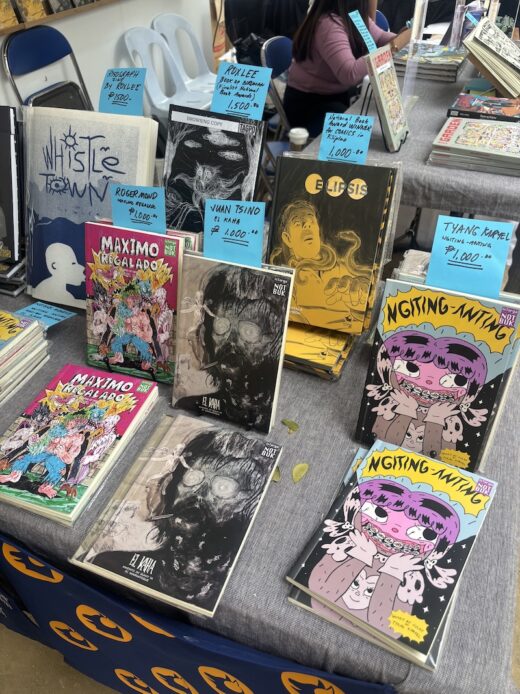
As a reader and writer myself, I found myself drawn to the booth of Istorya Studios Inc., a Guiguinto, Bulacan–based organization that showcased comics and print works combining illustration, photography, and essays into layered, narrative-driven pieces.
One of its featured titles, The Keeper by TRNZ, was a newly launched storybook adapted to an animated short film, previously exhibited at Art Fair Philippines a month ago.
View this post on Instagram
According to its booth representative, the key artists behind the studio, Rodel Tapaya and Marina Cruz, had been participating in AIP for years. Istorya Studios itself, however, is a relatively new publication that joined the fair only in 2023.
The group now runs a physical bookshop-café in Guiguinto and is working toward establishing its own gallery space that will become an integrated creative hub. “Our goal right now is to bring people to our area to experience the difference, because Guiguinto is a garden capital, and it’s inside a village. It’s a hidden location,” their staff said.
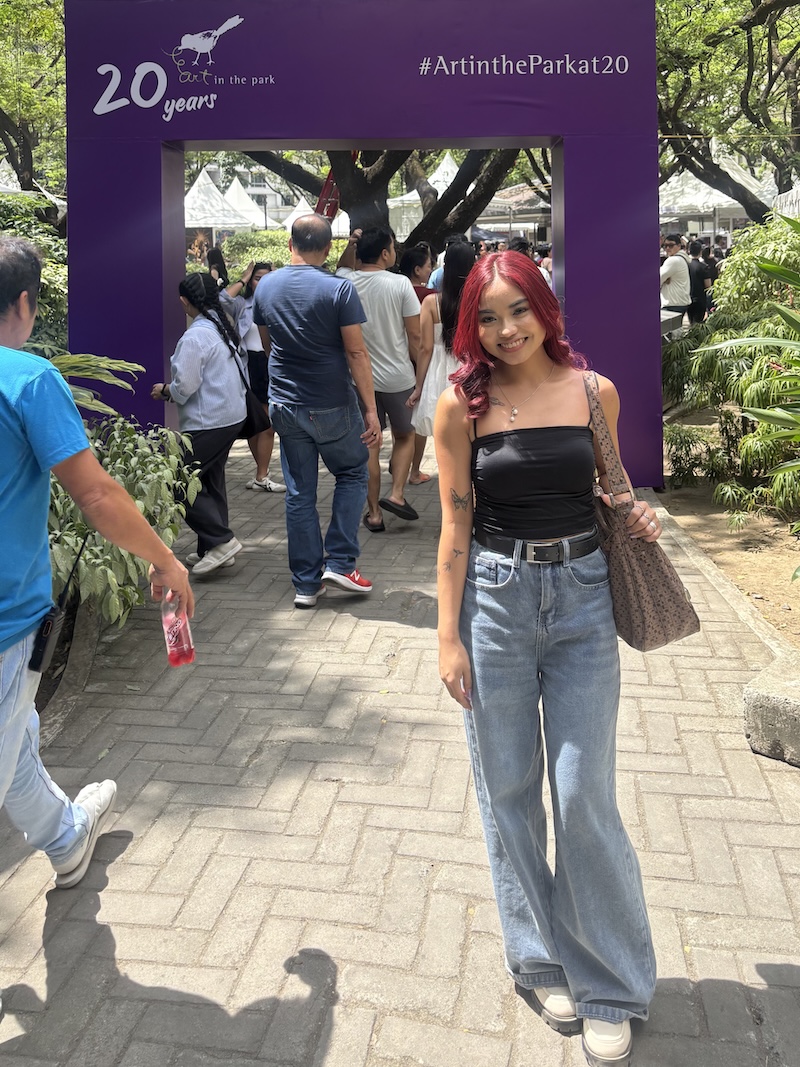
The author enjoying her first time connecting with diverse art community
Visiting Art in the Park felt like gallery hopping condensed into a single day.
True to Ms. Ongpin-Periquet’s words, the atmosphere was highly interactive yet casual, with artists and friends catching up, exchanging ideas, and learning from one another. It was also educational in a way that felt natural. Young visitors moved from booth to booth, exposed to different styles, mediums, and ways of seeing, quietly beginning to develop their own eye for art.
At the same time, the fair offered a pause from the usual pull of being online. Being there meant simply being present, giving time to each work and experiencing it alongside others. Looking ahead, Ms. Ongpin-Periquet said she hopes for nothing more than for the event to keep going. “I just want it to continue to be an event that people really look forward to and enjoy.”
As it is, there’s already a sense of anticipation. For a first-time visitor like me, Art in the Park has easily become something to return to.


