

Butch Dalisay (beside fictionist Robin Sebolino) on writing about time in fiction
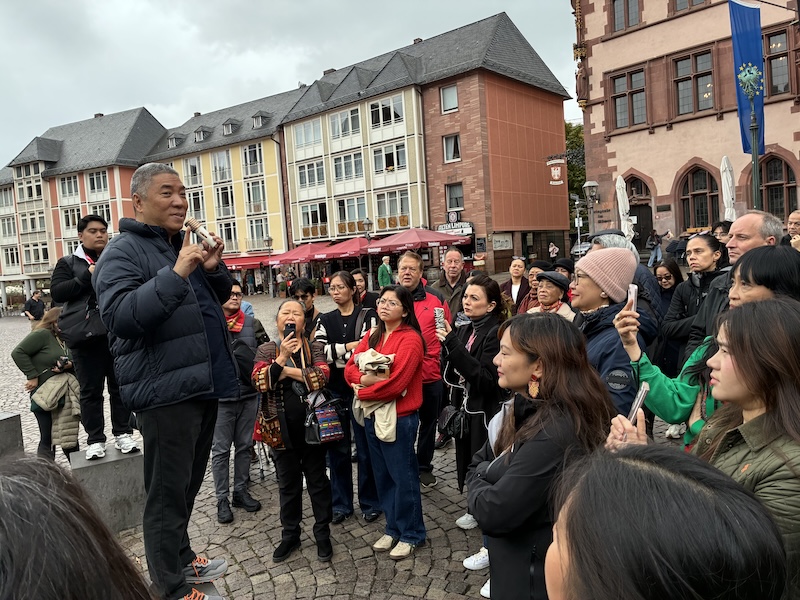
Ambeth Ocampo leads a Rizal walk through Frankfurt.
“When I first envisioned the Philippines as a Guest of Honour at the Frankfurter Buchmesse, some felt that it was far too ambitious, that we were too diverse, and too complex for the world’s largest book fair to embrace. But I believed then, 10 years ago, as I believe now, that our diversity is our greatest advantage, a gift, and never a hurdle.”
Those were the words of Sen. Loren Legarda, chair of the Senate’s Arts and Culture Committee and main proponent behind this global happening, at the opening of From Calamba to Frankfurt: Jose Rizal and the Frankfurt Bookfair, an exhibit last September 4 to October 17 at the National Library of the Philippines that became a precursor to the main event.
That main event was, indeed, a grand and much-awaited one. On October 15–19, the Philippines, for the first time ever, was the Guest of Honour (GoH) at the Frankfurt Book Fair (Frankfurter Buchmesse or FBM). This meant a special focus—signs about the country’s special billing were all over the massive Festhalle Messe exhibition center—a 2,000-sqm Philippine Pavilion by industrial designer Stanley Ruiz dedicated to the country’s books and authors, and some four concurrent events a day held at the Pavilion as well as the Philippine Stand, which sat alongside those of participating countries, and where the business of deals and rights-buying happened.
Imagine some 400 writers, illustrators, and publishers, almost 100 Filipino publishing houses, a few of us from Philippine media, and a slew of performers gathered in one place. It was a cacophony of culture; as discussions were held in one of the two main venues in the Pavilion, the Arena and Proscenium stages, you would hear music or chanting, aside from the chatter of people. In a variation of that eternal joke, somebody noted that if you bombed the Festhalle Messe, the Philippines would be left with illiterates, as almost the entire pantheon of fictionists, poets, filmmakers, and more were gathered here, delightfully garbed in different iterations of Filipiniana. (Yes, those terno sleeves really go with anything!)
“It’s a very big deal,” said Ino Manalo, chairman of the National Commission for Culture and the Arts (NCCA), one of the four “partners” in this effort, as it were, alongside the National Book Development Board (NBDB), the Department of Foreign Affairs (DFA), and the office of Sen. Legarda. “In a way, it’s a reinvestment in the book industry and the provision of outlets for writers. And also, it’s a statement that Philippine literature is alive.” That the event was tied up with Filipino national hero Jose Rizal because of his time spent in Germany was serendipitous, and became a key part of the theme; books by and about Rizal occupied one zone of the Pavilion, and several events were about him and his two seminal novels.

GoH curator Patrick Flores at the launch of his book ‘Sensible Forms’
The theme of the Philippine Guest of Honor (PH GoH) participation, “The imagination peoples the air (with specters),” was directly lifted from Rizal’s first novel Noli Me Tangere, describing the situation of Sisa and her remaining shreds of hope, perhaps, that she would see her children again. The Filipino translation leaves the conclusion more open-ended, said PH GoH curator Patrick Flores: “Pinupuno ang hangin ng hiwatig—and hiwatig is conjecture. The specter is not negative.” Flores said he wanted an organic link between the Philippines and Germany. “And the one with the most gravitas is Jose Rizal. It’s not a forced link. The hero is the writer, and all Filipinos read him. The Slovenian curator told me, ‘Patrick, you need a rock star for the pavilion.’ So we have Rizal, the polymath, the humanist, the global citizen, inspiration of revolutions, not only in the Philippines, but in Southeast Asia.”

The NBDB’s Charisse Tugade, Philippine Ambassador to Germany Susan Natividad, and the PH GoH’s Karina Bolasco
For Karina Bolasco, PH GoH’s head of the literary program and curator of books, the FBM “may be the last thing I’ll do for the industry,” as it came right after her retirement as director of the Ateneo de Manila University Press. “It’s been a challenge, especially this week before we left, right?” She was referring to the campaign to boycott the FBM, because of its perceived complicity with Israel and alleged attempts to exclude Palestinian writers. (There was, however, a discussion on Writing Through the Wounds: Filipino & Palestinian Literatures in Relational Solidarity with Nikki Carsi Cruz, Dorian Merina, Genevieve Asenjo, and Palestinian writers Tarik Hamdan and Atef Abu Saif that was well-attended; Hamdan later posted his thanks to the Philippines on his Facebook page.)
‘The Slovenian curator told me, “Patrick, you need a rock star for the pavilion.” So we have Rizal, the polymath, the humanist, the global citizen, inspiration of revolutions, not only in the Philippines, but in Southeast Asia’
“I think this is a portal, a one-time, big-time opportunity that will never happen again,” Bolasco said. She can be credited for first approaching Legarda in 2015 for help in putting up a decent booth at the FBM that year; they had spent only for rent, and had cut and put up their own decorations. Legarda helped out, even as the booth was still dwarfed by bigger ones with generous support from their governments. When the senator visited the fair that year and saw that Indonesia was Guest of Honour, that began her dogged campaign to get the country into the spotlight. “From then on, she was so resolute,” Bolasco recalled. “She really worked hard. And the consulate in Frankfurt, which had been shut down for so many years, was revived, because down the road, the Guest of Honour would need help from the consulate.”
“This is a once-in-a-lifetime opportunity for the Philippines, a chance for us to show the world. how rich, diverse, and really beautiful Philippine culture and literature are,” said Berlin-based Philippine Ambassador to Germany Susan Natividad. There are about 60,000 Filipinos in Germany now, she noted, and two consulates other than Frankfurt, in Munich and Stuttgart. “It’s taken a long time, and the Buchmesse has its own processes to follow. But now we’re here.”
In the long term, Bolasco said, she hopes “we also find a way to sustain the benefits of this thing. Otherwise, it will all just be squandered. But of course, if you look at public spending and how they’re using money for ghost projects…” She’s looking forward to “a quieter life, and I’d like to write.” What a career finale.
Stanley Ruiz used modern, clean-looking materials to build the Pavilion’s six structures, which took him about two years to design. “We realized that, being separate structures, you can somehow tell that they represent the islands and movement,” he explained during a talk at the start of the first day. “We wanted a fresh approach. We had a lot of details that we needed to deal with. Even the furniture—we have some from Cebu, Pampanga, Negros.” Flores made a lovely connection between the translucence of the structure shells and the theme, the nature of imagination itself: not quite clear, but still illuminated.
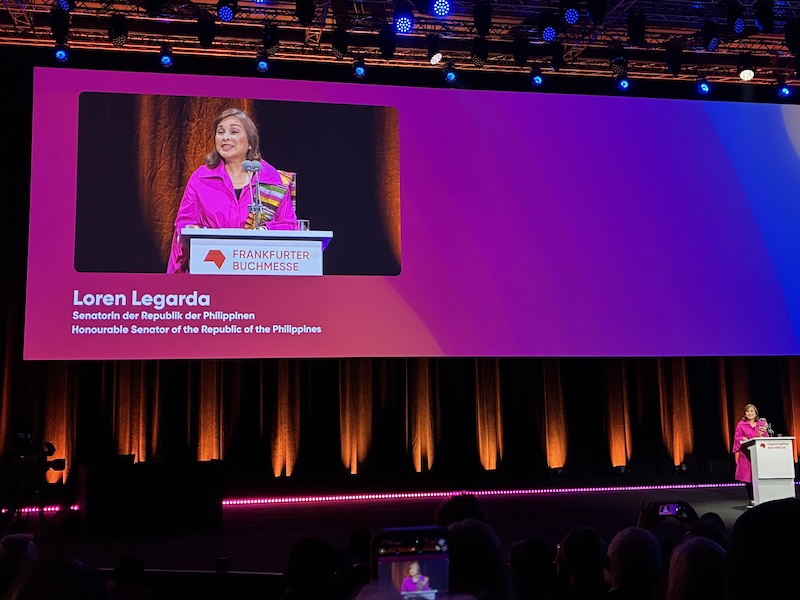
Legarda was quite the presence at the FBM. At the opening, before a packed crowd of Filipinos and Germans and delegates from different countries, she spoke of the Philippines as “a nation of storytellers, of islands, of journeys, of fighters, of survivors, of lovers, of memories, and of millions of stories longing to be told.”
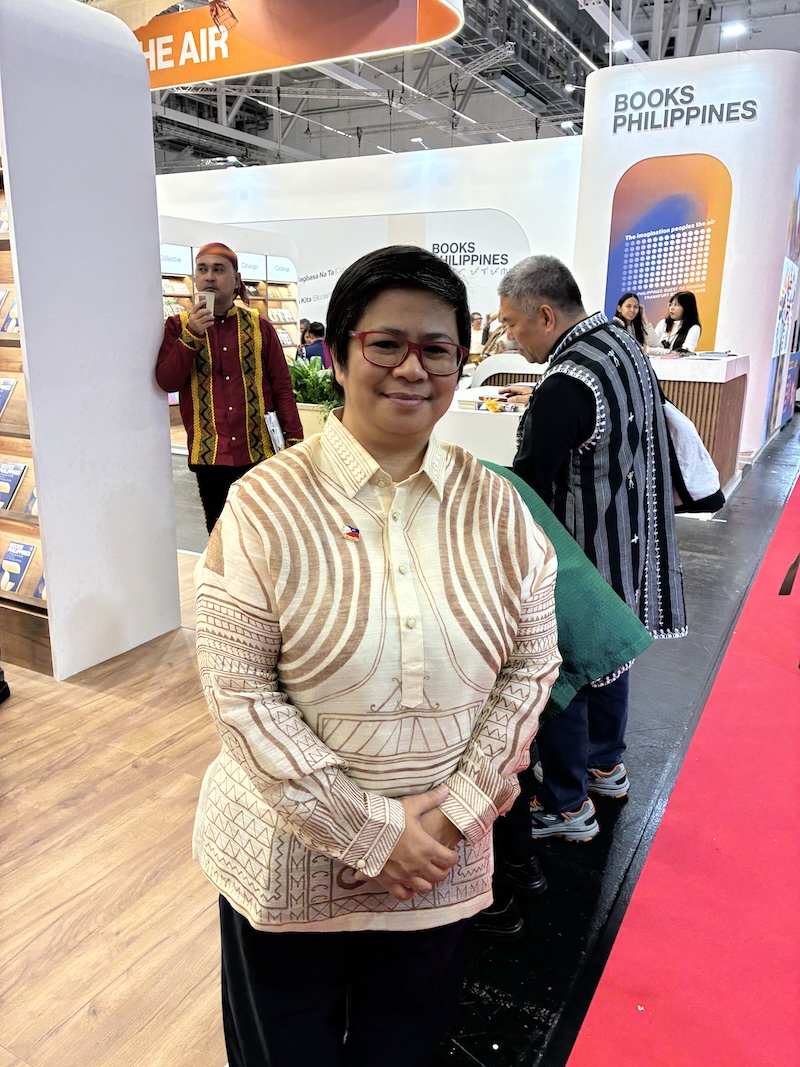
Prof. Analyn Salvador-Amores wears a barong with tattoo designs.
At the Philippine Stand, at the launch of the book Hunting for Artifacts: 19th Century German Explorers in the Luzon Cordillera—where Analyn Salvador-Amores, professor of anthropology and former director of the Museo Kordilyera at the University of the Philippines Baguio, led a panel of museum academics—Legarda good-naturedly (or was it?) demanded that the artworks carted away to German museums be returned.
“That’s a natural reaction,” said Amores with a laugh. “Even the communities, when they saw the photographs, they said, ‘Return them, return them.’ But do we have the capacity to take care of them in our museum? Is that being pragmatic? There’s a government-to-government negotiation for repatriating, so what we can do at the most now is digital repatriation.”
Amores began her research as far back as 2016, finding objects from Luzon, Visayas, and Mindanao, but focusing on Northern Luzon. “We haven’t really covered a lot of those things. Maybe because they (the museums) are conscious, there’s all this idea of decolonizing. Yes, they systematically collected all of this. But if you’re aware of it, like the German museums are…they sought our help, as they were looking for experts on the material culture of Northern Luzon.”
Amores noted how, when you looked at these items, they actually had signs of ownership. “If you look at the textiles closely, there are initials. There are embroideries, names written, even letters on the pipes. So this object was owned by somebody and taken away. It’s a kind of colonial violence when you take these important objects from the home, from the ritual site. But at the end of the day, for me, rather than blaming people for why they were collected, we should just be thankful for these repositories of Filipino culture that we have as references today.”
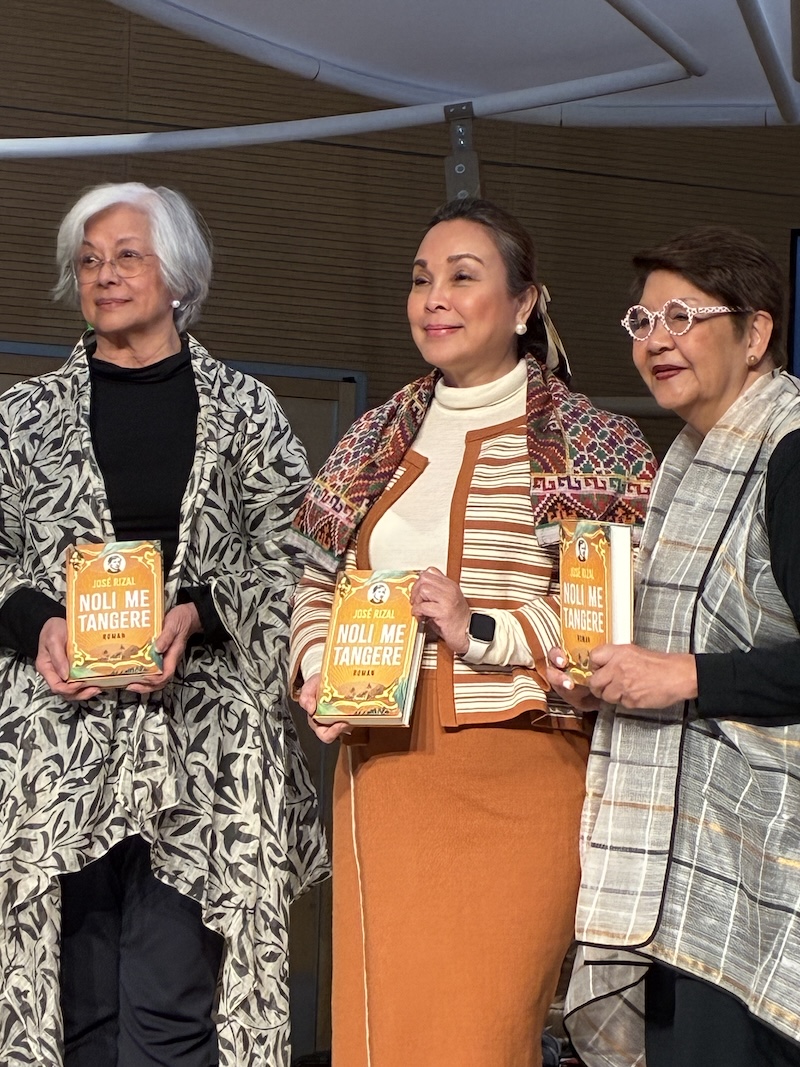
Noelle Sy-Quia, Sen. Loren Legarda, and Neni Sta. Romana-Cruz show off the new German ‘Noli.’
Later, at the launch of the new German translations of the Noli and the second novel, El Filibusterismo, Legarda asked historian Ambeth Ocampo why lanzones were featured in the book design, which yielded a number of explanations, from lanzones being abundant in Rizal’s birthplace of Calamba, Laguna, to legends on how the fruit lost its original poison, thanks to being handled by the Virgin Mary. During the presentation, Noelle Sy-Quia, great granddaughter of Rizal’s older sibling Maria (more on these descendants in a future article), pointed out how important the year 2026 would be. “It’s the 165th anniversary of his birth, and the 135th anniversary of his martyrdom. Also, it’s the 70th anniversary of the Rizal Law of June 12, 1956, Republic Act 1425, that made his novels mandatory reading in all Philippine schools.”
The problem was, Sy-Quia continued, Catholic schools resisted, fearing the novels would put the Church in a bad light (no kidding), so the Noli and Fili actually didn’t make it into all schools for another 10 years. Thus, it would also be the 60th anniversary of the lifting of this ban, 60 years since all Filipino students finally got to read the national hero. Incidentally, one man of the cloth who took the opposite side and championed the reading of Rizal’s novels was Bishop Cesar Guerrero of San Fernando, Pampanga, half-brother of Leon Ma. Guerrero, the diplomat who would write the most well-known English translations of the Noli and Fili to date. During the session with Rizal’s descendants, Sy-Quia would tell advertising executive (and Leon Ma. Guerrero’s son) David Guerrero, “We have your uncle to thank for that.”
Guerrero graciously accepts his role as “trustee” of his father’s legacy. “It feels like a big responsibility. And I want to do everything I can to make the translations as accessible and as available as possible, and to ensure their sustainability for the future.”
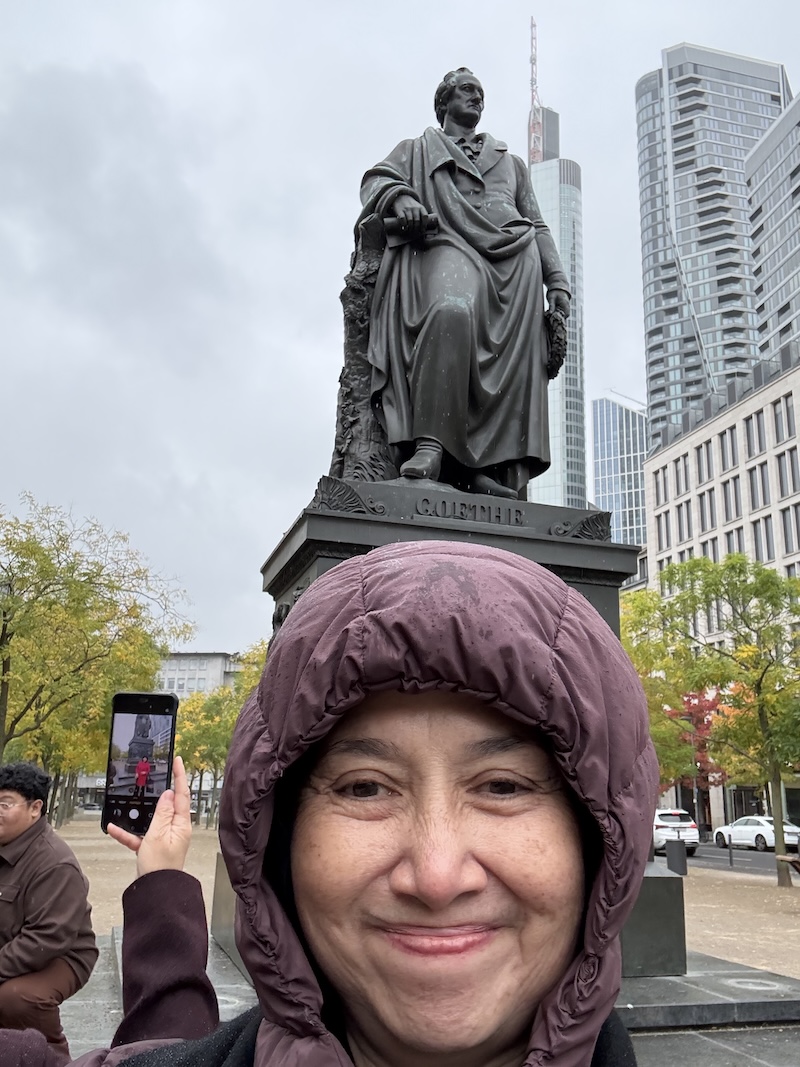
The author at the Goethe monument on the rainy walk
Speaking of Ocampo, he conducted a well-attended, rainy-day walk through some sites in Frankfurt somehow connected to Rizal (also more on that soon). Although the national hero actually spent most of his time in Heidelberg, there were still some interesting stops. We started at two adjacent monuments, one of Johannes Gutenberg, inventor of the printing press—“which Rizal was not impressed by,” Ocampo noted—and the nearby statue of German writer Johann Wolfgang von Goethe, which Rizal actually sketched. “Rizal’s comment was, ‘They made a very nice monument to Goethe, but he doesn’t look like a poet. He looks like a banker, a very industrious banker.’ So when you read Rizal’s diaries, especially this thing in Frankfurt, it’s full of such remarks. So this is why reading the diaries is important, because you see the world through the eyes of a 19th-century traveler like Rizal.”
‘Rizal’s comment was, “They made a very nice monument to Goethe, but he doesn’t look like a poet. He looks like a banker, a very industrious banker”’
Ocampo also mused that, since Rizal is read in translation, “Filipinos are separated from their past and their history because of language. And this is why things like the Frankfurt Book Fair are important—the whole idea of translation and making things open to other places, other cultures, other readers.”

Detail from ‘Grandmother’s Tale’ by Rodel Tapaya, acrylic on canvas, 2025, in the ‘Lola Basyang’ exhibit at Frankfurt’s Central Children’s and Youth Library (Zentrale Kinder-und Jugendbibliothek)
Patrick Flores also launched his book, Sensible Forms, a collection of short-form essays in English on about 140 artists, going back to 1986. By his own admission, Flores said his early essays were “burdened by academic theory and the need to keep explaining art. The latter writing, I think, has a more curatorial sensibility, which allows me to balance the local, the national, and the global,” added this prominent Filipino intellectual in the field, former chair of the University of the Philippines’ Department of Art Studies and now chief curator at the National Gallery Singapore. Flores also curated a fine series of exhibitions around the FBM, featuring Philippine art forms as diverse as photography, architecture, the pasyon, and even Lola Basyang. The latter is, again, serendipitous, Flores noted; 2025 marks the centennial of Lola Basyang, 100 years since the first kuwento, Ang Plautin ni Periking, was written by Severino Reyes and published on May 22, 1925, in Liwayway Magazine.
“The opportunities for us in the global arena are really open, and some kind of institutional support is required,” Flores added, acknowledging Legarda’s support for PH GoH. “Because this cannot just happen. Of course, the market can do it too. Or we can wait for global curators to pick us up. But we have to create our own conditions; the initiative should also come from us, like the senator’s work for the Venice Biennale and for the book fair. People should talk about the Philippines in a deeper way, with more gravity, because the art is there already.”
Butch Dalisay, fictionist, columnist, author of over 30 books, and revered elder statesman of Philippine literature, was on his third Buchmesse, and joined several panels, including one on writing about time as a fictional character. He was also quite vocal about why the FBM mattered, and said so in a Facebook post: “Today, at the end of a week’s sustained release of unflagging creative energy by the Philippine delegation in Frankfurt, I can only say ‘Mabuhay!’…I do not and cannot care if 25 years from now (or next week), some acerbic and self-righteous critic tries to reduce my life’s work in literature (and that of my colleagues here) to a word or a name we equate with waste. The loss and unhappiness is theirs, not mine, not ours.”
“From the very start, I was always for our full engagement here,” he told me in Frankfurt. “And I don’t know yet what the long-term impact of this exposure will be. But one of the things that it has done has been to bring us all together. The impact will probably be felt just as much at home as it will be abroad—a strong sense of community. The bonding that happened here over the past week is amazing. I have never felt that kind of energy at home.”
It was an important participation, despite the chaos in the Philippines, he noted, “because it will strengthen our resolve to use literature to find a way forward through this mess. This really clears our minds and strengthens our hearts to face our realities back home. Because now, I think this makes us feel that it’s worth it to write and to fight. I’m very hopeful that our younger writers will take up the challenge on their own terms, that they do not need to look to us for guidance.”
At 71, despite the cane he now brandishes, Dalisay remains ever the wordsmith. “I’m hoping I can finish about two or three more novels before I croak,” he said with a chuckle. “That is my sense of time. I think I have 10 more good years before dementia sets in. I’m very realistic about the horizon, and also very hopeful for it. I’m going to be writing to my last day.”


